Introduction
Search "how to start a one person company in the USA" and you'll hit a wall fast. A One Person Company (OPC) is a legal term under India's Companies Act—not a US entity type—so the results rarely match what you actually need.
The demand behind that search is still real. US freelancers formalizing their work, remote solopreneurs, and non-US founders all want a single-owner business with limited liability. Indian entrepreneurs who already know OPCs at home often use the same phrase when they plan a US structure.
This guide clears up the terminology first, then walks through how one person can legally structure and register a business in the US.
Key Takeaways
- A "One Person Company" is not a US legal entity — the Single-Member LLC is the closest equivalent
- Non-US residents can own 100% of a US LLC or corporation with no citizenship requirement
- Form in five steps: choose a state, file documents, get an EIN, complete BOI and licensing, open a bank account
- Choose the right structure before you file — fixing the wrong one later costs far more than forming carefully
What Is a "One Person Company" — And Does the US Have One?
India's OPC is a defined statutory entity. Under Section 2(62) of the Companies Act, 2013, an OPC is "a company which has only one person as a member." The founder must name a nominee at incorporation who takes over if the founder dies or becomes incapacitated.
The US has no matching category. No federal or state statute uses the label "One Person Company," and there's no nominee requirement anywhere in American corporate law.
Here's what happens when one person starts a business in the US:
- Default status: The moment you start operating without registering anything, you're automatically a sole proprietor. No paperwork, no separate legal entity, no liability shield.
- The common upgrade: Most solo founders elect a Single-Member LLC instead. It creates a separate legal identity and limited liability protection, without needing a nominee or minimum capital.
- Other options: A solo founder can also structure as a single-shareholder S-corp or C-corp, each with different tax and compliance trade-offs (covered next).
Unlike India's OPC rules, which restrict eligibility to Indian residents, non-US residents can own 100% of a US LLC or corporation. No green card, no visa, no residency requirement.
Choosing the Right Business Structure for a Solo Founder
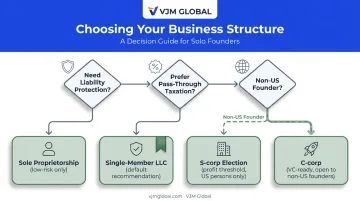
The right structure depends on three things: how much personal liability protection you need, how you want profits taxed, and whether you'll eventually raise outside capital.
Comparing Your Options
| Structure | Liability | Taxation | Setup Cost | Ongoing Compliance |
|---|---|---|---|---|
| Sole Proprietorship | Unlimited personal liability | Schedule C, self-employment tax | Minimal | Low; licenses/permits may still apply |
| Single-Member LLC | Personal assets protected by state law | Pass-through by default (disregarded entity) | State filing fee | State filings, registered agent |
| S-corp Election | Same as LLC/corp | Pass-through; wages taxed separately from distributions | State fee + Form 2553 | Payroll, Form 1120-S, reasonable compensation rules |
| Single-Shareholder C-corp | Strong liability protection | Corporate tax, plus dividend tax if profits are distributed | State fee | Heaviest recordkeeping and reporting |
Sole proprietorship works only for very low-risk, low-revenue work. There's zero separation between you and the business, meaning a lawsuit against your business is a lawsuit against your house, car, and savings.
Single-member LLC is the default recommendation for most solo founders. It delivers liability protection with pass-through taxation and minimal ongoing formalities.
S-corp election can produce real self-employment tax savings once profits climb high enough. You split income into a reasonable salary (taxed as wages) and distributions (not subject to self-employment tax).
The IRS doesn't publish a profit threshold for when this pays off. It depends on your reasonable salary, payroll costs, and state fees, so run the math per founder instead of relying on a generic rule of thumb.
C-corp with a single shareholder mainly makes sense if you're planning to raise venture capital or add shareholders later. The trade-off is double taxation and heavier compliance.
The Foreign Founder Wrinkle
Non-US founders face two extra considerations:
- EIN without an SSN: You can still get one, just through a different process (covered in the step-by-step section below)
- State selection: Delaware and Wyoming are popular for their founder-friendly corporate statutes, though the "right" state also depends on where you'll actually operate
There's one hard restriction worth knowing early: a nonresident alien cannot own S-corp shares. If you're a foreign founder, you're generally choosing between an LLC and a C-corp, not an S-corp.
Converting later means new registrations, new tax IDs, and sometimes surrendering the old entity's filings entirely. Cross-border formation advisors such as VJM Global help lock in the right structure upfront so founders avoid paying twice to unwind an early mistake.
Why Now Is a Good Time to Start a Solo Business in the USA
The Case for Starting Now
The solo-business economy in the US isn't shrinking. The Census Bureau counted 30.4 million nonemployer establishments in 2023, up from 29.8 million the year before, generating nearly $1.8 trillion in revenue.
A few forces are behind this growth:
- Cloud accounting tools have made bookkeeping something one person can manage without a finance team
- Remote hiring and freelance platforms let solo founders scale output without adding headcount
- Digital payment processing has removed barriers that once required merchant services and a physical office
There's also a less-quantifiable advantage: speed. When you're the only decision-maker, you skip the internal debates. You ship, you test, you adjust.
That momentum helps—but filing still comes with a few realities worth setting upfront.
What to Know Before You Start
- Timelines vary widely by state. Some states process LLC filings same-day online; others take longer for mailed applications
- "Solo" doesn't mean "simple." You still handle sales, compliance, and bookkeeping at once, so many founders outsource accounting early
- Separate your finances from day one. Mixing personal and business bank accounts is one of the fastest ways to lose the liability protection your LLC is supposed to provide
How to Start Your One-Person Business in the USA – Step by Step
One common mistake: assuming that filing your formation paperwork makes the business "official." It doesn't. Skipping the EIN or the BOI filing after incorporation is a frequent, avoidable gap—work through each stage below in order.
Step 1: Pick Your State and Business Name
Choose a state based on where you'll actually operate, factoring in filing fees and ongoing taxes. If you're a non-resident or plan to operate location-independently, a founder-friendly state like Delaware or Wyoming can make more sense than your home state.
- Search name availability through the state's Secretary of State database
- Register a DBA (doing business as) if you'll operate under a different trade name
- Confirm the name meets state rules, including the required entity designator (LLC, Inc., etc.)
Step 2: Choose Your Structure and File Formation Documents
File Articles of Organization (LLC) or Articles of Incorporation (corporation) with your chosen state.
You'll also need a registered agent, a person or service with a physical in-state address who receives legal and tax documents on your behalf. Solo and non-US founders typically use a registered agent service rather than themselves, since it's required to have a physical presence during business hours in the state of formation.
Step 3: Get Your EIN and Complete Federal Registrations
Apply for a free Employer Identification Number (EIN) from the IRS:
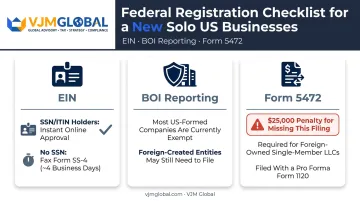
- If you have an SSN or ITIN: Apply online; approval is instant
- If you don't: File Form SS-4 by fax or mail; fax processing typically takes about four business days
Next, check your Beneficial Ownership Information (BOI) obligation under the Corporate Transparency Act. As of FinCEN's March 2025 rule, US-created companies and their beneficial owners are currently exempt from BOI reporting.
Only certain foreign-created entities registered to do business in the US still need to file. Rules here have shifted before, so confirm current status before you assume either way.
For foreign-owned single-member LLCs, there's an added layer: Form 5472, filed alongside a pro forma Form 1120, is required for US disregarded entities that are wholly owned by a foreign person. Missing it carries a steep penalty, starting at $25,000.
Step 4: Handle State and Local Licenses
Depending on your business activity and location, you may need:
- A state tax ID (separate from your federal EIN)
- Industry-specific licenses (professional services, food, health, etc.)
- Local city or county business permits
These requirements vary widely by state and industry, so check your specific city and county rules rather than assuming your LLC filing covers everything.
Step 5: Open a Business Bank Account and Set Up Finances
Use your EIN and formation documents to open a dedicated business bank account. This single step reinforces the liability separation your entity is supposed to provide, so don't skip it or delay it.
Set up basic bookkeeping from day one. Many solo founders outsource this to a back-office accounting partner like VJM Global so they can focus on the business instead of spreadsheets and tax deadlines.
Step 6: Get Insurance and Launch
Depending on your business type, consider:
- General liability insurance: covers common risks like property damage or injury claims
- Professional liability insurance: relevant if you're offering services or advice (consulting, design, tax prep)
Before you launch, confirm:
- Contracts and templates are ready
- Payment processing is set up
- Basic tracking is in place so you know what's working from week one
Conclusion
"One Person Company" isn't a US legal term, but a single founder still has several clear paths to build a real US business. For most people, that path is the Single-Member LLC.
Long-term success comes down to three things:
- Choose the right structure early
- Stay current on EIN, BOI, and licensing compliance
- Keep business finances separate from personal life from day one
Your structure doesn't need to be perfect at launch. Many founders start as an LLC and elect S-corp taxation once revenue justifies it. Get the foundation right, then let it evolve.
If you want help forming the entity or staying compliant after launch, VJM Global supports single-founder setups and ongoing US tax and accounting requirements.
Frequently Asked Questions
Can you have a company with only one person?
Yes. In the US, this typically takes the form of a sole proprietorship, single-member LLC, or single-shareholder corporation. Each carries different liability and tax implications.
What companies are owned by a single person?
Single-owner businesses span nearly every industry, from freelance consultancies and e-commerce stores run as sole proprietorships to single-member LLCs and single-shareholder S-corps or C-corps.
Does the USA have a "One Person Company" like India?
No. The US has no equivalent legal category. The closest functional match is a Single-Member LLC, which offers similar limited liability without India's mandatory nominee requirement.
Can a non-US resident start a one-person LLC in the USA?
Yes. US LLC and corporation ownership has no citizenship or residency requirement. Foreign founders will need an EIN and should plan for ITIN and tax filing nuances like Form 5472.
How much does it cost to start a single-member LLC in the USA?
State filing fees alone often run from about $70 in California and $90–$100 in Delaware or Wyoming up to $300 in Texas. Add registered agent fees and any professional formation help on top.
Is an LLC or S-corp better for a solo business owner?
An LLC is simpler and sufficient for most early-stage solo founders. An S-corp election can reduce self-employment tax once profits are high enough that the savings outweigh added payroll and compliance costs.