Introduction
Norway is one of Europe's most stable, transparent places to do business. It remains fully open to UK entrepreneurs despite sitting outside the EU. Brexit changed a lot for UK-Europe trade, but Norway's business registration doors stayed open.
That said, many UK founders struggle with the unfamiliar mechanics:
- Norwegian company law reads nothing like the Companies Act
- D-number applications feel bureaucratic
- Board residency rules trip up even experienced operators
This guide walks through the Aksjeselskap (AS) structure, the step-by-step registration process, and tax obligations on both sides of the North Sea. It also flags the pitfalls UK businesses most commonly hit when expanding into Norway.
Key Takeaways
- The Aksjeselskap (AS) is Norway's direct equivalent of a UK Ltd, requiring NOK 30,000 minimum share capital
- UK directors still qualify under Norway's board residency rules post-Brexit, as the UK sits on the permitted list
- A UK-Norway double tax treaty prevents double taxation, though the 183-day rule governs personal tax residency
- Foreign founders need a D-number, a Norwegian business address, and Brønnøysund registration before trading legally
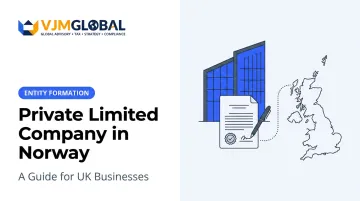
Understanding the Norwegian AS: Norway's Equivalent of a UK Private Limited Company
The Aksjeselskap, or AS, is Norway's private limited liability company. It's governed by the Norwegian Private Limited Liability Companies Act of 1997 and functions almost identically to a UK Ltd: separate legal personality, limited liability, and shares that can be transferred or sold.
If you've searched for Norway's "LLC equivalent," here's the direct answer: there's no exact match for the US-style LLC in Norwegian law. The AS is the closest functional counterpart, offering the same liability shield and independent legal status.
Share Capital and Ownership
Setting up an AS requires:
- Minimum share capital of NOK 30,000, deposited before registration
- One shareholder is enough — a single person or entity can own 100% of the shares
- No upper limit on the number of shareholders
Norwegian company law was amended in 2012 to lower this threshold from NOK 100,000, making the AS accessible to smaller founders. Always check the current figure against the latest Aksjeloven amendments before relying on it, since capital rules can shift.
With ownership comes the liability shield. Limited liability means shareholders aren't personally responsible for company debts beyond what they've paid for their shares. Your house, savings, and personal assets stay separate from the business.
Board Residency Rules Post-Brexit
UK founders often worry about this rule more than they need to. Norwegian law requires that at least 50% of AS board members, plus the managing director, reside in an EEA state, Switzerland, or the United Kingdom.
That UK carve-out survived Brexit intact. A UK-resident director still counts towards the residency quota, and no exemption application is needed.
AS vs ASA: Why Most UK SMEs Choose AS
Norway also has the ASA (allmennaksjeselskap), a public limited company requiring NOK 1,000,000 in minimum share capital. Unless you're planning a stock exchange listing or raising public capital, the AS suits nearly every UK SME entering the Norwegian market.
How to Register an AS in Norway: Step-by-Step for UK Founders
Registration involves five main stages. None of them require you to relocate.
Obtain a D-number. Any foreign director, shareholder in a company role, or contact person without a Norwegian national ID needs one before registration. Apply with form BR1015B and your Coordinated Register Notification, and post a certified colour passport copy. Skatteetaten's National Population Register assigns the number.
Secure a Norwegian business address. The AS needs a physical street address in Norway, not a PO box. UK founders and directors don't need to live in Norway themselves to own or run the company.
Draft the memorandum and articles of association. These set out share capital, shareholder details, and board composition. It must be signed by all founders.
Deposit share capital. Pay at least NOK 30,000 into a Norwegian bank account and get written confirmation from the bank or an accountant that the funds have landed.
File with Brønnøysund. Submit the Coordinated Register Notification, memorandum, articles, and capital confirmation to the Register of Business Enterprises within three months of the last founder's signature.
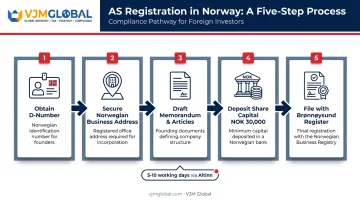
Timeline and fees: Electronic filing through Altinn typically takes 5 to 10 working days. Registration costs roughly NOK 6,825 online or NOK 7,912 by post. Confirm the current schedule before budgeting, as fees change periodically.
After incorporation, VAT is a separate step. Registration only becomes mandatory once taxable turnover crosses NOK 50,000 in a rolling 12-month period.
Tax and Compliance Obligations for UK-Owned Norwegian Companies
Once your AS is trading, the compliance clock starts running on both sides of the North Sea.
Corporate Tax, VAT and Double Taxation Relief
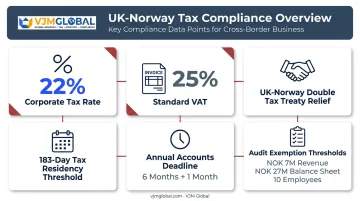
Norway's ordinary corporate income tax rate sits at 22% on AS profits, applied to taxable income after deductions. Confirm this against Skatteetaten's current rate table, since Norwegian tax rates do shift year to year.
Standard VAT is 25% on most goods and services, with registration required once turnover exceeds NOK 50,000.
Those domestic rates are only half the picture for a UK owner. The usual worry is paying tax twice on the same income — and you won't. The 2013 UK-Norway Double Taxation Convention has been in force since December 2013, covering income tax, corporation tax, and capital gains.
Relief works primarily through tax credits: Norway credits qualifying UK tax against Norwegian liability, and the UK does the reverse. Directors and companies claim relief when filing annual returns in each jurisdiction, referencing the treaty article that applies to their income type.
The 183-Day Rule
A UK director spending significant time in Norway needs to watch the calendar closely. You become Norwegian tax resident if you're present for:
- More than 183 days in any 12-month period, or
- More than 270 days across any 36-month period
Partial days count. The stay doesn't need to be consecutive, and the reason for being there is irrelevant. Cross that threshold and you trigger personal Norwegian tax liability, separate from your UK obligations.
Annual Reporting and Employer Duties
Norwegian companies must have their annual accounts approved within six months of year-end, with filing due roughly a month after approval. For calendar-year companies, that's typically 31 July.
Audit exemption applies only if the AS stays below all three thresholds:
- Operating revenue under NOK 7 million
- Balance sheet total under NOK 27 million
- No more than 10 full-time employees
Hiring staff in Norway adds two mandatory costs:
- Occupational injury insurance for work-related illness and injury
- OTP (Obligatorisk Tjenestepensjon), a mandatory pension with at least 2% employer contribution from the first krone earned
AS vs NUF: Choosing the Right Structure for Your UK Business
Some UK businesses skip the AS entirely and register a NUF (Norwegian-registered foreign business) instead. It's a branch structure, not a subsidiary, meaning the UK parent company stays directly liable for everything the Norwegian operation does.
| Factor | AS | NUF |
|---|---|---|
| Legal status | Separate Norwegian legal entity | Branch of the UK parent |
| Liability | Limited to share capital | Parent company fully liable |
| Minimum capital | NOK 30,000 | None required |
| Registration route | Online via Altinn | Paper filing only |
| Registry fee | NOK 6,825 (online) | NOK 4,398 (paper, combined) |
NUFs are quicker and cheaper to set up, with no minimum share capital. That speed comes at a cost: your UK company carries the liability, and Norwegian counterparties sometimes view a branch as less established than a locally incorporated AS.
Choose the structure that matches your plans:
- NUF — short-term contract or low-risk market pilot
- AS — lasting presence, local hires, or a liability shield between the parent and Norwegian operations
Common Pitfalls UK Businesses Face When Setting Up in Norway
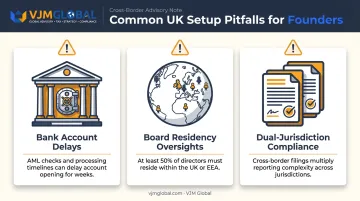
Even well-prepared founders hit friction points. Watch for these three in particular.
Bank account delays. Norwegian banks apply strict anti-money-laundering checks to foreign applicants, and account opening can drag on for weeks. Start this process the moment you have your D-number application submitted, not after registration completes.
Board residency oversights. It's easy to assume any UK director qualifies automatically. The rule requires at least 50% of the board (plus the managing director) to reside in Norway, an EEA state, Switzerland, or the UK. Get this wrong and board decisions can be challenged, delaying everything downstream.
Underestimating dual-jurisdiction compliance. Coordinating treaty relief claims, VAT registration, and two sets of annual filings—one Norwegian and one UK—is complex and easy to under-resource.
Cross-border tax support helps with treaty relief and international planning. VJM Global also offers Employer of Record hiring in Norway without a local entity first; pair that with a Norwegian-registered agent or accountant for Brønnøysund filings.
Frequently Asked Questions
What is the LLC equivalent in Norway?
Norway's Aksjeselskap (AS) is the closest structural equivalent to an LLC or UK Ltd. It offers limited liability protection and separate legal personality.
Is there a tax treaty between Norway and the UK?
Yes. The 2013 UK-Norway Double Taxation Convention prevents the same income being taxed twice. The full treaty text and synthesised MLI updates are available via GOV.UK's tax treaties publication.
What is the 183-day rule in Norway?
If you spend more than 183 days in Norway within any 12-month period, or 270 days across 36 months, you become Norwegian tax resident. This triggers personal Norwegian tax liability regardless of where your income originates.
Can a UK citizen own 100% of a Norwegian company?
Yes. Norway permits full foreign ownership of an AS. Shareholders face no residency requirement; at least half the board and the managing director must meet the residency rules.
How much does it cost to register a private limited company in Norway?
Budget NOK 30,000 minimum share capital plus a registration fee of about NOK 6,825 for online filing through Altinn. Confirm the latest figure on Brønnøysund's fee schedule, as fees change annually.
Do I need to live in Norway to set up an AS?
No. Founders and shareholders don't need Norwegian residency. You do need at least 50% of your board members, plus the managing director, residing in Norway, another EEA state, Switzerland, or the UK.