Introduction
HMRC recorded 46,950 R&D tax credit claims for the 2023 to 2024 tax year — a figure that dropped 26% year-on-year, according to HMRC's September 2025 R&D statistics. That decline reflects tighter eligibility rules and increased compliance scrutiny, but it also signals that many businesses are stepping back from claims they are likely entitled to.
This guide is for UK limited companies across any industry — manufacturing, construction, food production, software, professional services — that are spending money to develop or improve products, processes, or services. You do not need to be running a laboratory or a pharma business to qualify.
Here is what this guide covers:
- How R&D tax credits work under the current rules
- Whether your business is likely to qualify
- Which costs you can include in a claim
- Steps to make a valid, compliant submission to HMRC
Key Takeaways
- R&D tax credits reduce a company's Corporation Tax bill or generate a cash repayment for qualifying innovation expenditure.
- Any UK limited company subject to Corporation Tax that resolves genuine scientific or technological uncertainty may be eligible — no sector restriction applies.
- Qualifying costs include staff wages, employer NICs, pension contributions, subcontractor fees, consumables, software licences, and cloud computing costs.
- For accounting periods beginning on or after 1 April 2024, most companies claim under the Merged Scheme; loss-making R&D-intensive SMEs may use the higher ERIS rate instead.
- First-time claimants (or those who haven't claimed in over three years) must file a Claim Notification Form within six months of the accounting period end — missing this deadline voids the claim.
What Are R&D Tax Credits?
R&D tax credits are a Corporation Tax relief that lets UK companies either reduce their tax bill or, if loss-making, receive a cash payment directly from HMRC. The scheme exists to reward genuine investment in innovation — not just new products, but any project that pushes the boundaries of scientific or technical knowledge.
The Core HMRC Test
HMRC's definition of qualifying R&D is specific. Under HMRC's guidelines on the meaning of R&D for tax purposes, a project must:
- Seek an advance in overall knowledge or capability in a field of science or technology — not just an advance in your own company's knowledge
- Attempt to resolve a scientific or technological uncertainty that a competent professional in that field could not readily resolve
If the answer is already known, or could be found by a skilled practitioner applying standard techniques, it does not qualify. The test is about genuine technical uncertainty — not commercial novelty or internal learning.
Current Schemes
Two schemes apply for accounting periods beginning on or after 1 April 2024:
| Scheme | Who It Applies To | Key Characteristic |
|---|---|---|
| Merged Scheme | Most UK companies | Replaces previous SME and RDEC frameworks |
| ERIS (Enhanced R&D Intensive Support) | Loss-making R&D-intensive SMEs | Higher relief rate for qualifying companies |
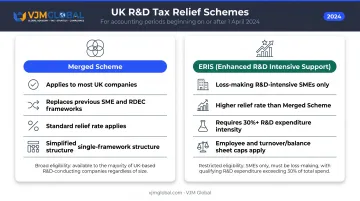
Accounting periods that started before 1 April 2024 are subject to the legacy SME and RDEC rules. If you are filing for an earlier period, confirm which framework applies before proceeding.
Who Qualifies for R&D Tax Credits in the UK?
The Three Core Conditions
Every claimant must satisfy all three:
- Be a UK limited company subject to Corporation Tax
- Have carried out qualifying R&D activities — meaning work that sought to resolve scientific or technological uncertainty
- Have incurred expenditure on those activities
What "Scientific or Technological Uncertainty" Means in Practice
This is HMRC's primary test. Uncertainty exists when a competent professional in the relevant field cannot determine whether something is technically possible — or how to achieve it — based on currently available knowledge. Commercial risk, financial uncertainty, or market unknowns do not count.
A construction firm developing a new structural technique where established methods cannot confirm feasibility faces genuine technical uncertainty. A software company adapting a known algorithm for a new client does not.
Which Industries Can Claim?
R&D tax credits are not restricted to technology or pharmaceutical companies. HMRC's 2023 to 2024 R&D statistics show that while Information and Communication (26% of claims), Manufacturing (26%), and Professional, Scientific and Technical (19%) account for the bulk of claims, companies in food production, agriculture, financial services, and construction can all include qualifying activity.
What matters is the nature of the work — not the sector your business operates in.
ERIS Eligibility Thresholds
ERIS (the Enhanced R&D Intensive Support scheme) is designed for smaller, R&D-heavy companies. To qualify, a company must:
- Have fewer than 500 employees
- Meet either the turnover cap (under €100m) or balance sheet cap (under €86m) — including linked or partner enterprises. These are HMRC's retained euro-denominated thresholds, carried over from EU-derived legislation
- Have qualifying R&D expenditure of at least 30% of total expenditure for periods starting on or after 1 April 2024
What Does NOT Qualify
- Activities in arts, humanities, or social sciences (including economics)
- Routine analysis, minor optimisation, or copying of existing products without genuine uncertainty
- Commercial steps involved in marketing or distributing an innovation
- General support services such as security, maintenance, or administration
What Costs Qualify for R&D Tax Credits?
Staff Costs
Directly employed staff costs attributable to qualifying R&D are claimable, including:
- Salaries and wages
- Employer's Class 1 National Insurance contributions
- Employer pension contributions
A proportion of management or support staff time spent directly supporting R&D activity can also be included, provided it is reasonably apportioned.
Subcontractors and Externally Provided Workers
Under the Merged Scheme, where R&D is subcontracted to an unconnected party, the claim is generally restricted to 65% of the relevant subcontractor expenditure. The rules on who can claim have also shifted: if your business both commissions and performs R&D, establish clearly which entity bears the qualifying costs before filing.
Consumables and Materials
Materials, consumables, and utilities (heat, light, power) consumed or transformed directly during the R&D process qualify. Where items are subsequently incorporated into commercially sold products, careful apportionment is required to isolate the R&D-related portion.
Software, Data, and Cloud Computing
This category became explicitly qualifying for accounting periods starting on or after 1 April 2023:
- Software licences directly used in qualifying R&D
- Purchased datasets employed in resolving technical uncertainty
- Cloud computing costs — including processing and storage — directly tied to R&D activity
This matters most for software and SaaS businesses that previously had no route to claim cloud infrastructure costs. If only part of a software licence or cloud service is used for R&D, an appropriate apportionment is required.
Capital Expenditure
R&D tax credits cover revenue expenditure only. Capital assets fall outside the R&D costs claim entirely — but they are not without relief:
- Excluded from R&D credits: equipment, machinery, and property
- Separately qualifying: capital items used in R&D may qualify for 100% R&D Capital Allowances under HMRC's Capital Allowances Manual (CA60000)
These are two distinct mechanisms. Treating capital assets as revenue expenditure — or missing the Capital Allowances route entirely — is one of the most frequent errors in self-prepared claims.
How to Claim R&D Tax Credits: Step-by-Step
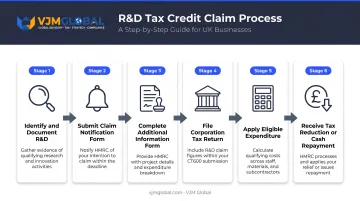
The end-to-end process covers six stages:
- Identify qualifying projects and document your R&D
- Submit a Claim Notification Form (if required)
- Complete and submit the Additional Information Form
- File your Corporation Tax Return
- Apply eligible expenditure to your tax computation
- Receive your tax reduction or cash credit repayment
Step 1: Identify Qualifying Projects and Document Your R&D
Map each candidate project against HMRC's definition. For each qualifying project, document:
- The specific scientific or technological uncertainty you attempted to resolve
- The work undertaken — including approaches tried and abandoned
- The outcome — whether successful or not (failed projects still qualify)
Good contemporaneous records — meeting notes, technical specs, test logs, time records — are what HMRC will want to see if they open a compliance check. Assembling this retrospectively is possible but harder and riskier.
Step 2: Submit a Claim Notification Form (If Required)
For accounting periods beginning on or after 1 April 2023, you must submit a Claim Notification Form via HMRC's online portal if:
- This is your first R&D tax credit claim, or
- Your last claim was more than three years ago
The deadline is six months after the end of the accounting period. This is an absolute cut-off — it cannot be extended.
Required information includes:
- Company UTR
- Senior R&D contact details
- Agent contact details (if applicable)
- Accounting period start and end dates
- High-level summary of planned activities showing how the work meets HMRC's R&D definition
Step 3: Complete and Submit the Additional Information Form
From 8 August 2023, all claimants must submit an Additional Information Form to HMRC before filing the Corporation Tax Return. The form requires:
- Project descriptions: field of science or technology, baseline level, advance sought, uncertainties encountered, how the project addressed them
- Cost breakdown: qualifying expenditure by category, PAYE cap information where relevant
- Agent details: all advisers involved in preparing, costing, or providing technical assessment for the claim
If the Corporation Tax Return is filed before the Additional Information Form is submitted, the R&D claim will be rejected.
Step 4: File Your Corporation Tax Return
Once the Additional Information Form is submitted, include the R&D claim in your Corporation Tax Return (CT600). The eligible expenditure is applied to your Corporation Tax computation — either reducing taxable profits through enhanced deductions or generating a surrenderable loss for a cash repayment under ERIS.
Claims can be made up to two years after the end of the relevant accounting period. Note that CT600 boxes 656 and 657 require confirmation that the Claim Notification and Additional Information Form steps have been completed.
Getting these steps right matters — errors in sequencing or documentation are among the most common reasons HMRC opens a compliance check. VJM Global has supported 250+ UK businesses through R&D tax credit claims, helping ensure submissions are correctly structured and properly evidenced from the outset.
Common Misconceptions and Mistakes to Avoid
"R&D Tax Credits Are Only for Tech Companies"
This is the most persistent and costly misconception. HMRC's test is about the nature of the activity, not the industry. A food manufacturer reformulating a product to resolve a genuine technical challenge may qualify just as much as a software firm. The question is always: was there a scientific or technological uncertainty that a competent professional could not readily resolve?
Over-Claiming Without Adequate Documentation
HMRC has significantly expanded its R&D compliance team. According to HMRC's 2024 to 2025 Annual Report, the department now has over 500 staff dedicated to R&D compliance (up from around 100 in 2020 to 2021). In 2023 to 2024, HMRC conducted checks on 9,700 claims — of which 77% resulted in an adjustment, with £441m identified as incorrectly claimed. Estimated R&D error and fraud now stands at £481m (5.9%) of total relief in 2024 to 2025.
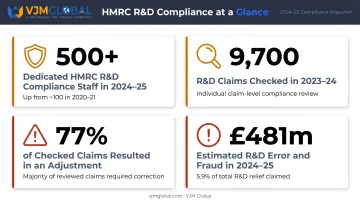
Claims that include routine activities, lack supporting documentation, or miscategorise expenditure are no longer slipping through. Scrutiny is at an all-time high.
Missing the Claim Notification Deadline
Since April 2023, new and lapsed claimants must submit a Claim Notification Form within six months of the end of the relevant accounting period — before the main claim is filed. Many businesses returning after a gap, or claiming for the first time, miss this step entirely. Once the deadline passes, the claim for that period is lost with no exceptions.
If you think you might qualify, take these steps early:
- Confirm whether your company meets the notification requirement (applies to first-time and lapsed claimants)
- Identify the deadline date for your accounting period
- Submit the notification form before preparing the full R&D claim
Frequently Asked Questions
How do you claim R&D tax credits in the UK?
UK limited companies must identify qualifying R&D activities, submit a Claim Notification Form if required, complete the Additional Information Form before filing, and then include the R&D claim in the Corporation Tax Return. A qualified tax adviser helps ensure each step is completed in the correct order.
Who qualifies for R&D tax credits?
Any UK limited company subject to Corporation Tax that has carried out qualifying scientific or technological R&D and incurred related expenditure may qualify. Eligibility is not sector-specific: manufacturing, construction, food production, and professional services can all contain qualifying activity.
How do R&D tax credits work in the UK?
Qualifying R&D expenditure is enhanced or credited against the company's Corporation Tax liability, reducing the tax owed or generating a cash repayment. The rate and mechanism depend on whether the company falls under the Merged Scheme or ERIS for the relevant accounting period.
How long does it take to receive R&D tax credits?
HMRC's current service standard is to process 85% of R&D claims within 40 days of receipt, and HMRC reported achieving 90% within that window in 2024 to 2025. Processing can take longer if HMRC opens a compliance check on the claim.
Can a loss-making company claim R&D tax credits?
Yes. Loss-making companies can surrender qualifying losses for a cash repayment from HMRC. Loss-making SMEs with qualifying R&D expenditure representing at least 30% of total expenditure may also access the enhanced ERIS rate, which provides higher relief.
What is the deadline to claim R&D tax credits in the UK?
R&D relief claims must generally be made within two years of the end of the relevant accounting period. First-time claimants and those returning after a gap of more than three years must also submit the Claim Notification Form within six months of the period end — that shorter deadline takes priority.