Noida sits at the heart of the NCR industrial and IT/ITES corridor, which has made it a magnet for startups, NRIs, and foreign investors from the US, UK, and Australia entering the Indian market. Many first-time founders, however, attempt registration without understanding entity selection, documentation, or compliance requirements. The result is delayed approvals or outright rejections.
This guide walks through entity types, the step-by-step registration process, documents, fees, timelines, and post-registration compliance for anyone setting up shop in Noida.
Key Takeaways
- Registration follows the national MCA SPICe+ process, plus UP stamp duty norms
- Entity choice—Pvt Ltd, LLP, OPC, or Subsidiary—is the top decision for foreign founders
- Accurate documentation typically brings incorporation in 7-15 working days
- Total cost depends on authorized capital, professional fees, and stamp duty
- Professional review of name approval and MOA/AOA drafting avoids costly delays
What Is Company Registration in Noida?
Registering a company in Noida means incorporating a business under the Companies Act, 2013 (or the LLP Act, 2008), filed with the Registrar of Companies (RoC) that holds jurisdiction over Uttar Pradesh. The RoC verifies your application and, once satisfied, issues a Certificate of Incorporation.
That certificate unlocks several practical outcomes:
- A distinct legal identity separate from founders or shareholders
- Limited liability protection, shielding personal assets from business debts
- Eligibility for government schemes, business credit lines, and public tenders
Incorporation is separate from operational registrations. Getting your Certificate of Incorporation is step one. Registrations like GST, Shop & Establishment licensing, or EPFO enrollment come after, once the entity legally exists.
Types of Business Entities You Can Register in Noida
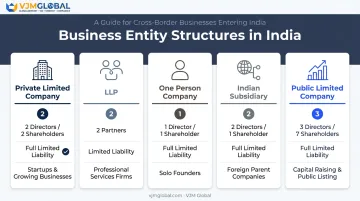
Entity selection shapes everything downstream, from compliance burden to how easily you can raise money. Here are the five structures available in Noida.
Private Limited Company
The default choice for startups and foreign-funded businesses. It needs a minimum of 2 directors and 2 shareholders, caps membership at 200, and restricts share transfers. Investors generally prefer this structure because it supports equity fundraising cleanly.
Limited Liability Partnership (LLP)
Built for professional services and founders who want partnership-style flexibility without unlimited liability. An LLP needs at least 2 designated partners, one of whom must be a resident of India.
One Person Company (OPC)
Designed for solo founders who want a corporate structure without bringing in a co-founder. Contrary to older assumptions, an OPC member simply needs to be a natural person and an Indian citizen. Since April 2021, residence outside India is no longer a bar, meaning many NRIs qualify too.
Indian Subsidiary Company
The standard entry route for US, UK, and Australian parent companies wanting a wholly-owned or joint venture presence. Rather than a separate legal category, it's a private or public company that follows FEMA (Foreign Exchange Management Act) rules on foreign investment, layered on top of standard Companies Act requirements.
Public Limited Company
Suited to larger businesses planning to raise capital from the public. It requires a minimum of 7 shareholders and 3 directors, with no membership cap.
VJM Global's business setup specialists help foreign companies, NRIs, and OCIs weigh these structures against their entry strategy, sector, and tax position before filing a single form.
Why Register a Company in Noida
Noida's appeal comes down to location and infrastructure. It sits directly on Delhi's border, giving businesses easy access to the capital's markets and transport networks. Noida also offers established IT/ITES parks, manufacturing zones, and Special Economic Zones (SEZs), along with proximity to key government and diplomatic offices.
Beyond geography, incorporation itself opens doors:
- Stronger investor confidence once a business holds a formal legal identity
- Eligibility for MSME and Startup India benefits, business loans, and public tenders
- Access to a state government actively courting foreign capital
Uttar Pradesh received ₹16,315.55 crore (roughly $2,070.80 million) in FDI equity inflows between October 2019 and March 2025, according to DPIIT's quarterly fact sheet. That figure reflects the broader state's investment climate, with Noida's IT/ITES and SEZ corridor accounting for a large share of that inflow.
Step-by-Step Company Registration Process in Noida
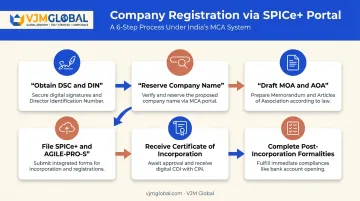
The entire process runs online through the MCA portal, centered on the SPICe+ (Simplified Proforma for Incorporating a Company Electronically Plus) form. There's no need to visit a government office in person.
Step 1: Obtain DSC and DIN
Every proposed director needs a Digital Signature Certificate to sign electronic filings. MCA guidance calls for Class-II or above. MCA allots Director Identification Numbers (DIN) for up to three directors directly through Part B of SPICe+, so you don't need a separate application.
Step 2: Reserve the Company Name
Part A of SPICe+ handles name reservation for new companies, checking your proposed name against MCA's naming guidelines and existing trademarks. Note: RUN is only for renaming an existing company; LLPs use a separate service called RUN-LLP.
Step 3: Draft the MOA and AOA
The Memorandum of Association defines what your company is allowed to do; the Articles of Association set internal governance rules, like how directors are appointed or how shares transfer. Get these wrong and you'll be amending them later, which costs time and money.
Step 4: File SPICe+ and AGILE-PRO-S with the MCA
This is where MCA's integrated incorporation service earns its "plus." A single filing simultaneously applies for PAN, TAN, and, through the linked AGILE-PRO-S form, EPFO and ESIC registration plus your business bank account. GST registration is optional at this stage.
Step 5: Receive the Certificate of Incorporation
Once the RoC verifies your documents, it issues the Certificate of Incorporation along with a unique Corporate Identification Number (CIN). This is the moment your entity legally exists.
Step 6: Complete Post-Incorporation Formalities
Before you start operating, complete these final formalities:
- Open a current bank account in the company's name
- Deposit the subscribed share capital
- Set up statutory registers required under the Companies Act
Skipping this step is a common reason companies fall out of compliance within their first year. Firms such as VJM Global, headquartered in Noida's Sector 142, handle these filings for foreign investors and NRIs entering the Indian market, reducing back-and-forth with the RoC.
Documents, Fees, and Timeline for Company Registration in Noida
Documents You'll Need
For directors and shareholders:
- PAN and Aadhaar (Indian nationals)
- Passport, mandatory for NRIs and foreign nationals
- A recent utility bill or bank statement, not older than 2 months
For the registered office, a physical Noida address is mandatory, backed by a rent agreement or sale deed, plus a No Objection Certificate (NOC) from the property owner. All copies must be self-attested by the respective director or shareholder before submission.
Cost Components
There's no single "registration fee." Costs break down across several buckets:
| Cost Component | What It Depends On |
|---|---|
| RoC/MCA filing fee | Authorized capital (calculated via MCA's fee calculator) |
| UP stamp duty on AoA | ₹500 flat, under Schedule I-B Entry 10 |
| UP stamp duty on MoA | ₹500 if filed with AoA; ₹1,000 if filed alone |
| DSC and DIN charges | Per director, fixed by certifying authority |
| Professional fees | Varies by entity type and complexity |
These stamp duty figures come directly from the Uttar Pradesh Stamp Act schedule.
India abolished minimum capital requirements years ago, so government costs stay relatively low. Where money actually goes is professional fees and compliance support, which vary based on entity type and how many directors or shareholders you're onboarding.
Timeline
Expect 7-15 working days from document submission to Certificate of Incorporation, assuming clean paperwork and no RoC queries.
For NRIs and foreign investors, notarization and apostille requirements are the single biggest cause of delay. Passports need notarization by a foreign authority or an Indian Embassy signature; non-English documents need certified translations. VJM Global routinely handles this exact bottleneck for overseas applicants, checking documents before submission rather than after rejection.
Post-Registration Compliance and Common Challenges in Noida
Getting your Certificate of Incorporation completes registration, but compliance obligations start immediately after.
Immediate Post-Incorporation Steps
- Activate PAN and TAN, and complete GST registration if applicable
- Appoint your first statutory auditor within 30 days of incorporation
- Issue share certificates to subscribers
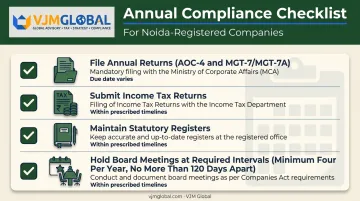
Recurring Annual Compliance
- File annual returns (AOC-4 for financial statements, MGT-7 or MGT-7A for smaller companies)
- Submit income tax returns
- Maintain statutory registers, covering members, directors, and charges
- Hold board meetings at required intervals, generally at least four a year with no more than 120 days between them
Where Applications Commonly Go Wrong
- MCA portal errors during form submission, often from mismatched data across linked forms
- Name rejections, either from resemblance to an existing company or conflict with a registered trademark
- Incomplete address proof or NOC, particularly when utility bills exceed the 2-month validity window
The fix is usually straightforward. Have someone who's filed dozens of these forms review your application before submission, and track your application status actively instead of waiting for MCA to flag issues.
VJM Global brings 30+ years of tax, audit, and business setup experience to this exact problem, having supported 500+ US, 250+ UK, and 250+ Australian businesses through incorporation and beyond.
Ongoing needs like bookkeeping, payroll compliance, statutory audits, and secretarial filings continue well after registration, and VJM Global supports clients through each of these stages.
Frequently Asked Questions
How to register a company in Noida?
Select your entity structure, obtain DSC and DIN for directors, reserve a company name, file SPICe+ with your MoA and AoA, and receive your Certificate of Incorporation. The entire process runs through the MCA portal.
How much does it cost to register a company in Noida, India?
Costs include RoC filing fees based on authorised capital, Uttar Pradesh stamp duty (typically ₹500-₹1,500 for MoA/AoA), DSC and DIN charges, and professional fees.
Can NRIs or foreign nationals register a company in Noida?
Yes. At least one director must be an Indian resident, and foreign nationals generally need notarized or apostilled identity and address documents before filing.
How long does company registration in Noida take?
Typically 7-15 working days, depending on document accuracy and how quickly the RoC processes your application.
Is a physical office address required for company registration in Noida?
Yes. You need a registered office address in Noida, backed by ownership proof or an NOC from the property owner, whether residential or commercial.
What is the minimum capital required to register a company in Noida?
There's no statutory minimum capital requirement. Founders can start with whatever nominal authorised capital they agree on among themselves.