Introduction
Most Indian entrepreneurs expanding internationally struggle with two problems: unfamiliar legal systems and unclear home-country obligations. Chile removes the first problem almost entirely. With bilateral trade reaching USD 3,758.50M in FY 2024-25 and India's pharma and auto sectors already commanding significant export share, Chile is one of the most accessible entry points in Latin America for Indian investors.
What sets Chile apart from most Latin American markets is the absence of barriers Indian entrepreneurs typically encounter. There's no mandatory local partner requirement and no minimum capital threshold for most structures. The legal framework explicitly grants foreign investors the same rights as Chilean nationals — a protection written into statute, not just policy.
This guide covers every phase of the process — the Chile-side incorporation steps and, critically, the India-side regulatory obligations under FEMA and RBI that most general guides skip entirely. Getting the sequence wrong on the India side creates real legal exposure. By the end, you'll know which structure fits your business, which RBI filings are mandatory before you invest, and what to file after.
Key Takeaways
- Chile permits 100% foreign ownership with no minimum capital for most structures — no Chilean co-owner required
- The SpA is the fastest incorporation route: registered online in 24–48 hours; full setup takes 3–5 weeks
- Indian investors must complete RBI Overseas Investment compliance and apostille all documents before registering in Chile
- Corporate tax runs 25% (SMEs) or 27% (larger companies) — qualifying SMEs get a reduced rate of 12.5% from 2025–2027
- A DTAA between India and Chile is in force, applicable in Chile from 1 January 2023
Why Chile Is a Smart Expansion Move for Indian Businesses
Chile holds sovereign credit ratings of A/stable from S&P and Moody's (A2/stable), affirmed in October 2025, and A-/stable from Fitch — the strongest sovereign ratings in Latin America. For Indian exporters and investors evaluating regional options, that credit profile signals contract enforceability, monetary stability, and predictable regulation.
Chile's trade architecture amplifies that access. With 36 active trade agreements covering the EU, US, China, and India, Chile gives Indian companies structured, preferential access to Latin American buyers — not just proximity.
The India-Chile Trade Opportunity
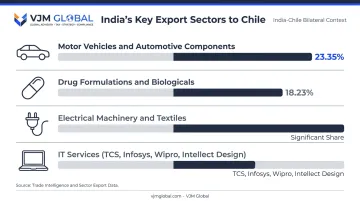
The India-Chile Preferential Trade Agreement (PTA), in force since August 2007 and expanded in 2017, now covers 2,829 tariff lines with Chile granting India a 30%–100% margin of preference on 1,798 of those lines. The sectors where Indian companies already have export momentum include:
- Motor vehicles and automotive components — 23.35% of India's exports to Chile
- Drug formulations and biologicals — 18.23% of exports
- Electrical machinery, manmade yarn, and cotton fabrics — additional significant categories
- IT services — TCS, Infosys, Wipro, and Intellect Design all have Chilean operations
Before assuming a specific product benefits from PTA preferences, verify using HS codes through DGFT or the Indian Trade Portal — duty concessions vary by line.
No Local Partner Required
A common misconception among Indian businesses is that Latin America requires local connections or a government-linked partner to operate. Chile's Foreign Investment Promotion Law (Law 20.848), Article 9, explicitly gives foreign investors the same legal regime as domestic investors. That means no arbitrary discrimination, and a clear right to remit capital and profits after meeting tax obligations.
In practice, this translates to three core protections for Indian investors:
- Equal treatment — same legal standing as Chilean domestic investors
- Capital repatriation — profits and invested capital can be remitted abroad after tax
- No forced local partnership — 100% foreign-owned entities are permitted
Business Structures Available in Chile for Indian Investors
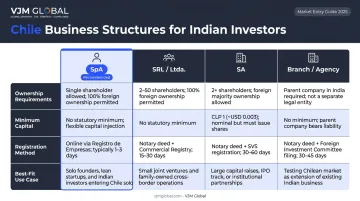
Four structures are available, each with distinct suitability for Indian investors:
| Structure | Key Feature | Best For |
|---|---|---|
| SpA (Sociedad por Acciones) | One or more shareholders; no minimum capital; fully online | Solo founders, startups, first-time market entry |
| SRL/Ltda. | 2–50 partners; shared operations | Small groups of Indian co-investors |
| SA (Sociedad Anónima) | Closed SA for 2+ shareholders; open SA accesses capital markets | Large enterprises planning to raise capital |
| Branch/Agency | Existing Indian company opens a Chile office under Art. 447 | Established Indian exporters testing the market |
The Branch Route Under Article 447
An existing Indian company can establish a Chilean branch without incorporating a separate legal entity. This is practical for IT services firms or consulting companies that want a local presence without the administrative burden of a new company. One requirement to plan for: the Indian parent's corporate documents (articles of incorporation, board resolution, and power of attorney) must be notarised, apostilled, and officially translated into Spanish.
Which Structure to Choose
For most Indian entrepreneurs starting fresh, the SpA is the clear default. It requires no minimum capital, allows a single owner, and the entire registration process runs online — making it the least complicated entry point available.
Indian companies with active export operations that already have Chilean clients may find a Branch more efficient. It avoids setting up a parallel legal entity in Chile while still establishing a recognized local presence.
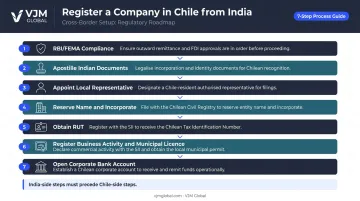
Step-by-Step: How to Set Up a Business in Chile from India
The process has two phases that must run in the correct sequence: India-side compliance first, Chile-side execution second. Reversing that order is one of the most common and costly mistakes Indian entrepreneurs make.
Step 1: Complete India-Side Regulatory Requirements
Before any funds move to Chile, Indian residents and companies must comply with the RBI's Overseas Investment (OI) framework under FEMA. The current framework (2022 OI Rules) governs how Indian entities report and structure foreign investments.
Key obligations:
- File Form FC with your Authorised Dealer (AD) bank
- Obtain a Unique Identification Number (UIN) for the investment
- Submit an Annual Performance Report (APR) to your AD bank by 31 December each year
- Ensure the investment falls within permissible sectors (real estate, gambling, and certain INR-linked products are prohibited)
Step 2: Prepare and Apostille Indian Documents
India joined the Hague Apostille Convention on 14 July 2005. Chile is also a member, so Indian documents apostilled by the Ministry of External Affairs (MEA) are accepted without further legalisation.
Documents that commonly require apostille for Chile registration:
- Passport copies
- Power of Attorney (POA) authorising your Chilean representative
- Certificate of Incorporation (for branch setups)
- Board Resolution authorising the investment
Documents in regional Indian languages must be translated into English first, then into Spanish by a certified translator in Chile.
Step 3: Appoint a Local Legal Representative
Chilean law requires a legal representative physically based in Chile with a valid RUT. This person (an attorney, accountant, or corporate service provider) acts before the SII (tax authority) and banks as your legal agent — not a business partner.
The appointment is formalised via a notarised and apostilled Power of Attorney issued in India, granting authority to complete registration, tax, and licensing steps.
Step 4: Reserve Company Name and Incorporate
Two routes exist:
- Empresa en un Día portal — 100% online, no additional registration cost, supports SpA and other structures; fastest route for most Indian founders
- Traditional notary route — required for branches and more complex structures; includes an extract published in the Diario Oficial (Official Gazette) within 60 days of notarisation; publication costs 1 UTM, though companies with capital below 5,000 UF are exempt
For the SpA online route, the process takes 24–48 hours once documents are ready.
Step 5: Obtain the RUT
The RUT (Rol Único Tributario) is Chile's tax identification number, mandatory for all companies and directors. Without it, the company cannot open a bank account, issue invoices, or sign contracts.
For non-resident Indian owners, the appointed Chilean representative obtains the corporate RUT directly from the SII using the apostilled POA. Foreign directors who need a personal RUT follow a separate application process through the SII.
Step 6: Register Business Activity and Obtain Municipal Licence
Activating the company for operations requires two filings:
- Inicio de Actividades — filed with the SII to declare the company's business activity and enable invoicing
- Patente Municipal — the municipal business licence from the local municipality where the company's registered address sits; costs 2.5–5 per mil of declared capital, with a minimum of 1 UTM and a maximum of 8,000 UTM; renewed annually in two semi-annual instalments
Regulated sectors — food, health, education, alcohol, pharmacies — require additional permits before the municipal licence is granted.
Step 7: Open a Corporate Bank Account
Chilean banks apply rigorous KYC/AML checks, particularly for foreign-owned companies. Expect the process to take several weeks. Documents required include:
- Apostilled incorporation documents and RUT certificates
- Proof of registered address in Chile
- Beneficial ownership declarations (required under UAF Circular 62/2025)
- Source-of-funds documentation for the Indian parent or investor
Fintech platforms operating in Chile can serve as interim liquidity solutions while traditional bank activation proceeds. Confirm with your Chilean legal representative which platforms suit your business type before committing.
Tax and Compliance Obligations in Chile
Corporate Income Tax
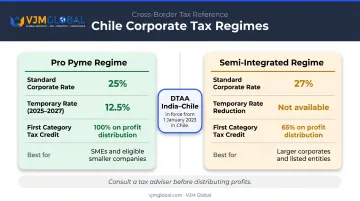
Chile operates two main corporate tax regimes:
| Regime | Standard Rate | 2025–2027 Temporary Rate |
|---|---|---|
| Pro Pyme (SME) | 25% | 12.5% (Law 21.755) |
| Semi-integrated system | 27% | Not reduced |
To qualify for the Pro Pyme regime, average gross income over the past three years must not exceed 75,000 UF, and initial effective capital must not exceed 85,000 UF.
Profit Repatriation and the DTAA
When an Indian shareholder distributes profits from Chile, an Additional Tax of 35% applies at the shareholder level. However:
- Pro Pyme shareholders can apply a 100% credit from First Category Tax already paid
- Semi-integrated shareholders can apply a 65% credit
An India-Chile DTAA is in force, applicable in Chile from 1 January 2023. Treaty benefits can significantly reduce the net tax on repatriated profits — confirm the specifics with a qualified tax adviser before distributing profits.
VAT and Monthly Obligations
Chile's standard VAT (IVA) rate is 19%, applied to most goods and services. All registered companies — including foreign-owned ones — must:
- Collect VAT from customers
- File Form 29 (monthly declaration) with the SII
- Make monthly provisional payments (PPMs) credited against the annual income tax bill; Pro Pyme PPM rates are temporarily halved to 0.125%–0.25% under Law 21.755
The annual income tax return is due by 30 April. Most foreign companies engage a local Chilean accountant (contador) to manage Spanish-language filings.
Payroll Obligations (If Hiring Chilean Employees)
Hiring Chilean staff adds another compliance layer. Once you bring on employees, these employer contributions apply:
- SIS insurance: ~1.26% (employer-funded)
- Unemployment insurance: 2.4% employer / 0.6% employee (indefinite contracts)
- Workplace accident insurance (Law 16.744): employer-funded at a base rate of approximately 0.90%–0.95%
- Health and pension contributions: withheld and remitted on behalf of employees
Non-registration of employees with Chilean social security (AFP, FONASA/ISAPRE) triggers penalties. Engage a local payroll provider or accountant before your first hire.
India-Specific Regulatory Requirements Before You Begin
This is where most general guides stop short. For Indian entrepreneurs, the India-side obligations are not optional formalities — they are legal prerequisites.
RBI Overseas Investment Framework
Under the Foreign Exchange Management (Overseas Investment) Rules, 2022, Indian residents and companies making direct investments in foreign entities must:
- File Form FC with their Authorised Dealer bank
- Obtain a UIN for the investment before funds are remitted
- Submit an Annual Performance Report (APR) to the AD bank by 31 December each year
Getting the Chile registration done first — before filing Form FC and obtaining the UIN — creates FEMA violations that can prevent legal profit repatriation and trigger RBI penalties. The sequence matters.
Liberalised Remittance Scheme (LRS) for Individual Investors
If an individual Indian investor (rather than a company) is funding the Chile entity personally, the LRS allows remittances of up to USD 250,000 per financial year for permitted capital account transactions, including equity investments in foreign companies.
Key distinctions:
- LRS applies to individual resident investors making portfolio-type or ownership investments
- Strategic control investments and corporate-level investments require the full ODI route with Form FC and UIN
- LRS cannot be used for margins, overseas FX trading, or lottery-type transactions
If the right route isn't clear for your situation, consult a FEMA adviser before remitting.
The Apostille Process in India
The MEA is India's apostille authority. The process for commonly required documents:
- Get documents notarised by a registered notary
- Submit to MEA for apostille (in-person or through authorised agencies)
- Documents in regional languages must first be translated into English, then into Spanish
Plan for 1–2 weeks for apostille processing. Do not ship original documents to Chile without apostille — the SII will not accept foreign-issued documents without legalisation.
How VJM Global Can Help
Getting these India-side steps right before engaging Chilean authorities is where most missteps occur. VJM Global's FEMA advisory practice — backed by 30+ years of ODI and cross-border tax experience — covers the compliance sequence end to end:
- Outbound investment structuring and ODI route selection
- Form FC preparation and UIN filing with AD banks
- DTAA advisory and cross-border tax planning
- Coordination between India-side compliance and Chile-side registration
Reach out at [email protected] for a consultation tailored to your investment structure.
Common Challenges and Mistakes to Avoid
The Sequencing Error
Starting Chile registration before completing Form FC and obtaining a UIN is the single most common and damaging mistake. The consequences include inability to legally repatriate profits, RBI penalties, and potential issues with Chilean bank compliance once the bank asks how the initial capital was remitted.
Banking KYC Underestimation
Chilean banks conduct thorough AML/KYC checks on foreign-owned companies. Many Indian entrepreneurs are surprised by the level of documentation requested about the Indian parent company: ownership structure, source of funds, and beneficial ownership declarations.
Prepare this documentation before incorporation, not after.
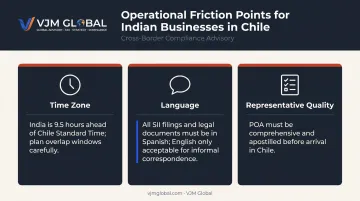
Operational Friction Points
- Time zone: India is 9.5 hours ahead of Chile Standard Time (8.5 hours during Chilean summer). Plan communication windows in advance — morning India time often falls outside Chilean business hours entirely
- Language: All official correspondence, contracts, and SII filings must be in Spanish; informal emails between business parties can be in English, but legal documents cannot
- Representative quality: A poorly briefed local representative with incomplete POA authority causes avoidable setup delays; ensure the POA is comprehensive and apostilled before it reaches Chile
When a Chilean Entity May Not Be Necessary
If your Indian company is selling to Chilean buyers without needing a local operational presence, setting up a Chilean entity may create unnecessary tax obligations rather than reduce them.
A SpA or Branch makes sense when you need:
- Invoicing authority in Chile
- Local employees on Chilean payroll
- A local entity to sign contracts or leases
Pure export relationships don't require local incorporation.
Frequently Asked Questions
How do I start a business in Chile as a foreigner?
Foreign nationals, including Indian citizens, can register a Chilean company without residency or a local co-owner by appointing a Chile-based legal representative, obtaining a corporate RUT from the SII, and registering via the Empresa en un Día portal or through a notary. The full process takes approximately 3–5 weeks once all apostilled documents are prepared.
What is the 19% tax in Chile?
The 19% refers to Chile's Value Added Tax (IVA), applied to most goods and services. All registered companies, including those with 100% Indian ownership, must collect this tax from customers and pay it to the SII monthly via Form 29.
Can an Indian national own 100% of a company in Chile?
Yes. Under Law 20.848, Indian nationals can own 100% of a Chilean company with no minimum capital and no obligation to have a Chilean co-owner. A local legal representative with a RUT is required: this person acts as your legal agent, not a co-owner.
Do I need to travel to Chile to set up a company?
Physical presence is not required. With a notarised and apostilled Power of Attorney issued in India, a Chilean representative can complete registration, tax, and municipal licensing steps remotely. Opening a corporate bank account may require in-person verification at some traditional banks, so consider alternative banking arrangements if travel isn't feasible.
What is the RUT and why does an Indian business owner need one?
The RUT (Rol Único Tributario) is Chile's mandatory tax identification number for all companies and directors. Without it, the company cannot open a bank account, issue invoices, or execute contracts. Indian business owners need a corporate RUT for the company and typically a personal RUT as a foreign director, both obtained through the SII via the appointed local representative.
What are the RBI and FEMA requirements for Indians setting up a business in Chile?
Indian residents must comply with the RBI's Overseas Investment framework under FEMA by filing Form FC with an Authorised Dealer bank, obtaining a Unique Identification Number (UIN), and submitting Annual Performance Reports. Those investing personal funds up to USD 250,000 per financial year may qualify to use the Liberalised Remittance Scheme (LRS) instead.