But registering a business in Saskatchewan isn't the same exercise as forming an LLC in Delaware or incorporating in Texas. The paperwork looks different. The terminology is different. And the tax system runs on entirely separate rails from what you're used to.
Your outcome also depends heavily on one early decision: do you form a brand-new Saskatchewan entity, or register your existing US company as an extra-provincial corporation? That choice shapes everything downstream, from liability exposure to how the Canada-US tax treaty applies to you.
This guide walks through the exact registration steps, the structure options available to US owners, realistic costs and timelines, and the cross-border tax traps that catch American business owners off guard.
Key Takeaways
- ISC fees range from $50 CAD (name reservation) to $255 CAD (incorporation or extra-provincial registration)
- US companies without a new entity typically need extra-provincial registration, not a trade name
- A CRA Business Number, GST account, and Saskatchewan PST account are all mandatory before operating
- Online ISC filings move quickly, but full setup often takes 2-4 weeks
- Permanent establishment risk under the Canada-US tax treaty makes cross-border tax guidance essential
Step-by-Step Guide to Registering a Business in Saskatchewan as a US Company
There are two distinct paths here. You either form a brand-new Saskatchewan entity, or you register your existing US company to operate under extra-provincial registration. Which one applies depends on your ownership structure and long-term plans, and we'll break down that decision further below. For now, here's how the actual filing process works.
Step 1: Choose and Search Your Business Name
Start by searching the ISC Business Names Registry to confirm your proposed name isn't identical or confusingly similar to an existing Saskatchewan business. ISC runs this comparison against the federal NUANS database as part of its $50 CAD name-reservation service, so you don't need to purchase a separate NUANS report.
A few naming rules to know:
- Restricted words like "Bank," "Trust," or "Royal" require special approval
- Corporate designators (Ltd., Inc., Corp.) are reserved exclusively for incorporated entities
- Approved name reservations stay valid for 90 days
If you're registering an existing US corporation as extra-provincial, check whether your name conflicts with something already on the Saskatchewan registry. If it does, you'll need to file under an assumed or alternate name for your Saskatchewan operations.
Step 2: Gather the Required Documents (US-Specific Requirements)
Your document checklist depends entirely on which path you're taking.
For extra-provincial registration, you'll need:
- A current Certificate of Good Standing (sometimes called a Certificate of Status) from your US home state
- Your corporate charter documents
- An appointed attorney or agent for service with a Saskatchewan address
For a brand-new Saskatchewan entity, you'll need:
- Government-issued ID for owners and directors
- A registered office address in Saskatchewan
- Share structure details for the incorporation filing
One point that trips up a lot of American founders: your US EIN does not replace a Canadian Business Number. You'll need both, operating independently of each other. If any of your US documents aren't originally in English, budget time for translation and, in some cases, notarization.
Step 3: File Your Registration Through ISC
You can file online through ISC's Corporate Registry portal, or in person at ISC service centres in Regina or Saskatoon. Most US businesses find the online route faster since it avoids travel entirely.
During submission, you'll provide:
- Business name and reservation number
- Business description and nature of activities
- Registered/records office address
- Director, officer, or attorney-for-service details
ISC accepts standard electronic payment methods for online filings. The agency notes that many online transactions process quickly. However, the only formally published turnaround guarantee applies to its priority service ($500 CAD), which ISC aims to review within one business day where possible. Standard filings generally clear faster than mail-in submissions, but don't count on a hard same-day guarantee.
Step 4: Receive Your Certificate and Complete Post-Registration Steps
Depending on your filing, you'll receive a Business Names Certificate, a Certificate of Incorporation, or an Extra-Provincial Registration confirmation. You'll need it for every step that follows.
Immediately after, you'll need to:
- Register for a CRA Business Number (BN) — the foundation for all your federal Canadian tax accounts
- Open a GST account under that BN
- Register separately for a Saskatchewan PST account with the Ministry of Finance
- Register with Saskatchewan WCB if you're hiring local employees
- Open a Canadian business bank account, using your ISC certificate as proof of registration
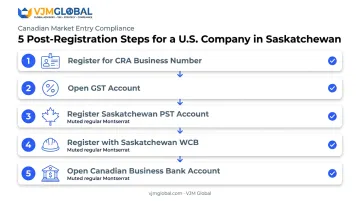
Skip any one of these and you're technically operating without full compliance, even if your ISC paperwork is squared away.
Choosing the Right Business Structure for Your US-Owned Business
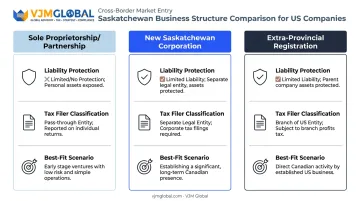
Which structure fits depends less on preference and more on how permanent your Saskatchewan presence is going to be.
Sole proprietorship or partnership works for an individual US owner testing a small Saskatchewan operation. It's the cheapest, simplest option. It also comes with unlimited personal liability, which makes it a poor fit for an established US corporate parent with assets to protect.
Forming a new Saskatchewan corporation creates a genuine subsidiary. You get liability protection, and the entity files as a standalone Canadian taxpayer. This route makes sense when your Canadian operations are meant to run somewhat independently, or when you want a clean legal separation from your US parent.
Extra-provincial corporation registration is the most common path for established US companies. It lets your existing entity operate in Saskatchewan without creating a new legal structure. This is required, not optional, whenever your US company has:
- A physical presence (office, warehouse, or place of business)
- Employees working in the province
- Ongoing contracts being fulfilled in Saskatchewan
Under Saskatchewan's Business Corporations Act, a foreign corporation must register within 30 days of starting to carry on business in the province.
Where US LLCs Get Complicated
If your US entity is an LLC, the extra-provincial registration process above gets more complicated. Canada doesn't recognize the US LLC the way the IRS does: your LLC might be a disregarded entity or pass-through partnership back home, but Canada classifies it as a corporation for tax purposes.
That mismatch matters because it can trigger double taxation if you don't structure things carefully. The entity that's "transparent" in the US may not line up with who Canada considers the actual taxpayer.
| Structure | Liability Protection | Canadian Tax Filer Status | Best Fit |
|---|---|---|---|
| Sole proprietorship/partnership | None | Individual/partners | Testing the market, solo owners |
| New Saskatchewan corporation | Yes | Separate Canadian entity | Standalone Canadian operations |
| Extra-provincial registration | Depends on parent entity | Existing entity, Canadian PE | Established US companies expanding presence |
Cost and Timeline to Register a Business in Saskatchewan
ISC's current fee table (effective June 2024) lays out the government charges:
| Filing type | Fee (CAD) |
|---|---|
| Name reservation | $50 |
| Trade name registration | $65 |
| Incorporation | $255 |
| Extra-provincial registration | $255 |
| Annual corporate return (on time) | $60 |
| Annual return (late) | $110 |
These figures come straight from ISC's official corporate registry fee schedule, so budget against these numbers rather than third-party estimates.
US businesses also face costs that don't show up on ISC's fee sheet:
- Certificate of Good Standing from your home state (fees vary by state)
- Registered agent or attorney for service in Saskatchewan (ongoing annual cost)
- Legal and professional fees for cross-border filings, commonly $500-$1,500 USD depending on complexity
As for timing: online ISC processing itself is typically quick, often within a few business days. Full operational readiness is a different story. Once you factor in document preparation, tax account setup, and opening a Canadian bank account, plan for 2-4 weeks before you're actually ready to invoice a Saskatchewan client.
Tax, GST/PST, and Cross-Border Compliance for US Businesses
This is where most American business owners get genuinely surprised, and where the real complexity of Saskatchewan expansion lives.
The CRA Business Number Comes First
Your Business Number (BN) is the 9-digit identifier that anchors every Canadian federal tax account you'll open: GST, payroll, corporate income tax. It's separate from your US EIN, and CRA has a dedicated non-resident registration process for exactly this situation.
Saskatchewan's Two-Tax System
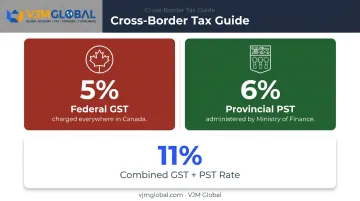
Here's the part that catches US businesses off guard almost every time: Saskatchewan runs two separate sales taxes, not one.
- 5% federal GST, charged everywhere in Canada
- 6% provincial PST, charged on top, separately administered by Saskatchewan's Ministry of Finance
Saskatchewan isn't a harmonized (HST) province, unlike Ontario or the Maritimes. You register for GST and PST separately, and they get remitted to different authorities entirely.
Treaty Protection Only Goes So Far
Sales tax isn't the only concern once you're operating in Saskatchewan — income tax exposure works differently. The Canada-US tax treaty generally limits Canadian tax on your business profits to income attributable to a Canadian permanent establishment.
But permanent establishment (PE) isn't defined by registration status. It's defined by fixed places of business, dependent agents, and, for services, day-count thresholds under Article V of the treaty.
Registering with ISC doesn't automatically create a PE. Having employees, an office, or ongoing contracts in Saskatchewan very often does.
Withholding tax obligations can also apply when you're paying Canadian employees or contractors, or repatriating profits back to your US parent company.
Where Professional Guidance Actually Pays Off
Between BN registration, dual sales tax accounts, WCB, and treaty exposure, most US owners end up needing two sets of eyes: someone who understands US-side reporting and someone fluent in Canadian filings.
Firms with genuine cross-border tax and entity structuring experience add real value here. VJM Global's advisory team, for example, has spent years helping American business owners plan international entity structures and navigate cross-border tax compliance, which is useful for mapping out your overall structure and avoiding classic entity-classification mismatches.
For Saskatchewan-specific filings with ISC and CRA, pair that guidance with a Saskatchewan-licensed lawyer or accountant who handles those filings directly.
Common Mistakes US Businesses Make When Registering in Saskatchewan
A few errors show up again and again with American founders:
- Assuming Saskatchewan uses HST. It doesn't. Missing the separate PST registration leads to penalties and back taxes down the line.
- Choosing the wrong structure without checking US tax implications. Forming a new entity when extra-provincial registration would have worked—or vice versa—creates costly compliance headaches to unwind.
- Underestimating documentation requirements. Forgetting the Certificate of Good Standing or failing to appoint a Saskatchewan attorney for service can stall your entire filing.
- Skipping treaty and permanent establishment review. Businesses that ignore PE exposure often discover unexpected Canadian tax filing obligations well after they've already started operating.
Frequently Asked Questions
Do I need to register my business in Saskatchewan?
Yes, if you operate under a different name, or maintain ongoing physical presence, employees, or contracts in Saskatchewan. The province's Business Corporations Act requires registration within 30 days.
How much does it cost to register a business in Saskatchewan?
Fees range from $65 CAD for a trade name to $255 CAD for incorporation or extra-provincial registration, plus a $50 CAD name reservation fee. Professional and legal fees for cross-border filings typically add another $500-$1,500 USD.
Can a US company register a business in Saskatchewan without forming a separate Canadian entity?
Yes. Extra-provincial corporation registration lets an existing US company operate in Saskatchewan under its original entity. You'll need to appoint a Saskatchewan attorney for service as part of that filing.
Do I need a Canadian address to register a business in Saskatchewan?
You need a Saskatchewan address for service, which can be a registered agent or virtual office rather than a physical storefront. This address is where legal and government correspondence gets sent.
How is a US LLC treated when registering a business in Saskatchewan?
Canada doesn't treat a US LLC the way the IRS does. It's classified as a corporation for Canadian tax purposes, which can create double-taxation risk if the entity isn't structured properly beforehand.
How long does it take to register a business in Saskatchewan?
Online ISC filings often process within a few business days. Full operational readiness, including tax accounts and a Canadian bank account, generally takes 2-4 weeks.