Introduction
Registering a business in South Carolina means legally forming an LLC or corporation through the SC Secretary of State, or "foreign qualifying" an out-of-state entity that's expanding into the Palmetto State.
The timing of this step isn't a minor detail. It directly determines when your liability protection kicks in and when the state considers you compliant.
Get the timing wrong, and the consequences run both directions. Register too late, and you risk fines, back taxes, and losing your right to sue in South Carolina courts.
Register too early, before your name or structure is locked in, and you're paying registered agent fees and amendment costs for no reason.
This guide walks through the best timing for different business scenarios, the signs you're actually ready, and the mistakes that trip up founders and foreign entities alike.
TL;DR
- Register before signing SC contracts, hiring employees, or accepting payments tied to the state
- New SC startups should register before any commercial activity begins
- Out-of-state companies must foreign qualify once they establish SC nexus (office, staff, warehouse)
- Delaying registration risks personal liability, fines, and loss of standing to sue in SC courts
- Confirm your business name and structure first; registering too early invites unnecessary amendment fees
Why Timing Matters When Registering Your Business in South Carolina
Your LLC or corporation's liability shield doesn't exist until the entity is legally formed. Sign a lease or hire staff before that filing goes through, and your personal assets sit exposed the entire time. Small businesses face real legal risk in their early years, which makes this gap more than a technicality.
There's a cost side to timing too. File your Articles of Organization before your business plan or structure is finalized, and you're paying registered agent fees and state filing costs before you've earned a dollar. That money could easily fund your first month of marketing instead.
The Legal Trigger: "Transacting Business"
South Carolina law requires foreign qualification once an out-of-state entity is considered to be "transacting business" in the state. The statute doesn't give a single bright-line test. Instead, it lists activities that don't count, such as:
- Maintaining bank accounts
- Holding internal company meetings
- Selling through independent contractors
- Completing an isolated transaction within 30 days
Everything outside those safe harbors is a judgment call, which is exactly why founders underestimate when they've crossed the line.
Banking, Taxes, and the Domino Effect
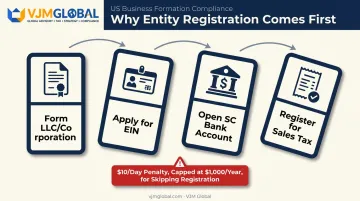
You typically need a formed entity before you can apply for an EIN, open a South Carolina business bank account, or register to collect state sales tax. Skip registration, and each of these downstream steps stalls.
Miss the "transacting business" threshold entirely, and a foreign corporation operating without authority can face a civil penalty of $10 per day, capped at $1,000 per year, under South Carolina Code Section 33-15-102.
Best Time to Register Your Business Based on Different Scenarios
There's no single "best time" to register in South Carolina. It depends on your physical presence, growth stage, and whether you're a domestic startup or an out-of-state entity expanding in.
Based on Business Activity and Physical Presence in SC
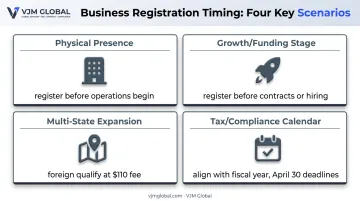
If you're opening an office, retail location, or warehouse in South Carolina, register before operations begin. Physical presence typically triggers the foreign qualification requirement, and there's little room for ambiguity once you have a lease and a street address.
Selling online without a physical footprint works differently. South Carolina's economic nexus threshold requires sales tax registration once your gross revenue from goods, digital products, or services delivered into the state exceeds $100,000 in the current or prior calendar year, according to the SC Department of Revenue's nexus guidance.
Cross that threshold, and you must obtain a retail license and begin collecting tax by the first day of the second calendar month after nexus is established. This is a separate test from entity foreign qualification — crossing the sales tax threshold doesn't automatically mean you need a certificate of authority.
Based on Growth Stage or Funding Readiness
Register before signing customer contracts, hiring your first SC-based employee, or closing an investment round. Investors and counterparties routinely require a formally registered entity before money or signatures change hands.
Solo founders can test an idea briefly as an unregistered sole proprietor. That said, the moment you accept your first paid contract or sale tied to South Carolina, the runway for staying unregistered ends.
Based on Multi-State or Foreign Qualification Needs
If your LLC or corporation was formed elsewhere and you're expanding into South Carolina, file for foreign qualification once you meet "transacting business" criteria, such as leasing office space or hiring SC-based staff. The application fee runs $110 for both foreign LLCs and corporations, with an additional $25 CL-1 license fee for corporations.
International entrepreneurs and NRIs setting up a US presence face an added layer of planning. Register before signing US contracts or opening a bank account, and build in extra lead time for registered agent appointment and EIN applications, since the process for foreign applicants without an SSN or ITIN takes longer than the standard online route.
Based on Tax and Compliance Calendar
Aligning your registration with the start of your fiscal year simplifies your first year of bookkeeping. A short first tax period isn't the end of the world, but it does create extra reconciliation work if it's not planned for.
Local business license renewal periods matter just as much. Several major SC municipalities share a common deadline:
| Jurisdiction | License Period | Renewal Deadline |
|---|---|---|
| Charleston (city) | Annual | April 30, then 5% penalty per late month |
| Columbia (city) | Annual | April 30, then 5% per month, compounding |
| Greenville (city) | May 1 - April 30 | April 30 postmark deadline |
| Charleston County | Annual | April 30 |
Registering just ahead of these windows avoids prorated fees and first-year penalty surprises.
Signs It's the Right Time, When to Delay, and What Happens If You Get the Timing Wrong
Signs you're ready to register:
- You've cleared a business name search through the SC Secretary of State's database
- You're about to sign a lease, vendor contract, or hire your first South Carolina employee
- You need an EIN, business bank account, or SC sales tax license to start operating
When to hold off on registering:
Two situations argue for waiting:
- Your structure or name isn't finalized. Registering prematurely often means paying for amendments later when you change the LLC to a corporation or tweak the name.
- You have no SC nexus yet. If you're only researching the market with no sales, presence, or contracts in the state, there's nothing to register for.
What happens if you register at the wrong time:
Timing mistakes cut both ways, and neither side is cheap:
- Too late: Penalties, back taxes, and an inability to enforce contracts in SC courts. A foreign corporation that isn't qualified can't maintain a lawsuit in the state until it fixes the problem, and the $10-per-day civil penalty (capped at $1,000 annually) adds up fast.
- Too early: Registered agent and compliance fees pile up before you've generated revenue, and any plan changes trigger amendment filings you didn't need to make.
- Tax license failures: Operating without displaying a required tax license can bring a penalty of $50 to $500 per failure, separate from any late-filing penalties on the return itself.
Best Practices for Timing Your South Carolina Business Registration Correctly
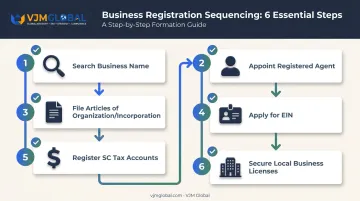
Getting the sequence right matters as much as getting the date right. Use this as your checklist:
- Search your name through the SC Secretary of State's database before filing anything
- Appoint a registered agent with a physical SC address for service of process
- File your Articles of Organization or Incorporation, which costs $110 for a domestic LLC or $135 for a domestic corporation package
- Apply for your EIN only after state formation is complete, since the IRS requires the entity to exist first
- Register for SC tax accounts through the Department of Revenue, including a retail license if you'll collect sales tax
- Secure local business licenses in every county or municipality where you'll operate
If you're scaling into South Carolina gradually rather than all at once, keep watching for nexus triggers — added staff, a new warehouse, or revenue crossing $100,000. Keep reassessing nexus regularly, since new triggers can appear anytime after your initial registration.
For international entrepreneurs, NRIs, or multinational companies entering the US market, this checklist gets more complicated. Registered agent requirements, EIN applications without a US Social Security Number, and coordinating entity formation with existing overseas tax obligations all add moving parts.
Cross-border specialists such as VJM Global regularly help international founders sequence entity formation, registered agent setup, and tax compliance across jurisdictions. That kind of coordinated planning reduces the risk of missing a step that only becomes obvious after the fact.
Finally, set calendar reminders for post-registration deadlines: license renewals, annual report filings, and SC Department of Revenue due dates. Most timing mistakes surface after formation, once renewal and filing deadlines start piling up.
Conclusion
There's no universal "best time" to register in South Carolina. It depends on your nexus, your activity level, and how ready your business actually is. What's consistent is this: registering at the right moment protects your personal liability, keeps you clear of penalties, and lets you operate in the state without friction.
If you're navigating a multi-state footprint or entering the US as an international founder, proactive planning, or professional guidance, saves far more than it costs.
Frequently Asked Questions
How much does it cost to register a business in the USA?
Total state registration costs typically run under $300 in most cases, though fees vary by state and entity type. South Carolina's own filing fees run $110 for an LLC and $135 for a corporation package, so check current amounts before filing.
What do I need to register a company in the USA?
You'll need a business name, chosen entity structure, a registered agent, formation documents like Articles of Organization, and an EIN. Each state has its own filing portal and specific document requirements.
Is it illegal to not register a business in the US?
Sole proprietors operating under their own legal name generally don't need to register. LLCs and corporations transacting business without registering, however, can face fines, back taxes, and loss of standing to sue in state courts.
Can a non-US citizen open a business in the USA?
Yes. Non-residents can form a US LLC or corporation without a visa or US citizenship. Registered agent and EIN steps differ slightly, since applicants without an SSN or ITIN must apply by phone, fax, or mail instead of online.
When must an out-of-state business register to do business in South Carolina?
Foreign qualification is usually required once a business has physical presence, employees, or regular in-person operations in the state. Simple activities like maintaining a bank account or selling through independent contractors usually don't trigger it.
Do I need to register my business in South Carolina before opening a bank account or signing contracts?
Most banks and contract counterparties require proof of registration and an EIN before finalizing agreements. Requirements vary by bank, but it's the standard expectation across the board.