Many Indian founders struggle with the same questions when they start this process. Which filing portal do you use? What happens when the IRS asks for a Social Security Number you don't have? Who signs for your company at a South Carolina address you've never visited?
This guide walks through the full process — structure selection, registration, taxes, and the compliance work that continues long after your entity is formed.
Key Takeaways
- South Carolina charges no state property tax and no local income tax, with a flat 5% corporate tax rate
- Domestic LLC filing costs $110; corporations cost $135 total, including the CL-1 fee
- A registered agent with a South Carolina street address is mandatory for LLCs, LLPs, and corporations
- Indian companies can hand off entity formation, EIN filing, and ongoing compliance instead of navigating US paperwork alone
Why South Carolina Is a Strong Choice for Business Expansion
South Carolina sits on the East Coast with direct access to the Port of Charleston, which moved more than 2.6 million TEUs in 2025 and drives nearly $87 billion in annual economic impact across the state. For Indian companies planning to import, export, or serve both US and international markets, that gateway shortens shipping routes and supports dual-market operations.
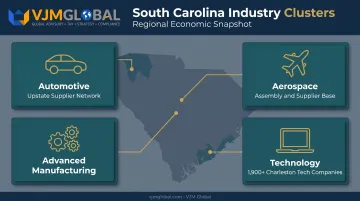
The state has also built recognisable industry clusters:
- Automotive – a dense Upstate supplier network
- Aerospace – major airframe assembly and a deep Upstate supplier base
- Advanced manufacturing – supported by South Carolina Commerce's named priority industries
- Technology – Charleston alone hosts 1,900+ tech companies
Tax Credits That Reduce Setup Costs
South Carolina also offsets setup cost with credits worth reviewing before you incorporate or hire:
- New Jobs Credit – for employers creating 10+ full-time positions
- Research Expenses Credit – 5% of qualified SC research spending
- Capital Investment Credit – 0.5% to 2.5% of qualifying equipment basis
- Headquarters Credit – 20% of qualifying investment (minimum $50,000 in real property)
Full details are on the SC Department of Revenue's tax credit page.
Step-by-Step Process to Start a Business in South Carolina
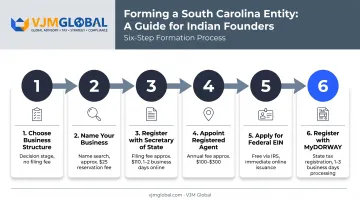
Forming a South Carolina entity from India follows six clear steps. Fees, timelines, and non-resident requirements are noted at each stage.
1. Choose a Business Structure
Your structure decision affects liability, taxation, and remote ownership flexibility:
- LLC – pass-through taxation, limited liability, most popular for foreign-owned entities
- C-Corporation – separate legal entity, flat 5% state tax, easier for outside investment
- LLP – requires partnership registration; not limited to licensed professions in SC
- Limited Partnership – lowest filing fee at $10
For most Indian founders forming a US presence remotely, the LLC remains the default choice because owners don't need US residency or an SSN to hold membership interests.
2. Name Your Business
Search availability through the Secretary of State's business filings portal. If you're not ready to file immediately, you can reserve a name:
- LLC name reservation: $25, non-renewable, valid for 120 days
- Corporation name reservation: $10, valid for 120 days
3. Register With the Secretary of State
Filing fees vary by entity type:
| Entity Type | Filing Fee |
|---|---|
| LLC (Articles of Organization) | $110 |
| Corporation (Articles + CL-1 initial report) | $135 |
| Limited Partnership | $10 |
Mail or in-person applications can take up to five business days, per SC Business One Stop. Online filing timelines aren't officially published, so build in a buffer rather than assuming instant approval.
4. Appoint a Registered Agent
South Carolina law requires every LLC, LLP, and corporation to maintain a continuous in-state office and a registered agent with a physical SC street address. Nationality doesn't change this rule — it applies to the entity, not the owner.
Since Indian founders rarely have a physical SC presence, most rely on a third-party registered agent service, typically costing $100 to $300 per year.
5. Apply for a Federal EIN
Form SS-4 is where things get tricky for non-US residents. Applicants without an SSN or ITIN enter "foreign" on line 7b. Online EIN issuance requires a US legal residence, so most Indian founders can't use it. Instead:
- Fax filing – roughly four business days
- Mail filing – around four weeks
Per the IRS's December 2025 Form SS-4 instructions, phone applications are also available for international applicants. Don't expect same-day issuance if you're filing from India.
6. Register With SC Department of Revenue (MyDORWAY)
Once your entity exists and holds an EIN, register through MyDORWAY for applicable sales, withholding, and other state taxes. Any employer with even one employee physically working in South Carolina must open a withholding account, regardless of where the company is headquartered.
Understanding Business Structures and Costs
Comparing Business Structures
Match the entity to how you will own and fund the business:
- LLC: Strong default for foreign-owned businesses—pass-through taxation and liability protection without corporate double taxation
- Corporation: Fits teams that plan to raise institutional capital or issue shares
- LLP: Built for partnership-based professional services; renew annually within the 60-day window before expiry ($100 fee)
Cost Breakdown
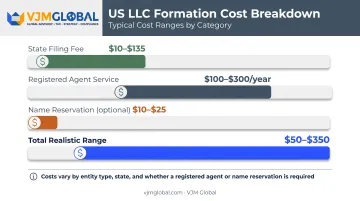
Typical South Carolina setup costs:
- State filing fee: $10 (LP) to $135 (corporation)
- Registered agent service: $100–$300/year
- Name reservation (optional): $10–$25
- Total realistic range: $50–$350, depending on entity type and whether you use a reservation
Compliance, Taxes, and Licensing After Formation
South Carolina has no statewide business license, but most municipalities and counties issue their own. Check your city's requirements before you open. Retail and professional permits often apply separately.
Ongoing tax obligations once you're operational:
- Federal corporate returns (Form 1120, 1120-S, or 1065 depending on structure)
- State corporate income tax at 5% for C-corps
- Sales tax collection where nexus exists
- Payroll tax withholding for any SC-based employee
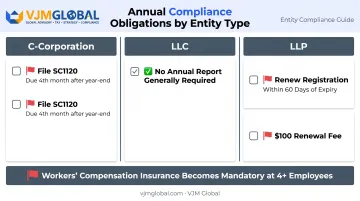
Annual filing requirements differ by structure:
- C-corporations: File SC1120 each year, due the 15th day of the fourth month after year-end
- LLCs: Generally no state annual report requirement
- LLPs: Renew within 60 days of registration expiry
If you hire four or more employees, workers' compensation insurance becomes mandatory under SC Workers' Compensation Commission rules — part-time staff and family members count toward that threshold.
How VJM Global Supports Indian Businesses Expanding to South Carolina
Entity formation and compliance in South Carolina work nothing like India's Companies Act framework. There's no ROC equivalent, no DIN or DSC process, and the EIN system creates real friction for applicants without an SSN. Getting these details wrong doesn't just delay setup. It can trigger penalties down the line.
VJM Global's US entity formation service covers this ground for Indian companies entering South Carolina:
- Entity-type advisory (LLC or C-Corp; S-Corp only where eligibility allows)
- Name reservation and Secretary of State filing
- EIN application support through the IRS
- Registered agent coordination
- Ongoing federal, state, and payroll tax compliance across all 50 states
With 30+ years of experience and a track record serving 500+ American business owners, VJM Global's teams file through the same South Carolina and federal channels local businesses use. US entity work is handled under US rules, not as an add-on to Indian company-law processes.
For companies not ready to commit to full incorporation, VJM Global's Employer of Record service lets you hire in South Carolina without a local entity first. That path is useful for testing the market before you formalise a physical presence.
Frequently Asked Questions
How much does it cost to start a business in South Carolina?
State filing fees run from $10 for a limited partnership to $110 for an LLC and $135 for a corporation. Budget extra for name reservation ($25) and a commercial registered agent if you don’t appoint one in-house.
What do I need to do to start a business in SC?
Pick an entity type, check and optionally reserve the name, file formation documents with the Secretary of State, appoint a registered agent with a South Carolina street address, and get a federal EIN.
What is needed to start an LLC in SC?
You'll need Articles of Organization, a $110 filing fee, and a registered agent maintaining a physical South Carolina street address.
How long does it take for an LLC to be approved in SC?
Mail or in-person filings take up to five business days per official guidance. Online processing times aren't published, so allow extra buffer time when planning from abroad.
How do I register my business name so no one else can use it?
Reserve it on the Secretary of State’s portal for $25—that holds an LLC name for 120 days (non-renewable). Filing your formation documents is what secures the name going forward.
Do I need a business license for my SC LLC?
There's no statewide license, but most cities and counties require their own local business license. Check requirements directly with your specific municipality before operating.