SAP implementation costs in India vary significantly depending on the product tier, deployment model, scope of customisation, and India-specific compliance requirements. This guide breaks down what UK businesses should realistically budget across each dimension—and highlights the compliance landmines that catch most businesses off guard.
Key Takeaways
- SAP implementation in India costs £23,400–£39,000 (₹30–50 lakhs) for small deployments, rising to £234,000+ (₹3 crore+) for enterprise-scale projects
- Key cost drivers include business size, deployment model, number of users, customisation depth, and India-specific compliance (GST, e-invoicing)
- UK businesses consistently underestimate India-specific regulatory configuration costs and post-go-live AMC fees
- Cloud-based SAP (GROW with SAP, SAP Business One Cloud) lowers upfront spend but adds recurring subscription costs — model these across a 3–5 year horizon
How Much Does SAP Implementation in India Cost? A UK Budget Overview
SAP does not publish a fixed price list—costs vary based on product version, business size, number of users, deployment choice, and implementation partner. India-based costs are substantially lower than equivalent UK or Western European implementations, making India an attractive option for UK businesses with Indian operations.
What goes wrong when UK businesses misunderstand the cost structure:
- Underbudgeting by benchmarking against Indian domestic SME figures without accounting for multi-entity or cross-border complexity
- Overlooking India-specific compliance modules (GST, TDS, e-invoicing) that don't have direct UK equivalents
- Treating the software licence as the total cost rather than as just one component
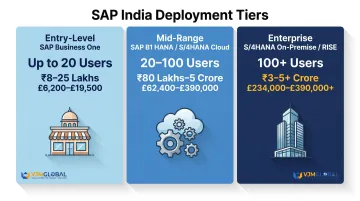
Costs break down into three broad deployment tiers based on company size and operational complexity.
Entry-Level / SME Deployment (SAP Business One, up to ~20 users)
Indicative cost range: ₹8–25 lakhs (approximately £6,200–£19,500)
SAP Business One is a single-database ERP built for small businesses with straightforward operations. At this tier, deployments cover core modules—finance, inventory, purchasing—with minimal customisation.
Suited to UK businesses setting up a small Indian subsidiary or back-office unit that needs basic ERP integration with the UK parent system.
Mid-Range Deployment (SAP Business One HANA or SAP S/4HANA Cloud, 20–100 users)
Indicative cost range: ₹80 lakhs–5 crore (approximately £62,400–£390,000)
Mid-range deployments span multiple modules—supply chain, production planning, CRM—with moderate customisation. SAP S/4HANA Cloud subscriptions in India run roughly ₹50,000–1.5 lakhs per month, depending on user count and active modules.
This tier fits UK companies with established Indian operations across multiple functions or locations that need a broader ERP footprint without full enterprise complexity.
Enterprise Deployment (SAP S/4HANA On-Premise or RISE with SAP, 100+ users)
Indicative cost range: ₹3–5+ crore (approximately £234,000–£390,000+)
Full enterprise deployments involve multi-module, multi-site rollouts with heavy customisation, integration into the UK parent's SAP instance, and phased go-lives across Indian locations. This is where cross-border financial consolidation and group reporting requirements drive the most complexity—and cost.
Relevant for large UK multinationals or listed companies with complex Indian operations requiring statutory compliance, group-level reporting integration, and full financial consolidation.
At a Glance: SAP India Deployment Tiers for UK Businesses
| Deployment Tier | Users | Indicative Cost (₹) | Approx. (£) | Typical Use Case |
|---|---|---|---|---|
| Entry-Level (SAP B1) | Up to 20 | ₹8–25 lakhs | £6,200–£19,500 | Small Indian subsidiary or back office |
| Mid-Range (B1 HANA / S/4HANA Cloud) | 20–100 | ₹80 lakhs–5 crore | £62,400–£390,000 | Multi-function Indian operations |
| Enterprise (S/4HANA On-Premise / RISE) | 100+ | ₹3–5+ crore | £234,000–£390,000+ | Complex multi-site with UK parent integration |
Key Factors That Drive SAP Implementation Costs in India
UK businesses implementing SAP in India face cost drivers that domestic Indian buyers rarely encounter — cross-border integration, unfamiliar compliance requirements, and remote infrastructure management all add to the bill.
Business Size and Module Scope
Costs scale with the number of SAP modules deployed. Finance and procurement modules form the baseline, while adding production planning, HR, analytics, or CRM modules increases both licensing and implementation fees proportionally. Each additional module brings configuration complexity, data migration requirements, and training overhead.
Deployment Model: Cloud vs On-Premise
On-premise licensing:
- Higher upfront capital cost (perpetual licence)
- Annual maintenance charges: 18–22% of net licence value
- Requires local server infrastructure in India
Cloud subscription models:
- Lower initial outlay with recurring monthly/annual fees
- No local server infrastructure costs
- SAP Business One Starter Pack: ₹3,599 per user per month; Professional + Limited bundle: ₹7,499 per user per month
- Removes the need to procure, secure, and maintain physical infrastructure in India — a practical advantage for UK businesses managing Indian operations remotely
Number and Type of SAP Users
SAP licences are user-based and distinguish between:
- Professional users (full access, higher cost): approximately ₹1,60,000 (£1,250) per user for SAP Business One perpetual licence
- Limited users (function-specific, lower cost): approximately ₹80,000 (£625) per user
Choosing the right licence mix is one of the most direct ways to control costs. Named-user licences account for approximately 40–70% of all costs agreed in the SAP contract.
Customisation and Add-On Requirements
Several customisation layers add cost beyond the base implementation:
- India-specific add-ons (manufacturing batch management, pharma QC modules) carry their own development and maintenance fees
- Custom workflows and third-party integrations increase consulting hours
- Connecting the Indian SAP instance to a UK parent ERP or reporting system can double consulting hours compared to a standalone India deployment
India-Specific Compliance Configuration
India has a complex indirect tax regime that must be built into SAP from the outset:
- GST with multiple rates (primarily 5% and 18% post-reform, plus 40% for luxury/demerit goods) and mandatory filing requirements
- E-invoicing mandatory for businesses with annual turnover exceeding ₹5 crore
- TDS/TCS withholding configurations across multiple sections under the Income Tax Act
- State-level compliance requirements with no direct UK equivalent
India-specific GST and localisation configuration runs ₹15–40 lakhs (approximately £11,700–£31,200) as a separate line item in most implementations — a cost that frequently goes unbudgeted by UK businesses until the project is already underway.
Full Cost Breakdown: What UK Businesses Actually Pay
The total SAP investment goes well beyond the initial licence or subscription fee. UK businesses should account for at least six distinct cost components across the implementation lifecycle.
1. SAP Licence or Subscription Fee
- One-time perpetual licence (on-premise) or recurring annual/monthly subscription (cloud)
- Most businesses include only this cost in initial budgets — yet it typically represents only 20–30% of the total project cost
2. Implementation and Consulting Fees
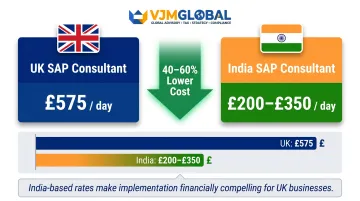
The largest single cost component in most projects. India-based SAP implementation partners charge significantly lower day-rates than UK consultants:
- UK SAP consultant median daily rate: £575 per day
- India-based implementation rates: 40–60% below Western onshore rates
- Effective India consultant day rate: approximately £200–350 per day (derived estimate based on cost arbitrage)
This cost arbitrage makes India-based implementation financially compelling — though UK businesses still need a local India advisor to bridge the gap between SAP partner deliverables and India regulatory requirements. VJM Global, having supported 250+ UK businesses with India operations, covers this localisation layer alongside GST registration, entity structuring, and compliance validation.
3. India Compliance and Localisation Configuration
Indian compliance configuration typically runs £11,700–£31,200 (₹15–40 lakhs) as a separate line item — not bundled into standard SAP partner quotes. Required configurations include:
- GST module setup and e-invoicing integration
- TDS/TCS configuration
- State-specific tax treatment for Indian legal entities
4. Data Migration, Training, and Go-Live Support
This phase covers:
- Legacy data extraction and cleansing (commonly from Tally or Excel in Indian entities)
- End-user training across Indian and UK teams
- UAT and hypercare support post-go-live
Data quality issues in Indian subsidiaries frequently cause budget overruns here. Allocate 15–25% of total implementation cost to this phase.
5. Annual Maintenance and Support (AMC)
- On-premise licences: 18–22% of licence cost annually (SAP Standard Support: 18%; SAP Enterprise Support: 22%)
- SAP Business One: 19% of contract value per year
- Cloud subscriptions: Support included within subscription fee, but may require additional partner AMC contracts for customisations
UK businesses should build 3-year AMC costs into their total cost of ownership calculation.
6. Post-Go-Live Enhancements and System Optimisation
Most implementations require ongoing tweaks, process adjustments, and module enhancements during the first 12–18 months. Application Management Services (AMS) annual cost runs 15–25% of the implementation cost.
What UK Businesses Consistently Underestimate When Budgeting for SAP in India
India Regulatory Complexity vs UK VAT
UK financial teams often assume GST configuration is analogous to VAT and underestimate the configuration effort. UK VAT operates with a single standard rate (20%), a reduced rate (5%), and zero-rated items (0%). India GST, by contrast, involves:
- Multiple tax rates (primarily 5% and 18%, plus 28% for luxury goods)
- Mandatory input credit reconciliation via GSTR-2B
- E-invoicing above ₹5 crore turnover threshold
- Frequent regulatory updates (the GST Council has held 56 meetings since GST implementation in July 2017)
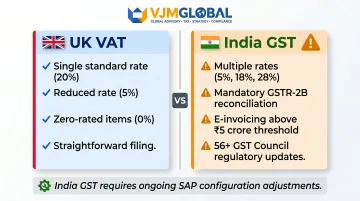
This requires ongoing SAP maintenance and configuration adjustments that UK VAT compliance never demands.
Currency and Timing Risk
Projects planned in GBP but executed in INR are exposed to exchange rate movements over 6–18 month implementation timelines. A 5–10% INR appreciation against GBP has a direct impact on the GBP-equivalent final project cost. UK businesses should build a currency buffer of at least 8–10% into their India SAP budgets (current rate: 1 GBP ≈ ₹128.20 INR).
Post-Go-Live Productivity Dip and Hidden Support Costs
Currency risk is only part of the exposure. Operational costs after go-live catch most UK businesses off guard.
Most UK businesses budget for implementation but not for the 3–6 month productivity dip as Indian teams adapt to the new system. One post-implementation analysis estimated 15–20% productivity degradation during the first six months post-deployment, with recovery taking weeks for high-performing teams and months for others.
Support, retraining, and configuration fixes during this window typically add 10–20% to the first-year total — costs that rarely appear in the original budget.
How to Set a Realistic SAP Budget for Your India Operations
Define Scope Before Approaching Partners
Document Indian business processes, user count, module requirements, and compliance obligations before soliciting quotes. Vague scope leads to lowball estimates that inflate significantly once requirements are clarified—one of the primary causes of budget overruns in India SAP projects.
Recommended scope documentation:
- Number and type of users (professional vs limited)
- Modules required (finance, procurement, HR, CRM, production planning)
- Integration points with UK parent systems
- India-specific compliance requirements (GST, TDS, e-invoicing, industry-specific regulations)
- Data migration scope and legacy system inventory
Build India Compliance Costs In From Day One
Explicitly ask SAP implementation partners to itemise GST, e-invoicing, TDS, and any industry-specific compliance configuration as separate line items in proposals. A local India advisory firm can validate these requirements before you sign anything — catching gaps that implementation partners often miss.
VJM Global has spent 30+ years helping 250+ UK businesses navigate India's tax and compliance landscape. Their pre-implementation services include:
- Pre-implementation compliance scoping and readiness assessments
- GST multi-rate configuration validation
- E-invoicing integration requirements
- TDS/TCS withholding tax advisory
- IT functional advisory for GST systems testing and compliance reporting
Bringing this expertise in early — before the implementation partner finalises scope — is what keeps compliance costs from surfacing as surprises mid-project.
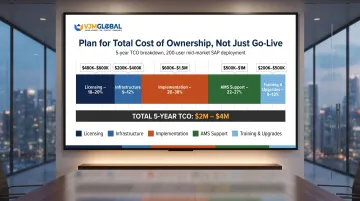
Plan for Total Cost of Ownership, Not Just Go-Live
Calculate costs across a 3–5 year horizon including:
- AMC (18–22% annually for on-premise; subscription renewal for cloud)
- Licence renewals or user additions
- Module upgrades and enhancements
- User training refresh cycles
- Regulatory update configurations
5-year TCO model (200-user mid-market deployment):
| Cost Component | Estimated 5-Year Cost |
|---|---|
| Licensing (RISE or Cloud Private) | $480,000–$600,000 |
| Infrastructure | $200,000–$400,000 |
| Implementation | $600,000–$1.5M |
| AMS | $500,000–$1M |
| Training, change management, upgrades | $200,000–$500,000 |
| Total 5-year TCO | $2M–$4M |
Source: SCM Software Lab
Conclusion
SAP implementation costs in India are significantly lower than equivalent UK deployments, but UK businesses must look beyond the licence fee to understand the true investment. India-specific compliance complexity, data migration challenges, and ongoing AMC costs all contribute to a final figure that frequently surprises businesses that benchmark against domestic Indian SME projects.
A well-structured SAP budget typically covers three foundations:
- Full lifecycle costs, not just implementation fees
- Clearly defined scope and GST/TDS compliance requirements from day one
- Experienced India-based partners who understand both the technical and regulatory landscape
For UK businesses managing these requirements, working with advisors like VJM Global—who combine SAP implementation oversight with deep India regulatory expertise—helps prevent the budget overruns that catch underprepared teams off guard.
Frequently Asked Questions
How much does SAP cost in India?
SAP implementation costs in India range from approximately ₹30–50 lakhs (£23,400–£39,000) for small businesses up to ₹3–5 crore (£234,000–£390,000) or more for large enterprise deployments, depending on the product (SAP Business One vs S/4HANA), deployment model, number of users, and scope of customisation.
What are the 7 stages of a SAP implementation project?
SAP Activate follows six phases: Discover, Prepare, Explore, Realise, Deploy, and Run. Some partners extend this to seven stages by separating Integration Testing and User Acceptance Testing. Consulting fees accumulate across every phase — the Realise and Deploy stages typically drive the highest costs in India-based projects.
How long does SAP implementation take in India?
Timelines range from 3–6 months for SAP Business One in small businesses to 9–18 months for enterprise SAP S/4HANA deployments. Longer timelines directly increase consulting and project management costs due to extended resource allocation and complexity.
Is SAP Business One or SAP S/4HANA better for a UK company's Indian subsidiary?
SAP Business One suits smaller Indian subsidiaries (up to ~50 users, simpler operations), while SAP S/4HANA is more appropriate for larger or more complex Indian operations. UK parent system integration requirements often influence which product is the right fit.
Can a UK business manage an SAP implementation in India remotely?
Remote management is possible but adds coordination challenges and communication delays across time zones. Working with an India-based advisory or implementation management partner helps protect UK business interests on the ground and reduces the risk of scope creep or compliance gaps.
What India-specific configurations add cost to SAP implementations that UK businesses don't expect?
Four configurations catch UK businesses off guard: GST multi-rate setup, mandatory e-invoicing integration, TDS/TCS withholding tax, and state-level compliance requirements. None have a direct UK equivalent, and all are routinely absent from initial quotes — adding ₹15–40 lakhs (£11,700–£31,200) to project costs.