That shift makes sense. Singapore-China bilateral goods trade hit S$162.85 billion in 2025, and the two governments have upgraded their free trade agreement to cover more services and investment. But moving from "we trade with China" to "we have a legal entity in China" involves a completely different set of decisions.
This guide walks through entity types, documentation, costs and the exact process a Singapore-based founder needs to follow to set up legally in mainland China.
TL;DR
- Entity options: WFOE (most common), Joint Venture (restricted sectors), Representative Office (research only; no revenue)
- Capital: No statutory minimum; subscribed capital must be paid within 5 years under China’s revised Company Law
- Timeline: Typically 2–4 months for a straightforward WFOE; longer for manufacturing or licensed sectors
- Documents: Apostilled ACRA certificates, Chinese-translated Articles of Association, local registered address
- Holding structure: Many Singapore founders use Hong Kong as an intermediate layer for tax and banking flexibility
What Is a China Business Setup for Singapore Investors?
Starting a business in China from Singapore means incorporating a legal entity on the mainland, owned either by your Singapore-incorporated parent company or by you as a Singapore resident individual.
Here's the part many founders miss: Singapore companies are treated as ordinary foreign investors under China's Foreign Investment Law. There's no special carve-out just because Singapore and China share strong trade ties. You get the benefits of the China-Singapore Free Trade Agreement (CSFTA) on tariffs and certain services, but registration procedures follow the same rules that apply to any foreign investor.
Three structures dominate:
- WFOE (Wholly Foreign-Owned Enterprise) — the default choice for Singapore SMEs in consulting, trading or tech
- Joint Venture — required only in sectors still restricted under China's Negative List
- Representative Office — for market research and liaison work, not sales
Most Singapore founders start here, then narrow down based on their sector and revenue goals.
Why Singapore Businesses Are Choosing China (When It Makes Sense)
China entry isn't automatically the right move. It makes sense when you need direct market access, supply chain control, or IP protection that sourcing arrangements can't give you. Here's what's driving Singapore interest:
- Market scale: An onshore entity gives direct access to one of the world's largest consumer and manufacturing markets, without relying on distributors
- CSFTA tariff benefits: Tariffs fall away on 95% of Singapore's exports to China when goods meet the 40% local content rule
- Deep trade corridor: Bilateral trade reached S$162.85 billion in 2025; Singapore's Ministry of Trade and Industry ranks Singapore as China's largest foreign investor
- Supply chain control: Negotiate directly with manufacturers and manage logistics without a middleman
- IP protection: China uses a first-to-file trademark system — register locally before someone else files your brand
None of this guarantees success. A Singapore trading firm exporting commodities has very different needs from a SaaS company wanting a China-facing sales office. Match the structure to the actual business goal, not just the market opportunity.
Choosing the Right Business Structure as a Singapore Investor
Most early missteps happen at this stage. Founders pick a structure based on cost or speed, not on what the business actually needs to do.
WFOE, JV or Representative Office?
| Structure | Ownership | Can it invoice? | Best for |
|---|---|---|---|
| WFOE | 100% Singapore-owned | Yes | Consulting, trading, tech, most services |
| Joint Venture | Foreign + Chinese partner | Yes | Negative List sectors (telecom, certain media, education) |
| Representative Office | Foreign parent, no separate legal person | No | Early market research only |
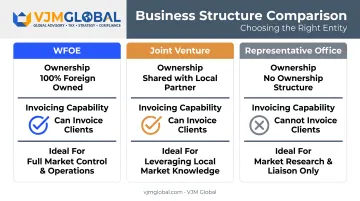
A WFOE gives you full operational control, which is why it's the go-to for Singapore SMEs. A Joint Venture only becomes necessary when your sector sits on China's Negative List and requires a local partner.
China's 2024 Negative List narrowed further, removing the last restrictions on manufacturing sectors. That means more Singapore manufacturers can now set up a fully-owned WFOE where a JV used to be mandatory. Restrictions remain in areas like telecoms, media, education, healthcare and certain natural resources, so check your specific sector before assuming full ownership is available.
The most common mistake? Setting up a Representative Office when the real goal is revenue-generating operations. An RO can't issue invoices or sign local sales contracts. If you're planning to actually sell in China, skip the RO and go straight to a WFOE.
Documents and Requirements Singapore Investors Need to Prepare
Your Singapore parent company's documents don't automatically carry weight in China. They need to be legalised first.
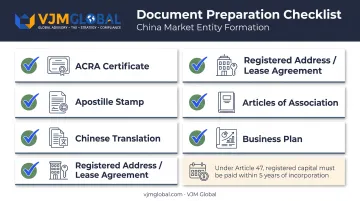
Core documentation checklist:
- Apostilled certificate of incorporation and register of shareholders/directors from ACRA
- Registered Chinese company name approval and clearly defined business scope
- Local Chinese registered address with a signed lease agreement
- Legal representative appointment (can be a Singapore national)
- Articles of Association translated into Simplified Chinese
- Business plan or feasibility study
Since China's Apostille Convention took effect in November 2023, Singapore documents can go through the apostille route via the Singapore Academy of Law rather than full consular legalisation. This is faster, but confirm with your receiving Chinese authority whether they'll accept the electronic e-Apostille format or want a physical stamped copy. Local practice still varies.
On capital: there's no statutory minimum registered capital requirement. But under Article 47 of China's revised Company Law, whatever capital you subscribe must be paid in within 5 years. Don't treat this as a formality. Set a realistic funding schedule at the outset, not an arbitrary figure on paper.
How to Start a Business in China from Singapore – Step by Step
Registration breaks down into seven practical stages. Most delays come from running both sides at once: Singapore-side document preparation and China-side filing. VJM Global supports Singapore companies through those parallel workstreams as part of cross-border entity formation.
Step 1 – Define Business Scope and Choose Your City
Your registered business scope drives your tax category and what licences you'll need. Be specific: vague scopes get rejected or limit what you can invoice for later.
Shanghai suits finance and trading, Shenzhen fits tech and hardware, and Guangzhou works well for manufacturing and export-linked operations.
Step 2 – Select Entity Type and Reserve Company Name
Decide between WFOE and JV based on your sector's Negative List status. Once confirmed, submit a name reservation to the local Administration for Market Regulation (AMR). Chinese names follow strict formatting conventions, so have backup options ready.
Step 3 – Prepare and Apostille Singapore Parent Documents
Get your ACRA-issued documents apostilled, then translated into Simplified Chinese. Draft your Articles of Association and business plan in parallel; don't wait for apostille completion to start this.
Step 4 – Register with AMR and Obtain the Business Licence
File for the 5-in-1 business licence, which covers company registration, tax, and social security in one filing. You'll receive a Unified Social Credit Code. This becomes your entity's permanent identifier.
Step 5 – Get a Company Chop and Open Bank Accounts
Register with the Public Security Bureau for your official company chop (seal). This isn't optional paperwork. Chinese contracts and invoices are only valid with the correct chop applied. From there, open a foreign capital account and a local RMB operating account.
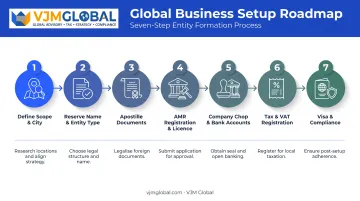
Step 6 – Complete Tax, VAT and Social Security Registration
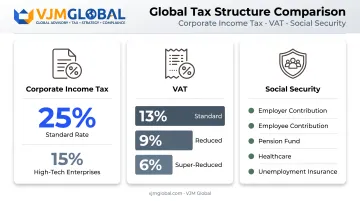
You have 30 days from receiving your business licence to register with the State Taxation Administration. Know your applicable rates going in:
- Corporate Income Tax: standard rate of 25%, with a reduced 15% rate available for qualified high-tech enterprises
- VAT: 13% for most goods, 9% for select categories like transport and telecoms, 6% for modern services
- Social security: register employees for pension, medical, unemployment, work-injury and housing fund contributions at local rates
Step 7 – Handle Visa, Compliance and Ongoing Filings
If a Singapore founder plans to relocate and work in China, appointing them as legal representative is not enough on its own. They still need a Foreigner's Work Permit and Z-visa before starting work.
Once operational, plan for:
- Annual filings and statutory audits
- Ongoing VAT and CIT compliance
- Profit repatriation back to Singapore
Accounting and compliance across both markets is a common pain point after launch. VJM Global supports Singapore businesses that need ongoing multi-jurisdiction coordination once the entity is live.
Conclusion
Setting up in China from Singapore is achievable, but it rewards founders who plan rather than rush. Picking the right entity, preparing apostilled documents correctly, and budgeting a realistic capital and compliance timeline prevent the costly delays that catch out first-time entrants.
China's regulations keep evolving — the Negative List narrows, tax rules shift, and company law has changed materially in the last two years alone. Stay current on those rules, and bring in cross-border help for entity setup, tax, and ongoing compliance when you need it. VJM Global supports Singapore-based founders with formation and multi-jurisdiction compliance so entry stays on track.
Frequently Asked Questions
Can foreigners set up business in China?
Yes. Singapore individuals and companies can own 100% of a WFOE in most sectors under China's Foreign Investment Law. A local Chinese partner is only required in Negative List sectors.
What is the 6-year rule in China for foreign individuals?
This relates to individual income tax residency, not business registration. A foreigner resident in China for 183+ days across six consecutive years can become liable for tax on worldwide income, not just China-sourced income.
How long does it take to register a company in China from Singapore?
A straightforward WFOE typically takes 2-4 months, covering name reservation, licensing, and bank account setup. Manufacturing or licensed sectors usually take longer due to additional approvals.
Do I need a Chinese partner if I'm a Singapore investor?
Only if your business falls under a restricted sector on China's Negative List. Most services, trading, and tech businesses can proceed as a 100% Singapore-owned WFOE without a local partner.
How much capital do I need to start a business in China?
There's no statutory minimum registered capital. However, whatever amount you subscribe must be paid in full within 5 years, under the revised Company Law's Article 47.
Can I operate my China business through a Singapore holding company?
Yes. Your Singapore entity can hold shares in a Chinese WFOE as its parent company. The China entity itself must still handle all onshore invoicing, contracts, and local compliance.