What's driving the interest? A skilled, cost-competitive workforce, a strategic logistics position between Western Europe and the East, and no restrictions on 100% foreign ownership for most business activities.
The demand is coming from US startups testing European markets, e-commerce sellers needing EU warehousing, remote-first companies hiring engineering talent, and larger enterprises setting up EU subsidiaries. This guide walks through exactly how a US-based founder registers and runs a compliant Polish entity, without relocating.
TL;DR: What US Founders Need to Know
- Poland permits 100% foreign ownership with no residency requirement for directors or shareholders
- Most US founders choose the sp. z o.o. (equivalent to an LLC), requiring PLN 5,000 minimum share capital
- Registration can be done remotely via the S24 online system, or through a notary and local proxy
- Online registration takes 1-5 business days; notarial routes take several weeks including translation and apostille
- Ongoing compliance includes CIT at 9-19%, VAT at 23%, and Polish-language bookkeeping under Polish GAAP
What Does Starting a Business in Poland from the USA Actually Involve?
US founders establish a Polish legal entity or branch that can trade, hire, and hold a local bank account, without relocating from the United States.
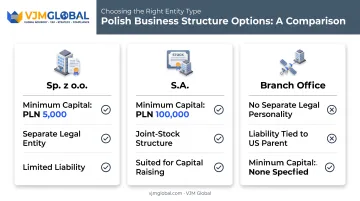
US founders typically choose among three structures:
- Capital company (sp. z o.o. or S.A.) — a separate legal entity; shareholders aren't personally liable for company debts
- Branch office — an extension of your US company, with no separate legal personality; your US entity carries the liability
- Representative office — limited to promotion and advertising activities only, no trading permitted
Most US founders choose the sp. z o.o. It caps liability at the company level and keeps the capital bar low.
Under the consolidated Polish Commercial Companies Code, an S.A. (joint-stock company) requires PLN 100,000 in minimum capital versus PLN 5,000 for an sp. z o.o. That gap is why smaller and mid-sized US entrants rarely take the S.A. route.
What to Know Before You Start
Many US founders underestimate three things: the language barrier in official filings, the documentation burden for US-issued paperwork, and the coordination cost of an eight-hour time difference. Time and coordination:
- Most registration steps can be completed remotely
- Bank account opening and some notarial signatures may need extra back-and-forth
- Budget several weeks, not days, before the entity is fully operational (registration + bank account + VAT)
Reliance on local professionals:
- A notary, sworn translator, and Polish accountant are near-unavoidable beyond the simplest S24 filing
- Polish-language bookkeeping is a legal requirement, not a preference
- A local or cross-border accounting partner is required once you are operational
Shell entity vs. real operations:
- Decide upfront: lightweight entity to test the market, or a fully staffed Polish operation
- A lean test entity can run on contractors
- A full operation needs local hires, ZUS registration, and payroll infrastructure from day one
Why Start a Business in Poland from the USA? (When It Makes Sense)
Poland isn't right for every US founder. It fits when you need EU market access, a lower cost base than Western Europe, and a clear ownership path as an OECD-based company.
| Factor | Why it matters for US founders |
|---|---|
| Market size | EU's sixth-largest economy at EUR 922.9B GDP (2025) |
| Tax competitiveness | Ranked 35th globally on the 2025 International Tax Competitiveness Index |
| Ownership freedom | No FDI screening for most sectors if you've been established in the EU/EEA/OECD for two-plus years |
| Talent pool | Growing ICT specialist workforce, with hourly labor costs still below EU averages |
| Entry capital | Just PLN 5,000 minimum for an sp. z o.o. |
Tax and ownership details that change the math:
- Reduced 9% CIT rate applies to qualifying small taxpayers and new businesses with current-year revenue under EUR 2 million, though it excludes capital-gains income
- Polish Investment Zone incentives can exempt qualifying new-investment income from CIT for 10–15 years if you secure the support decision before investment begins
- Ownership caps of 49% still apply in air transport, broadcasting, and airport/seaport operations, per the US State Department's 2025 Investment Climate Statement
If your model sits in a capped sector, plan for a local partner before you incorporate.
Early Decisions That Matter
Most delays come from underestimating documentation and banking complexity. Get these five decisions right early:
- True setup costs. Notary fees for a PLN 5,000 transaction are statutorily capped around PLN 160. Sworn translation and US apostille processing add further costs that vary by document volume and urgency.
- Bank account timeline. Some Polish banks (mBank, for example) require representatives to sign in person at a branch, though a notarized power of attorney can substitute. Budget for a multi-day document review after signing.
- Structure choice. An sp. z o.o. limits liability; a branch office ties liability back to your US parent. Choose based on how much exposure you're comfortable carrying.
- Accounting language. Polish accounting records must be kept in Polish under Polish GAAP. This is a legal requirement that makes a local accountant nearly mandatory.
- In-house vs. partner-managed compliance. Handle KRS filings, VAT, and ZUS deadlines in-house or through a formation partner—that choice sets how much bandwidth the process takes on your end.
How to Start a Business in Poland from the USA: Step-by-Step
The biggest mistakes US founders make: assuming personal presence is required, underestimating translation and apostille lead times, and skipping VAT registration deadlines until it's too late.
Step 1: Choose Your Legal Structure and Register the Entity
Compare your options based on liability tolerance and scale: sp. z o.o. for most, S.A. for larger capital-raising plans, branch office if you want to keep the entity tied to your US parent.
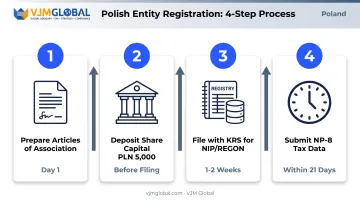
- Prepare and execute articles of association in person, via notary, or online through S24 for standard-template filings
- Deposit the minimum share capital (PLN 5,000 for sp. z o.o.) into a Polish bank account
- File with the National Court Register (KRS) and obtain your NIP and REGON numbers
- Submit supplementary NIP-8 tax data within 21 days of KRS entry (or seven days if you'll be a social-contribution payer)
Common miss: assuming US-issued documents skip the sworn Polish translation or apostille requirement. They don't. Foreign-register documents used for representative offices, for instance, must include a Polish translation.
Official fees are modest: PLN 250 for S24 registration, PLN 500 for the notarized/court-filing route. Court review targets are one day for S24, seven days for standard filings, though these are targets, not guarantees.
Step 2: Open a Business Bank Account
Gather your documentation early: company registration certificate, articles of association, shareholder/director IDs, and proof of address. Some Polish banks require director verification that can be handled remotely or via a notarized proxy, though not universally.
Plan for multi-currency handling. Cross-border USD-PLN or USD-EUR transactions are routine for US-owned Polish entities, and your bank relationship should support that from day one.
Step 3: Register for VAT and Set Up Tax Compliance
Determine whether VAT registration is mandatory. From January 2026, the domestic small-business exemption threshold sits at PLN 240,000 in annual sales, prorated if you start mid-year. Certain activities, such as legal and advisory services or precious-metal goods, don't qualify for the exemption regardless of turnover.
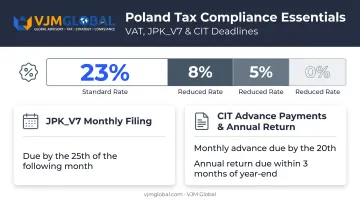
- VAT rate: 23% standard, with reduced 8%, 5%, and 0% rates for qualifying goods/services
- JPK_V7 filings: Monthly filers use JPK_V7M, due by the 25th of the following month
- CIT deadlines: Monthly advances due by the 20th; annual return due within three months of year-end
Common miss: missing early VAT deadlines simply from unfamiliarity with the Polish filing calendar. Polish GAAP-compliant bookkeeping (in Polish) is required, which is where a local or cross-border accounting partner becomes essential rather than a nice-to-have.
Step 4: Handle Immigration and Residency Considerations
US citizens can own and direct a Polish company entirely from the US, with no residence permit required, purely on the basis of ownership or a board title.
A residence permit only becomes relevant if you plan to personally stay in Poland for more than three months and manage the business from within the country. If that's your plan, the company typically needs to meet an economic threshold, such as earning at least 12 times the local average monthly gross salary or employing at least two qualifying workers for a year.
Step 5: Set Up Operations, Hiring, and Ongoing Compliance
Decide whether to hire locally, use contractors, or bring on staff through an Employer of Record to test the Polish market without building a full local team immediately.
If you do hire directly:
- Register employees with ZUS within seven days of the insurance obligation arising
- Budget for employer social contributions in the roughly 19-22% range on top of gross pay, per PwC's tax summaries
- Build a compliance calendar covering KRS, tax authority, and ZUS deadlines — missed filings compound quickly
If you are not ready to run every local filing yourself, an Employer of Record keeps payroll and statutory contributions compliant while you test the market.
VJM Global supports US businesses with entity formation and EOR arrangements across 100+ countries, covering the legal-employer relationship, payroll, and statutory contributions when you have not incorporated locally yet.
Frequently Asked Questions
How much does it cost to start a business in Poland?
Minimum capital is PLN 5,000 for an sp. z o.o., plus court/registration fees of PLN 250-600. Add notary fees and sworn translation costs on top; total cost varies by structure and document volume.
What business is profitable in Poland?
IT and software, BPO/shared services, e-commerce, automotive parts manufacturing, and renewable energy all see strong demand, aided by targeted government incentives like the Polish Investment Zone.
Can a US citizen own 100% of a company in Poland?
Yes. There's no residency or nationality restriction on ownership or directorship for capital companies, outside a handful of regulated sectors like broadcasting and airports.
Do I need to be in Poland to register a company?
No. Most registrations happen remotely through the S24 system or via a notarized power of attorney and a local proxy handling in-person steps.
How long does it take to register a business in Poland from the US?
Online S24 registration runs 1-5 business days. The notarial route takes several weeks once you factor in translation and apostille lead times for US documents.
What taxes will my Polish company pay?
Standard CIT is 19%, dropping to 9% for qualifying small taxpayers. VAT sits at 23% standard rate, plus payroll contributions and withholding tax on dividends or royalties paid out.