
Introduction
The UAE's Indian community is a genuine economic force. As of January 2026, the Ministry of External Affairs counts 4,344,008 overseas Indians living in the UAE. That base increasingly wants financial products built for both markets, not just one.
India's NBFC, wealth management, and fintech sectors are expanding fast. Easier FDI norms make India-facing financial services ventures even more attractive to UAE-based entrepreneurs.
Interest isn't limited to one type of promoter. NRIs, OCI holders, UAE-registered companies, and finance professionals in Dubai and Abu Dhabi all want a compliant, income-generating India business without relocating.
The hard part is clearing entity choice, licensing, capital rules, and ongoing compliance across two jurisdictions.
This guide walks through entity type, licensing, capital, and compliance, step by step.
Key Takeaways
- Match your activity to the right regulator—NBFC, advisory, insurance broking, and fintech sit under RBI, SEBI, or IRDAI
- Use a private limited company with at least one India-resident director for FDI-backed setups
- Plan capital from lower advisory thresholds up to ₹10 crore or more for NBFCs
- Budget weeks for incorporation and several extra months for regulatory licensing
- Rely on India-based compliance support to cut delays when you run the business from the UAE
What Is a Financial Services Business in India (For a UAE-Based Promoter)?
A financial services business, in this context, is an India-incorporated entity that offers regulated or advisory financial products to customers in India. Typical activities include lending, investment advice, portfolio or wealth management, insurance broking, and fintech or payments.
Which regulator applies depends on what you do: the Reserve Bank of India (RBI), the Securities and Exchange Board of India (SEBI), or the Insurance Regulatory and Development Authority of India (IRDAI).
This guide focuses on one scenario: the promoter, investor, or director lives in the UAE—an NRI, an OCI holder, or a UAE-registered company—often steering the India entity remotely while a local team handles day-to-day operations.
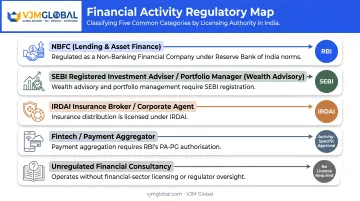
The right structure depends entirely on what you plan to offer:
- NBFC (Non-Banking Financial Company): lending, asset finance, or investment activities — RBI
- SEBI Investment Adviser or Portfolio Manager: wealth management and securities-linked advisory — SEBI
- IRDAI insurance broker or corporate agent: distributing or advising on insurance — IRDAI
- Fintech or payment aggregator: digital payments, lending platforms, or transaction processing — activity-specific approvals
- Unregulated financial consultancy: advisory or research that does not hold client funds or manage investments — no RBI/SEBI/IRDAI licence
That last category matters more than it sounds. A pure consultancy that doesn't touch regulated activity can often operate with standard company registration, no RBI, SEBI, or IRDAI approval needed. Everything else on this list requires regulatory sign-off before you can legally operate.
Why Start a Financial Services Business in India from the UAE (When It Makes Sense)
Setting up from the UAE can be a smart move, but only under the right conditions. India's regulators scrutinize financial businesses closely, and a rushed setup usually costs more time than it saves.
A Growing, Financially Engaged Diaspora
Over 4.3 million overseas Indians now call the UAE home. That's a large, recurring source of demand for advisory and wealth management services bridging both markets—think NRIs holding assets in India but managing their finances from Dubai or Abu Dhabi.
India's Financial Infrastructure Is Scaling Fast
India's digital rails—UPI and the Account Aggregator framework—plus rising fintech adoption keep expanding the addressable market. NBFC credit grew 5.9% year-on-year at the end of March 2025, per the RBI's latest annual report. That reflects real demand for lending and investment products outside traditional banking channels.
FDI Rules Favor Regulated Activity
Here's what many promoters get wrong: most regulated financial services activities qualify for 100% FDI under the automatic route, provided minimum capitalization norms are met. Unregulated or partly regulated activities, by contrast, need government approval. That single distinction can add months if your activity is misclassified.
Tax Treaty Support
The India-UAE tax treaty caps dividend tax at 10% for a qualifying beneficial owner, reducing friction when profits move back to the UAE. It doesn't eliminate Indian tax on share gains, but it prevents the same income from being taxed twice.
Put these pieces together, and a UAE-based founder can serve NRI and India-resident clients from one compliant entity, while keeping their personal tax base in the UAE. It's not automatic. It depends on choosing the right activity and structure from day one.
Key Decisions and Regulatory Considerations Before You Start
UAE company formation and India financial services licensing aren't the same exercise. Mainland UAE setups can move in days; India's regulatory layer adds months, and many promoters underestimate that gap.
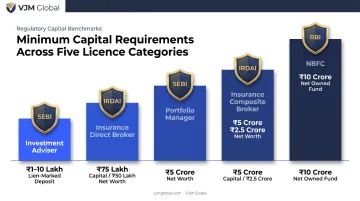
Get the regulator and licence category right first. Lending, investment advisory, broking, and payments activities each carry different capital thresholds:
| Activity | Regulator | Indicative capital/net worth |
|---|---|---|
| NBFC (new, generic) | RBI | ₹10 crore Net Owned Fund |
| Portfolio Manager | SEBI | ₹5 crore net worth |
| Investment Adviser | SEBI | ₹1–10 lakh lien-marked deposit (client-tier based) |
| Insurance Direct Broker | IRDAI | ₹75 lakh capital, ₹50 lakh net worth |
| Insurance Composite Broker | IRDAI | ₹5 crore capital, ₹2.5 crore net worth |
Confirm your FDI route. Regulator-supervised activities generally get automatic-route approval. Misdescribing your activity, calling a lending business "financial consultancy," for instance, can push it into the government-approval route unnecessarily.
Plan for the resident director requirement. Under the Companies Act, 2013, at least one director must meet India's residency test in a financial year, pro-rated in the company's first year. This applies regardless of NRI or OCI status. UAE-based promoters typically fulfil it through a nominee director or an India-based partner director.
Lock in capital at incorporation. Undercapitalising against the licence threshold forces a second infusion later and can slow bank KYC and licence filings.
Don't assume passive shareholding is enough. A common mistake: promoters assume their entity can hold 100% shares passively, with no India-based operational anchor. In practice, banks conducting KYC and regulators reviewing applications expect a functioning India presence, not just a shareholding certificate.
How to Start a Financial Services Business in India from the UAE – Step by Step
The process moves through five connected phases: activity classification, entity setup, capital infusion, regulatory licensing, and ongoing operations. The six steps below follow that sequence. Skip a phase, or reorder them, and you'll likely redo work.
The most common mistake: incorporating before confirming the activity classification and license pathway. Founders lock in a structure, then discover their activity needs a different capital threshold or a different FDI route entirely.
Step 1 – Identify Your Financial Activity and the Right Regulator
Define the exact activity, not a broad category:
- Lending or asset financing → RBI (NBFC registration)
- Investment advice or portfolio management → SEBI
- Insurance distribution or advice → IRDAI
- Payment processing or aggregation → RBI (payment aggregator authorization)
- Pure advisory without holding funds or managing investments → standard company registration only
A common miss is describing the activity too broadly for the license you actually want. Say you plan "financial advisory," but your model quietly includes managing client portfolios. That's Portfolio Manager territory under SEBI, not a consultancy. Nail the classification before touching entity structure.
Step 2 – Choose the Entity Structure and Ownership Route
A private limited company is the standard vehicle for FDI-backed financial services businesses in India. It offers limited liability, permits foreign shareholding, and satisfies most regulators' entity requirements.
Two decisions follow from Step 1:
- FDI route - automatic or government approval, based on whether your activity is regulator-supervised
- Resident director arrangement - since the Companies Act requires at least one India-resident director, UAE-based promoters typically use a nominee director or an India-based partner director
Firms experienced in cross-border entity formation, VJM Global among them, help Middle East-based promoters map their intended activity to the correct India entity type. They rely on India's own statutory instruments and regulators, rather than a generic offshore template.
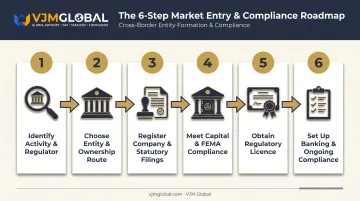
Step 3 – Register the Company and Complete Statutory Filings
Incorporation runs through the Ministry of Corporate Affairs using the SPICe+ form, which bundles company registration, Director Identification Number allotment, and PAN/TAN issuance into one filing. You'll also need:
- A valid registered office address in India
- Digital Signature Certificates for signing directors
- GST registration, if your business model requires it
Incorporation itself usually wraps up in a few weeks once documentation, including notarized and apostilled papers for UAE-based directors, is in order. The MCA doesn't publish a fixed processing guarantee, so build in buffer time for name-approval queries or resubmissions.
Step 4 – Meet Capital and FEMA Compliance Requirements
Promoter capital has to come in through proper banking channels, with FEMA-compliant reporting. That typically means:
- Filing Form FC-GPR through RBI's FIRMS portal once shares are allotted against inbound capital
- Retaining Foreign Inward Remittance Certificates as evidence of the funding trail
- Filing annual FLA returns with RBI once foreign investment sits on the books
Alongside FEMA reporting, meet the minimum capital or Net Owned Fund threshold specific to your license, ₹10 crore for a generic new NBFC, for example, or the applicable net worth threshold for a SEBI Investment Adviser. Directors and significant shareholders also go through KYC and fit-and-proper checks here.
Step 5 – Obtain the Regulatory License or Registration
With the entity incorporated and capital in place, apply for the actual authorization: an RBI Certificate of Registration for an NBFC, SEBI registration for an Investment Adviser or Portfolio Manager, or IRDAI licensing for insurance-linked activities.
Every application needs, at minimum:
- A detailed business plan and projected financials
- An AML/KYC policy appropriate to the activity
- Evidence of fit-and-proper directors and shareholders
- Proof of minimum capital or net worth
Set expectations honestly. Incorporation might take a few weeks; regulatory licensing regularly takes several months longer, and none of the three regulators publishes a fixed approval window.
Step 6 – Set Up Banking, Accounting, and Ongoing Compliance
You'll need a functioning corporate bank account in India. This step sometimes requires in-person verification, or a properly executed power of attorney authorizing a local representative to act on the promoter's behalf.
From there, ongoing compliance becomes routine but non-negotiable:
- Periodic GST filings, where applicable
- Annual ROC filings and statutory register updates
- Statutory audits conducted by a practicing Chartered Accountant
- Regulatory reporting specific to your license (RBI, SEBI, or IRDAI returns)
Most remotely-run businesses lose ground here, not at licensing, but in the months after, when KYC updates and filing deadlines pile up without a local team watching them. Building a local back-office function from day one keeps the business compliant while you run it from the UAE.
Conclusion
Building a financial services business in India from the UAE comes down to sequencing: get activity classification, entity structure, and regulatory compliance right before you incorporate, not after. Fast incorporation means little if the licence application stalls because the entity wasn't built for the right regulator.
UAE-based promoters, whether NRIs, OCI holders, or UAE-registered companies, can build a fully compliant India financial services business. You need the right structure, a properly arranged resident director, and local support that understands both regulatory requirements and the realities of running a business remotely.
Success also depends on what follows incorporation. As the business scales across both markets, regulatory thresholds, tax positions, and compliance obligations need periodic review, not a single check at setup.
VJM Global supports UAE promoters with India entity formation, FEMA/FDI advisory, and ongoing ROC, tax, and compliance work so the structure stays aligned as you grow.
Frequently Asked Questions
How do I start a financial services company in India from the UAE?
Identify the right regulator (RBI, SEBI, or IRDAI) for your specific activity. Incorporate a private limited company with a resident director, meet applicable capital norms, and secure the relevant licence before launching.
How much money do I need to start a financial services company in India from the UAE?
Costs vary sharply by activity. A basic advisory firm needs comparatively modest capital, while an NBFC needs ₹10 crore in Net Owned Fund and insurance-linked entities have their own defined thresholds.
Do I need an Indian resident director to register a company in India from the UAE?
Yes. Indian company law requires at least one director who meets India's residency test in a financial year. UAE-based promoters typically fulfil this through a nominee or partner-director arrangement.
Can a UAE-based company or NRI own 100% of an Indian financial services company?
In most cases, yes, under the automatic FDI route, once minimum capitalisation and sectoral conditions are met. Some unregulated or partly regulated activities require government approval instead.
Is RBI or SEBI approval mandatory for every financial services business in India?
No. Regulated activities like lending, investment advice, or broking need RBI, SEBI, or IRDAI approval. Purely unregulated financial consultancy generally doesn't need a financial regulator's licence.
How long does it take to register and license a financial services company in India?
Company incorporation can be completed in a few weeks. Obtaining the applicable regulatory licence typically takes several additional months, depending on the activity and regulator involved.