Many first-time importers assume the hard part is finding a supplier or a shipping company. It isn't. The real work happens before a single box leaves the US: registering a UK-facing business, getting an EORI number, sorting out VAT, and confirming your product doesn't need a license you didn't know about.
This isn't corporate-only territory anymore. Established exporters, e-commerce sellers running Amazon or Shopify stores, and first-time entrepreneurs are all testing the UK market at the same time. This guide walks through what actually happens, step by step, from your first product decision to your first cleared shipment.
Key Takeaways
- Finish UK entity, EORI, and VAT setup before your first shipment leaves the US
- You needn’t relocate—but UK registrations, tax setup, and customs compliance are mandatory
- Do market research, entity registration, customs/licensing, and supplier onboarding before goods arrive
- Get compliance and landed cost right early—speed of shipping comes second
What Is an Import Business (UK from USA)?
An import business, in this context, is a company set up by a US-based entrepreneur or US company to bring US-manufactured or US-sourced goods into the UK for resale through retail, wholesale, or online channels.
Logistics alone does not create the margin. You need a landed cost that still leaves room for profit once goods reach a UK buyer. Anyone can arrange a container. Fewer people price it correctly.
There are a few common formats to choose from:
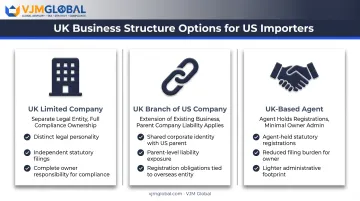
- UK limited company: a separate UK legal entity you own from the US
- UK branch of your US company: an extension of your existing business rather than a new one
- Trading through a UK-based agent: someone else holds the registrations and handles compliance on your behalf
Some importers focus on a single flagship product. Others run a growing catalogue across several categories, selling wholesale to UK retailers or direct-to-consumer through a storefront or marketplace.
The structure and channel you pick shape your tax setup and how quickly you can scale. Decide both before you register anything.
Why Import Into the UK Makes Sense for US Businesses Right Now
Moving into the UK works best when three conditions hold:
- Your product already sells well in the US
- You've seen real (not assumed) UK demand for that category
- Shipping economics still leave room for profit after duty and VAT
Skip any one of those and the numbers get shaky fast.
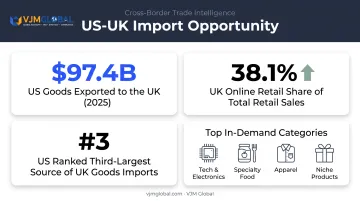
The market size backs up the opportunity. The US exported $97.4 billion in goods to the UK in 2025, according to US Census Bureau trade data. Separate UK figures put the US as its third-largest source of goods imports, behind only Germany and China.
Where UK Demand Concentrates
UK shoppers keep buying certain US categories that local and EU suppliers don't fully satisfy:
- Tech and consumer electronics
- Specialty food and drink
- Apparel and footwear
- Niche or hard-to-find specialty products
E-commerce is doing much of the heavy lifting here. UK online retail was projected to reach 38.1% of total retail sales in 2025, according to the US Commercial Service's UK e-commerce guide.
Duty Treatment Isn't a Blanket Advantage
Don't assume US goods clear UK customs duty-free. The UK Global Tariff applies by default, based on your product's commodity code.
Narrow US-specific preferences exist—such as beef and ethanol quotas under the 2025 UK-US Economic Prosperity Deal—but most categories still pay standard rates. Check your commodity code before building a pricing model around zero duty.
The upside: you can run most of this from the US. A UK-registered entity, a customs agent, and a UK fulfillment partner cover the groundwork without a full-time UK office. Once your compliance systems are running, the customer base and supplier relationships you build become a long-term asset, not just a one-off sales channel.
What to Know Before You Start
Before you commit capital, set realistic expectations for effort and timeline.
Early-stage work is admin-heavy, not product-heavy. Expect to spend more time vetting suppliers, registering your UK entity, and sorting EORI and VAT setup than sourcing product itself.
Three realities to plan for:
- Steady income takes time. Between production lead times, freight, and customs clearance, most importers need several shipment cycles, often months, before revenue stabilizes.
- Organization beats technical skill. Running this well depends more on staying on top of paperwork and deadlines than deep product expertise.
- Early margins are thin. Once freight, duty, and VAT are factored into your first shipments, don't expect fat margins until volume brings per-unit costs down.
The model is viable—but the first few months look more like setup than sales, so budget time and cash accordingly.
How to Start an Import Business in the UK from the USA – Step by Step
Here's the process broken into the stages that actually apply to a US owner bringing goods into the UK, rather than a generic import checklist. The most common mistakes at each stage: shipping before registrations are active, misjudging landed cost, and scaling before the first cycle is stable.
Step 1 – Identify Your Product, UK Market Fit, and Import Route
Start with two questions: what are you importing, and what's your role (manufacturer, wholesaler, or reseller of US-sourced goods)?
Validate demand before committing:
- Check UK import volumes for your product's commodity code using HMRC trade data
- Compare category size against ONS retail sales figures
- Test buyer interest through UK marketplace search trends, not just US sales history
Decide your shipping route too. Goods can ship directly US-to-UK, or get consolidated and repackaged first, usually the better option for smaller SKUs or mixed pallets.
Common miss: Picking a product that sells well in the US but has no verified UK buyer, or one restricted under UK import rules. Food, cosmetics, and chemicals are frequent surprises here.
Step 2 – Choose Your UK Business Structure and Register It
Three main routes, each with different liability, tax, and banking implications:
| Structure | Best for | Key consideration |
|---|---|---|
| UK limited company | Most importers wanting a clean UK tax presence | Separate legal entity; needs a genuine UK registered office |
| UK branch of your US company | Businesses extending an existing US operation | Not a separate entity; parent company liability applies |
| Trading via a UK agent | Owners who want minimal UK admin | Agent holds registrations on your behalf |
You can register a UK limited company with Companies House while living in the US. A UK director doesn't need to be a UK resident, though the company still needs a genuine UK registered office address. Once incorporated, you'll register for Corporation Tax with HMRC and receive a Unique Taxpayer Reference.
This is where VJM Global comes in for US owners who don't want to navigate Companies House and HMRC registration alone. The team matches the structure to how goods and money will actually move, then handles the registration itself.
Common miss: Choosing a structure that doesn't match your actual goods and payment flow, creating tax and banking friction down the line.
Step 3 – Get Your EORI Number and Register for VAT
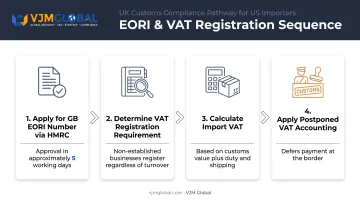
A GB-prefixed EORI number is non-negotiable for UK customs clearance, with no exceptions for commercial imports. You apply through HMRC, and approval usually comes through within five working days.
VAT registration works differently depending on your setup:
- UK-established businesses register once taxable turnover passes £90,000, per current HMRC VAT threshold guidance
- Non-established businesses making UK taxable supplies must register regardless of turnover, with no threshold to wait for
Import VAT gets calculated on the customs value of your goods plus duty and shipping costs, and can often be reclaimed later through postponed VAT accounting instead of being paid upfront at the border.
If you don't have a UK address or UK bank account, expect to need extra documentation or a UK-based agent to get through this smoothly.
Common miss: Shipping the first order before the EORI number is actually active. Goods get held at UK customs, and demurrage charges start piling up fast.
Step 4 – Check Licences, Certifications, and Product Compliance
Most goods only need that EORI number and nothing else. Regulated categories require specific licences or certifications, identified by your product's commodity code:
| Category | What's typically required |
|---|---|
| Food, animal products | Health certification, IPAFFS pre-notification, border checks |
| Plants and plant products | Phytosanitary certificate, importer registration |
| Medicines | MHRA authorization depending on product and route |
| Chemicals (PIC-listed) | Compliance with GB Prior Informed Consent rules |
| Firearms and ammunition | Specific import licence before goods reach the UK |
Beyond licensing, check whether your product needs a UKCA mark, or whether it can still carry a CE mark. Great Britain continues to recognise CE marking for many product categories, though rules vary by sector.
Licence fees vary widely by product category and issuing body. Check the specific commodity code and relevant UK agency for current pricing rather than assuming a flat cost.
Common miss: Assuming no licence is needed because the goods are legal to sell in the US. UK import controls run on their own rules entirely.
Step 5 – Set Up Shipping, Customs Clearance, and Documentation
Decide early whether you'll self-file customs declarations or hand that off to a freight forwarder or customs agent. For a US-based owner managing this remotely, most find the agent fee worth the time saved.
Core documents you'll need for every shipment:
- Commercial invoice
- Packing list
- Bill of lading (sea) or airway bill (air)
- Certificate of origin (only if claiming preferential tariff treatment)
Incoterms define who pays for freight, insurance, and duty at each stage of the journey, so agree on these with your supplier before the first shipment, not after a dispute over an unpaid duty bill.
Shipping mode depends on product value, urgency, and volume: air suits smaller, high-value, time-sensitive goods, while sea works better for bulk shipments where cost matters more than speed. Build customs clearance time into your inventory planning either way.
Common miss: Vague Incoterms, which lead to disputes over who actually owes duty, freight, or insurance mid-shipment.
Step 6 – Plan for Duties, Import VAT, and Cash Flow
Customs duty and import VAT are both calculated from your product's commodity code and declared value, and both are due before goods are released from UK customs, not after you've sold them.
That timing matters for cash flow. Duty and VAT tie up money before a single UK sale happens. Two tools help ease that:
- Duty deferment accounts: delay payment and consolidate a month's charges into one collection
- Postponed VAT accounting: moves import VAT onto your regular VAT return instead of paying at the border
Don't ignore the exchange rate. HMRC publishes customs exchange rates monthly, and a shift in GBP-USD can change your sterling duty and VAT bill even when your USD invoice price hasn't moved.
Common miss: Underestimating total landed cost (product plus freight plus duty plus VAT) and pricing too low to stay sustainable once all four costs are counted.
Step 7 – Launch Sales Channels and Monitor Performance
Decide how UK buyers will actually find you: marketplaces like Amazon UK, direct wholesale outreach to UK retailers, or your own UK-facing storefront. Each carries different setup requirements and different margins.
Once shipments start moving, track three numbers closely:
- Landed cost per unit
- Margin per shipment
- Delivery time from order to UK delivery
These numbers catch problems early, before a pricing mistake becomes a pattern across dozens of shipments. Resist the urge to expand product lines or shipment volumes until your first supply-and-sales cycle is fully proven.
Common miss: Scaling order volume before the customs, VAT, and logistics process for the first product line has actually stabilized.
Conclusion
Starting a UK import business as a US owner comes down to sequencing. Get your entity registration, EORI number, VAT setup, and any product licensing sorted before you scale shipment volume, not after.
Speed to first shipment matters less than most people assume. Clarity on structure and compliance determines whether the second, third, and tenth shipments run smoothly.
Once that foundation holds, the real work becomes refining landed costs and tightening supplier and logistics choices over time. That's what turns one successful shipment into an actual UK import operation.
Specialist support can shorten that learning curve considerably, particularly for owners handling this alongside an existing US business. VJM Global supports US owners with entity formation and compliance when entering the UK and other foreign markets.
Frequently Asked Questions
How much does it cost to get an import licence in the UK?
Costs vary by product category and issuing body, so there's no flat fee. Check your product's commodity code and the relevant UK agency (APHA, MHRA, HSE, or DBT) for current pricing.
Do I need an import licence in the UK?
Most goods only require an EORI number. Regulated categories, such as food, medicines, plants, animals, and chemicals, need a specific licence or certification on top of that.
How do I import goods from the USA to the UK?
Register a UK-facing business structure, get a GB EORI number, check licensing and your commodity code, arrange shipping and customs clearance, and budget for duty and VAT before goods are released.
Do I need to set up a UK company to import goods from the USA?
A UK limited company is common but not mandatory. Your US company can trade into the UK through a branch or an agent instead, depending on your tax and banking preferences.
What is an EORI number and do I need one as a US business?
It's a mandatory customs identifier for anyone importing into Great Britain, obtained through HMRC. Where you're based doesn't exempt you from needing one for commercial imports.
How long does it take to start importing into the UK from the USA?
Entity, EORI, and VAT registrations can often be completed within weeks. Reaching steady income usually takes several shipment cycles due to production and customs lead times.