At the same time, running a travel agency no longer means sitting behind a desk in London. Host agencies, franchise networks and cloud-based booking tools have made it entirely possible to own and operate a UK travel business without ever setting foot in the country.
That's why US travel advisors, established agencies, and entrepreneurs eyeing transatlantic niches are all asking the same question: can I legally register and run a UK travel agency from the United States? This guide walks through exactly how, from entity setup to licensing to the tax paperwork nobody warns you about.
Key Takeaways
- US citizens and companies can legally register and direct a UK limited company with zero residency requirement
- ATOL is mandatory for flight-inclusive packages; ABTA covers most non-flight holidays when they apply
- Plan on 8–12 weeks from formation to full ATOL trading approval, not Companies House’s 24-hour claim
- FBAR and Form 5471 filing duties still apply to American owners despite US–UK tax treaty relief
What Is a UK Travel Agency Business (and Can a US Company Own One)?
A UK travel agency arranges and sells travel components—flights, hotels, tours, and transfers—to consumers or businesses, earning commission or a service fee in return. That's the whole job.
You're not running a travel blog with affiliate links or producing content and hoping for click-throughs. You're matching real travellers with real suppliers and managing the booking, the money, and the liability that comes with both.
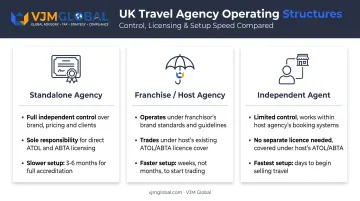
Common operating structures include:
- A traditional standalone agency, registered and licensed independently
- A franchise or host agency arrangement, trading under an established brand's ATOL and ABTA cover
- An independent agent working under a host agency's umbrella, without holding a separate licence
Here's the part most Americans assume is complicated but isn't: non-UK residents, including US citizens and US companies, can legally register and act as director of a UK limited company. There's no residency requirement, no need for a UK passport, and no obligation to relocate.
Companies House simply requires a UK registered office address, a completed SIC code for travel activities, and identity verification for the director, wherever that director happens to live.
Is Starting a UK Travel Agency From the USA Right for You?
Legally straightforward doesn't mean effortless. Before you commit capital and ATOL application fees, get clear on what remote ownership demands day to day.
What to Know Before You Start
The real test is operational: can you run the business five to eight hours ahead of your own clock?
- UK suppliers, banks, and regulators mostly operate 9-to-5 GMT, which means early mornings or working evenings if you're on US Eastern or Pacific time
- Travel agencies often need several years to reach steady income, and dual time zones can stretch that runway further
- Physical presence in the UK is not legally required for company registration, but ATOL/ABTA applications and some banking processes may still expect a UK correspondence address
If you can't commit to being reachable during UK business hours, at least through a local partner or host agency, this model gets harder fast.
Why It Makes Sense
UK outbound travel is a large, repeat market: nearly 95 million trips a year, worth close to £79 billion.
That demand is also tilting toward experience-led and niche travel—adventure trips, destination weddings, and curated itineraries instead of off-the-shelf packages. TTG's 2025 trend coverage put lesser-known destinations and experiential travel at the centre of the year, which favours specialist agencies over generalists.
- A remote, US-based specialist can serve a transatlantic niche that a UK-only agency might miss entirely
- A UK-registered brand becomes a long-term asset, one that can serve UK clients, US clients, and international travellers under a single credible entity
- Building the brand now, while remote work and cross-border ownership are normalised, is easier than retrofitting it later
Early (Cross-Border) Decisions That Matter When Starting a UK Travel Agency From the USA
Most founders underestimate the wrong thing. Registering a UK company is genuinely fast and simple. Staying compliant across two countries at once is where things get messy.
Costs that catch founders off guard:
- ATOL bonding requirements, which scale with your projected licensable revenue
- ABTA joining fees and annual subscriptions (published as non-refundable, but without a public fee schedule)
- Franchise or host agency fees, if you go that route instead of licensing independently
- Running parallel UK and US accounting and legal support, rather than assuming one advisor covers both
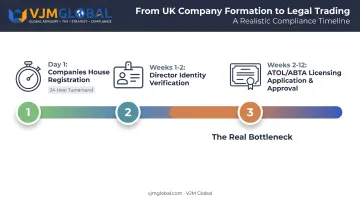
Realistic timeline to legally trade: UK company formation can take as little as 24 hours online, but factor in Companies House director identity verification, plus 8-12 weeks for ATOL or ABTA approval, before you're actually cleared to sell flight-inclusive packages.
There's also friction that's specific to non-residents:
- Overseas directors must complete Companies House identity verification like anyone else
- A UK registered office or service address is mandatory, even if every employee and operation sits in the US
- US-UK tax treaty obligations need active management to avoid double taxation, not passive assumption that the treaty "handles it"
Founder dependency is the other early call: run this solo from the US, plug into a UK host agency, or bring on a UK-based hire for time-sensitive supplier and client needs.
Given the compliance layering, many US founders use a cross-border entity formation and compliance partner rather than stitching advisors together country by country. VJM Global has supported 500+ American business owners and 250+ UK businesses with UK company registration, registered address arrangements, and coordinated US-UK tax and accounting compliance.
How to Start a Travel Agency in the UK From the USA – Step by Step
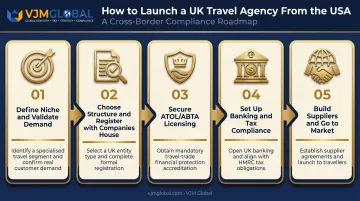
Getting from idea to live UK bookings means working through five practical stages. Three mistakes come up repeatedly: assuming US business licences or insurance transfer to the UK (they don't), underestimating ATOL bonding costs, and launching marketing before UK registration is actually complete.
Step 1 – Define Your Niche and Validate UK Market Demand
Pick a lane: corporate travel, luxury, adventure, destination weddings. Then test whether your US-based expertise or network actually translates into UK client demand, rather than assuming it does.
- Talk to UK contacts or online travel communities before building anything
- Run a small pilot booking to test willingness to pay, not just interest
- Common miss: assuming a niche that's popular with US travellers automatically has a UK audience. It often doesn't.
Step 2 – Choose Your UK Business Structure and Register with Companies House
Decide between forming your own UK limited company or partnering with a UK host agency/franchise instead of registering a new entity.
- Register with Companies House, selecting the correct SIC code for travel agency activities
- You'll need a UK registered office address and completed identity verification for the US-based director
- Common miss: not realising a UK registered office address is required even when every operation stays based in the USA
Step 3 – Secure ATOL/ABTA Licensing, Bonding and Insurance
Work out whether ATOL applies to you. If you're selling flight-inclusive packages or flight-only sales to UK consumers, it does, and that's true even if you're selling from outside the UK. There's no overseas-establishment exemption per CAA guidance on ATOL requirements.
- Standard and Small Business ATOL applications average around 12 weeks to a decision
- Bonding runs at roughly 15% of licensable revenue, with a minimum of £50,000
- Joining a UK host agency, consortium or franchise can give you access to existing ATOL/ABTA coverage instead of applying independently as a new foreign-owned business
- Secure professional indemnity and public liability insurance, and get written confirmation that a UK insurer will actually cover a US-resident owner before you assume it's automatic
ABTA, by contrast, is voluntary and covers non-flight packages through a bond, insurance, or trust account. Non-UK companies can apply if they're selling holidays to UK consumers, but there's no public numeric fee schedule, so budget conservatively and get a quote early.
Step 4 – Set Up UK Banking and Cross-Border Tax Compliance
This is where most of the published "non-resident friendly" claims fall apart. Several major UK banks publicly require a UK resident on the application, so shop around and confirm eligibility in writing before you count on any specific provider.
- Understand UK VAT treatment under the Tour Operators' Margin Scheme (TOMS), which taxes your margin rather than the full sale price when you sell as principal
- If you're a disclosed agent earning commission, you're generally outside TOMS and account for VAT under normal rules instead
- US filing continues after UK formation: Form 5471 may apply by ownership stake, and FBAR applies once foreign accounts exceed $10,000 (IRS foreign account guidance)
A cross-border tax partner is a practical necessity at this stage. VJM Global, for example, supports UK Corporation Tax registration, VAT compliance and Confirmation Statements alongside US FBAR, FATCA and foreign tax credit filings. Coordinating both jurisdictions under one adviser reduces the risk of a missed deadline.
Step 5 – Build Supplier Relationships, Tech Stack and Go to Market
With registration and licensing in motion, start building the operational backbone.
- Establish supplier relationships with UK hotels, tour operators and airlines, or lean on a host agency's negotiated rates if you're not licensing independently
- Set up your tech stack, meaning CRM, booking software, and a payment processor that handles multi-currency USD/GBP transactions cleanly
- Launch niche-focused marketing and track which channels convert UK versus international clients
- Stabilise operations before scaling. Get your first handful of bookings right before chasing volume
Conclusion
Launching a UK travel agency from the USA is achievable. Companies House doesn't care where you live, and ATOL doesn't discriminate based on your passport. What determines success is whether entity registration, licensing, and cross-border tax compliance get done properly from day one. Patching them together after a customer complaint or an HMRC letter is how launches stall.
Validating UK demand and choosing the right operating model (independent, host agency, or franchise) matters more than how fast you launch. Rushing to market with the wrong structure just means rebuilding later, at greater cost.
Treat compliance as an ongoing partnership with legal and tax advisors, not a box you tick once at formation. That mindset is what separates agencies still trading in year three from the ones that fold under a VAT notice or an unfiled FBAR.
Frequently Asked Questions
How can a US business start a travel agency in the UK?
Register a UK limited company through Companies House as a non-resident director, then secure ATOL and/or ABTA licensing depending on whether you sell flight-inclusive packages. Add a UK business bank account and sort cross-border tax compliance before you start trading.
How much do independent travel agents in the UK earn?
Operator commission offers often sit around 10–13%, but many agents net closer to 2–6% after price parity and splits. Income still hinges on your niche, host-agency deal, and how long you have been trading.
Are there travel agency franchises available in the UK for US businesses?
Yes, UK travel franchises and host agencies exist and generally accept overseas owners, though acceptance terms vary by brand. They cut licensing and setup work in return for fees and a share of profits.
Do I need a UK visa or work permit to run a UK travel agency from the USA?
No visa is required simply to own shares or act as director from the US. Working physically inside the UK, even briefly, would require the appropriate immigration permission first.
Can a US company register a UK limited company without a UK resident director?
Yes. No director needs to live in the UK, but the company must maintain a UK registered office address and complete Companies House identity verification for all directors.
What are the tax implications for a US citizen owning a UK travel business?
You'll need to handle UK Corporation Tax, VAT, and statutory filings alongside US reporting requirements like FBAR and potentially Form 5471. Use a cross-border tax advisor who can manage both UK filings and US reporting together.