Introduction
The US-Singapore Free Trade Agreement (USSFTA), signed in 2003 and in effect since January 2004, was the first US free trade agreement with an Asian nation. Two decades on, it continues to shape how American companies structure their APAC operations — and how Asian businesses access the US market.
Despite its strategic value, many companies struggle to navigate complex international trade agreements. Most don't fully understand how the USSFTA's provisions on tariff elimination, services liberalization, investment protection, and dispute resolution can directly benefit their cross-border operations. That gap translates directly into missed tariff savings, underutilized investment protections, and slower market entry.
This article breaks down what the USSFTA actually offers — from tariff elimination and rules of origin to Chapter 15 investment protections — and what it means for businesses expanding into India and across the Asia-Pacific region.
TLDR:
- The USSFTA, effective since January 2004, was the first US FTA with an Asian nation and provides zero-tariff access for US goods into Singapore
- Chapter 15 provides investment protections covering fair treatment, expropriation safeguards, and investor-state dispute settlement (ISDS)
- Singapore hosts ~5,700 American companies and offers APAC access through its network of 29 FTAs
- APAC companies can leverage Singapore structuring to access USSFTA protections when investing into the US, provided they maintain substantial business activities
What Is the US-Singapore Free Trade Agreement?
The USSFTA was signed on May 6, 2003 by President George W. Bush and Singapore's Prime Minister Goh Chok Tong. Key milestones in its passage:
- July 24, 2003 — US House ratified 272-155
- July 31, 2003 — Senate approved 66-32
- September 3, 2003 — President Bush signed it into law
- January 1, 2004 — Both countries implemented the agreement
It was the first exercise of Trade Promotion Authority (passed in 2002) and the first US free trade agreement with any Asian economy.
Strategic Context and Company Presence
Singapore is one of the United States' largest trading partners in Southeast Asia. It's consistently rated among the world's most competitive and open economies — ranked #2 globally in the 2025 IMD World Competitiveness rankings (down from #1 in 2024) and #1 in the 2025 Global Talent Competitiveness Index. As a close US ally, Singapore hosts approximately 5,700 American companies, many using it as their regional headquarters for Asia-Pacific operations.
Comprehensive Scope Beyond Tariffs
The USSFTA is a high-standard, comprehensive FTA that goes beyond tariff cuts. It covers:
- Trade in goods and services
- Investment protections with dispute resolution
- Intellectual property rights
- Government procurement access
- Labor standards
- Environmental protections
That breadth — spanning investment rules, IP, and labor standards — is why the USSFTA is frequently cited as a template for subsequent US trade agreements.
Real-World Impact: Trade Growth Since Implementation
Bilateral trade has grown substantially since 2004. US goods trade with Singapore reached approximately $83.5 billion in 2023 (US exports $42.7 billion, imports $40.8 billion) — roughly 163% growth in goods trade alone from 2003 to 2023, per US Census data.
When services are included, total bilateral trade hit $146.0 billion in 2024, a 7.9% increase from 2023. Overall bilateral trade has grown more than 62% since the agreement took effect.
Key Provisions: Tariffs, Trade in Goods, and Services
Tariffs and Trade in Goods
Under the USSFTA, Singapore bound all tariffs for US goods at zero—meaning there are essentially no import duties on US goods entering Singapore. Most tariffs were eliminated immediately upon implementation in 2004, with remaining duties phased out over three to ten years.
Key sectors that gained expanded export opportunities include:
- Medical instruments and equipment
- Microelectronics and semiconductors
- Photographic equipment
- Certain textiles and apparel
- Pharmaceuticals
- Chemicals
Rules of Origin
Goods must qualify as "originating" to receive preferential tariff treatment. Two primary methods determine origin:
- Tariff Shift Test: The product undergoes sufficient transformation to shift into a different tariff classification
- Regional Value Content (RVC) Test: A specified percentage of the product's total value must originate from the US or Singapore
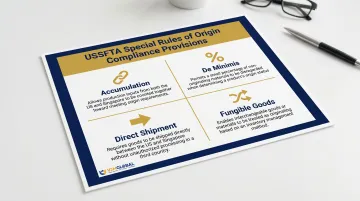
Special provisions simplify compliance:
- Accumulation allows materials from either country to count as originating
- De Minimis rules mean small amounts of non-originating materials won't disqualify a product
- Direct Shipment requires goods to move between the two countries without transiting third parties
- Fungible Goods provisions permit identical goods to be mixed and tracked by inventory method
One practical compliance advantage: no specific certificate of origin is required. Importers can request supporting documentation from exporters to verify preferential treatment claims.
Services, Intellectual Property, and Government Procurement
Singapore accorded substantial access to its services and investment market under the USSFTA, with few exceptions. This opened significant opportunities for US service providers in high-value sectors:
- Engineering and environmental consulting
- Medical and healthcare services
- Information technology and software
- Legal and financial services
- Education and training
- Distribution and logistics
The agreement also strengthened intellectual property protections, extending enhanced safeguards for patents, trademarks, and copyrights — a particularly valuable provision for US technology and pharmaceutical exporters.
On government procurement, US companies gained direct access to bid on Singapore government contracts, putting them on comparable standing with domestic firms for the first time.
Investment Protections: What Chapter 15 Offers
Chapter 15 of the USSFTA functions similarly to a bilateral investment treaty (BIT), providing high-standard, legally enforceable protections for both Singaporean investors in the US and US investors in Singapore. This is a rare feature among US trade agreements, particularly after the USMCA substantially reduced investment protections compared to NAFTA.
Substantive Investment Protections
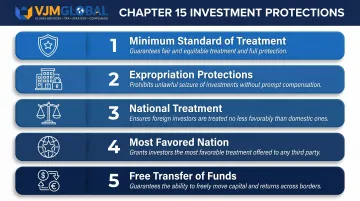
Chapter 15 guarantees five core protections:
1. Minimum Standard of Treatment
Investors receive fair and equitable treatment (FET) and full protection and security (FPS) under customary international law.
2. Expropriation Protections
The host state cannot expropriate investments, directly or indirectly, without fair market compensation.
3. National Treatment
Foreign investors receive treatment no less favorable than domestic investors in like circumstances.
4. Most Favored Nation (MFN)
Treatment must be no less favorable than that accorded to investors from any third country.
5. Free Transfer of Funds
All transfers relating to covered investments—profits, dividends, capital—can move freely and without delay.
Investor-State Dispute Settlement (ISDS)
The USSFTA provides a neutral arbitral forum where foreign investors can bring claims directly against the host state (either the US or Singapore) for breaches of investment protections. An arbitral tribunal can award monetary damages to compensate investors harmed by host-state actions, bypassing domestic courts entirely.
This mechanism is especially useful for investors who structure their holdings through treaty jurisdictions. International tribunals have accepted good-faith, pre-dispute structuring as legitimate — as seen in cases like Elliott v. South Korea and Cascade v. Turkey.
The critical boundary is timing: any restructuring must occur before a dispute becomes "reasonably foreseeable."
Denial of Benefits Clause
The treaty's investment protections can be denied to investors who do not maintain "substantial business activities" in the territory of the other party. Tribunals assess this based on materiality, not magnitude, examining factors like:
- Payment of local taxes and salaries
- Leased office space with permanent personnel
- Local board meetings and locally residing directors
- Local auditors and bank accounts
- Capital raising activities
- Engagement with local customers and vendors
A shell company registered in Singapore with no real activity will not satisfy this standard — tribunals look for evidence of day-to-day business, not just formal incorporation.
Singapore as a Global Trade Hub and Investment Gateway
Singapore's position as a global business hub rests on several reinforcing pillars. Ranked #1 for ease of doing business in 2024, it combines regulatory efficiency with deep talent pools and a contract-friendly legal environment.
Key foundations of its business appeal include:
- Straightforward company registration with low setup friction
- Highly skilled, English-speaking workforce
- Competitive tax regime with government R&D incentives
- Commercial courts, international arbitration centers, and mediation facilities respected for transparency
APAC Investment Platform
Singapore serves as an ideal regional headquarters for multinational companies operating across Asia-Pacific. Approximately 4,200 multinationals established regional headquarters in Singapore as of 2021. Singapore's extensive FTA network—29 implemented agreements as of March 2026—provides preferential access to markets including:
- ASEAN member states
- Japan and South Korea
- Australia and New Zealand
- European Union (EUSFTA)
- United Kingdom (UKSFTA)
- China (through RCEP)
- India (through CECA)
Paired with access to over 90 Double Taxation Agreements, this network allows companies to route operations through Singapore while reducing withholding taxes across multiple jurisdictions simultaneously.
Business Mobility Through USSFTA Visa Provisions
Beyond trade access, the USSFTA extends its reach to people mobility — a practical benefit for businesses deploying talent between the two countries. The agreement includes dedicated visa provisions that ease cross-border movement for business professionals:
| Visa Type | Initial Duration | Renewability | Annual Quota |
|-----------|------------------|--------------|--------------|
| H-1B1 (professionals) | Up to 18 months | Indefinitely renewable (1-year increments) | 5,400 for Singaporeans |
| E1/E2 (trader/investor) | 2-year stay | Indefinitely extendable | No separate cap |
The 5,400 H-1B1 quota has never been reached. The highest recorded usage was 944 approvals in FY2023 — just 17.5% of available capacity.
For Singaporean professionals, this translates to a reliable, low-competition pathway into the US workforce, entirely separate from the oversubscribed general H-1B lottery system.
What the USSFTA Means for Businesses Operating Today
Current Strategic Relevance
APAC investment into the US remains strong. US FDI in Singapore reached $467.6 billion at the end of 2024, making Singapore the 4th largest destination for US outward FDI globally—exceeding US FDI in China, Japan, and South Korea combined. Singapore FDI in the US was $36.9 billion in 2022.
The current US trade policy environment—including broader tariff actions and focus on reshoring manufacturing—makes the USSFTA's investment protection provisions especially valuable. For APAC companies structuring investments into the US, routing through Singapore provides access to one of the few remaining comprehensive ISDS mechanisms against the United States.
Strategic Considerations for APAC Investors
Companies headquartered outside Singapore can potentially structure investments through Singapore to access USSFTA protections—a practice known as "nationality planning." International tribunals have generally accepted this approach as legitimate when:
- Investments are made in good faith
- Structuring occurs before any dispute is foreseeable
- Substantial business activities are maintained in Singapore
The practical implication: APAC investors with genuine regional operations in Singapore can protect their US-bound investments through the treaty framework, provided they establish and maintain real business substance.
For businesses navigating this across the US, Singapore, and India simultaneously, the compliance picture grows considerably more complex. Treaty protections only hold when the underlying structures—transfer pricing, entity substance, FEMA compliance—are set up correctly from the start.
VJM Global works with foreign companies on exactly this: structuring India market entry to align with international tax obligations, FDI regulations, and treaty frameworks. With 500+ American businesses served and 30+ years of cross-border advisory experience, the team understands how agreements like the USSFTA intersect with India operations in practice.
Frequently Asked Questions
Does the US have a free trade agreement with Singapore?
Yes. The US-Singapore Free Trade Agreement (USSFTA) has been in force since January 1, 2004, making it one of the longest-standing and most comprehensive bilateral trade and investment agreements the US maintains with an Asian economy.
What is the US-Singapore Free Trade Agreement?
The USSFTA is a bilateral agreement signed in 2003 covering tariff elimination, trade in goods and services, intellectual property protections, and government procurement. It also includes a robust investment chapter with dispute resolution mechanisms, including investor-state arbitration.
What tariffs apply under the US-Singapore Free Trade Agreement?
Singapore bound all tariffs for US goods at zero, with most eliminated immediately in 2004 and remaining duties phased out within three to ten years. US goods now enter Singapore duty-free, provided they meet Rules of Origin requirements through tariff shift or regional value content tests.
How do US trade tariffs affect Singapore?
The USSFTA already binds Singapore tariffs for US goods at zero, so US tariff policy changes affect Singapore primarily through their broader impact on global trade and supply chains — not through direct bilateral tariff barriers.
Who is Singapore's biggest trade partner?
For merchandise trade in 2025, Taiwan leads at S$170.3 billion, followed by China (S$162.9 billion), Malaysia (S$145.0 billion), and the US (S$139.2 billion), per Singapore's Department of Statistics. For services trade in 2024, the US ranks first at S$185.1 billion — well ahead of the EU (S$116.7 billion) and China (S$74.8 billion).
Why does Singapore have low tariffs?
Singapore operates as a free-trade, open economy, with trade as the cornerstone of its growth model. Its network of 29 FTAs — including the USSFTA — progressively eliminates tariff barriers to attract investment, boost exports, and sustain its position as a global trading hub.