Setting up a "US subsidiary" sounds like a single, defined step. In practice, the outcome depends heavily on which entity type you choose, which state you incorporate in, and which tax elections you make along the way. Get these wrong and you can end up with duplicate registrations, unexpected withholding tax, or a structure that doesn't suit your investors.
This guide covers when incorporation actually makes sense, the exact formation steps, how to choose the right structure and state, the ongoing tax obligations you'll take on, and the mistakes UK companies make most often.
Key Takeaways
- A US subsidiary is a separate legal entity, shielding the UK parent from US liabilities in ways a branch office cannot
- Confirm sustained US demand first: most companies follow a three-stage pattern before incorporating
- C-Corporations and LLCs are the only realistic options for foreign owners; S-Corps are off the table
- Delaware offers legal predictability, but incorporating where you actually operate can avoid duplicate registration costs
- Federal, state, and sales tax apply as three separate layers, unlike the UK's single-authority system
How to Set Up a US Subsidiary as a UK Company
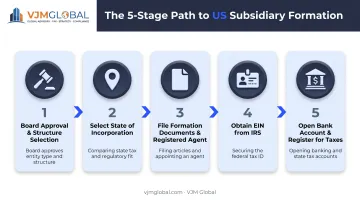
Once you've decided to incorporate, the process follows a fairly predictable sequence. Here's what actually needs to happen, in order.
Step 1: Get Parent Company Approval and Choose a Business Structure
Formation should start at board level, not with a Secretary of State filing. The UK parent's board needs to pass a formal resolution authorising the new US entity, naming who can sign on the company's behalf, and confirming the initial capital commitment.
At the same time, decide between a C-Corporation and an LLC. This choice affects every step that follows, from the state you incorporate in to how dividends get taxed later, so it shouldn't be deferred.
One thing you can cross off immediately: S-Corporation status isn't available here. The IRS restricts S-Corp shareholders to qualifying US individuals, and a UK corporate parent simply doesn't qualify.
Step 2: Select Your State of Incorporation
UK companies typically choose between two paths:
- Incorporate in a business-friendly state like Delaware, regardless of where operations happen
- Incorporate directly in the state where staff, offices, or customers are actually based
If you incorporate in one state and operate in another, you will usually need to foreign qualify in the operating state as well. That means a second registration, a second fee, and another ongoing compliance obligation.
Step 3: File Formation Documents and Appoint a Registered Agent
With structure and state chosen, formation itself is largely paperwork:
- File Articles of Incorporation (C-Corp) or Articles of Organization (LLC) with the relevant Secretary of State
- Appoint a registered agent with a physical US address in that state, a legal requirement, not an optional extra
- Draft bylaws (C-Corp) or an operating agreement (LLC) setting out governance
The registered agent receives legal notices and state correspondence on the subsidiary's behalf. It needs to be a reliable, permanent arrangement rather than a temporary fix.
Step 4: Obtain an EIN from the IRS
Every US subsidiary needs an Employer Identification Number before it can file taxes, hire staff, or open a bank account. For a US-based founder with a Social Security Number, this is an instant online process.
UK founders don't have that option. Without a US SSN, the IRS pushes applicants toward the mail or fax route, and current guidance from the IRS Taxpayer Advocate Service puts processing at four weeks or more. Build this into your timeline early: banking, payroll, and tax registration all wait on the EIN.
Step 5: Open a US Business Bank Account and Register for Taxes
Banks typically ask for:
- Certificate of incorporation or formation
- EIN confirmation letter
- Passports for beneficial owners and signatories
- Proof of US business address
Many traditional banks still require an in-person visit for foreign-owned entities, though some fintech providers now support fully remote onboarding.
Once banking is sorted, register for state and local taxes where the subsidiary has nexus. Depending on the state or states involved, that can include:
- Income tax
- Franchise tax
- Sales tax
- Payroll tax
When Should a UK Company Set Up a US Subsidiary?
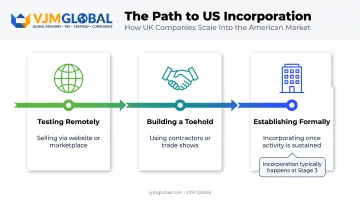
Most UK businesses don't wake up one day and decide to incorporate in the US. It happens gradually, in three fairly predictable stages:
- Testing remotely – selling into the US via website or marketplace, with no US-based presence at all
- Building a toehold – using US contractors, attending trade shows, or making regular business trips
- Establishing formally – incorporating once activity becomes sustained and continuous rather than occasional
Incorporation typically becomes necessary at stage three. Common triggers include hiring US staff directly, sponsoring a work visa, or holding a US bank account in the company's own name.
The tax trigger you can hit before incorporating
Permanent Establishment (PE) can create US tax exposure before you incorporate. Under Article 5 of the US-UK tax treaty, a PE exists where a UK enterprise has a fixed place of business in the US.
It also exists where an agent habitually exercises authority to conclude contracts on the enterprise's behalf. A UK company can therefore trigger federal tax exposure without a subsidiary—through an office, warehouse, or sales rep who regularly signs contracts in the US.
Federal PE is not the only threshold. State "nexus" (the link that creates a state tax filing duty) is usually lower than PE and sits outside the treaty. A UK company can owe state corporate tax well before any federal liability, sometimes from remote sales alone.
Choosing how you show up in the market matters as much as when you incorporate.
Subsidiary vs. Branch vs. Representative Office
| Structure | Liability | Taxation | Best For |
|---|---|---|---|
| Subsidiary | Separate legal entity; shields the UK parent in most circumstances | Taxed as a domestic US corporation | Genuine operational presence: staff, contracts, revenue |
| Branch | Parent remains directly liable for branch obligations | Foreign corporation taxed on US-connected income (Form 1120-F) | Testing operations without full separation |
| Representative Office | Parent liable; no separate entity | No US tax filing if activities stay preparatory or auxiliary | Market research only, no revenue generation |
A representative office only stays outside PE territory if its activities remain genuinely limited to storage, display, delivery, or information-gathering. The moment it starts generating revenue or negotiating deals, that exemption disappears.
Choosing the Right Structure and State for Your US Subsidiary
C-Corporation or LLC: Which Fits a UK Parent?
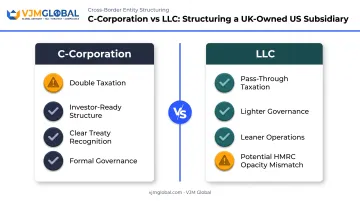
A C-Corporation is generally the default for UK groups that want:
- US investment down the line (most investors expect a C-Corp)
- Clear tax treaty recognition
- A governance structure familiar to US stakeholders and banks
The trade-off is double taxation: the corporation pays US tax on its profits, then the UK parent pays tax again on dividends received (though the treaty can reduce that rate, more on this below).
An LLC offers pass-through taxation and lighter governance, which suits leaner operations. However, it comes with a complication: not every UK-US scenario recognises an LLC consistently.
HMRC generally treats a Delaware LLC as opaque, so members are usually taxed in the UK on distributions rather than as profits arise. If the US taxes the LLC as a pass-through instead, that mismatch can mean UK double-tax relief doesn't apply cleanly. Worth reviewing before you file, not after.
Picking a State of Incorporation
Delaware remains the default choice for a reason. More than two-thirds of Fortune 500 companies call Delaware their corporate home, largely because of its predictable corporate case law and strong privacy protections for shareholders.
But Delaware isn't automatically cheapest or simplest. Its minimum franchise tax runs from $175 (Authorized Shares Method) to $400 (Assumed Par Value Capital Method), plus a $50 annual report fee. If your subsidiary actually operates in California, you'll pay California's $800 minimum franchise tax on top of that, plus the cost of foreign-qualifying there.
| Consideration | Delaware | State of Operations |
|---|---|---|
| Legal predictability | Strong, well-established case law | Varies by state |
| Franchise tax | $175–$400 + $50 annual report | Varies (e.g. California: $800 minimum) |
| Extra registration needed? | Yes, if operating elsewhere | No, if operating there |
For a pure holding structure with no physical US operations, Delaware usually wins. For a subsidiary that will employ people and sign leases in, say, Texas, incorporating directly in Texas often avoids paying for two registrations instead of one.
Getting Expert Support for Cross-Border Formation
Choosing between Delaware and an operating state, or between a C-Corp and an LLC, isn't a decision to make from a generic checklist. It depends on your investment plans, where your team will actually sit, and how the treaty treats your specific structure.
Firms with dual UK-US expertise can match structure and state to your group's goals, rather than defaulting to whatever is most commonly recommended online.
VJM Global, for instance, has supported over 250 UK businesses with cross-border compliance. Its US service line covers:
- LLC and C-Corp formation
- Registered agent appointment
- EIN applications
- Ongoing state tax registration
Getting this input before you file usually prevents costly rework on entity type, state choice, and tax registrations.
Tax, Compliance, and Common Mistakes When Setting Up a US Subsidiary
Ongoing Tax and Compliance Obligations
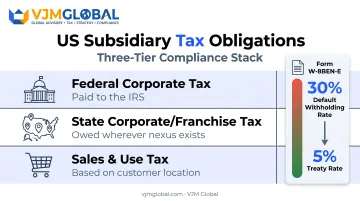
Once incorporated, a US subsidiary faces three separate layers of tax, a structure that catches many UK companies off guard given the UK's single-authority system.
- Federal corporate tax – paid to the IRS on the subsidiary's profits
- State corporate/franchise tax – paid to each state where the subsidiary has nexus
- Sales & use tax – collected based on where customers are located, not just where the subsidiary is incorporated
Dividends paid back to the UK parent face a standard 30% US withholding tax by default. Filing IRS Form W-8BEN-E can reduce that to the treaty rate, typically 5% where the UK parent owns at least 10% of voting power. Some qualifying holding structures can go lower still under the treaty's limitation-on-benefits rules.
Beyond dividend withholding, intercompany transactions between the UK parent and US subsidiary (management fees, cost allocations, licensing charges) must follow arm's-length transfer pricing rules under IRS Section 482. Document how prices were set as if the two companies were unrelated, and keep the paperwork ready before you file, not scrambled together if the IRS asks.
Common Mistakes UK Companies Make
Three mistakes come up repeatedly:
- Incorporating too early: Setting up a subsidiary before US demand is genuinely sustained means paying ongoing compliance costs for an entity that isn't earning its keep yet.
- Ignoring corporate formalities: Skipping separate bank accounts, board minutes, or documented decisions risks piercing the corporate veil and exposing the UK parent to US liability.
- Missing state nexus obligations: Assuming registration in the state of incorporation covers everything can lead to penalties for unfiled returns in states where the subsidiary actually has nexus.
Conclusion
A US subsidiary works best when it's set up at the right stage of a UK company's expansion, after genuine market traction exists, not before. Incorporating too early just adds compliance costs to a US presence that isn't earning revenue yet.
Most of the costly mistakes covered here don't come from the incorporation process itself. They come from the wrong structure, the wrong state, or a missed tax filing that surfaces months later as a penalty notice.
Working with a firm that understands both UK and US compliance, such as VJM Global, helps UK companies avoid these pitfalls and set up with the right entity in the right state from the start.
Frequently Asked Questions
Can I set up a US company from the UK?
Yes. UK founders can incorporate a US C-Corporation or LLC entirely remotely in most states. Some steps, like opening a bank account, may need extra identity verification.
Do I need to visit the US in person to set up a subsidiary?
Formation itself can be completed remotely from the UK. Some banks still require an in-person visit or video verification before opening a business account.
Should a UK company choose an LLC or a C-Corporation for its US subsidiary?
C-Corps suit companies planning to raise investment or wanting treaty clarity. LLCs suit leaner operations but can complicate UK foreign tax credit claims.
Which US state is best for a UK-owned subsidiary?
Delaware suits holding structures needing legal predictability and privacy. Incorporating in your actual operating state often avoids paying for a second registration.
Does a US subsidiary protect the UK parent company from liability?
A properly maintained subsidiary generally limits liability to the US entity itself. Skipping corporate formalities, though, can undermine that protection entirely.
How long does it take to set up a US subsidiary from the UK?
Basic formation can take one to two weeks. EIN (employer tax ID) issuance, bank account opening, and tax registrations can stretch the full process to several weeks.