Here's the catch: shared language and a common-law heritage make the US feel familiar, but it runs on a genuinely different rulebook. There's no single national business registry. Tax and employment law vary across 50 states. US banks apply their own due diligence standards, regardless of your UK track record.
This guide covers the realistic entry routes into the US, how to pick the right entity and state, what the US-UK tax treaty actually means for your filings, and the mistakes that trip up even well-funded founders.
Key Takeaways
- Match your entry route (entity, EOR, distributor, or e-commerce) to capital, timeline, and control needs
- US-UK tax treaty cuts withholding on dividends, interest, and royalties—IRS filing still applies
- Form 5472 still applies to foreign-owned US entities; penalties start at $25,000
- Cross-border specialists cut formation time and close compliance gaps
Why the US Market Is a Strategic Opportunity for UK Businesses
UK companies also carry advantages that other foreign entrants lack. A shared common-law legal tradition means contracts, IP protections, and dispute resolution concepts translate more directly than they would from a civil-law jurisdiction. English-language operations remove an entire layer of friction in negotiations, marketing, and compliance documentation.
US regulators and investors are also already familiar with UK corporate structures. That institutional familiarity shows up in faster due diligence, smoother investor conversations, and banking relationships that don't require explaining basic concepts from scratch.
VJM Global has worked with 250+ UK businesses across fintech, consumer products, professional services, and life sciences on US market entry and ongoing compliance.
Sectors Leading UK Expansion into the US
Post-Brexit, UK businesses have diversified away from EU-centric trade. A handful of sectors are leading that shift:
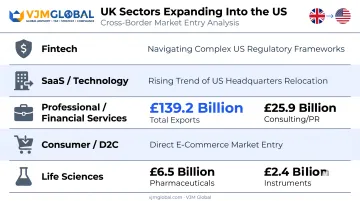
- Fintech: UK firms are setting up US operations, though the Financial Times reported in 2025 that many hit significant US regulatory complexity
- SaaS and technology: leading British tech companies are exploring US headquarters moves for better investor access
- Professional and financial services: UK services exports to the US totalled £139.2 billion in the four quarters to Q1 2025; consulting and PR alone contributed £25.9 billion
- Consumer and D2C brands: using e-commerce as a low-cost entry point before committing to physical infrastructure
- Life sciences: UK pharmaceutical exports to the US reached £6.5 billion, alongside £2.4 billion in scientific instruments
US Market Entry Strategies for UK Companies
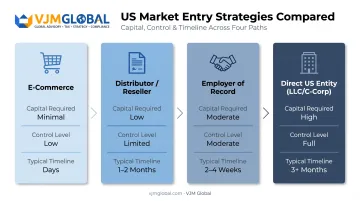
Most successful UK entrants don't start by incorporating. They start lean, validate demand, and layer on commitment as the market proves itself. Entry options sit on a spectrum of commitment—match the route to how far you've already validated US demand.
Direct US Entity Establishment (LLC or C-Corp)
This route fits UK companies with proven US demand or active fundraising plans. US investors and larger enterprise customers generally expect a domestic entity before they'll sign a term sheet or a contract.
The complexity comes from three fronts hitting at once:
- Navigating federal and state regulations simultaneously, since they don't always align
- Opening a US bank account as a foreign-owned entity, including the required verification steps
- Obtaining an Employer Identification Number (EIN) from the IRS
VJM Global supports UK companies through this exact process, handling entity formation, EIN registration, and ongoing state compliance so the paperwork doesn't stall the launch.
Employer of Record (EOR) for Market Testing
An EOR lets you hire US-based staff or test a specific market segment without incorporating anything. It's typically the lowest-risk starting point for UK SMEs still validating product-market fit before committing real capital.
One caveat: hiring through an EOR while directing significant business activity from the US can create unintended permanent establishment exposure, which triggers tax obligations you weren't expecting. Structure the arrangement carefully with your adviser.
Distributor, Reseller, and Trading Partnerships
If your business already operates comfortably through intermediaries in the UK, distributors and resellers offer a familiar model for the US. You get market access without setting up local infrastructure.
The trade-off is real, though. You lose direct control over branding, pricing, and the customer relationship itself, all of which now sit with your US partner.
E-Commerce and Digital-First Entry
Testing US demand through Amazon US, Shopify, or digital payment platforms is the lowest-investment route available. No entity, no lease, no local hires.
Sales tax nexus is the main catch. Since South Dakota v. Wayfair (2018), states no longer require physical presence before demanding sales tax registration. Thresholds vary by state:
- South Dakota: registration required above $100,000 in gross sales
- California: registration required above $500,000 in sales of tangible property
Digital-only sellers can trigger these obligations purely through transaction volume, with zero physical footprint in the state.
Choosing the Right Business Structure and State for US Market Entry
This decision shapes everything that follows: banking relationships, tax exposure, and how easily you can raise US capital later. Getting it wrong is expensive to unwind—treat structure and state choice as a deliberate step, not a formality.
LLC vs. C-Corporation for UK Owners
A single-member LLC owned by a UK parent is treated as a disregarded entity for tax purposes. That doesn't mean it's ignored by the IRS, though. It still triggers a Form 5472 filing, attached to a pro forma Form 1120, whenever there's a reportable transaction.
A C-Corporation works differently:
- Taxed at a flat 21% federal rate via Form 1120
- Dividends paid to the UK parent face a standard 30% withholding rate
- Under the US-UK treaty, that often falls to 5% (if the UK company owns ≥10% of voting stock) or 15% otherwise—only if Form W-8BEN-E is on file before payment
Most investor-backed UK companies choose the C-Corp structure specifically because US venture investors expect it.
Delaware vs. Your Operating State
66.7% of Fortune 500 companies are incorporated in Delaware, according to the Delaware Division of Corporations' 2024 Annual Report. Its established corporate case law and investor familiarity make it the default choice for companies planning to raise US venture capital.
That said, Delaware isn't automatically right for everyone. If your UK company has physical trading, warehousing, or retail operations concentrated in one state, incorporating there directly often makes more practical sense.
Delaware incorporation also doesn't replace local duties: you still need to foreign-qualify and meet tax and compliance rules in every state where you actually operate.
Banking, EIN, and Ongoing Compliance
US banks run their own customer due diligence process on foreign-owned entities, verifying beneficial ownership for anyone holding 25% or more, plus at least one control person. Non-US directors should expect to provide identity and address documentation that goes beyond what UK banks typically request.
EIN applications work differently without a US address:
- Fax: roughly four business days (return fax number required)
- Mail: roughly four weeks
- Phone: international line available for direct applications
Every state also requires a registered agent on file. VJM Global's entity formation service handles state selection, EIN acquisition, and registered agent setup end-to-end, which removes a genuine bottleneck for UK clients unfamiliar with the process.
Tax, Compliance, and Regulatory Considerations for UK Companies
UK companies hold a real advantage that businesses from many other regions simply don't get: an active, comprehensive tax treaty with the US. It changes the compliance calculus, but it doesn't eliminate the compliance work itself.
The US-UK Tax Treaty Advantage
With Form W-8BEN-E properly filed, the treaty reduces standard withholding rates:
- Dividends: as low as 5% for qualifying direct dividends, potentially 0% for an 80%-owned subsidiary meeting ownership-period conditions
- Interest: generally 0%
- Royalties: 0% for most copyright and software royalties
Here's what the treaty doesn't do: it doesn't remove your obligation to file Form 5472 with a pro forma Form 1120. Skip that filing, and the penalty starts at $25,000, according to the IRS Form 5472 instructions, with an additional $25,000 per related party if the failure continues 90 days past an IRS notice.
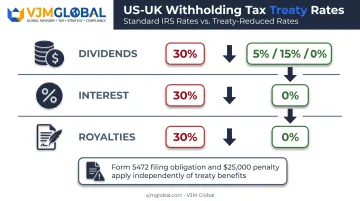
Treaty benefits and filing obligations are two separate tracks.
Sales Tax Nexus and State-Level Obligations
Economic nexus rules mean UK companies can owe sales tax registration purely from transaction volume, with no physical presence required. On top of that, franchise tax and annual report fees vary significantly by state:
- Delaware: $175 to $400 minimum, depending on calculation method
- California: $800 minimum franchise tax, with limited exceptions
- Texas: no tax due below a $2.65 million revenue threshold, though information reports may still apply
These fees apply even in low-revenue years, so budget for them regardless of how sales are tracking.
Payroll and Employment Tax From Day One
Hiring in the US, whether directly or through an Employer of Record (EOR), triggers obligations immediately:
- Federal and state tax withholding
- FUTA and state unemployment contributions
- Forms 941 (quarterly), 940 (annual), and W-2 filings
- State-specific requirements, including workers' compensation coverage
There's no grace period. The obligations start with your first payroll run, not once you've "settled in."
UK GAAP/IFRS vs. US GAAP Reporting Gap
The reporting divergence catches many UK groups off guard when it's time to consolidate. A few practical differences:
- US GAAP generally expenses R&D as incurred, while IFRS capitalises qualifying development costs
- US GAAP permits LIFO inventory accounting, which IFRS prohibits outright
- Consolidation models differ structurally between the two frameworks
VJM Global's CPAs and Chartered Accountants produce US GAAP-compliant filings while keeping UK-compliant reporting intact for UK-based investors or lenders. That keeps the parent company's books usable on both sides of the Atlantic.
Avoiding Common Mistakes and Building a Practical Entry Roadmap
Two mistakes cost UK founders the most time and money on US entry:
- Assuming UK banking and negotiation norms transfer. They don't. US banks run KYC from scratch, regardless of your track record back home, and payment terms that are standard in the UK can look unusual to a US counterpart.
- Hiring or signing a lease before infrastructure is ready. Move before the EIN, registered agent, and payroll setup are in place, and you create liability exposure that is painful and expensive to unwind.
A Practical 5-Step Entry Roadmap
- Validate demand through EOR hiring, a distributor relationship, or e-commerce before committing capital
- Select an entry strategy matched to your available capital, timeline, and desired level of control
- Register the entity and lock in compliance infrastructure, meaning EIN, registered agent, and state filings
- Open banking with foreign-owner documentation prepared in advance, not assembled after the account gets flagged
- Scale hiring and distribution once the compliance foundation is proven and stable
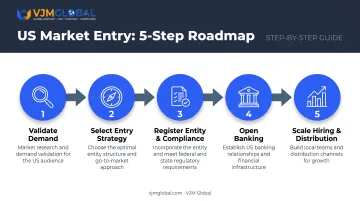
This sequence will not guarantee a smooth entry. Skipping steps almost always costs more time and money than following it.
Frequently Asked Questions
What are the 5 international market entry strategies with examples?
The five main routes are exporting, licensing/franchising, joint ventures, foreign direct investment, and e-commerce. Pret A Manger used franchising for its US expansion, while GSK and Pfizer combined operations through a joint venture.
How do I register a UK company in the US?
Select your entity type and state, appoint a registered agent, file formation documents with the Secretary of State, obtain an EIN from the IRS, then open a US business bank account. Each step depends on the previous one being complete.
Is there a tax treaty between the US and UK?
Yes, an active treaty has been in force since 2003. It reduces withholding on dividends, interest, and royalties when Form W-8BEN-E is properly filed, but it doesn't remove your Form 5472 filing obligations.
What is the fastest way for a UK business to test the US market?
Employer of Record hiring or e-commerce entry both let you test the market within weeks, without forming a US entity. EOR works best for service-based testing, while e-commerce suits product-based businesses.
Which US state is best for a UK company to incorporate in?
Delaware is the default for most companies, largely due to investor familiarity and established corporate case law. If your physical operations are concentrated in one state, incorporating there directly often makes more sense.
Can a UK business owner get a visa to run their US company?
Visa eligibility is separate from entity registration and depends entirely on individual circumstances. Speak with an immigration specialist directly, since this falls outside standard entity-formation and tax advisory work.