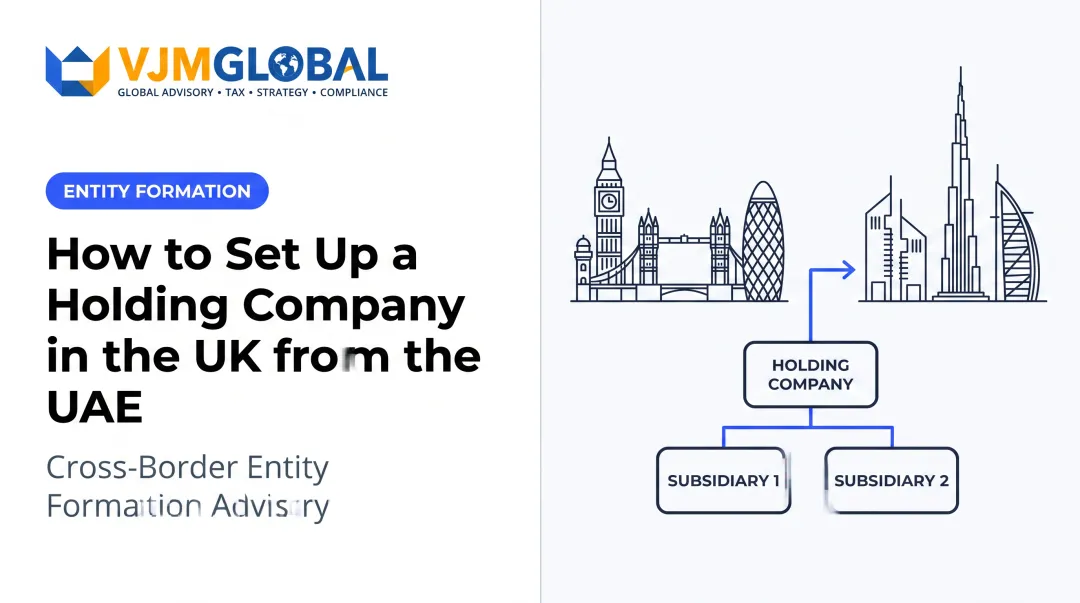
Holding companies often get pigeonholed as a tax planning tool. That's only half the story. Their real value shows up in day-to-day control, asset protection, and the ability to scale without unravelling your entire business structure.
This article covers the practical benefits of a UK holding company, not just the theory you'll find in a textbook.
TL;DR
- A UK holding company separates ownership from trading risk, protecting assets from operational threats
- Key tax wins include the Substantial Shareholding Exemption (SSE) and dividend exemption on most UK and overseas subsidiary income
- Centralised governance simplifies reporting and speeds up decision-making across multiple entities
- Holding structures make succession planning smoother and reduce inheritance tax exposure via Business Relief
- These benefits compound as your group grows, adds subsidiaries, or expands internationally
What Is a Holding Company (Brief Context)
A holding company owns shares in other companies (subsidiaries) rather than trading itself.
In the UK, holding companies are typically set up as private limited companies sitting above one or more operating subsidiaries. Under the Companies Act 2006, Section 1159, a company qualifies as a holding company if it:
- Holds a majority of the subsidiary’s voting rights
- Can appoint or remove a majority of the subsidiary’s board
- Controls a majority of voting rights through an agreement with other members
It is a structural tool for group control, asset protection, and tax planning—not an operating business in its own right.

Key Advantages of a UK Holding Company
The advantages below map to outcomes UK business owners actually track: tax liability, asset security, succession readiness, and ease of raising capital—not abstract theory.
Tax Efficiency Through Exemptions and Reliefs
UK holding companies can benefit from the Substantial Shareholding Exemption (SSE), which exempts qualifying gains on the sale of subsidiary shares from Corporation Tax.
To qualify, HMRC requires the investing company to hold at least 10% of the investee's ordinary share capital, with entitlement to at least 10% of distributable profits and assets, generally for a continuous 12-month period (HMRC Capital Gains Manual CG53070). The investee must also meet trading conditions throughout the relevant period.
Dividends received from UK and most overseas subsidiaries are generally exempt from further Corporation Tax under the UK dividend exemption rules in CTA 2009, Part 9A (Corporation Tax Act 2009, Part 9A). The distribution must fall within an exempt class and must not trigger anti-avoidance provisions.
Why this matters:
- Groups can reinvest sale proceeds and dividend income without double taxation, freeing up cash for growth
- PKF Smith Cooper notes that SSE can potentially avoid Corporation Tax at 25% on qualifying capital gains from a subsidiary sale, illustrating the scale of the relief available on a qualifying disposal
- Restructuring, mergers, and exit decisions become far less tax-punishing when this exemption applies
KPIs impacted: effective tax rate, net proceeds on disposal, retained group cash.
Expect the biggest payoff if you plan to sell a subsidiary, attract investors, or repatriate profits from overseas operations.

Asset Protection and Risk Ring-Fencing
Valuable assets, whether that's IP, property, or cash reserves, can sit at the parent company level, separate from trading risk.
This shields core assets if a subsidiary runs into financial or legal trouble. One failing business unit shouldn't be able to drag down everything else you've built.
Insolvency rules reinforce the point. In British Eagle International Air Lines Ltd v Compagnie Nationale Air France, the House of Lords confirmed that assets inside an insolvent company are generally available to that company's unsecured creditors on a pari passu basis (British Eagle case report).
Keep valuable assets at parent level, outside the trading entity, and they stay beyond that subsidiary's creditor pool.
Why ring-fencing pays off:
- Prevents contagion from one failing subsidiary to the wider group
- Strengthens lender confidence and speeds up investor due diligence
- Builds long-term resilience against sector-specific shocks
KPIs impacted: asset security, creditor exposure, financing and insurance terms.
High-risk sectors, IP- or property-heavy groups, and firms entering unfamiliar markets gain the most from this structure.

Simplified Group Management and Governance
A holding company creates a single point of control for shareholder decisions, dividend policy, and intra-group financing.
That centralisation reduces administrative duplication and speeds up decision-making across subsidiaries. Instead of chasing separate approvals from multiple entity boards, key strategic calls flow through one governance layer.
Why centralisation helps:
- Reduces friction in multi-entity operations, particularly for groups with joint ventures or overlapping shareholders
- Streamlines consolidated reporting, even though the exact time or cost savings vary by group size and complexity
- Builds investor confidence, since a clean governance structure speeds up due diligence during fundraising or acquisitions
At VJM Global, we help groups formalise this through intercompany agreements, cost-sharing arrangements, and transfer pricing policies, alongside proper board meeting minutes and secretarial records. Without documented processes, centralised control on paper doesn't translate into practical efficiency.
KPIs impacted: administrative cost, reporting turnaround time, governance clarity.
Multi-entity groups, joint ventures, and businesses preparing to bring in outside investors feel this advantage first.
Facilitates Succession Planning and Business Continuity
Shares in a holding company can be transferred or restructured for inheritance planning without disrupting the underlying trading operations.
Family businesses can bring in the next generation gradually while retaining control at the top level. Day-to-day operations continue uninterrupted while ownership shifts happen quietly above them.
Business Relief for Inheritance Tax adds real weight here. HMRC allows up to 100% relief on qualifying business property, including shares in an unlisted company, provided the deceased owned the asset for at least two years before death (HMRC Business Relief guidance).
For deaths on or after 6 April 2026, 100% relief is capped at £2.5 million of qualifying property, with a 50% relief rate above that threshold.
Crucially, HMRC's group manual confirms that a holding company's shares can still qualify for relief even though subsidiary shares might otherwise look like investments, provided the group is wholly or mainly a trading group.
Why families use this structure:
- Reduces disruption to daily operations during ownership transitions
- Lowers inheritance tax exposure for family shareholders
- Cuts down on shareholder disputes by keeping control clearly defined at the holding level
KPIs impacted: continuity risk, inheritance tax exposure, shareholder alignment.
Family-owned and multi-generational businesses, plus companies preparing for a sale or IPO, are the clearest fit.

What Happens When a Holding Structure Is Missing or Ignored
Skip the holding structure, and the gaps show up fast:
- Personal or single-entity exposure to subsidiary liabilities, with no buffer between trading risk and core assets
- Inefficient tax treatment on intercompany dividends or disposals, often meaning tax is paid twice where it didn't need to be
- Difficulty separating valuable assets from operational risk, leaving IP and cash reserves exposed
- Complicated succession or exit planning, since shares in a single trading company don't offer the same flexibility
- Reduced attractiveness to investors and lenders, who read unclear governance as a red flag during due diligence
How UK Businesses Can Extend Holding Structures Internationally
Many UK holding companies also establish subsidiaries abroad, and India is a common destination for cost-effective operations and market access.
Setting up in India means navigating local company law, exchange-control rules, and compliance requirements that don't map neatly onto UK practice.
A wholly owned subsidiary, for instance, must follow India's foreign direct investment (FDI) framework. Certain sectors, such as lottery and gambling, are excluded from FDI altogether.
UK companies can choose from a few structures:
- Private limited company – a wholly owned Indian subsidiary
- Branch office – for existing UK companies extending operations
- Project office – for time-bound, specific projects in India

Once the structure is chosen, local filing, tax, and exchange-control work still has to land correctly on the ground. VJM Global assists UK holding companies with entity setup, accounting, tax compliance, and back-office support for Indian operations. With over 30 years advising foreign investors entering India and 250+ UK businesses supported to date, expansion tends to run more smoothly when compliance is handled locally rather than managed from overseas.
How to Get the Most Value from a UK Holding Company
A holding structure only creates value when you execute it properly:
- Get tailored legal and tax advice rather than copying a generic template that ignores your group's specific goals
- Document intercompany agreements, dividend policies, and governance procedures, then review them regularly instead of setting them once and forgetting them
- Reassess the structure periodically as the group grows, adds subsidiaries, or enters new markets
Cost-sharing agreements and transfer pricing policies deserve particular attention here. Groups that skip this step often face closer HMRC scrutiny during a disposal or restructuring.
Conclusion
The value of a UK holding company lies in three things: tax efficiency, asset protection, and streamlined governance.
These advantages compound over time. A structure that saves modest tax on year one dividends can save far more once you're disposing of a subsidiary under SSE, or transferring shares to the next generation under Business Relief.
Treat the holding structure as an evolving framework. Review it as the group grows, and again whenever you enter a new market, dispose of a subsidiary, or bring in new shareholders—so tax, protection, and governance stay aligned as the facts change.
Frequently Asked Questions
What are the main benefits of setting up a holding company in the UK?
The main benefits are tax efficiency, asset protection, and simplified group governance. Holding companies separate ownership from trading risk while enabling exemptions like SSE and dividend relief.
Do UK holding companies pay tax on dividends from subsidiaries?
Most dividends from UK and overseas subsidiaries are exempt from Corporation Tax under CTA 2009, Part 9A, provided they fall within an exempt class. Certain anti-avoidance conditions can still restrict this exemption.
What is the Substantial Shareholding Exemption and how does it help holding companies?
SSE exempts qualifying capital gains from Corporation Tax when a holding company sells shares in a trading subsidiary. It requires at least a 10% shareholding held for 12 months, plus trading conditions on the investee.
Can a UK holding company own subsidiaries in other countries like India?
Yes. Cross-border ownership is common, but you must navigate India's FDI rules, exchange-control restrictions, and entity-formation requirements. Typical structures include private limited companies, branch offices, and project offices.
Is a holding company structure suitable for small or family-owned businesses?
Yes. Holding structures support gradual succession planning and separate personal or family risk from operational risk, even for smaller groups with just one or two subsidiaries.
How much does it cost to set up a holding company in the UK?
Companies House charges as little as £100 for digital incorporation, or up to £156 for same-day filing. Factor in additional ongoing compliance and advisory costs beyond the basic filing fee.