
This guide walks through the exact accounting steps for retentions receivable and payable, the corporation tax, VAT, and CIS treatments, and the most common mistakes to avoid.
Key Takeaways
- Retentions must be recognised as income in full when the contract stage is complete—not when the cash arrives
- Split the retention into a separate balance sheet debtor code to keep your aged debtors clean
- VAT on retentions is not due until you raise a VAT invoice or receive payment, whichever comes first
- CIS deductions apply only to the cash actually received, not the retained portion
- Review retention debtors at year-end and raise a bad debt provision for any amounts unlikely to be recovered
What Is a Construction Retention and Why Does It Create Accounting Complexity?
A retention is a percentage (commonly 3–5% under standard JCT contracts, although main contractors frequently amend this to 5%) withheld by the main contractor or client from each interim payment. The first half is typically released on practical completion, and the second half after the defects liability period ends—often 12 months later.
With billions tied up in retentions annually, the accounting complexity stems from timing mismatches. Income is earned at one point, VAT becomes due at another, cash arrives much later (or not at all), and the risk of non-collection is real. This creates separate considerations across your profit and loss account, balance sheet, corporation tax position, and VAT returns.
That risk of non-collection is far from theoretical. The sector's insolvency rate makes retention losses a genuine financial threat:
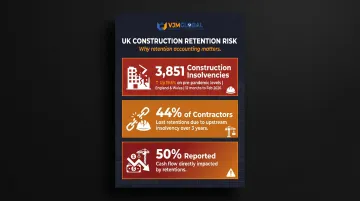
- Construction insolvencies in England and Wales reached 3,851 in the 12 months to February 2026—up 19.6% on pre-pandemic levels
- 44% of contractors surveyed by the Pye Tait report lost retentions to upstream insolvency over a three-year period
- 50% reported their cash flow was directly affected by retentions
How to Account for Retentions in UK Construction: Step-by-Step
Step 1: Record the Full Contract Value as Income
Record the full gross value of the work completed—including the retention element—as turnover in your profit and loss account at the point of completion or the relevant contract stage. Do not wait for cash receipt to recognise income, as this would understate revenue and distort your tax position.
This aligns with both generally accepted accounting practice (GAAP) and HMRC's Business Income Manual (BIM51520), which permits two methods:
Method 1 (Turnover method): Include retentions within turnover, provide for the estimated cost of remedial work, and make provision for any debt impairment
Method 2 (Deferral method): Defer recognition of retentions until their receipt becomes "virtually certain"
Most small contractors use Method 1 because it gives a clearer, more accurate picture of revenue. HMRC only challenges Method 2 where a builder defers recognition, but in practice a large proportion of retentions are consistently received—creating a material tax difference.
Step 2: Separate the Retention Into a Dedicated Balance Sheet Code
Rather than leaving the retention in your standard trade debtors ledger, move it to a separate "Retention Receivable" or "Retention Debtor" code on the balance sheet. This keeps your aged debtor report accurate and prevents chasing the wrong figures for cash collection.
Example:
Contract value: £100,000
Retention: 5% (£5,000)
Accounting entries:
- Record £100,000 income in P&L
- Post £95,000 to trade debtors
- Post £5,000 to retention debtor account (separate balance sheet code)
This separation matters. Mixing retentions with trade debtors inflates your apparent current debtors, distorts cash collection reports, and makes aged retention tracking unreliable.
VJM Global works with UK construction firms to set up dedicated receivable and payable retention codes within their accounting systems—making it straightforward to monitor what's owed and when.
Step 3: Raise a VAT Invoice (or Record Receipt) to Trigger the VAT Tax Point
Unlike the income recognition point, the VAT tax point for a retention is delayed under Regulation 89 of the VAT Regulations 1995. VAT is not due to HMRC until either:
- A VAT invoice is raised for the retention, or
- The retention payment is received
Whichever happens first.
Practical implication: Do not include the VAT on the retention in your VAT return until that tax point is reached. This means your VAT liability does not arise at the time of the original invoice—only on the non-retained portion.
Note on Domestic Reverse Charge (DRC): For CIS-registered businesses, the customer accounts for VAT rather than the supplier under the DRC (in effect since 1 March 2021), making the timing issue less critical for many subcontractors. However, understanding the correct treatment remains important for compliance.
Step 4: Apply CIS Deductions Only on Cash Received
CIS operates on a cash basis—deductions are only applied to the money actually paid, not the total contract value. This means the CIS tax withheld on the retention is only calculated and deducted when the retention cash is released.
Worked Example:
| Item | Gross Amount | Retention (5%) | Net Paid | CIS @ 20% | Cash Received |
|---|---|---|---|---|---|
| Labour | £10,000 | £500 | £9,500 | £1,900 | £7,600 |
| Materials | £5,000 | £250 | £4,750 | £0 | £4,750 |
| Total | £15,000 | £750 | £14,250 | £1,900 | £12,350 |
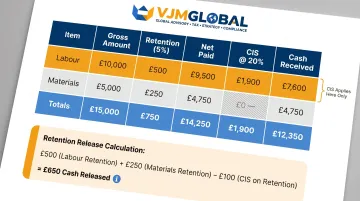
When the £750 retention is released later, CIS at 20% is calculated only on the labour element (£500), resulting in a further £100 CIS deduction and £650 cash received (£500 labour + £250 materials – £100 CIS).
Critical point: The subcontractor's payment status at the date of retention release determines whether CIS applies—not the status when the work was originally done. A subcontractor's status may change over a 12-month defects period.
Step 5: Review Retention Debtors at Year-End and Create Provisions
At the company year-end, each retention debtor balance must be reviewed. If there is reasonable doubt that a retention will ever be paid—for example, the main contractor is in financial difficulty or the retention is significantly overdue—a bad debt provision should be raised.
Corporation tax benefit: A formally raised bad debt provision reduces taxable profit, meaning corporation tax is not paid on income that may never arrive. HMRC's guidance at BIM42700 acknowledges this is common in the industry, and the provision approach is accepted provided there is documentary evidence supporting the assessment.
Evidence required includes:
- Internal memos or meeting minutes
- Correspondence with the debtor
- Solicitors' letters or reports
- Information on the debtor's financial position
- Credit agency reports
Given that 9,466 construction firms were in "critical" financial distress in Q1 2026—up 49% year-on-year—retention reviews are more important than ever.
Corporation Tax, VAT, and CIS Treatment of Retentions
Corporation Tax
Regardless of whether the retention has been received, corporation tax is payable on the full income recognised in the accounts. If a retention is included in turnover, it forms part of taxable profit for that period.
Critical: Companies must set aside tax on retention income even if the cash has not arrived. This is why the bad debt provision is so valuable—it prevents paying corporation tax (currently 25% for most companies) on amounts you may never collect.
Under BIM51520, HMRC accepts two approaches:
- Turnover method: Include retentions in turnover and offset with a bad debt provision
- Deferral method: Defer recognition until receipt is virtually certain
HMRC typically only challenges the deferral method where retentions are consistently received but not recognised, creating a material tax difference.
VAT on Retentions
The delayed tax point rule is clear: when a retention is withheld, no VAT is due at the time of the original invoice for the retained amount. VAT only becomes due when a separate retention invoice is issued or the payment lands in your bank account—whichever is earlier.
This prevents contractors from paying VAT to HMRC on money they haven't received. In practice, many contractors mistakenly include the full invoice VAT (including the retention element) in their VAT return immediately — creating an overpayment they then have to reclaim from HMRC.
Under the Domestic Reverse Charge (applicable to most construction services within CIS scope), the customer accounts for VAT rather than the supplier. The timing rules still apply — both parties need to know when the tax point falls.
CIS and Retentions
Contractors calculate CIS deductions on the cash actually paid, not the full contract value. When a main contractor pays an interim certificate and withholds a retention, the CIS deduction applies only to the amount being paid in that transaction, not the gross value.
When the retention is eventually released, the CIS deduction at that point should reflect the labour content of the retention payment. The contractor must provide a payment and deduction statement within 14 days of the end of the relevant tax month. That month runs from the 6th of one month to the 5th of the next.
Current CIS rates:
- Registered subcontractor: 20%
- Unregistered subcontractor: 30%
- Gross payment status: 0%
Accounting for Retentions You Owe to Subcontractors
Main contractors and larger subcontractors who withhold retentions from their own supply chain must record these on the payable side. The withheld amount should be recorded as a "Retention Payable" or "Retention Creditor" on the balance sheet, representing a future liability.
Matching principle: The full subcontractor cost should be recognised in the P&L when the work is done, with the withheld retention sitting as a creditor until it is released. This gives an accurate picture of liabilities and prevents the accounts from understating future cash obligations. Under FRS 102 Section 11, retention payables are classified as trade payables — financial liabilities measured initially at the transaction price and subsequently at amortised cost.
Cash flow forecasting implication: Tracking retention payables allows the business to anticipate when large retention payments will fall due. Construction CFOs should incorporate both retention receivables and payables into cash flow forecasts — this prevents liquidity surprises and gives a more accurate picture of actual working capital at any point in a project.
Common Mistakes When Accounting for Retentions
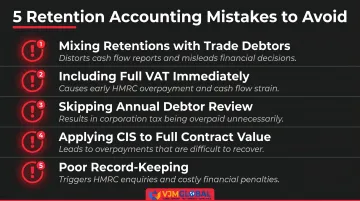
These are the most common errors contractors make — and each one carries a real financial or compliance cost:
- Leaving retentions in the main debtor ledger inflates current debtors, distorts cash collection reports, and buries aged retentions. Always use a separate balance sheet code.
- Including the full VAT on retentions in the same period as the original invoice is incorrect — the tax point is delayed, which means you're paying HMRC early and then chasing a reclaim.
- Skipping an annual review of retention debtors means no bad debt provisions are raised on amounts unlikely to be collected, so the company overpays corporation tax. Given current insolvency levels in UK construction, this review is essential.
- Applying CIS to the full contract value rather than cash actually paid leads to overpayments that are slow and difficult to recover.
- Poor records for bad debt provisions, retention release dates, or CIS calculations risks HMRC enquiries and penalties.
Frequently Asked Questions
How do you account for retentions?
Record the full contract value as income when the work is complete, move the retention element to a separate retention debtor account on the balance sheet, and raise a bad debt provision at year-end for any amounts at risk of non-recovery.
Do you capitalise retention?
No. Retentions are not capitalised as fixed assets. They are held as a current or non-current debtor on the balance sheet depending on expected receipt date, and recognised as income through the profit and loss account.
What is the VAT tax point for construction retentions in the UK?
The VAT tax point for a retention is delayed until the earlier of a VAT invoice being raised or the retention payment being received, in line with HMRC's Regulation 89 time of supply rules.
How are retentions treated under CIS?
CIS operates on a cash basis, meaning deductions are only calculated on money actually paid. CIS on a retention is not due until the cash is released and paid, based on the subcontractor's verified status at that date.
When should you raise a bad debt provision on a retention debtor?
Raise a bad debt provision when recovery becomes unlikely: for example, if the holding party is insolvent, significantly overdue, or in dispute. Doing so reduces taxable profit for that period and avoids overpaying corporation tax.
How do retention receivables appear on a UK construction company's balance sheet?
Retentions expected to be received within 12 months are shown as current debtors, while those due after 12 months may be shown as non-current debtors. Using a separate "retention receivable" code keeps them distinct from standard trade debtors and improves reporting accuracy.