Introduction
A UK subsidiary is a separate legal entity — not a branch, not a representative office. That distinction carries real compliance weight: missed filing deadlines trigger automatic penalties, and misreading group size rules can force an unexpected statutory audit costing £10,000 or more.
Overseas companies frequently underestimate how different UK accounting obligations are from those in their home jurisdiction. The rules governing what to file, when, and under which standards are specific to UK law — and they apply from day one.
This guide covers the core challenges you'll face:
- Which accounting standards apply (FRS 102 vs. UK-adopted IFRS)
- What to file with Companies House and HMRC, and when
- How to consolidate the subsidiary into the parent's group accounts
- When statutory audit is mandatory — and how group size drives that answer
- How UK tax accounting affects distributable reserves and dividend capacity
TLDR:
- UK subsidiaries file standalone statutory accounts with Companies House within 9 months of year-end
- Most UK subsidiaries use FRS 102 (UK GAAP); listed group members use UK-adopted IFRS
- Audit exemption is based on worldwide group size — large multinationals typically cannot exempt their UK subsidiary
- Corporation Tax is due 9 months and 1 day after period end; CT600 deadline is 12 months — neither aligns with Companies House
- Parent companies consolidate UK subsidiaries line-by-line under IFRS 10; transfer pricing must follow OECD Guidelines
What Is a UK Subsidiary Company?
A UK subsidiary is a company incorporated in the United Kingdom where a foreign or domestic parent holds more than 50% of the voting shares. Under s1159 of the Companies Act 2006, a subsidiary relationship exists when the holding company:
- Holds a majority of voting rights
- Has the right to appoint or remove a majority of the board of directors
- Controls a majority of voting rights under agreement with other shareholders
Legal Distinction: Subsidiary vs Branch
The distinction matters for accounting:
UK Subsidiary:
- Separate legal entity incorporated under UK law
- Files its own statutory accounts with Companies House
- Liabilities are independent of the parent company
- Taxed as a UK-resident company on worldwide profits
UK Branch:
- Extension of the overseas parent — no independent legal identity
- Registers under the Overseas Companies Regulations without creating a new legal entity
- Branch results are consolidated into the parent's accounts; no separate filing required
Independent Accounting Records Requirement
Section 386 of the Companies Act 2006 mandates that every UK subsidiary must keep adequate accounting records that must:
- Show and explain all transactions
- Disclose the financial position with reasonable accuracy at any time
- Enable directors to ensure accounts comply with the Act
This applies whether or not the parent maintains consolidated records. Parent companies must also take reasonable steps to ensure their UK subsidiary keeps records adequate for proper group consolidation.
Accounting Standards for UK Subsidiaries: FRS 102 vs UK-Adopted IFRS
UK subsidiaries choose between two primary accounting frameworks: FRS 102 (UK GAAP) and UK-adopted International Accounting Standards (IAS/IFRS). The choice depends on company size and listing status.
FRS 102: The Default Framework
Most UK subsidiaries prepare statutory accounts under FRS 102, the Financial Reporting Standard applicable in the UK and Republic of Ireland. FRS 102 is:
- Less prescriptive than full IFRS
- Tailored specifically to Companies Act 2006 legal requirements
- Appropriate for small and medium-sized entities
Reduced Disclosure Framework (Section 1A): Smaller subsidiaries meeting the small company thresholds may use Section 1A, which significantly reduces disclosure volume. From 6 April 2025, small company thresholds increased to:
- Annual turnover: £15 million (previously £10.2 million)
- Balance sheet total: £7.5 million (previously £5.1 million)
- Average employees: 50 (unchanged)
A company qualifies by meeting at least 2 of these 3 criteria.
UK-Adopted IFRS
For financial years beginning on or after 1 January 2021, UK-adopted international accounting standards replaced EU-adopted IFRS following Brexit. UK-adopted IFRS is required for:
- Subsidiaries that are part of groups with securities listed on a UK-regulated market
- Any company choosing to adopt IFRS voluntarily
Both sets of standards were identical at the point of divergence but may evolve separately over time as the UK Endorsement Board (UKEB) oversees UK adoption decisions.
IFRS 10 and IAS 27: Governing International Standards
For subsidiaries operating within an IFRS group, two standards govern how the relationship between parent and subsidiary is reported:
| Standard | What It Governs | Practical Impact |
|---|---|---|
| IFRS 10 – Consolidated Financial Statements | When and how a parent must consolidate a subsidiary | Assets, liabilities, income, and expenses combined line-by-line in group accounts |
| IAS 27 – Separate Financial Statements | How the parent records its investment in the subsidiary in its own standalone accounts | Investment carried using either the cost method or fair value through profit or loss |
Standalone Statutory Accounts Still Required
Even when a UK subsidiary is consolidated into a parent's IFRS group accounts, the subsidiary must still prepare and file its own individual statutory accounts with Companies House. Group consolidation does not replace the UK subsidiary's separate filing obligation under the Companies Act 2006.
Key Accounting Obligations: What UK Subsidiaries Must File and When
UK subsidiaries face overlapping but distinct compliance requirements from Companies House and HMRC. Deadlines are not aligned, and automatic penalties apply for late filing.
Companies House Annual Accounts Filing
Deadline: Private companies must file accounts within 9 months from the end of the accounting reference period.
Content required:
- Profit and loss account
- Balance sheet (signed by a director)
- Notes to the accounts
- Directors' report (unless small company exemption claimed)
Late filing penalties (private companies):
| How Late | Penalty |
|---|---|
| Up to 1 month | £150 |
| 1–3 months | £375 |
| 3–6 months | £750 |
| Over 6 months | £1,500 |
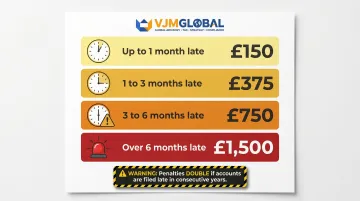
Penalties double if accounts are filed late in two successive financial years. Persistent failure can lead to compulsory strike-off.
Confirmation Statement
Every company must file a confirmation statement with Companies House at least once every year, within 14 days after the end of the review period. This confirms that company information held by Companies House is up to date. Failure to file may result in fines up to £5,000 and potential strike-off.
HMRC Corporation Tax Obligations
Registration: Register for Corporation Tax within 3 months of starting the tax accounting period.
CT600 filing deadline: Company Tax Return (CT600) must be filed within 12 months after the end of the accounting period.
Corporation Tax payment deadline: Tax due 9 months and 1 day after the period end (for non-large companies). Large companies (profits over £1.5 million) pay in quarterly instalments.
VAT Registration and MTD Compliance
If taxable turnover exceeds £90,000 in any rolling 12-month period, the subsidiary must register for VAT. Making Tax Digital (MTD) for VAT requires all VAT-registered businesses to:
- Keep records digitally
- File VAT Returns using HMRC-recognised software
- Submit returns quarterly (typically)
There is no opt-out from MTD for VAT-registered entities.
PAYE and Payroll Obligations
Subsidiaries employing staff or paying directors must:
- Operate PAYE
- Deduct income tax and National Insurance Contributions (NICs)
- Submit Full Payment Submissions (FPS) to HMRC in real time on or before each payment date
For overseas parent companies managing UK subsidiaries remotely, these obligations run on different clocks — Companies House, HMRC Corporation Tax, VAT, and PAYE each have their own deadlines and filing systems. Keeping them coordinated is one of the more common pressure points for cross-border operations.
How to Account for a Subsidiary in the Parent Company's Books
Parent companies use two approaches: the cost method in separate financial statements and full consolidation in group accounts.
Cost Method in Separate Accounts
Under IAS 27, when preparing separate (non-consolidated) financial statements, a parent accounts for its investment in a UK subsidiary using one of three methods:
- At cost: Investment recorded at acquisition cost and held at cost unless impaired
- Fair value through profit or loss: Under IFRS 9
- Equity method: As described in IAS 28
Most parents use the cost method. Dividends received from the subsidiary are recognised as income in the parent's profit and loss account.
Consolidation Process Under IFRS 10
When preparing consolidated financial statements, IFRS 10 requires the parent to combine the subsidiary's assets, liabilities, income, and expenses line-by-line with the parent's own financials. Three elimination requirements apply:
- Intercompany balances (loans, payables, receivables)
- Intercompany transactions (sales, purchases, management fees)
- Unrealised profits from intragroup trading
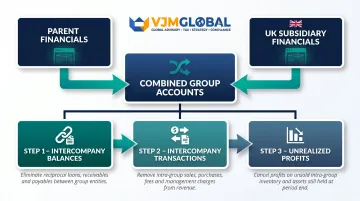
FRS 102 Section 9 requires the same consolidation approach for UK GAAP preparers.
Intercompany Transactions and Transfer Pricing
All transactions between the parent and UK subsidiary (management fees, loans, royalties, shared services) must be:
- Eliminated on consolidation to avoid double-counting
- Priced on an arm's length basis in the subsidiary's own books
UK transfer pricing rules are set out in Part 4 of the Taxation (International and Other Provisions) Act 2010. Section 164 requires interpretation consistent with OECD Transfer Pricing Guidelines — where connected-party transactions differ from arm's length terms, profits and losses must be recalculated accordingly.
HMRC requires detailed transfer pricing documentation for transactions exceeding certain thresholds. This documentation burden — including FAR (Functions, Assets, Risks) analysis and benchmarking studies — is an area where specialist support from a firm like VJM Global can help ensure compliance with both OECD guidelines and HMRC requirements.
Goodwill on Acquisition
If the parent acquires the UK subsidiary at a price exceeding the fair value of its net identifiable assets, the excess is recognised as goodwill.
FRS 102: Goodwill must be amortised over its useful economic life. If the entity cannot reliably estimate useful life, the life must not exceed 10 years. Goodwill is also subject to impairment review if indicators arise.
IFRS 3/IAS 36: Goodwill is not amortised. Instead, it must be tested for impairment at least annually and whenever there is an indication of impairment.
Audit Requirements for UK Subsidiaries: Who Qualifies for Exemption?
UK companies must have annual accounts independently audited unless they qualify for an exemption. The most common exemption is the small company exemption under s477 Companies Act 2006.
Small Company Audit Exemption
A private limited company qualifies for audit exemption if it meets at least 2 of 3 size criteria:
| Criterion | Financial years beginning on or after 6 April 2025 |
|---|---|
| Annual turnover not more than | £15 million |
| Balance sheet total not more than | £7.5 million |
| Average number of employees not more than | 50 |
An audit is still required if:
- The company's articles of association require one
- Shareholders holding at least 10% of issued share capital request one
Group Size Rule: The Critical Catch
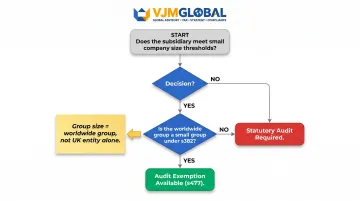
Under s479 Companies Act 2006, a subsidiary that is part of a group that does not qualify as a "small group" under s382 cannot claim the small company audit exemption, even if the subsidiary itself meets the small company criteria.
This catches many overseas-parented subsidiaries off guard. A small UK subsidiary of a large multinational group will require a statutory audit because it is the worldwide group size, not the UK entity's size alone, that determines eligibility.
s479A Parent Guarantee Exemption – Post-Brexit Restriction
Where a mandatory audit would otherwise apply due to the group size rule, one alternative route exists. Under s479A CA2006, a subsidiary may be exempt from audit if:
- The parent undertaking is established under the law of any part of the United Kingdom
- The subsidiary is included in the parent's consolidated audited accounts
- The parent formally guarantees the subsidiary's liabilities under s479C
- Members of the subsidiary agree to the exemption
Critical post-Brexit change: From 1 January 2021, this exemption is no longer available to subsidiaries of EEA parents. Only UK-incorporated parent companies can provide the s479A guarantee. For European groups with UK subsidiaries, this creates a direct compliance impact: they must either meet the standard s477 thresholds (subject to the group size rule) or accept mandatory audit.
Tax Accounting Essentials for UK Subsidiaries
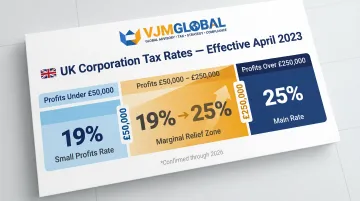
Corporation Tax Rates
From 1 April 2023 (confirmed through 2026):
| Profit Level | Rate |
|---|---|
| Under £50,000 | 19% (small profits rate) |
| £50,000 – £250,000 | Marginal relief applies (effective rate between 19% and 25%) |
| Over £250,000 | 25% (main rate) |
Taxable Profit vs Accounting Profit
The profit calculated for Corporation Tax differs from the profit shown in statutory accounts. Key divergences include:
- Capital allowances replace accounting depreciation
- Disallowable expenses (such as entertainment and certain provisions)
- R&D tax reliefs and other adjustments
When filing the CT600, the subsidiary must separately compute its profit or loss for Corporation Tax purposes and its total Corporation Tax liability.
Deferred Tax Accounting Under FRS 102
Section 29 of FRS 102 requires recognition of deferred tax for timing differences: gains and losses recognised in the profit and loss account in a different period than they are recognised in the tax computation.
Key requirements:
- Measure deferred tax using tax rates enacted or substantively enacted by the reporting date
- Recognise deferred tax assets (including tax losses) only if probable they will be recovered against future taxable profits
- Prohibit deferred tax on goodwill itself, but recognise it on fair value adjustments from business combinations
FRS 102 uses a timing differences (income statement) approach, which differs from the temporary differences (balance sheet) approach under IAS 12. These deferred tax positions feed directly into how profits are ultimately distributed to parent companies — making repatriation planning a natural next step.
Profit Repatriation: Dividends and Interest
Dividends
The UK levies no withholding tax on dividends paid by a UK subsidiary to a non-resident parent company. However, the subsidiary must have sufficient distributable reserves (retained earnings per filed accounts) before declaring a dividend.
Interest Payments
UK domestic law requires companies making payments of UK-source interest to withhold tax at 20% under ITA 2007 s874. This rate is proposed to rise to 22% for payments on or after 6 April 2027.
Exceptions where interest may be paid gross include:
- Payments to UK-resident companies
- Payments by UK banks
- Interest on quoted Eurobonds
- "Short" interest on loans intended to be in place for less than one year
If no domestic exception applies, the payer must obtain prior HMRC authorisation before paying interest at a reduced treaty rate. Key treaty rates include 0% for payments to recipients in Germany, France, and the Netherlands.
Frequently Asked Questions
How do you account for a subsidiary?
In the parent's separate financial statements, the subsidiary investment is held at cost (or fair value, or using the equity method). In group consolidated accounts, the subsidiary's financials are fully consolidated line-by-line with intercompany transactions eliminated. IFRS 10 governs consolidation; IAS 27 governs separate financial statements.
Does a UK subsidiary need an audit?
Most UK subsidiaries require an audit unless they qualify for the small company exemption — and group size, not just the subsidiary's own size, determines eligibility. Post-Brexit, the s479A parent guarantee exemption applies only where the parent is incorporated in the UK, not the EEA.
Which IFRS deals with subsidiaries?
IFRS 10 (Consolidated Financial Statements) governs when and how subsidiaries are consolidated. IAS 27 (Separate Financial Statements) covers how the parent accounts for the investment in a subsidiary in its own books.
What is a UK subsidiary?
A UK subsidiary is a company incorporated in the United Kingdom where a parent entity holds more than 50% of the shares. It is a separate legal entity with its own accounting, tax, and filing obligations under UK law, distinct from a branch or representative office.
What accounting standard does a UK subsidiary use?
Most UK subsidiaries use FRS 102 (UK GAAP). Subsidiaries in listed groups or those that choose to do so may use UK-adopted IFRS. Smaller subsidiaries may qualify for reduced disclosures under FRS 102 Section 1A if they meet the small company thresholds.