The pressure is real. HMRC's own evaluation found an 11.8% productivity increase for micro-businesses using web-based accounting software. Yet with dozens of tools now marketing themselves as "AI-powered," finding software that actually reduces your workload — rather than just looking impressive in a demo — takes more than a Google search.
This guide cuts through the noise. It covers six options for UK businesses in 2025–2026 — the five best AI accounting software platforms plus the managed alternative — what each does genuinely well, UK compliance considerations you cannot afford to ignore, and a practical checklist for making the right call.
Key Takeaways
- VJM Global is the managed alternative to adopting a tool at all — its team runs your existing platform and does the bookkeeping work the AI would otherwise assist you with
- MTD for VAT is already live; MTD for Income Tax arrives April 2026 — check compliance readiness before anything else
- Xero, Sage, QuickBooks, Dext, and FreeAgent lead the UK market for AI-assisted accounting, each suited to different business profiles
- Genuine machine learning improves over time; rules-based automation does not — the distinction matters when choosing a tool
- HMRC mandates 6-year record retention for VAT and limited companies — your software needs to handle this automatically
- AI handles the repetitive work; qualified accountants handle the judgement calls. The two work best together.
What Is AI Accounting Software and Why Does It Matter for UK Businesses?
AI accounting software uses machine learning, optical character recognition (OCR), and automation to replace manual input across core finance tasks:
- Invoice capture and processing
- Transaction categorisation
- Bank reconciliation
- Anomaly detection
- Financial reporting
Not all tools are equal, though. Genuine AI learns from corrections and improves accuracy over time — rules-based automation follows fixed instructions and fails when patterns change. Many vendors market the latter as the former, so the distinction is worth understanding before you buy.
The UK Compliance Context
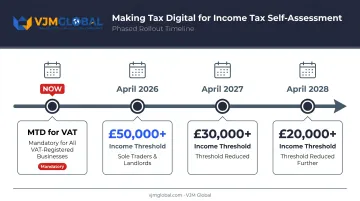
The MTD timeline makes choosing the right software genuinely urgent:
- MTD for VAT — mandatory now for all VAT-registered businesses
- MTD for ITSA from April 2026 — applies to sole traders and landlords with qualifying income (self-employment or property income) over £50,000
- April 2027 — threshold drops to £30,000
- April 2028 — threshold drops to £20,000
According to ICAEW's March 2025 research, roughly three-quarters of finance functions already use AI to enhance decision-making and productivity — manual-first workflows are becoming a competitive disadvantage.
The six options below were evaluated on how genuinely intelligent their automation is, UK compliance coverage, integration quality, and practical fit across business sizes — with the managed route assessed on the work it takes off your desk rather than the software it replaces.
Best AI Accounting Software in the UK
Best AI Accounting Software in the UK
Each option below has been evaluated for AI capability, UK tax compliance (MTD for VAT and ITSA), and practical fit across business types — from sole traders to multi-entity practices.
VJM Global
Every platform below automates work you are still responsible for. The AI categorises the transaction, but someone reviews it; the assistant drafts the report, but someone signs it off. VJM Global is the option for businesses whose real problem is not a slow workflow but no one to run it. It is a chartered accountancy and business advisory firm with 30+ years' experience and 100+ Chartered Accountants, CPAs, and company secretaries — not a tool you adopt, but a team that does the work.
This changes what the AI question means. If the constraint is finance headcount rather than data entry speed, the choice is not which assistant to buy but whether to own the process at all. VJM Global's teams work across Xero, QuickBooks, NetSuite, Zoho, SAP, Sage, and Tally — including the platforms ranked below — so you keep whatever AI features your software offers and simply stop being the one operating them. The firm handles day-to-day bookkeeping, VAT return preparation, management reporting, and month-end close.
Night-shift staffing aligned to UK working hours means work progresses overnight and queries are answered inside your business day. VJM Global has served 250+ UK businesses, reports a 95% client retention rate, and is a member of EAI International, a global network of independent accounting and tax firms.
| Feature | Detail |
|---|---|
| Scope of Engagement | Bookkeeping, VAT return preparation, management reporting, and month-end close delivered by the firm's team |
| Platforms Managed | Xero, QuickBooks, NetSuite, Zoho, SAP, Sage, Tally — including every platform ranked below |
| Pricing | Contact for pricing — monthly retainer based on transaction volume and entity count |
Best for: UK businesses that would rather outsource the finance function than automate parts of it, and those without the internal capacity to supervise an AI-assisted workflow properly.
Xero
Xero is among the UK's most widely used cloud accounting platforms, with over 250,000 accountants and bookkeepers using it in their practices. Its AI capabilities have moved well beyond automated bank feeds.
JAX (Just Ask Xero) is Xero's dedicated AI financial superagent — letting users can query their financials in plain English, automate data entry, and coordinate accounting tasks without switching between screens. Analytics Plus adds machine learning-powered cash flow forecasting across 30, 60, 90, and 180-day horizons. Bank reconciliation predictions and intelligent invoice coding reduce month-end close time considerably.
| Feature | Detail |
|---|---|
| Key AI Features | JAX AI superagent, automated bank reconciliation, intelligent invoice coding, Analytics Plus cash flow forecasting, anomaly detection |
| UK Compliance | Full MTD for VAT and ITSA support, HMRC-recognised, digital audit trails, role-based access |
| UK Pricing (excl. VAT) | Ignite £16/month · Grow £37/month · Comprehensive £50/month · Ultimate £65/month |
Note: Starter, Standard, and Premium plans were discontinued from 12 September 2024. Verify current tiers at xero.com/uk/pricing.
Best for: Accountancy practices, established SMEs, and businesses wanting a broad integration ecosystem (the Xero App Store connects hundreds of third-party tools).
Sage (Sage Accounting / Sage 50)
Sage is a UK-founded company, headquartered in Newcastle, with roughly 40 years of HMRC compliance history behind it. That track record matters when evaluating MTD readiness.
Sage Copilot, embedded directly in the Sage interface, functions as a generative AI finance assistant. It flags unusual transactions, categorises and reconciles payments, surfaces cash flow risks and trends, and checks for common HMRC-relevant errors. Because Copilot works within the existing Sage workflow, the adoption curve for existing users is minimal.
Sage also provides strong payroll integration and Construction Industry Scheme (CIS) support, making it particularly well-suited to UK contractors and construction firms.
| Feature | Detail |
|---|---|
| Key AI Features | Sage Copilot for anomaly detection, cash flow insights, automated reconciliation, intelligent invoice categorisation, AI-assisted reporting |
| UK Compliance | Full MTD for VAT, HMRC-recognised payroll, CIS support, GDPR-compliant data handling |
| UK Pricing (excl. VAT) | Sage Accounting: Start £18/month · Standard £39/month · Plus £59/month · Sage 50 base pricing — verify directly at sage.com/en-gb |
Best for: Established SMEs and accountancy practices already in the Sage ecosystem, particularly those with payroll or CIS requirements.
QuickBooks Online
Intuit launched QuickBooks Intuit Assist for the UK market in October 2024 : a generative AI assistant that interprets receipts and bills, surfaces cash flow pressure points, and identifies spending anomalies without requiring manual categorisation.
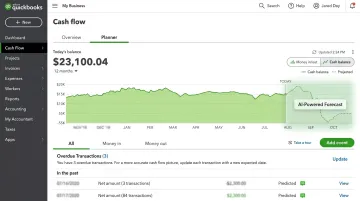
The AI-powered cash flow planner gives forward-looking projections based on recurring transaction patterns. Automated invoice chasing reduces debtor days without manual follow-up. QuickBooks integrates cleanly with e-commerce, payroll, and CRM platforms, making it a practical all-rounder for product and service businesses alike.
| Feature | Detail |
|---|---|
| Key AI Features | Intuit Assist (generative AI for queries/reports), smart expense categorisation, automated invoice chasing, AI cash flow projections, receipt capture |
| UK Compliance | MTD for VAT compliant, HMRC-recognised, self-assessment support, automated VAT calculations |
| UK Pricing (excl. VAT) | Sole Trader Plus £10/month · Simple Start £16/month · Essentials £38/month · Plus £56/month · Advanced £123/month |
Subject to 20% VAT. Free trial available. Verify at quickbooks.intuit.com/uk/pricing.
Best for: Growing UK SMEs, small product businesses, and sole traders who need strong integrations alongside MTD compliance.
Dext (formerly Receipt Bank)
Dext occupies a specific but critical position in the UK accounting workflow: it handles the pre-accounting stage. Rather than replacing your ledger, it eliminates manual data entry before the data reaches Xero, QuickBooks, or Sage.
Dext claims 99%+ extraction accuracy across receipts, invoices, and bank statements using OCR and machine learning. Supplier rules learn from previous categorisation decisions, so repetitive documents are processed automatically.
For accountancy practices managing multiple client files, Dext's bulk processing and audit-ready document storage (7-year retention with bank-level encryption) significantly cut bookkeeping overhead. It integrates with over 30 accounting platforms and connects to 11,500+ banks.
| Feature | Detail |
|---|---|
| Key AI Features | OCR-powered invoice/receipt extraction, ML supplier rules, bulk document processing, smart categorisation, expense management |
| UK Compliance | MTD-ready data export, 7-year document retention, HMRC-compliant audit trails, VAT-line extraction |
| UK Pricing | Not publicly listed — verify directly at dext.com/uk |
Best for: UK accountancy practices managing high document volumes, and businesses that want to eliminate data entry at the source before pushing clean data to their ledger.
FreeAgent
FreeAgent is built specifically for UK freelancers, contractors, and micro-businesses, and the product design reflects that focus closely. Owned by NatWest Group since 2018, it comes pre-loaded with UK tax rules and integrates directly with NatWest, Royal Bank of Scotland, Ulster Bank, and Mettle business current accounts.
Eligible NatWest and RBS business account holders get FreeAgent free, making it one of the lowest-cost MTD entry points available. The tax timeline feature proactively alerts users to upcoming HMRC deadlines (self-assessment, corporation tax, VAT), particularly valuable for business owners managing compliance without an accountant. Built-in self-assessment and Corporation Tax preparation removes the need for separate filing tools.
| Feature | Detail |
|---|---|
| Key AI Features | Automated bank categorisation, smart invoice reminders, AI-assisted expense matching, cash flow timeline, real-time tax estimates |
| UK Compliance | Full MTD for VAT and ITSA compliance, self-assessment filing, Corporation Tax preparation, HMRC-recognised |
| UK Pricing | Landlord £10/month · Sole Trader £19/month · Partnership/LLP £27/month · Limited Company £33/month · Free for eligible NatWest/RBS/Ulster/Mettle account holders |
Best for: UK freelancers, contractors, sole traders, and micro-businesses, particularly those banking with NatWest or RBS.
Key Features to Look for in AI Accounting Software for UK Businesses
Not every tool that claims "AI" actually delivers it. UK businesses face specific compliance obligations that narrow the field considerably — apply these five filters before shortlisting any platform.
1. MTD and HMRC compliance readiness Any tool you consider must support MTD for VAT now and MTD for ITSA from April 2026. Missing the quarterly submission requirements triggers a points-based penalty system — four points brings a £200 fine, with further charges from day 15 and day 30 for late payments. Verify MTD status with the vendor directly and cross-reference with HMRC's software finder for MTD VAT.
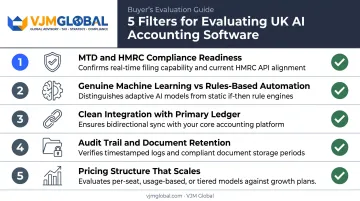
2. Genuine machine learning vs. rules-based automation The difference matters more than vendors admit:
- Rules-based tools require manual setup and break when transaction patterns shift
- Machine learning tools learn from your corrections and improve categorisation accuracy over time
Ask vendors directly whether their categorisation engine adapts from user corrections. That single question separates genuine AI from rebranded automation.
3. Clean integration with your primary ledger The tool must push structured data — including VAT lines, attachments, and audit context — directly into Xero, Sage, or QuickBooks without gaps. Any integration that exports only a CSV summary creates reconciliation work that wipes out any time saved.
4. Audit trail and document retention HMRC retention requirements by business type:
- VAT records — minimum 6 years
- Limited company accounting records — 6 years from the end of the financial year
- Self-employed records — at least 5 years after the 31 January submission deadline
- VAT OSS/MOSS records — 10 years
Look for tamper-proof, timestamped logs and source documents linked to each transaction entry. These must survive a software contract ending.
5. Pricing structure that scales with your business Flat-fee models suit high-volume users. Per-document models suit lower-volume clients. Evaluate the full cost at your expected transaction volume — not the headline entry price. Always trial before committing.
Conclusion
The UK's AI accounting software market has matured to the point where there is a credible option for every business type:
- VJM Global suits businesses that would rather hand the finance function to a team than run a tool themselves
- Xero and Sage suit established practices and larger SMEs
- QuickBooks handles growing small businesses that need broad integrations
- Dext removes data entry at source for practices managing high document volumes
- FreeAgent covers freelancers and micro-businesses with minimal friction and, for NatWest customers, no subscription cost
The right choice depends on your business size, transaction volume, existing software stack, and MTD obligations — not on which platform has the most impressive homepage.
AI automates the repetitive work. It does not replace the professional judgement required for tax planning, cross-border compliance, or strategic financial decisions. ICAEW and ACCA both frame AI as evolving the accounting role toward higher-value advisory — not eliminating it.
For UK businesses with more complex compliance requirements — particularly those operating across multiple jurisdictions or managing operations in markets like India — that gap is where professional advisory matters most. VJM Global has supported 250+ UK businesses with cross-border accounting, international tax planning, DTAA advisory, and multi-jurisdiction compliance. The firm works alongside cloud platforms including Xero and QuickBooks as part of its outsourced accounting service, sitting alongside whichever platform a business already uses.
If your compliance picture extends beyond UK borders, reach out to VJM Global at [email protected] or visit vjmglobal.com to discuss how professional advisory fits alongside your existing accounting setup.
Frequently Asked Questions
What AI accounting software is available in the UK?
The main AI accounting platforms available to UK businesses include Xero, Sage, QuickBooks Online, Dext, FreeAgent, and Zoho Books (free tier available, Standard from £12/month). Most major cloud platforms now embed machine learning or AI automation into core workflows such as bank reconciliation, invoice categorisation, and cash flow forecasting.
Which AI accounting software is best for UK businesses?
It depends on business type. Xero and Sage suit established practices and SMEs; QuickBooks suits growing small businesses; FreeAgent suits freelancers and sole traders; and Dext suits businesses focused on eliminating manual data entry upstream of their ledger. Apply MTD compliance as your first filter before comparing any other feature.
Is there a ChatGPT for accounting?
Several accounting-specific AI tools function similarly — Xero's JAX is a purpose-built AI financial superagent, and Intuit Assist in QuickBooks handles financial queries and report summaries. General tools like Microsoft Copilot and ChatGPT can assist with drafting reports, but require careful human review given the risk of inaccurate tax or regulatory outputs.
Does AI accounting software support Making Tax Digital (MTD) in the UK?
All five platforms covered in this article — Xero, Sage, QuickBooks, Dext, and FreeAgent — support MTD for VAT. MTD for Income Tax Self-Assessment expands from April 2026; verify each tool's specific ITSA readiness directly with the vendor before the deadline, as capabilities and plan inclusions vary.
Will AI replace accountants in the UK?
No. AI automates repetitive, rules-based tasks but cannot replicate the professional judgement required for tax planning, compliance strategy, or cross-border advisory. Both ICAEW and ACCA describe AI as shifting accounting roles toward higher-value advisory work — not removing the need for qualified professionals.
How much does AI accounting software cost for UK small businesses?
Entry-level plans start from £10–£19/month for sole traders (FreeAgent, QuickBooks Sole Trader Plus), with SME plans ranging from £16–£39/month depending on the platform. FreeAgent is free for eligible NatWest and RBS business account holders. Verify current pricing with each vendor directly, as rates and promotional offers change.