Introduction
Many Singapore businesses assume their existing audited accounts satisfy Dubai's requirements. They don't. An annual financial audit in Dubai is an independent, IFRS-compliant review conducted by a UAE-licensed auditor — and Dubai's regulatory framework, governed by the UAE Commercial Companies Law, Corporate Tax Law, and free zone mandates, creates obligations that differ fundamentally from Singapore's ACRA-based system.
Singapore companies filing under SFRS or SFRS(I) cannot transfer those reports to satisfy UAE authorities. Dubai requires statements audited by UAE-registered professionals — regardless of whether your Singapore audit is current or fully compliant at home.
This guide covers who must conduct a Dubai audit, what the process entails, how to prepare your books for UAE review, and the misconceptions that most commonly cause compliance failures.
Key Takeaways
- Audits are mandatory for mainland LLCs, free zone entities (DMCC, JAFZA, DIFC, DAFZA), and companies exceeding AED 50 million in revenue
- Dubai audits must follow IFRS standards, not Singapore's SFRS framework—audited accounts from home jurisdictions do not substitute for UAE requirements
- Non-compliance risks license suspension, trade license renewal blocks, lost bank credit access, and FTA penalties from AED 10,000
- Expect a 2–6 week process: planning, risk assessment, evidence gathering, testing, and formal reporting
- Year-round recordkeeping with cross-border accounting support reduces audit costs and compliance delays
What Is a Financial Audit in Dubai and Who Needs One?
A financial audit in Dubai is an independent examination of a company's income statements, balance sheets, cash flow statements, and accounting records. Its purpose is to confirm that these documents present a "true and fair view" of financial health under IFRS and UAE-specific regulations.
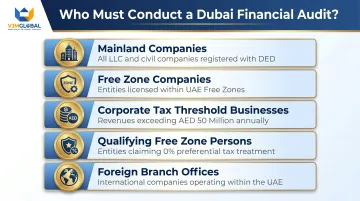
Who must conduct one:
- Mainland companies: All LLCs and PJSCs under Federal Decree-Law No. 32 of 2021 (UAE Commercial Companies Law)
- Free zone companies: Entities in DMCC, JAFZA, DAFZA, DIFC, and most other free zones require annual audits for license renewal
- Corporate tax threshold: Businesses with revenue exceeding AED 50 million under the UAE Corporate Tax Law
- Qualifying Free Zone Persons: All entities claiming the 0% corporate tax rate must maintain audited statements regardless of revenue
- Foreign branch offices: Branches of foreign companies operating in the UAE
Singapore businesses operating in Dubai frequently encounter multiple audit obligations at once — and confuse them. Here's how they differ:
Audit types clarified:
| Audit Type | Initiated By | Purpose |
|---|---|---|
| Statutory/Annual Financial Audit | Company (mandatory) | Independent verification of financial statements for regulatory compliance under ISA |
| FTA VAT Audit | Federal Tax Authority | Verify VAT compliance, invoices, input claims |
| FTA Corporate Tax Audit | Federal Tax Authority | Verify CT calculations, returns, transfer pricing |
| Internal Audit | Company (voluntary) | Assess internal controls, risk management |
The statutory audit and FTA tax audits are entirely separate obligations. Preparing for one does not satisfy the other, and both can apply to your business at the same time.
Why Singapore Businesses Operating in Dubai Must Prioritize Annual Audits
Legal Stakes and Enforcement
Non-compliance carries concrete, escalating consequences under Cabinet Decision No. 75 of 2023:
- Failure to keep required records: AED 10,000 first offense, AED 20,000 repeat within 24 months
- Late tax return filing: AED 500 per month (first 12 months), escalating to AED 1,000 per month thereafter
- Failure to facilitate tax auditor: AED 20,000
- Late payment interest: 14% per annum, charged monthly
Free zone non-compliance leads to license suspension, blacklisting, and inability to renew. DMCC, JAFZA, and DAFZA enforce audit submission deadlines strictly. Missing the deadline blocks your license renewal regardless of profitability.
Singapore-UAE Differences That Catch Businesses Off Guard
The frameworks are not interchangeable:
- Singapore companies file audited accounts with ACRA under SFRS or SFRS(I)
- UAE requires IFRS-compliant statements submitted to free zone authorities or the Ministry of Economy
- Even though SFRS(I) is substantively identical to IFRS, it is legally issued by Singapore's ASC, not the IASB—UAE authorities do not recognize it as IFRS compliance
You cannot substitute a Singapore audit for a UAE audit. The regulatory authority (Ministry of Economy for mainland, individual free zone bodies for DMCC/JAFZA/DIFC) will reject Singapore-prepared reports.
Corporate Tax Dimension
Since the UAE introduced a 9% corporate tax in June 2023, businesses must maintain verifiable, audited financial records for tax computation and FTA filing.
Key thresholds:
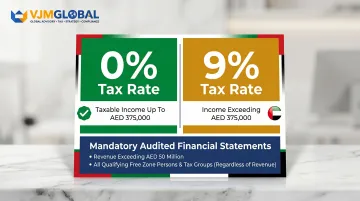
- 0% tax rate on taxable income up to AED 375,000
- 9% tax rate on income exceeding AED 375,000
- Mandatory audited financial statements for non-group taxpayers with revenue exceeding AED 50 million
- All tax groups and Qualifying Free Zone Persons must maintain audited statements regardless of revenue under Ministerial Decision No. 84 of 2025
Banking and Business Growth Benefits
UAE banks require audited financial statements for credit facilities:
- Major UAE banks (Emirates NBD, Mashreq, Dubai Islamic Bank) typically require 2–3 years of audited financials for loans exceeding AED 1 million
- Banks use audited statements to calculate Debt Service Coverage Ratio and verify asset ownership
- Non-audit-ready businesses lose access to working capital financing and growth credit lines
Free zone authorities like DMCC and JAFZA make audited financials a prerequisite for license renewal. Investors and joint venture partners demand audited accounts before committing capital. Without audit-ready books, you forfeit access to partnerships, government contracts, and external funding.
Investor and Stakeholder Confidence
The type of audit opinion matters as much as having one. A clean (unqualified) opinion confirms your financials are free from material misstatement — the baseline UAE partners and government procurement offices expect. A qualified or adverse opinion, by contrast, signals unresolved accounting issues and will prompt investors and lenders to require explanations before proceeding.
For Singapore businesses entering the UAE, audit quality also affects your standing with the FTA. Audited statements that contradict your tax filings — even inadvertently — can trigger a compliance review. Getting the audit right the first time is the cleaner, lower-risk path.
How the Annual Audit Process Works in Dubai
The process moves from engagement and planning through risk assessment, evidence gathering, testing and verification, to the issuance of an audit report—typically lasting 2–6 weeks depending on company size and records readiness.
Planning and Risk Assessment
The auditor begins by understanding your business model, industry, and financial structure. They identify areas of elevated audit risk:
- Related-party transactions between Singapore parent and Dubai subsidiary
- Intercompany pricing arrangements
- Foreign currency entries and translation adjustments
- Revenue recognition timing and contract terms
The auditor designs the audit approach based on risk areas, materiality thresholds, and regulatory requirements specific to your jurisdiction (mainland vs. free zone).
Evidence Gathering and Testing
With the risk profile established, the auditor moves into document collection and testing. Core financial records reviewed include:
- Financial statements, trial balance, and general ledger
- Bank statements reconciled to accounting records
- Sales and purchase invoices, plus fixed assets register
- Payroll records and WPS (Wage Protection System) reports
Supporting compliance documents typically requested:
- VAT and corporate tax filings
- Lease agreements
- Trade license, MoA, and shareholder agreements
Having these documents organized in advance significantly shortens audit duration and reduces costs. Businesses with year-round cloud-based bookkeeping (Zoho, QuickBooks) complete audits faster and cheaper than those scrambling to compile records post-year-end.
Reporting and Follow-Up
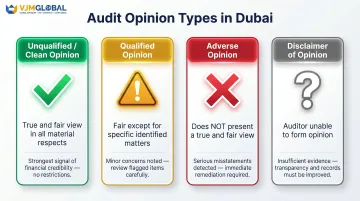
The auditor issues an audit report expressing an opinion on whether the financial statements present a true and fair view:
| Opinion Type | Meaning |
|---|---|
| Unqualified (Clean) | Statements present a true and fair view in all material respects |
| Qualified | Fairly presented except for specific identified matters |
| Adverse | Statements do NOT present a true and fair view |
| Disclaimer | Auditor unable to form an opinion due to scope limitations |
Management receives a management letter with findings and internal control improvement recommendations. The company submits the final report to the relevant free zone authority or regulatory body within the specified deadline—typically 3–6 months from financial year-end depending on jurisdiction.
How Singapore Businesses Should Prepare for a Dubai Financial Audit
Close the Accounting Standards Gap
Singapore businesses using SFRS at home must ensure their Dubai entity's books are maintained under IFRS from day one. Three standards commonly cause reconciliation issues for Singapore businesses:
Revenue recognition (IFRS 15) focuses on transfer of control rather than risks and rewards. Dubai auditors scrutinize contract terms to determine performance obligations — Singapore private companies under SFRS may recognize revenue at a different point in time.
Lease accounting (IFRS 16) requires lessees to capitalize almost all leases as right-of-use assets with corresponding liabilities. Operating leases that stay off-balance-sheet under SFRS must appear on the books for Dubai entities.
Financial instruments (IFRS 9) applies a forward-looking expected credit loss model for impairment. SFRS provisioning methods differ, so reconciliation is typically needed for accounts receivable provisions and investment classifications.
Action step: Engage an IFRS-compliant bookkeeping partner from day one of Dubai operations. Retrofitting SFRS books to IFRS post-year-end is expensive and error-prone.
Document Preparation Checklist
Treat document readiness as a year-round discipline, not a year-end task:
Core financial documents:
- Financial statements (balance sheet, income statement, cash flow, equity statement)
- Trial balance and general ledger
- Bank statements and reconciliations
- Fixed assets register with depreciation schedules
Transactional evidence:
- Sales and purchase invoices
- Payroll records and employment contracts
- Lease agreements and rental contracts
Regulatory filings:
- VAT returns and FTA correspondence
- Corporate tax registration certificate and tax returns
- Trade license (current and valid)
- Memorandum of Association (MoA)
- Board and shareholder meeting minutes
Transfer Pricing and Intercompany Transactions
Singapore businesses with parent-subsidiary or branch structures must document intercompany transactions clearly. UAE auditors and the FTA scrutinize:
- Management fees
- Royalties and IP licensing
- Shared services charges
- Intercompany loans and financing arrangements
Each of these transaction types must comply with the arm's length principle. The UAE follows OECD Transfer Pricing Guidelines under Articles 34–36 of the Corporate Tax Law, giving auditors and the FTA clear grounds to challenge pricing retrospectively.
Documentation requirements:
- Master File and Local File required if revenue exceeds AED 200 million or if part of an MNE group with consolidated revenue above AED 3.15 billion
- Transfer Pricing Disclosure Form required for all taxpayers with related-party transactions, submitted alongside the Corporate Tax Return
Maintain clear agreements and pricing justifications from the first transaction, regardless of whether you meet the formal documentation threshold.
Select a UAE-Licensed Auditor
With transfer pricing documentation in order, the next step is appointing a qualified auditor. Auditors must be registered with the UAE Ministry of Economy and/or approved by the relevant free zone authority.
Verification steps:
| Authority | How to Verify |
|---|---|
| UAE Ministry of Economy | Check MoE registered auditors list |
| DMCC | Verify against DMCC Approved Auditors List |
| JAFZA | Confirm with JAFZA authority approved auditor list |
| DIFC | Check DIFC Registered Auditors portal |
Selection criteria:
- Verify the auditor's approval status for your specific free zone
- Confirm IFRS expertise and ISA audit methodology experience
- Assess familiarity with cross-border structures and Singapore-Dubai arrangements
- Review engagement terms, timelines, and fee structure upfront
VJM Global supports foreign businesses through IFRS reconciliation, pre-audit preparation, and coordination with UAE-licensed audit partners — covering the compliance gap between Singapore accounting practices and UAE requirements.
Cost Orientation
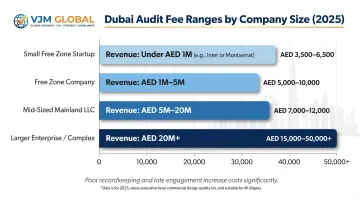
Indicative audit fee ranges by business size (2025 data):
| Company Profile | Revenue Range | Fee Range (AED) |
|---|---|---|
| Small free zone startup | Under AED 1M | 3,500 – 6,500 |
| Free zone company (general) | AED 1M – 5M | 5,000 – 10,000 |
| Mid-sized mainland LLC | AED 5M – 20M | 7,000 – 12,000 |
| Larger enterprise/complex | AED 20M+ | 15,000 – 50,000+ |
Key cost drivers:
- Transaction volume and number of entries
- Recordkeeping quality (organized cloud books reduce costs; poor records increase them)
- Corporate tax compliance scope (adds 10–20% to audit fees)
- Intercompany structure complexity
- Late engagement (last-minute requests command premium pricing)
Common Misconceptions Singapore Businesses Have About Dubai Audits
"Our Singapore-Audited Accounts Satisfy Dubai Requirements"
FALSE. UAE regulatory authorities—including the Ministry of Economy for mainland entities and individual free zone bodies (DMCC, JAFZA, DIFC, DAFZA)—require financial statements prepared under IFRS and audited by a UAE-registered auditor in accordance with ISA.
Singapore's Accounting Standards Council issues SFRS — not the IASB. Even SFRS(I), which is substantively identical to IFRS, cannot be presented as "IFRS-compliant" to UAE authorities. The regulatory framework demands IFRS as issued by the IASB, audited by a UAE-licensed professional.
Who will reject it: The Ministry of Economy (for mainland), DMCC, JAFZA, DAFZA, or DIFC (for free zones) will reject Singapore-prepared audit reports when you attempt to submit them for license renewal or regulatory filing.
"Free Zone Companies Are Exempt From Audit Requirements"
FALSE. All major Dubai free zones mandate annual audited financial statements:
- DMCC: Mandatory for all licensed entities, including zero-revenue and inactive companies, per DMCC regulations
- JAFZA: Required for license renewal
- DAFZA: Required annually with a 90-day submission deadline
- DIFC: Required under DIFC Law No. 5 of 2018 for all public companies and private companies exceeding small company thresholds (under 20 shareholders and annual turnover below USD 5 million)
Additionally, all Qualifying Free Zone Persons must maintain audited financial statements under Ministerial Decision No. 84 of 2025 for corporate tax purposes, regardless of revenue. The "free zone = no audit" assumption is simply wrong — and it leads directly to license suspension.
"Completing the Statutory Audit Covers FTA Requirements"
FALSE. This confusion is understandable — both involve auditors and compliance — but the statutory audit and the FTA tax audit are independent obligations serving completely different purposes.
Here's how they differ:
- Statutory audit: Verifies financial statement accuracy under ISA for regulatory and commercial compliance — required by your free zone or the Ministry of Economy
- FTA tax audit: A government-initiated inspection to verify VAT, Corporate Tax, or Excise Tax compliance, triggered by risk-based selection, inconsistencies in returns, large transactions, or refund claims
Both obligations exist independently. Completing one does not satisfy the other — you can face FTA penalties even with a current statutory audit, and vice versa. Federal Decree-Law No. 32 of 2021 and free zone regulations treat them as separate requirements.
Frequently Asked Questions
How much is the audit fee in Dubai?
Audit fees range from AED 3,500–6,500 for small free zone startups to AED 15,000–50,000+ for larger enterprises with complex structures. Free zone and mainland companies may be priced differently. Poor recordkeeping, high transaction volumes, and late engagement significantly increase costs.
What is the annual audit in UAE?
The annual audit is a legally required, IFRS-compliant independent examination of a company's financial statements by a UAE-registered auditor following ISA standards. It applies to most mainland and free zone companies under UAE Commercial Companies Law (Federal Decree-Law No. 32 of 2021) and individual free zone regulations.
Is a financial audit mandatory for all companies in Dubai?
It depends on legal structure and jurisdiction. Mainland LLCs and PJSCs are mandated under federal law, and most major free zones (DMCC, JAFZA, DAFZA, DIFC) require it for license renewal. The UAE Corporate Tax Law also mandates audits for businesses above AED 50 million in revenue, plus all tax groups and Qualifying Free Zone Persons regardless of revenue.
Does a Singapore company's audit report satisfy UAE audit requirements?
No. Singapore-audited accounts under SFRS or SFRS(I) do not satisfy UAE requirements — UAE authorities require IFRS-compliant statements audited by a UAE-licensed or free zone-approved auditor. Although SFRS(I) is substantively identical to IFRS, it is legally distinct and not recognized as meeting UAE compliance obligations.
What documents do Singapore businesses need to prepare for a Dubai audit?
Core documents typically requested include:
- Financial statements (balance sheet, income statement, cash flow, equity statement)
- Bank statements, reconciliations, and general ledger
- Sales and purchase invoices, payroll records, and lease agreements
- VAT and corporate tax filings, trade license, MoA, and meeting minutes
How long does an annual audit take in Dubai?
Most audits take 2–6 weeks depending on company size, transaction volume, and how well-organized the financial records are. Businesses that maintain year-round bookkeeping with cloud-based systems complete audits faster and at lower cost than those compiling records post-year-end.