Introduction
Foreign companies entering Singapore often discover two separate audit regimes operating in parallel — one governing public sector accountability, another governing private companies. Getting clarity on which framework applies to your entity is one of the first compliance questions to resolve.
The Audit Act 1966 governs public sector accountability through the Auditor-General's Office (AGO), covering government agencies and entities that administer public funds. The Companies Act Chapter 50 handles statutory audit requirements for private companies, regulated by the Accounting and Corporate Regulatory Authority (ACRA).
Both frameworks shape Singapore's compliance environment. Foreign companies entering the market may interact with either system depending on their structure and funding sources.
Key Takeaways
- The Audit Act 1966 empowers the Auditor-General to audit all public sector accounts and entities handling public funds
- Private companies must appoint a registered auditor within 3 months of incorporation unless they qualify for exemption
- Small companies meeting two of three size thresholds for two consecutive years may qualify for audit exemption
- ACRA regulates private company audits; Singapore Standards on Auditing (SSAs) align closely with international standards
- Non-compliance carries fines up to S$5,000 and potential regulatory action
Singapore's Audit Landscape: Two Distinct Frameworks
Singapore maintains separate legal pillars for audit regulation. The Audit Act 1966 (2020 Revised Edition, operative from 31 December 2021) establishes the statutory foundation for public sector audits. The Companies Act 1967 (Chapter 50) governs statutory audits for private companies.
Foreign businesses setting up Singapore entities interact mainly with Companies Act requirements. The Audit Act, however, applies directly to organizations that:
- Receive government grants or public funding
- Manage public contracts or infrastructure projects
- Partner with statutory boards or public authorities
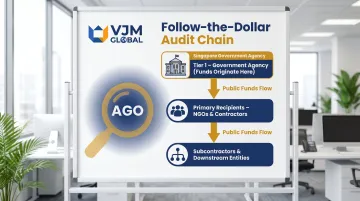
This is where the "follow-the-dollar" audit mechanism matters. Introduced via a 2017 amendment, it allows the Auditor-General to trace public funds through government agencies down to private contractors and NGOs.
Supporting this framework, the Public Sector (Governance) Act 2018 extends audit obligations to statutory boards through Part 5 provisions covering financial administration, auditor appointment, and reporting requirements for Group 1, 2, and 3 public bodies.
The Audit Act 1966: Public Sector Audit Framework
Purpose and Scope
The Audit Act 1966 anchors public sector accountability to Parliament and the President. It mandates the Auditor-General to audit government accounts, public authorities, and any entity administering public funds—ensuring proper stewardship of taxpayer money.
Key Definitions and Coverage
Section 2(1) defines the two terms that determine audit coverage:
- "Public authority" — any body established by or under written law for a public purpose
- "Public funds" — all moneys received by or on behalf of the Government or public authority, including loans, trusts, and voluntary payments for public benefit
This broad definition pulls private entities into scope. A private firm managing a government grant program, or an NGO receiving public subsidies, can fall within the AGO's audit perimeter.
Auditor-General's Duties and Powers
Section 3 defines the AG's core duties:
- Examine and audit accounts of all accounting officers and persons entrusted with public funds
- Verify that reasonable precautions safeguard collection and custody of public funds
- Confirm funds are expended for intended purposes with proper authorization
- Ensure effective rules and procedures govern revenue assessment and collection
Section 6 grants the AG extensive investigative powers:
- Free access to all records, books, vouchers, and documents
- Authority to require explanations from any person
- Power to examine individuals under oath
- Ability to search books and records in public offices
Non-compliance or obstruction carries penalties up to S$5,000 fine or 12 months imprisonment, or both.
Section 6A (introduced 2017) provides procedural protection: individuals cannot refuse to provide information on self-incrimination grounds. However, the Act grants "use immunity"—meaning information provided is generally not admissible against that individual in subsequent proceedings. The exception applies to false information offences.
Follow-the-Dollar Audits
The 2017 amendment introduced Section 4A, enabling the AGO to trace public funds beyond immediate government recipients to third parties.
Key features:
- Triggered only when the Minister for Finance, satisfied it is in the public interest, directs the AG to undertake the audit
- Covers grants, subsidies, loans, guarantees, financial assistance, and supply contracts (including subcontracts)
- Extends to NGOs, contractors, autonomous universities, and any entity receiving or disbursing public funds
- Scope limited to compliance with applicable terms and conditions
Compliance implications for vendors and grant recipients:
Organizations receiving public funding should maintain strong financial controls and thorough documentation. The AG may request records demonstrating that funds were used according to grant conditions or contract terms.
Foreign firms new to Singapore's public-private arrangements should pay particular attention to these requirements, as documentation gaps are a common audit trigger for entities unfamiliar with the framework.

Reporting and Accountability
Key reporting obligations under the Act include:
- Section 7 — AGO personnel are bound by strict secrecy obligations; confidential information obtained during audits cannot be disclosed
- Section 8 — The AG's report must be presented to the President and subsequently tabled in Parliament, typically in early July each year
These reports carry real consequences: findings can trigger remedial actions, internal investigations, and significant reputational damage for affected entities.
The FY2023/24 AGO Report identified 25 significant lapses across public sector entities, including procurement and contract management issues at National Parks Board (NParks) and Singapore Sports Council (SportSG), plus lapses in revenue handling and IT controls.
Statutory Audit Requirements for Private Companies in Singapore
Default Auditor Appointment Requirement
Under the Companies Act Section 205, all private companies incorporated in Singapore must appoint at least one auditor—either a public accountant or ACRA-registered accounting firm—within three months of incorporation. The auditor holds office until the first Annual General Meeting (AGM), after which the company may reappoint or change auditors.
Auditor's Statutory Duties
Section 207 defines the auditor's role:
- Express an opinion on whether financial statements give a true and fair view of the company's financial position
- Verify compliance with Singapore Financial Reporting Standards (SFRS)
- Examine for material discrepancies or irregularities
- Provide consolidated reports for companies with subsidiaries
- Check that accounting and other records have been properly kept
- Report immediately to the Registrar any Act breach not adequately addressed
Auditor Remuneration
Section 205(16) establishes fee-setting procedures:
- For auditors appointed at general meetings: fees fixed there or by directors if authorized
- For auditors appointed by directors or Registrar: fees determined accordingly
- Disclose fees to shareholders upon request
- Fees are negotiable between client and audit firm
Resignation and Removal Procedures
Companies must follow specific procedures depending on whether an auditor resigns or is removed:
- Provide proper notice based on the scenario (resignation vs. removal)
- Hold an extraordinary general meeting if required for removal
- Removal requires a shareholder special resolution; resignation requires written notice to the company
- Notify the Registrar within 14 days under Section 173A
Non-compliance carries financial penalties:
- Section 205(17): Fine not exceeding S$5,000 for the company and every director in default
- Section 207(10): Fine not exceeding S$4,000 for obstructing or refusing auditor access
Relevance for Foreign Companies
Foreign-owned entities face the same three-month auditor appointment deadline as locally incorporated companies—regardless of where the parent company is headquartered. This deadline frequently conflicts with parent company fiscal calendars or delayed ACRA registration timelines, creating compliance gaps before operations have even started.
For multinationals managing entities across jurisdictions, key practical considerations include:
- Confirming the Singapore subsidiary's incorporation date to track the three-month appointment window
- Aligning Singapore audit timelines with group reporting requirements
- Ensuring the appointed auditor is registered with ACRA (not simply a group auditor from another jurisdiction)
- Understanding how SFRS differs from home-country standards such as IFRS, US GAAP, or Ind AS
Audit Exemptions in Singapore: Small Companies, Small Groups, and Dormant Companies
Small Company Exemption
Section 205C defines qualifying criteria:
A private company qualifies as "small" if it meets at least two of three criteria for the past two consecutive financial years:
- Total annual revenue ≤ S$10 million
- Total assets ≤ S$10 million
- Number of employees ≤ 50
The entity must be a private company AND meet the two-out-of-three financial threshold for two straight years. Both conditions must apply together.

Small Group Exemption
For companies within a corporate group, qualification requires meeting two tests:
- The individual company must qualify as a small company
- The entire group must qualify as a "small group" on a consolidated basis
Meeting the small company threshold alone is insufficient if the wider group exceeds the limits. The consolidated group test specifically targets foreign subsidiaries of larger multinational groups that might otherwise appear to qualify based on Singapore operations alone.
Dormant Company Exemption
Section 205B exempts dormant companies (those with no accounting transactions since incorporation or since the previous financial year-end).
Transactions disregarded for dormancy determination:
- Share allotment under the constitution
- Appointment of company secretary or auditor
- Maintenance of registered office
- Keeping of statutory registers
- Payment of fees, charges, penalties under written law
- Prescribed nominal sums
Any active financial transaction outside these exceptions revokes dormant status immediately, though the exemption continues for the financial year during which the company was dormant throughout.
Disqualification and Ongoing Obligations
These rules apply across all three exemption types — small company, small group, and dormant. Companies lose exempt status when:
- They cease to be a private company during the financial year
- They fail to meet two of three criteria for two consecutive years
- Any accounting transaction (not on the disregarded list) occurs
Losing exempt status does not eliminate all compliance obligations. Even exempt companies must still:
- Prepare unaudited financial statements (UFS)
- Maintain proper accounting records under Section 199
- Hold Annual General Meetings
- Lodge Annual Returns with ACRA
Unaudited financial statements remain essential for tax submissions, bank account applications, and government grant eligibility. Financial institutions and government agencies require recent financial statements regardless of audit exemption status.
Regulatory Bodies and Singapore Standards on Auditing (SSAs)
ACRA's Role
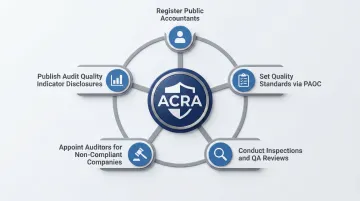
The Accounting and Corporate Regulatory Authority serves as primary regulator for private company audits. Key functions include:
- Registering public accountants and accounting entities
- Setting quality standards through the Public Accountants Oversight Committee (PAOC)
- Conducting inspections and quality assurance reviews
- Appointing auditors for companies that fail to do so
- Publishing Audit Quality Indicator (AQI) disclosures covering seven quality markers
ACRA collaborates with the Institute of Singapore Chartered Accountants (ISCA) and Singapore Accountancy Commission (SAC) to enforce professional standards.
Singapore Standards on Auditing (SSAs)
ISCA's Auditing and Assurance Standards Committee develops SSAs following formal due process. Standards require ISCA Council approval before submission to PAOC for concurrence.
SSA-ISA alignment: Singapore Standards on Auditing are "based on" International Standards on Auditing (ISAs) and maintained in line with ISAs in effect, with only limited modifications for local legal requirements. This alignment ensures Singapore audits meet global credibility standards, which matters particularly for multinational companies benchmarking Singapore's audit environment against their home country norms.
SSAs cover:
- Risk assessment and audit planning
- Evidence gathering and documentation
- Materiality thresholds
- Reporting requirements and opinion formation
On the accounting standards side, the Accounting Standards Committee under ACRA has managed Singapore Financial Reporting Standards (SFRS) since 1 April 2023, taking over from the dissolved Accounting Standards Council.
Auditor-General's Independence
The Auditor-General enjoys structural independence protecting audit integrity:
- Appointed by the President (not the Government whose accounts are audited)
- Reports directly to the President and Parliament
- Constitutional provisions safeguard the AG's independence
Current Auditor-General: Mr. Ng Wai Choong, appointed 8 February 2025, bringing 35 years of public sector experience including previous roles as Commissioner of Inland Revenue and CEO of IRAS. He replaced Ms. Goh Soon Poh, who completed approximately 6 years of service.
Frequently Asked Questions
What is the Audit Act 2019?
There is no "Audit Act 2019" in Singapore. The correct legislation is the Audit Act 1966, with the current operative version being the 2020 Revised Edition (in effect from 31 December 2021). This edition incorporates all amendments through 1 December 2021, including the significant 2017 amendment introducing follow-the-dollar audit provisions.
Who is the Auditor-General of Singapore and what is their role?
The current Auditor-General is Mr. Ng Wai Choong, appointed by the President on 8 February 2025. Under the Audit Act 1966, the AG audits government accounts, public authorities, and entities administering public funds. The AG reports directly to the President and Parliament to ensure public accountability.
Which companies are exempt from statutory audit in Singapore?
Three categories qualify for audit exemption:
- Small companies meeting two of three criteria (revenue ≤S$10M, assets ≤S$10M, ≤50 employees) for two consecutive years
- Small groups where both the company and consolidated group meet the same thresholds
- Dormant companies with no accounting transactions
All exempt companies must still prepare unaudited financial statements and meet other compliance obligations.
What is a "follow-the-dollar" audit in Singapore?
Introduced under Section 4A of the Audit Act 1966 (2017 amendment), a follow-the-dollar audit lets the Auditor-General trace public funds from government agencies to downstream recipients — including NGOs, contractors, and subcontractors. It can only be triggered when the Minister for Finance determines it is in the public interest and formally directs the AG to proceed.
What happens if a Singapore company fails to appoint an auditor?
ACRA may appoint an auditor on the company's behalf. Non-compliance with Section 205 results in a fine not exceeding S$5,000 for the company and each director in default. Companies must also notify the Registrar within 14 days of any auditor appointment or change under Section 173A.
What are Singapore Standards on Auditing (SSAs)?
SSAs are professional guidelines issued by ISCA's Auditing and Assurance Standards Committee (with PAOC concurrence) that govern how audits must be conducted in Singapore. They align closely with International Standards on Auditing (ISA), with limited local modifications, so Singapore audits meet global credibility standards and remain comparable across borders.