But picking the wrong city can backfire. Incorporate in the wrong state, and you might face unnecessary franchise taxes. Assume the wrong visa applies, and your expansion timeline stalls. Miss a sales-tax nexus threshold, and penalties follow.
This guide ranks the top US cities for Singapore-owned businesses and breaks down the visa, tax-treaty, and entity-structure factors that generic "best cities to start a business" lists usually skip.
Key Takeaways
- Delaware, San Francisco, New York, Austin, and Miami each suit different industries and funding stages for Singapore founders.
- Singapore nationals do qualify for the E-2 Treaty Investor visa, a detail many guides get wrong.
- The US and Singapore have no comprehensive income tax treaty, despite the USSFTA trade agreement.
- Entity choice (Delaware C-Corp vs. LLC) directly affects fundraising ability and profit repatriation.
- Cross-border compliance (sales tax nexus, annual reports, IRS filings) needs ongoing attention, not a one-time setup.
Overview of Starting a Business in the US as a Singapore Entrepreneur
For a Singapore founder, "best city" means something different than it does on a generic startup ecosystem ranking. It has to account for visa pathways, tax exposure, and whether the local industry mix actually fits your business.
The US-Singapore Free Trade Agreement (USSFTA), in force since January 1, 2004, underpins roughly $146 billion in bilateral trade. USSFTA is a trade agreement, not a tax treaty, and that distinction matters more than most guides admit (more on this below).
The rankings that follow weigh five practical factors:
- Incorporation speed and cost
- Tax environment
- Funding access
- Industry alignment
- Singapore-specific logistics (flight connectivity and time-zone overlap)
Best US Cities to Start a Business for Singapore Entrepreneurs
Each city below was evaluated on registration ease, tax burden, access to capital, and how well the local economy matches the sectors Singapore founders tend to build in: fintech, SaaS, hardware, and trade.
Wilmington, Delaware
Delaware is the default incorporation jurisdiction for foreign-owned startups, particularly for anyone planning to raise US venture capital. Most Delaware entities don't even operate there. They're incorporated there and run from wherever the team actually sits.
For Singapore founders, three things stand out:
- Flexible corporate law that gives founders and investors predictable governance rules
- Investor familiarity: US VCs default to Delaware C-Corps, which speeds up term sheet negotiations
- A straightforward registered-agent process that doesn't require a US-resident owner
| Factor | Details |
|---|---|
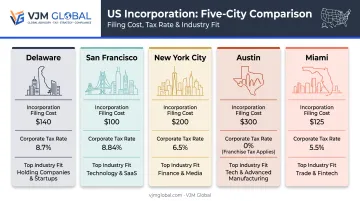
| Business Setup | Domestic corporation filing starts at $109 minimum; LLC formation runs $110 for a one-page filing. Add $9 per extra page. |
| Tax Environment | Corporate income tax is 8.7% of apportioned federal taxable income. Franchise tax minimum is $175 (Authorized Shares method) or $400 (Assumed Par Value method). |
| Key Industries | Delaware is jurisdiction-only: operating businesses are typically based elsewhere while incorporated here. |
San Francisco Bay Area, California
This is still the world's deepest startup ecosystem, and it's the natural fit for Singapore founders building SaaS, AI, or deep-tech products and planning to raise US venture capital.
What makes it worth the higher cost of living:
- Unmatched VC density: more capital chasing early-stage tech deals than anywhere else in the country
- Access to top engineering talent, particularly in machine learning and infrastructure
- Direct flights connecting Singapore to San Francisco, which matters more than people expect once you're commuting between offices
| Factor | Details |
|---|---|
| Business Setup | Corporation filing costs $100; LLC filing costs $70. Processing timelines vary by submission method (online vs. mail). |
| Tax Environment | C-corp tax rate is 8.84% with an $800 minimum franchise tax. LLCs pay the same $800 annual tax, plus an additional fee once California income exceeds $250,000. |
| Key Industries | AI, SaaS, biotech, and enterprise software, closely aligned with Singapore's tech-founder profile. |
New York City, New York
NYC suits Singapore founders whose businesses don't fit neatly into "pure tech," such as fintech, e-commerce, media, or adtech.
Why it works well for finance-heavy Singapore businesses:
- Access to enterprise clients and institutional capital that isn't purely VC-driven
- East Coast connectivity to Europe, useful for businesses with transatlantic ambitions
- A regulatory environment fintech founders recognize, given Singapore's own status as a financial hub
| Factor | Details |
|---|---|
| Business Setup | Corporation filing is $125; LLC filing is $200. LLCs must also publish notice in two newspapers within 120 days and file a $50 Certificate of Publication. |
| Tax Environment | NY State corporate tax runs 6.5%, rising to 7.25% above $5 million in business income. NYC adds its own 8.85% Business Corporation Tax on top. |
| Key Industries | Fintech, adtech, and e-commerce: sectors with strong overlap with Singapore's finance and trade base. |
Austin, Texas
Austin has become the go-to lower-cost alternative to the coastal hubs, and Texas has no state corporate income tax at all.
For cost-conscious Singapore SMEs, this matters:
- Lower operating costs across office space, salaries, and general overhead compared to California or New York
- A growing hardware and tech ecosystem that's attracted major relocations from the Bay Area
- Business-friendly state policy with minimal regulatory friction
| Factor | Details |
|---|---|
| Business Setup | LLC and corporation filings both cost $300. Expedited processing (2-3 business days) is available for an extra $50 per document. |
| Tax Environment | No state corporate income tax. Franchise tax applies above a $2.65 million revenue threshold, at 0.375% for retail/wholesale or 0.75% for other businesses. |
| Key Industries | Hardware, clean energy, and enterprise software. |
Miami, Florida
Miami works best for Singapore founders eyeing a Latin America foothold or building in fintech and trade-adjacent sectors.
The appeal here:
- No state income tax on individuals, which helps with talent retention
- A growing crypto and fintech scene with real institutional backing
- Genuine strategic value as a bridge into LatAm markets for trading and logistics businesses
| Factor | Details |
|---|---|
| Business Setup | Corporation filing totals $70 (filing plus registered-agent fee); LLC filing totals $125. |
| Tax Environment | Corporate income tax is 5.5%. Florida levies no personal state income tax. |
| Key Industries | Fintech, trade and logistics, and real estate. |
Key Considerations for Singapore Entrepreneurs Entering the US Market
Picking a city is only step one. These five factors determine whether the expansion actually works.
Entity Structure: C-Corp vs. LLC
A Delaware C-Corp is what most US investors expect to see before writing a check. It supports preferred stock, multiple funding rounds, and clean equity structures. An LLC, by contrast, offers pass-through taxation (no entity-level tax in most cases) but it's a harder sell to venture investors and complicates profit repatriation into Singapore.
If you're raising institutional capital, the C-Corp usually wins. If you're running a services or trading business funded by the founders themselves, the LLC's simpler tax treatment can be the better fit.
Visa and Immigration Pathway
Here's a correction worth making: Singapore nationals are eligible for the E-2 Treaty Investor visa. USCIS guidance on E-2 treaty investors reflects Singapore's treaty status since January 1, 2004 — many guides get this wrong.
E-2 eligibility requires:
- Singaporean nationality and a bona fide US enterprise
- Substantial capital genuinely at risk in the business
- The applicant developing and directing the enterprise, typically through 50%+ ownership or operational control
Other visa routes worth knowing:
- L-1 intracompany transfer — for founders who've worked at least one year for the Singapore parent entity within the prior three years
- EB-5 — requires a $1.05 million investment (or $800,000 in a targeted employment area) creating at least 10 jobs
- O-1 — for founders with demonstrated extraordinary ability in their field
Founders who prefer not to relocate can use a remote-founder model: incorporate and run the US entity from Singapore while keeping day-to-day operations at home.
Tax Treaty and Double-Taxation Exposure
This is the part most Singapore founders miss. The IRS's income tax treaty list does not include Singapore. The USSFTA covers trade, not income tax.
Practical implication: without treaty relief, US-source dividends paid to a Singapore parent company are generally subject to 30% withholding. Interest, royalties, and effectively connected income follow different rules, so this needs case-by-case review before repatriating profits.
Banking and Fund Flows
Opening a US business bank account remotely as a Singapore-owned entity is possible but rarely simple. Banks typically want:
- Incorporation documents and an EIN
- Beneficial ownership verification for every owner above a certain threshold
- Proof of a US business address, sometimes satisfied through a registered agent
Once funds start moving back to Singapore, tax treatment matters as much as the transfer itself. Foreign-sourced dividends, branch profits, and service income can qualify for tax exemption if the income was taxed abroad at a rate of at least 15%. Where that exemption doesn't apply, a foreign tax credit can offset Singapore tax on the same income.
Ongoing Cross-Border Compliance
Formation is the easy part. Staying compliant afterward is where founders get tripped up — federal and state filings, sales-tax nexus monitoring, and annual reports don't stop after year one.
Sales tax nexus thresholds vary by state:
- California: $500,000 in sales
- New York: $500,000 in receipts and 100+ transactions
- Texas: $500,000 threshold
- Florida: $100,000 threshold
VJM Global supports Singapore-owned businesses with US entity formation, tax filings, and back-office operations across jurisdictions — a practical need once a company is juggling multiple states' rules simultaneously.

How We Chose These Cities
The most common mistake Singapore founders make: picking a city on brand reputation alone. "Silicon Valley" sounds right until you check whether your visa pathway or tax exposure actually supports it.
This ranking weighted five factors:
- Registration ease and cost
- Tax environment
- Funding access
- Industry alignment
- Singapore-specific logistics (flight routes and time-zone overlap)
Each factor was checked against current tax and immigration data—not lifestyle appeal or brand reputation alone.
Conclusion
There's no single "best" US city for Singapore founders. The right choice is the one that matches your industry, funding stage, and visa reality. A SaaS founder chasing Series A capital and a trading business eyeing LatAm markets shouldn't land in the same place.
Before committing to a state, weigh long-term scalability against compliance costs and tax exposure. Those numbers compound over years, not just at formation.
VJM Global works with Singapore businesses on US entity formation, tax compliance, and back-office setup: the operational pieces that rarely appear on ecosystem rankings, but decide whether the move pays off. Map those costs and filing requirements before you lock in a city.
Frequently Asked Questions
What are the best cities in the USA for Singapore businesses to start a business?
San Francisco, New York, Austin, Miami, and Seattle top many shortlists, but the right choice depends on your industry, funding stage, and visa plans. A fintech founder and a hardware startup won't want the same city.
Do Singapore entrepreneurs need a visa to start a business in the US?
Incorporating a US entity does not require a visa. Personally working in or relocating to the US does. Singapore is not an E-2 treaty country, so founders typically explore L-1, H-1B, O-1, or EB-5 options depending on their situation.
What is the best US state to incorporate a company for a Singapore-owned business?
Delaware is the most common choice thanks to its flexible corporate law and investor familiarity with the Delaware C-Corp structure, regardless of where the actual operations are based.
Is there a tax treaty between Singapore and the United States?
No. The USSFTA is a trade agreement, not an income tax treaty. Without a treaty, US-source dividends to a Singapore parent are generally subject to 30% withholding, which affects repatriation planning.
Can a Singapore company open a US bank account remotely?
It's generally possible but requires incorporation documents, an EIN, and beneficial ownership verification. Many founders use professional formation services to streamline the documentation and avoid delays.
How much does it cost for a Singapore entrepreneur to register a business in the US?
Costs vary widely by state — filing fees alone range from around $70 in Florida to $300 in Texas, before factoring in registered agent and franchise tax costs. Always check current state-specific fee schedules.