Introduction
If you're a Singapore entrepreneur eyeing Dubai as your next market, the business license is where everything starts. It's the legal foundation that lets you operate commercially, hire employees, open corporate bank accounts, and trade in the UAE — without it, none of that is possible.
Dubai sits at the intersection of Asia, the Middle East, and Africa, making it a natural complement to Singapore's role as an Asia-Pacific hub. For businesses already operating out of Singapore, the geographic and commercial fit is hard to ignore.
The UAE's tax structure strengthens that case further. With 0% personal income tax and potential 0% Corporate Tax on qualifying Free Zone income, Dubai has become a top expansion destination for Singapore-based businesses.
What this guide covers:
- The types of licenses available and when to choose each
- Step-by-step process from business activity selection to license issuance
- Actual costs involved and realistic timelines
- The most common mistakes Singapore entrepreneurs make when setting up from afar
Key Takeaways
- Dubai issues business licenses under two main jurisdictions — Mainland (via the Department of Economy and Tourism) and Free Zones — each with different market access rules and tax implications
- Singapore entrepreneurs can own 100% of their Dubai business in most Free Zone setups and nearly all Mainland activities
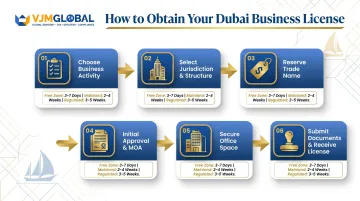
- Getting licensed follows 6 steps: choose your business activity, select a jurisdiction, reserve a trade name, get initial approval, secure office space, then submit final documents
- License costs range from AED 12,000 to AED 35,000 depending on jurisdiction and activity
- Post-licensing obligations such as Corporate Tax registration and UBO declarations are mandatory; missed deadlines carry financial penalties
Why Singapore Entrepreneurs Are Choosing Dubai to Expand
Dubai serves a strategic purpose for Singapore businesses: it provides direct access to the Middle East, Africa, and South Asia, complementing Singapore's existing position as an Asia-Pacific gateway. Total bilateral trade in goods between Singapore and the UAE reached S$27.94 billion, confirming the UAE as Singapore's largest Middle East trading partner.
Structural advantages for Singapore entrepreneurs:
- 0% personal income tax on all employment and salary income
- 0% Corporate Tax for qualifying Free Zone entities meeting substance requirements
- 9% Corporate Tax on Mainland businesses only on taxable income above AED 375,000
- No capital gains tax on qualifying equity participations (5%+ ownership held for 12+ months)
Singapore's tax regime, while already competitive, imposes a corporate tax rate of 17% on chargeable income above S$200,000. For Singapore companies earning above that threshold, a Dubai Free Zone entity can reduce the effective corporate tax burden to zero — a material advantage for businesses with significant cross-border revenues.
Tax efficiency is only part of the picture. The bilateral trade infrastructure makes market entry equally straightforward.
Trade framework:
The bilateral trade relationship operates through the GCC-Singapore Free Trade Agreement (signed 2008, in force 2013) and a Bilateral Investment Treaty (signed 2017, in force 2019). The GSFTA eliminates tariffs on approximately 99% of Singapore's exports to the GCC, removing import duties that would otherwise raise costs for Singapore exporters entering Gulf markets.
Types of Business Licenses and Jurisdictions in Dubai
Three License Categories
Dubai issues three primary license types:
| License Type | Purpose | Common Activities |
|---|---|---|
| Commercial | Trading and distribution | Import, export, buying/selling goods |
| Professional | Service-based businesses | Consulting, IT, marketing, design |
| Industrial | Manufacturing or production | Processing, assembly, fabrication |
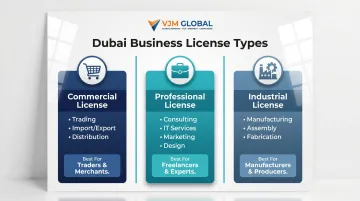
Singapore entrepreneurs most commonly pursue Commercial or Professional licenses, depending on whether their business model centers on trading goods or delivering services.
Mainland vs. Free Zone: The Critical Decision
Mainland licenses (issued by the Department of Economy and Tourism, DET):
- Allow direct trade with the UAE local market
- Enable government contract bidding
- Permit unrestricted geographic operations within the UAE
- Require Ejari-registered office lease
- Subject to standard 9% Corporate Tax on income above AED 375,000
Free Zone licenses (issued by individual zone authorities):
- Designed for international trade and cross-border services
- Simpler, faster setup process (3-7 working days)
- May qualify for 0% Corporate Tax on eligible income
- Cannot sell directly to UAE mainland customers without a mainland distributor or branch
- Often include flexi-desk and visa packages in upfront cost
Jurisdiction choice directly determines who you can sell to. If your model requires supplying UAE government entities or selling directly to UAE consumers, a Mainland license is mandatory — a Free Zone license won't suffice. Many applicants choose Free Zone based solely on lower upfront cost without recognizing this restriction until it's too late.
Most Relevant Free Zones for Singapore Businesses
DMCC (Dubai Multi Commodities Centre):
- Industry focus: Commodities, crypto, finance, trading, AI, gaming
- Setup cost: Basic Biz Package from AED 35,484; Jump Start Package AED 43,780 (includes flexi desk)
- Visa allocation: 2-year employment visa from AED 2,973
- Best for: Fintech, trading houses, commodities firms
IFZA (International Free Zone Authority):
- Industry focus: SMEs, consultancy, general trading, tech
- Setup cost: From approximately AED 12,900 (zero-visa) to AED 14,900+ (one-visa packages)
- Visa allocation: Included in license tier packages
- Best for: Startups and cost-conscious service providers
JAFZA (Jebel Ali Free Zone Authority):
- Industry focus: Logistics, petrochemicals, food processing, oil & gas
- Setup cost: Via cost calculator at jafza.ae — pricing varies significantly by activity and space requirements
- Visa allocation: Shareholder, director, and employee visas available
- Best for: Logistics, manufacturing, supply chain operations
Once you've identified the right zone, the next decision is how to structure the entity itself.
Legal Structure Options
Within Free Zones, you can establish:
| Structure | Shareholders | Use Case | Liability |
|---|---|---|---|
| FZ-LLC | 2-50 | Multi-shareholder setups | Limited to capital |
| Sole Establishment | 1 | Single-owner businesses | Limited to capital |
| Branch of Foreign Company | Parent company | Extension of Singapore entity | Parent company liable |
Structure selection affects liability exposure, visa quotas, and banking eligibility. Branches of foreign companies require more documentation during bank account opening but may simplify reporting for Singapore headquarters.
100% Foreign Ownership Confirmed
Federal Decree-Law No. 26 of 2020, effective early 2021, removed the requirement for 51% Emirati ownership for most activities. Singapore nationals can now hold 100% ownership in all Free Zone setups and nearly all Mainland activities.
Still restricted sectors requiring UAE national participation:
- Security and defense
- Telecommunications
- Financial services (banks, exchange houses, insurance)
- Commercial agencies
- Hajj and Umrah organizing
For all other activities, Singapore entrepreneurs can establish sole-ownership companies without a local sponsor.
Step-by-Step Guide to Obtaining a Business License in Dubai
The process follows a sequential structure governed by the licensing authority you choose. Typical timelines:
- Free Zone: 3–7 working days
- Mainland: 2–4 weeks
- Regulated activities (requiring ministry approvals): 3–5 weeks
Step 1: Choose Your Business Activity
Dubai authorities maintain a classified list of approved business activities. Selecting the right one is critical because it determines:
- License type required (Commercial, Professional, or Industrial)
- External approvals from sector regulators
- Future costs and visa allocations
Activities requiring external regulator approval:
| Regulator | Sector |
|---|---|
| Dubai Health Authority (DHA) | Healthcare, medical services, clinics |
| Road and Transport Authority (RTA) | Transport, logistics, vehicle-related |
| Dubai Civil Aviation Authority | Air cargo, travel agencies |
| Ministry of Human Resources | Recruitment, manpower supply |
| National Media Council | Publishing, advertising, printing |
Advice for Singapore entrepreneurs: Map out planned activities for the next 2–3 years before selecting a category. Amending a license later adds cost and processing time.
Step 2: Select Your Jurisdiction and Legal Structure
This decision should be based on:
- Local UAE clients require a Mainland license; international clients can operate from a Free Zone
- Qualifying Free Zone income may achieve a 0% corporate tax rate
- Free Zones often carry lower upfront costs but restrict direct access to the local UAE market
Important: Switching jurisdictions after setup requires complete re-licensing. A Free Zone license cannot be converted to Mainland, and vice versa.
Step 3: Reserve a Trade Name
UAE trade name rules are specific:
Prohibited:
- God's names or divine attributes (Arabic or English)
- Country names, continent names, or city names (without government approval)
- Offensive or indecent language
- Government organization names or abbreviations
Required:
- Must end with legal structure suffix (LLC, FZ-LLC, EST, FZCO)
- Must be translatable to Arabic (foreign names incur additional annual reservation fees)
- Certain words like "Capital" require Central Bank approval
Step 4: Apply for Initial Approval and Draft the MOA
Initial Approval is a government "no objection" certificate confirming the licensing authority has cleared the proposed activity for registration. It does not permit trading.
For LLC structures:
- A Memorandum of Association (MOA) must be prepared and notarized
- MOA defines shareholder ownership percentages, capital contributions, and management structure
For regulated activities:
- A No Objection Certificate (NOC) from the relevant authority must be secured before initial approval is finalized
Step 5: Secure Office Space and Register the Lease
All UAE business licenses require a registered physical address. Options include:
| Office Type | Visa Allocation | Cost Impact | Best For |
|---|---|---|---|
| Flexi-desk | 2–3 visas | Lower | Startups, remote teams |
| Dedicated office | Varies by size | Higher | Teams requiring physical presence |
Mainland requirement: Lease must be registered with Ejari and attested by the Real Estate Regulatory Agency (RERA).
Free Zone requirement: Office type directly affects visa allocation. Flexi-desks typically allow 2–3 visas; larger offices allow more.
Step 6: Submit Final Documents and Receive the License
Standard document set required:
- Passport copies of all shareholders (6+ months validity)
- Trade name reservation certificate
- Initial approval receipt
- Signed Memorandum of Association
- Office lease agreement (Ejari-registered for Mainland)
- Any external regulatory approvals
- Recent passport-size photographs
Digital issuance: Once fees are paid, the license is issued digitally and synced with the Ministry of Human Resources and the Federal Tax Authority.
Remote processing: Many Free Zone licenses can be completed entirely without traveling to the UAE. A business setup advisor familiar with Dubai's regulatory process can coordinate document attestation, authority liaison, and submission on your behalf — which is particularly useful when managing the process from Singapore across different time zones.
Costs, Timeline, and Documents Required
Cost Breakdown by Jurisdiction
Free Zone licenses:
- DMCC Basic Biz Package: AED 35,484 (includes license, visa processing, registration)
- DMCC Jump Start Package: AED 43,780 (includes flexi desk)
- IFZA standard packages: AED 12,900 to AED 20,900 (depending on visa allocation)
- JAFZA: Via cost calculator (varies by activity and office type)
Mainland licenses:
- Commercial licenses: Approximately AED 18,500 to AED 24,500 (registration, trade name, license issuance)
- Professional licenses: Approximately AED 15,000 to AED 35,000 (depending on activity and office rent)
- Market fees calculated as percentage of office rent apply to some Mainland setups
DET does not publish a public fee schedule. Verify costs directly with DET or a licensed business setup consultant before committing.
Variable Costs Often Underestimated
These costs catch many first-time applicants off guard — budget for them from day one:
- Each 2-year employment visa: AED 3,000 to AED 5,000 per person
- Medical screening and Emirates ID: Additional AED 500 to AED 800 per person
- Sector-specific permits (DHA, RTA, or other regulators): AED 2,000 to AED 10,000
- DMCC annual license renewal: AED 20,285 (standalone); AED 50,265 for General Trading
- Late renewal penalties: AED 2,500 (31-60 days), AED 5,000 (61-90 days)
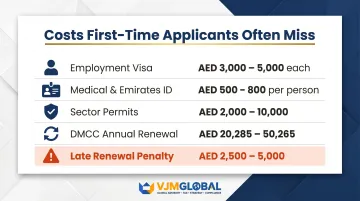
Plan for at least two years of operational costs — not just Year 1.
Standard Document Checklist for Singapore Entrepreneurs
Gather these before starting your application to avoid delays:
- Valid passport (minimum 6 months validity) for all shareholders
- Recent passport-size photographs (white background)
- Proof of current Singapore business registration (required for branch setups)
- Business plan (required by select Free Zones)
- Personal bank statements for the past 6 months (needed for post-licensing bank account opening)
Typical Timeline
| Jurisdiction / Activity | Typical Timeline |
|---|---|
| Free Zone (standard setup) | 3–7 working days |
| Mainland (non-regulated) | 2–4 weeks |
| Regulated activities | 3–5 weeks |
| Basher platform (simple Mainland activities) | 15 minutes to same day |
The Basher digital platform (basher.gov.ae) enables some Mainland licenses to be issued in as little as 15 minutes for simple, non-regulated activities. Most Singapore-based applicants setting up remotely or pursuing regulated activities won't qualify for this fast-track route.
Common Mistakes Singapore Entrepreneurs Should Avoid
Mistake 1: Choosing Jurisdiction Based on Cost Alone
The most consequential pre-licensing mistake is selecting a Free Zone solely because of lower upfront cost, without considering market access needs.
Reality check: A Singapore entrepreneur wanting to supply UAE government entities or sell directly to UAE consumers must have a Mainland license. A Free Zone license will not permit this activity without establishing a separate Mainland branch or appointing a local distributor, which adds significant cost and complexity.
Ask before choosing:
- Who are my target customers? (UAE-based or international?)
- Will I need to bid on government contracts?
- Do I plan to open retail locations or service UAE-based clients directly?
If any of these apply, a Mainland license is the right starting point — Free Zone restructuring later is possible but costly.
Mistake 2: Overlooking Post-Licensing Compliance Obligations
Many new Dubai business owners — particularly those managing operations remotely from Singapore — overlook mandatory post-licensing requirements:
Corporate Tax registration on EmaraTax:
- Deadline: Within 3 months of incorporation for companies formed on or after 1 March 2024
- Penalty for late registration: AED 10,000 administrative penalty
- Applies to: All companies, including dormant entities
Ultimate Beneficial Owner (UBO) declaration:
- Deadline: Within 15 days of licensing
- Requirement: Any individual owning 25% or more must be identified and registered
- Penalty for non-compliance: AED 50,000 to AED 100,000, with possible license suspension
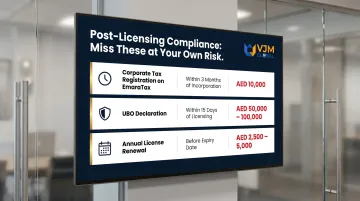
Annual license renewal:
- Must be completed before expiry date
- Late renewal penalties range from AED 2,500 to AED 5,000 depending on delay period
Mistake 3: Assuming Bank Account Opening Is Automatic
A Dubai trade license does not guarantee a smooth bank account opening. UAE banks run rigorous AML compliance checks — particularly for non-resident shareholders — and the process takes 4–8 weeks with traditional banks.
Best practices:
- Initiate the banking process immediately after Initial Approval, not after license issuance
- Prepare documents in advance: 6 months of personal bank statements, a clear business model summary, expected transaction flows, and source of funds evidence
- Consider digital-first banks like Emirates NBD's online business account channel for faster processing
- Be prepared for video KYC interviews and detailed questionnaires about beneficial ownership
Frequently Asked Questions
How much does a business license cost in Dubai?
License costs typically range from AED 12,000 to AED 35,000, varying by jurisdiction (Free Zone vs. Mainland), business activity, and office type. Budget separately for visas (AED 3,000–5,000 each), regulatory approvals (AED 2,000–10,000), and annual renewals.
Can you own 100% of your business in Dubai?
Yes, Singapore entrepreneurs can own 100% of their business in all Free Zone setups and in nearly all Mainland activities following the 2021 UAE ownership reforms. Only a small number of strategically sensitive sectors (security, telecoms, financial services, commercial agencies) still require a local partner.
What are the different types of business licenses in UAE?
The three main types are Commercial (for trading and distribution), Professional (for service-based businesses such as consulting and IT), and Industrial (for manufacturing or production). Your primary business activity determines the correct type — it must match your actual operations.
How do I register my business in UAE?
The process covers six steps: choose a jurisdiction and activity, reserve a trade name, obtain initial approval, secure office space, submit documents (MOA if applicable), pay fees, and collect the license. Free Zone setups complete in 3–7 days; Mainland setups take 2–4 weeks.
What is the difference between LLC and FZ-LLC in UAE?
An LLC operates under UAE Mainland law (Federal Decree-Law No. 32 of 2021), supports 1–75 shareholders, and gives full UAE market access. An FZ-LLC is governed by the relevant Free Zone authority, supports 1–50 shareholders (varies by zone), and restricts direct mainland trading. Both structures cap personal liability at the amount of capital contributed.