
Registration isn't one-size-fits-all. Contractors and subcontractors follow different routes with HMRC, and mixing them up creates real financial pain. Get the category wrong, or skip registration altogether, and you're looking at deduction rates three times higher than they need to be.
This guide covers eligibility, the exact registration steps, how to qualify for gross payment status, and the mistakes that trip up limited companies most often.
Key Takeaways
- Limited companies register as a contractor, subcontractor, or both, based on their construction role
- Contractor registration runs through HMRC's standard new-employer process
- Unregistered subcontractors face a 30% deduction instead of the standard 20%
- Gross payment status lets verified companies get paid with zero deductions
- Overseas-owned companies doing UK construction work follow a separate registration path
What Is CIS and Why It Matters for Limited Companies
CIS is HMRC's mechanism for collecting tax upfront from the construction sector. Under the scheme, contractors deduct money from subcontractor payments and send it straight to HMRC. These deductions count as advance payments toward the subcontractor's own tax and National Insurance bill.
Here's the part that catches limited companies off guard: your company can be a contractor, a subcontractor, or both at the same time. It depends entirely on which side of the payment you're on for a given job.
- Paying another business for construction work? You're acting as a contractor for that transaction.
- Getting paid by another business for construction work you've carried out? You're the subcontractor.
Plenty of limited companies do both within the same month, hiring subcontractors on one job while working under a main contractor on another.
The Cost of Getting This Wrong
The financial stakes are specific and significant:
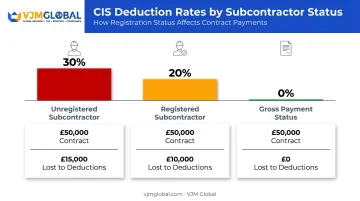
| Status | Deduction rate |
|---|---|
| Unregistered subcontractor | 30% |
| Registered subcontractor | 20% |
| Gross payment status | 0% |
This deduction mechanism comes from the Finance Act 2004, which gives HMRC the legal basis to withhold tax at source from construction payments. The actual percentages (30%, 20%, 0%) aren't printed in the Act itself — they're set out in current HMRC guidance. On a £50,000 contract, that's the difference between losing £15,000 and losing £10,000 to deductions before you've even filed a tax return.
Contractor vs Subcontractor: Which Registration Applies to Your Limited Company
Before registering, you need to know which hat your company is wearing. Sometimes it's both.
Who Must Register as a Contractor
You must register as a contractor if your limited company:
- Pays subcontractors for construction work as its core business, or
- Is a non-construction business that has spent more than £3 million (excluding VAT) on construction within a rolling 12-month period
That second point catches businesses off guard. A retailer fitting out multiple stores, or a manufacturer expanding its factory floor, can trigger "deemed contractor" status purely through spend, with no intention of ever becoming a construction company.
Who Must Register as a Subcontractor
Any limited company carrying out construction work for a contractor needs subcontractor registration. This applies whether you're providing:
- Labour only
- Labour and materials combined
There's no minimum contract size or company size exemption here.
What Counts as Construction Work Under CIS
| Covered by CIS | Usually exempt |
|---|---|
| Site preparation, demolition, alterations, repairs | Architecture and surveying |
| Heating, lighting, power, and drainage installation | Scaffolding hire without labour |
| Internal cleaning during construction | Delivery of materials only |
| Construction, extension, and decorating | Carpet fitting |
Contractors and Subcontractors Have Different Jobs
Once registered, the ongoing obligations diverge sharply:
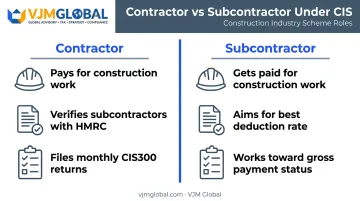
- Contractors must verify every subcontractor with HMRC before the first payment and file monthly CIS300 returns.
- Subcontractors need to focus on securing the best deduction rate and, ideally, working toward gross payment status.
Many limited companies handle both roles at once. Getting the registration order wrong for either side is the single most common CIS mistake we see.
Step-by-Step Guide to Registering Your Limited Company for CIS
Two things need to be in place before you touch the CIS registration process:
- Your company must already be registered with Companies House
- You need a Corporation Tax UTR (Unique Taxpayer Reference)
You'll also need to register as an employer with HMRC, even if you have zero employees, because contractor registration for CIS runs through the PAYE for employers system.
Registering as a Contractor
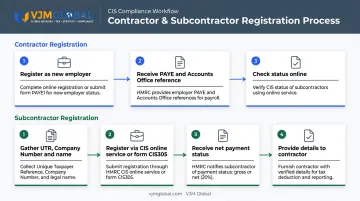
- Register as a new employer online through HMRC's employer registration service. Do this before your first payday, and no more than two months before you start paying anyone.
- HMRC confirms registration by letter, including your Employer PAYE reference, which you'll need to operate CIS. You'll also need an Accounts Office reference to verify subcontractors later.
- Check your registration status using HMRC's reply-time checker tool if you haven't heard back. Processing times vary, so don't assume a fixed number of working days.
Registering as an employer sets you up to operate CIS as a contractor, but it's the employer registration process itself, not an automatic side-effect, that gets you there. Answer the employer registration questions accurately regarding construction activity.
Registering as a Subcontractor
- Use HMRC's CIS online service with three key details: your company's Corporation Tax UTR, Company Registration Number, and registered company name.
- This registers you for "net payment status," meaning you'll receive payments with 20% deducted, rather than 30%.
- No online access? Use form CIS305, which also lets you apply for gross payment status at the same time.
Whichever route you use, your company details must match exactly across Companies House, HMRC, and the CIS system. Even a slight mismatch in your registered name can cause verification failures down the line.
Overseas-owned companies doing UK construction work face an added layer of complexity. These businesses follow a related but distinct process, using HMRC's non-resident CIS registration route. This typically requires additional documentation, such as a tax-clearance certificate from the home country. For companies managing compliance across multiple jurisdictions, firms experienced in cross-border advisory, including VJM Global, can help coordinate this alongside home-country tax obligations.
Applying for Gross Payment Status
Gross payment status is the endgame for many growing subcontractors. It means your contractor pays you in full, with zero CIS deductions at source. Instead, you handle your tax obligations directly through normal Corporation Tax filings.
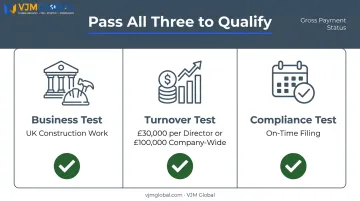
The Three Tests You Must Pass
| Test | What it checks |
|---|---|
| Business test | Your company carries out UK construction work (or supplies labour for it) and operates through a bank account |
| Turnover test | Net construction turnover (excluding VAT and materials) reaches £30,000 per director, or £100,000 for the company overall |
| Compliance test | Your tax and National Insurance filings and payments have been made on time |
If your company is controlled by five or fewer people, the £30,000 threshold applies per controller, not just per director.
One application does double duty. If you're not yet CIS-registered, applying for gross payment status registers you for CIS at the same time.
Reviewed Every Year, Not a One-Time Win
HMRC reviews gross payment status annually. Miss payment deadlines or file late, and it can be withdrawn:
- HMRC first writes explaining the issue
- If unresolved, a withdrawal letter follows, effective in 90 days
- You have 30 days to appeal
- Reapplication isn't possible for one year after cancellation
Why Bother With Gross Status Early
For a limited company scaling up, the cash flow difference is substantial. A subcontractor turning over £300,000 a year loses £60,000 to standard 20% deductions. That cash sits tied up until the next tax reconciliation. Gross payment status keeps it in your working capital from day one. Many limited companies apply the moment they clear the turnover threshold, rather than waiting.
Avoiding Common Registration Mistakes and Getting It Right
Registration is the starting line, not the finish line. Here's where limited companies typically go wrong.
Frequent Registration Errors
- Registering late: starting construction work before completing registration, triggering the higher deduction rate retroactively on early invoices
- Registering under the wrong category: treating the company as subcontractor-only when deemed contractor status has already kicked in
- Mismatched company details: registered name or number differing slightly between Companies House, HMRC, and the CIS system, causing verification failures
The Compliance Doesn't Stop at Registration
Once registered as a contractor, you're committed to:
- Verifying every new subcontractor with HMRC before the first payment
- Filing CIS300 returns by the 19th of each month
- Keeping accurate records of every deduction made
Miss a monthly return and penalties start at £100 for a single day late, climbing to as much as £3,000 or 100% of the CIS deductions on the return if it's over 12 months overdue.
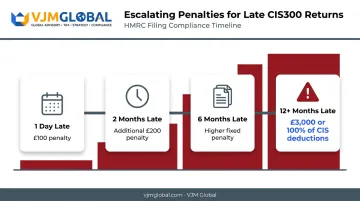
That's a steep price for an administrative slip, and it's exactly why overseas-owned or first-time UK limited companies often bring in specialist support before their first invoice goes out rather than fixing errors after the fact.
Frequently Asked Questions
How do I register for CIS?
Register as a contractor through HMRC's new employer process, or as a subcontractor via HMRC's CIS online service using your company's UTR and Company Registration Number. Many limited companies need to complete both.
Do you need to be CIS-registered?
Contractors must register by law before paying subcontractors. Subcontractors aren't legally required to register, but unregistered subcontractors face a 30% deduction instead of the standard 20%.
Why is CIS registered?
CIS exists so HMRC can collect tax and National Insurance in advance from construction payments, reducing tax evasion in an industry historically prone to it.
What are the different types of CIS?
Three deduction categories apply: unregistered (30%), registered standard (20%), and gross payment status (0%). Separately, businesses register under contractor, subcontractor, or both categories depending on their role.
How long does CIS registration take?
Processing times vary and aren't fixed by HMRC. Check the official reply-time checker for current estimates based on your specific request type.
What is gross payment status under CIS?
It lets verified limited companies receive full payments with no CIS deductions at source. Qualifying requires passing HMRC's business, turnover, and compliance tests, and the status is reviewed annually.