Introduction
A lot of US founders have a Singapore Pte Ltd sitting quietly on ACRA's register right now. Maybe it was set up to test Southeast Asian demand, hold IP, or launch a venture that never got off the ground. Then priorities shifted, and the entity just... stopped.
Here's the problem: dormant doesn't mean closed. ACRA and IRAS both keep the clock running on filing obligations, and every missed deadline adds risk.
Managing this from the US only makes it harder:
- No local Singpass access
- No eyes on registered-office mail
- A five-month process across a 12–13 hour time difference
This guide walks through what "dormant" actually means to each regulator, the exact striking-off steps, what to prepare on the US tax side, and whether closing is even the right call.
Key Takeaways
- ACRA and IRAS define dormancy differently—your company stays legally live until struck off
- Striking off is free via ACRA and usually completes in 3–6 months if the company is debt-free
- US owners must clear Singapore tax filings and track US items such as Form 5471
- Missing director consent or a lapsed company secretary are the top reasons applications stall
Understanding Dormant Company Status in Singapore
ACRA and IRAS look at completely different things when they assess whether your company is "dormant." Confusing the two is one of the fastest ways to derail a closure timeline from overseas.
ACRA's Test: No Accounting Transactions
ACRA considers a company dormant when it has no significant accounting transactions during the financial period: nothing that would affect the financial statements. A company can technically be dormant under this test even after incorporation, if it never traded at all.
IRAS's Test: No Income Earned
IRAS asks a different question: did the company earn any income during the whole basis period? Under IRAS's income-based definition, a dormant company may still apply for a filing waiver when:
- Returns and computations have been filed through cessation
- No investment income exists
- There is no plan to restart within two years
Here's why this matters for a US owner planning an exit:
- Dormant for IRAS (no income) can still mean "live" and filing-obligated under ACRA until strike-off
- Getting an IRAS waiver doesn't end ACRA's annual return requirement
- Neither status equals closure — only a completed strike-off or wind-up does that
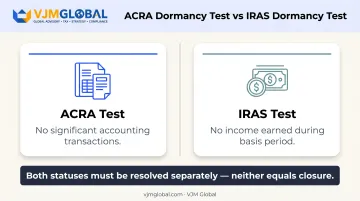
Treat these as two separate boxes to check, not one.
How to Close a Dormant Company in Singapore From the USA: Step-by-Step
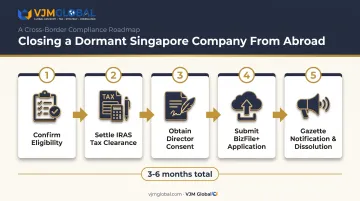
Closing a Singapore entity from abroad follows the same legal process as closing one locally. The difference is coordination. Here's the sequence.
Step 1: Confirm Eligibility for Striking Off
ACRA applies six conditions before it will accept a striking-off application. Your company must have:
- Stopped trading, or never started business after incorporation
- No unpaid debts or unresolved matters with any government agency
- No charges registered against it
- No ongoing legal proceedings, in Singapore or elsewhere
- No pending regulatory or disciplinary action
- No assets and no liabilities, including future or contingent claims
US owners often lack visibility into notices sent to the registered Singapore address. Have your company secretary pull a current compliance snapshot against ACRA's striking-off requirements before you go any further. This single step catches most of the surprises that later stall an application.
Step 2: Settle IRAS Tax Clearance and GST Deregistration Remotely
Before filing for strike-off, you need to close out every tax obligation:
- File the last Form C-S/C, or use IRAS's "Apply for Waiver/File last Form C-S/C (Dormant/Striking Off)" digital service at mytax.iras.gov.sg
- Cancel GST registration within 30 days of ceasing business, if you were previously registered, and file the final Form GST F8
Filing directly requires Corppass and Singpass credentials. A US-based director without local Singpass generally needs a Singpass Foreign user Account, or must authorize a local tax agent to act as Approver on the filing. This is where most remote owners bring in a Singapore-based provider. Someone with an existing Corppass administrator relationship can move this along without the owner touching the portal at all.
Step 3: Obtain Director Consent and Clear Statutory Registers
ACRA requires consent from all or a majority of directors, including US-based ones. Before applying, confirm:
- No outstanding court summons against the company or its directors
- Statutory registers — shareholders, registered office, register of registrable controllers — are fully current
- Any recent changes to officers or members were filed within ACRA's deadlines
Sorting this out remotely means collecting signatures across time zones, so start early.
Step 4: Submit the Striking-Off Application via BizFile+
The application itself is free, and it can be filed by a director, a company secretary, or a registered filing agent. Most US owners without Singpass authorize a cross-border advisory firm to file on their behalf. VJM Global, for instance, coordinates these filings across its US and Asia-Pacific teams so overlapping hours keep the process moving instead of stalling on a time-zone gap.
One detail that trips people up: co-directors must endorse the application within 14 days via BizFile+, or it lapses entirely. If your co-director is asleep in a different hemisphere when the clock starts, that window disappears fast without advance coordination.
Step 5: Navigate the Gazette Notification and Final Dissolution
Once ACRA approves the application, the process moves through public notice stages:
| Stage | What Happens |
|---|---|
| First Gazette Notification | Published if no objection is raised after ACRA's review |
| Objection window | Interested parties can object during a set waiting period |
| Final Gazette Notification | Company is formally dissolved on the stated date |
The entire process generally runs at least three months from approval, longer if an objection surfaces. Once dissolved, the company ceases to exist as a legal entity. At that point, loop in a US tax advisor about any final reporting tied to the dissolution date, since Singapore closure and US reporting obligations don't automatically sync up.
What US Owners Need Before Applying: Pre-Closure Checklist
Get these five items sorted before you file, not after:
- Clear every Singapore-side liability: outstanding debts, CPF contributions if you ever had employees, and cancelled business licenses. Unresolved items can trigger an ACRA or IRAS objection.
- Identify your Form 5471 category and deadline: US persons dissolving a foreign corporation may need Item D and Schedule O on a final-year Form 5471. Section 6038 penalties start at $10,000 per failure and can reach $50,000.
- Address FBAR and FATCA reporting for any Singapore bank account tied to the company. Don't close that account too early; it can block a pending IRAS refund and complicate final disclosures.
- Resolve intercompany loans or capital contributions between the US parent and the Singapore entity before filing.
- Set up remote access in advance: a Singpass Foreign User Account, or signed authorization for a corporate service provider to manage Corppass, BizFile+, and IRAS portal actions.
Skipping any of these rarely stops the filing outright, but it almost always adds weeks to the timeline.
Common Mistakes and Cross-Border Pitfalls
Three mistakes come up again and again with remote closures:
- Assuming dormancy equals automatic closure. It doesn't. Obligations keep accruing until the company is formally deregistered, and specific Companies Act breaches carry fines of up to SGD 5,000 per director.
- Closing the corporate bank account too early. That can block a pending IRAS refund. Once the company dissolves, IRAS will not redirect a tax credit to a third party, so final amounts take slower channels to settle.
- Ignoring the US-side filing obligations. Most closure guides only cover the Singapore process. Form 5471, FBAR, and Form 8938 don't disappear just because ACRA has struck the company off. They follow your ownership and account activity during the reporting year.
Should You Close or Keep the Company Dormant?
Striking off isn't always the right move. If there's a realistic chance you'll re-enter the Singapore market, keeping the company dormant is usually the better option.
Reasons to stay dormant:
- Lower ongoing compliance cost than incorporating again later
- Preserves your brand name and any IP holding structure
- Simple restart path: notify IRAS when you're ready to resume activity
Reasons to strike off instead:
- No realistic plan to return to the Singapore market
- Full exit from director liability exposure and filing obligations
- Ongoing cost and admin with no offsetting strategic benefit
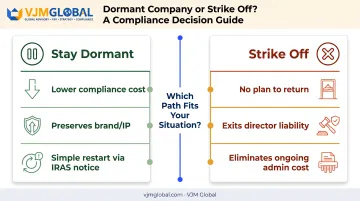
Choose dormant if the entity still has strategic value. Strike off if it has become pure overhead.
Frequently Asked Questions
What is considered a dormant company in Singapore?
ACRA and IRAS apply different tests: ACRA looks at accounting transactions, while IRAS looks at income earned. A company can be dormant under one test and not the other.
What happens if a company goes dormant?
The company keeps reduced but real obligations (annual returns, a company secretary, and possibly tax filings) and stays on the register until it's struck off or wound up.
Do dormant companies need to file annual returns?
Yes. Dormant companies must still file annual returns with ACRA within seven months of financial year-end, even if exempt from preparing financial statements.
Can I close a Singapore dormant company entirely from the US without visiting Singapore?
Yes. Directors can sign consents remotely, and a Singapore-based company secretary or corporate service provider files the BizFile+ application on your behalf.
Does closing a Singapore dormant company affect my US tax filings?
Potentially. US persons may still need to report the dissolution via Form 5471 and address related FBAR or FATCA disclosures, so coordinate with a US tax advisor before filing.
How long does it take to close a dormant company in Singapore from abroad?
Typically three to six months, driven mostly by IRAS tax clearance and ACRA's gazette objection period, roughly the same timeline as filing from within Singapore.