But here's the catch: the legal system is unfamiliar. Companies Act requirements, Deeds and Commercial Registries Authority (DCRA) paperwork, and beneficial ownership disclosures can trip up first-time foreign investors fast.
This guide breaks down business structures, the incorporation process step-by-step, compliance obligations, costs, and tax duties for US businesses eyeing Guyana.
Key Takeaways
- Guyana imposes no minimum share capital requirement for incorporation
- Foreigners can own 100% of a locally incorporated company, and US citizens face no restrictions on directorship
- Every company needs a registered office, one director, a company secretary, and beneficial ownership disclosure at 25%
- Local registration fees run about G$63,550 (~$305 USD); external company fees span G$80,000–G$300,000 (~$385–$1,445 USD)
- Professional guidance from local attorneys and cross-border advisors cuts down on documentation delays
Why US Businesses Are Expanding into Guyana
Guyana's growth numbers are hard to ignore. The IMF's May 2025 report estimates 43.6% real GDP growth in 2024, with non-oil sectors alone expanding 13.1%, evidence that growth extends beyond the petroleum sector alone. Looking ahead, the IMF's April 2026 outlook projects 16.2% growth in 2026, though that's a forecast, not a locked-in result.
GDP growth is only part of the picture, though — foreign direct investment tells a more nuanced story. The IMF estimates roughly US$7,487 million in gross oil FDI inflows during 2024. But once you account for operator repatriation of profits, the IMF's 2025 Article IV report shows a net FDI outflow of US$5,497 million. Gross inflows and net FDI are not the same thing, and businesses should treat the two figures separately when evaluating Guyana's investment climate.
Regional Trade Access
Guyana's CARICOM membership matters for market access. GO-Invest positions the country as strategically located for Caribbean trade, and Guyana applies the CARICOM Common External Tariff on qualifying goods.
That said:
- CARICOM access isn't automatic duty-free treatment for every product
- Rules of origin still apply
- Businesses should verify tariff treatment for their specific goods before assuming preferential access
Bottom line: Guyana's growth story is real, but claims about unrestricted foreign ownership or automatic profit repatriation rights under the Investment Act should be verified directly with GO-Invest before you build a strategy around them.
Business Structures Available in Guyana
US businesses entering Guyana generally choose from three paths, each governed differently.
Incorporated Company
A Guyana-incorporated company is formed under the Companies Act (Cap. 89:01). It's the closest equivalent to a US LLC or corporation.
- Requires formal legal formation through Articles of Incorporation
- Offers limited liability protection, separating personal and business assets
- Subject to 40% corporation tax for commercial companies
- Requires annual audited financial statements filed with DCRA
External (Foreign) Company Registration
This route lets a US-incorporated company operate in Guyana without creating a brand-new local entity.
- Registers your existing US company under Companies Act sections 316–321
- Requires a power of attorney and statutory declarations
- Preserves your original corporate structure while adding Guyana-specific compliance
Sole Proprietorship or Partnership
This is the simplest, cheapest option, though it comes with real trade-offs.
- Registered through DCRA's business-name process, separate from the Companies Act
- Filing fee is just G$5,000, with a typical seven working day turnaround
- Offers no separation between personal and business liability
- Income taxed at individual rates, not corporate rates
Which Structure Fits Your Business?
Most US businesses lean toward incorporation or external company registration. Both offer limited liability and support land ownership rights — something sole proprietorships can't provide. The right pick depends on whether you want a fresh Guyana entity (incorporation) or prefer keeping your US corporate identity intact while operating locally (external registration).
Comparison Snapshot
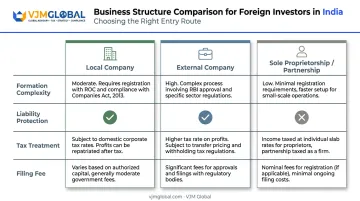
The table below breaks down how the three structures compare on cost, liability, and formation complexity.
| Factor | Local Company | External Company | Sole Prop/Partnership |
|---|---|---|---|
| Formation complexity | Moderate-high | Moderate | Low |
| Liability protection | Full | Full (parent entity) | None |
| Tax treatment | 40% corporate (commercial) | Guyana-source income taxed similarly | Individual tax rates |
| Filing fee | ~G$63,550 | G$80,000–G$300,000 | G$5,000 |
| Best suited for | Long-term Guyana operations | US companies testing the market | Small, low-risk ventures |
Step-by-Step Guyana Incorporation Process for US Businesses
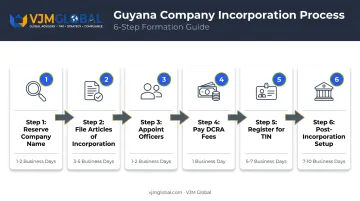
Here's the practical sequence for getting a local company registered.
Reserve your company name. Submit a Request for Name Search and Reservation to DCRA. The name can't be identical or deceptively similar to an existing entity and must carry a proper legal suffix.
Prepare and file Articles of Incorporation. This document covers company name, registered office address, share structure, and board size. It must be accompanied by a statutory declaration from an attorney-at-law confirming incorporator eligibility.
Appoint your officers. You'll need:
- At least one director (no residency requirement)
- A company secretary (mandatory under Companies Act section 67)
- Shareholders, with signed consent forms from each officer
Pay the DCRA registration fee. For local companies, the itemized total is G$60,000 prescribed fee + G$3,200 notices + G$350 mandatory copy = G$63,550. External company fees range from G$80,000 to G$300,000, depending on share capital.
Register for a Tax Identification Number (TIN). Head to the Guyana Revenue Authority (GRA) with your Certificate of Incorporation and valid ID for at least two directors. GRA processes this online or in person.
Handle post-incorporation setup. Open a local bank account, secure any industry-specific permits, and establish bookkeeping systems.
DCRA states the certificate can be uplifted in three working days once your submission is complete. That clock doesn't include attorney prep time, document corrections, or bank account setup.
Coordinating apostilled documents, translations, and cross-border paperwork is where most US founders lose weeks. Working with advisors experienced in cross-border business setup, like the team at VJM Global, can help keep documentation moving instead of stalling in back-and-forth corrections.
Compliance Requirements for Foreign-Owned Companies in Guyana
Getting incorporated is step one. Staying compliant is the ongoing job, and it starts with knowing who can hold what role in the company.
Directors and Shareholders
- No residency or nationality restrictions apply
- Minimum of one director and one shareholder
- One person can legally hold both roles simultaneously
Registered Office Rules
Companies Act section 187 requires a physical Guyana address at all times; a P.O. box does not satisfy this requirement. Any change of address must be formally reported to DCRA under section 188.
Beneficial Ownership Disclosure
Address changes aren't the only thing DCRA tracks. Its current Beneficial Ownership Application Form requires disclosure of anyone holding 25% or more ownership — not 20%, as some outdated sources suggest. This falls under AML/CFT obligations, and updates must be filed with DCRA whenever ownership structure changes.
KYC Documentation
Expect to provide:
- Valid government-issued ID
- Proof of address
- Source of funds documentation
- Notarized and apostilled corporate documents (for the US parent entity, if registering as external company)
Annual Filing Obligations
Section 153(3) requires an annual return, signed by a director or secretary, within 42 days after the annual general meeting. This return is separate from your GRA corporation tax filing: filing one does not satisfy the other. Audited financial statements must accompany the return under section 154.
Taxes and Ongoing Obligations After Incorporation
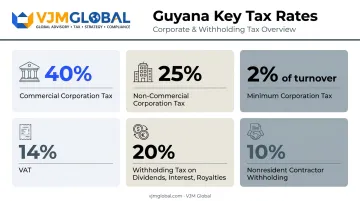
Tax compliance is where many foreign-owned companies stumble, often because they apply outdated rates or miss Guyana-specific thresholds. Here's what's currently in effect.
| Tax Type | Rate/Threshold |
|---|---|
| Commercial company corporation tax | 40% of chargeable profits |
| Non-commercial company corporation tax | 25% (not 27.5%) |
| Minimum corporation tax | Higher of standard tax or 2% of turnover |
| VAT | 14% standard rate |
| Withholding tax (dividends, interest, royalties to non-residents) | 20% |
| Nonresident contractor withholding | 10% of gross payment |
A few practical notes:
- VAT registration becomes mandatory once annual taxable turnover hits G$15 million
- Corporate tax returns are due April 30, with advance installments due March 15, June 15, September 15, and December 15
- VAT returns are due within 21 days after the filing period; withholding tax returns within 14 days of the following month
Miss these deadlines and GRA penalties stack up quickly. Bookkeeping accuracy matters just as much as timing, since a mismatch between your books and filed returns invites scrutiny.
Many US businesses handle this by outsourcing Guyana tax compliance to a local accounting firm familiar with GRA filing systems. That keeps deadlines and bookkeeping on track while you focus on running the business rather than juggling two countries' tax calendars.
Frequently Asked Questions
How much does it cost to register a company in Guyana?
Local company incorporation totals roughly G$63,550 (about US$300) in DCRA fees. External/foreign company registration ranges from G$80,000 to G$300,000 (roughly US$380 to US$1,430) depending on share capital, plus attorney and professional service fees.
How long does it take to register a company in Guyana?
DCRA can issue a certificate within three working days of a complete submission. Delays typically stem from incomplete KYC documentation or missing source-of-funds paperwork, so prepare these upfront.
Can a foreigner incorporate a company in Guyana?
Yes. Foreigners can own 100% of a Guyana-incorporated company. There are no nationality or residency restrictions on directors or shareholders.
What is the minimum capital requirement to incorporate a company in Guyana?
Guyana's Companies Act and DCRA materials don't specify a fixed minimum share capital. Your Articles of Incorporation still need to define share classes and rights, so confirm current requirements with a local attorney before filing.
What business structure works best for US companies expanding into Guyana?
Most US businesses choose either local incorporation or external company registration for the liability protection both offer. The right choice depends on your growth timeline and how much you want tied to your existing US entity, so a cross-border advisory review helps narrow this down.
Do foreign-owned companies in Guyana need a local bank account?
Not always a legal requirement, but practically necessary. A local account simplifies tax payments, payroll processing, and day-to-day transactions considerably.