
Agra isn't just the Taj Mahal. The district produces over 150,000 pairs of shoes daily, and roughly 25% of the district's population works directly or indirectly in footwear and allied trades, according to the Council for Leather Exports' 2022 report. Add handicrafts, marble inlay work, and tourism, and you've got a diverse local economy that increasingly needs formal business structures.
This guide is for local entrepreneurs, but it's equally relevant for NRIs, OCIs, and foreign investors from the US, UK, and Australia eyeing Agra's export and manufacturing hubs. We'll cover entity types, the registration process, documents, costs, and what happens after you get your certificate.
Key Takeaways
- Registration runs through the MCA portal via SPICe+, governed by the Companies Act, 2013
- Common structures include Private Limited Company, LLP, OPC, Section 8, and Nidhi Company
- Processing typically takes 7–15 days, depending on document readiness and name approval
- NRIs and foreign nationals can register, subject to FEMA rules and a resident director requirement
- Post-registration compliance, including ROC filings and tax returns, is as critical as the incorporation itself
What Is Company Registration in Agra?
Company registration is the legal process of forming a business entity under the Companies Act, 2013, administered by the MCA. Under Section 9 of the Act, from the date of incorporation, the company becomes a body corporate with perpetual succession. It can own property, enter contracts, and sue or be sued in its own name.
For businesses in Agra's manufacturing, handicraft export, and trading hubs, this legal status matters more than it might seem—it separates business risk from personal risk in a way informal setups simply can't.
Company vs. sole proprietorship/partnership:
- A registered company has a separate legal identity distinct from its owners
- Sole proprietorships and partnerships don't offer this separation, so the owner's personal assets remain exposed to business liabilities
- A company can raise funds, take loans, and enter contracts independently of its founders
Once the Registrar approves your filing, you receive a Certificate of Incorporation (CoI) with a unique Corporate Identity Number (CIN). That CIN becomes your company's legal fingerprint for every future filing, whether you're registering with GST, opening a bank account, or filing annual returns with the Registrar of Companies (ROC) that covers Agra under the Kanpur jurisdiction.
Why Register a Company in Agra
Agra sits close to Delhi-NCR and Jaipur, giving it logistical access to major markets while retaining century-old industries in leather, footwear, handicrafts, and tourism. For businesses looking to scale beyond informal trading, formal registration unlocks specific advantages informal trading can't offer.
What formal registration enables:
- Access to institutional funding and business loans
- GST registration and Import Export Code (IEC) eligibility, both required for serious exporters
- Credibility with international buyers who expect verifiable legal entities before signing contracts
Uttar Pradesh has also leaned into ease-of-doing-business initiatives. The state's Nivesh Mitra single-window portal handles state-level approvals, and the UP Industrial Investment and Employment Promotion Policy 2022 reports the portal received over 800,000 applications with roughly 97% disposed of by September 2022. That volume signals real administrative capacity, though Nivesh Mitra covers state approvals only, not MCA incorporation.
These state-level efficiencies matter, but for NRIs and foreign investors, registering a compliant Indian entity usually isn't optional. FEMA and RBI reporting requirements mean that operating informally through a friend's account or an unregistered arrangement creates real regulatory exposure. A properly incorporated entity is the starting point for legitimate cross-border business.
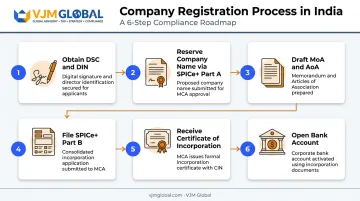
Step-by-Step Process to Register a Company in Agra
The entire process happens online through the MCA portal. It moves through digital credentials, name approval, document drafting, and finally incorporation with linked tax registrations—all without a single physical visit to a government office in most cases.
Step 1: Obtain DSC and DIN
Every proposed director needs a Digital Signature Certificate (DSC) to sign electronic filings, obtained from a licensed certifying authority (MCA doesn't issue these directly). Alongside this, each director needs a Director Identification Number (DIN), a unique ID that stays with them across all future directorships.
Step 2: Reserve Your Company Name via SPICe+ Part A
You'll propose one or two unique names through SPICe+ Part A. MCA checks these against existing company names and trademarks, so vague or overly similar names get rejected quickly. Pick something distinctive from the start—resubmissions cost time.
Step 3: Draft MoA and AoA
The Memorandum of Association (MoA) defines what your company can legally do, covering its objects and scope. The Articles of Association (AoA) set internal governance rules: how directors are appointed, how meetings run, how shares transfer. Standard companies typically use e-MoA (INC-33) and e-AoA (INC-34) formats within the SPICe+ system.
Step 4: File SPICe+ Part B for Incorporation
This is where everything converges. Part B combines your incorporation application with:
- DIN allotment (for up to three proposed directors)
- PAN and TAN applications
- EPFO and ESIC registration
- GST registration (optional, based on need)
This combined form is far more efficient than the old multi-form process, but errors in any single section can delay the entire filing. Foreign founders working through VJM Global typically have this filing reviewed before submission to avoid such delays.
Step 5: Receive Your Certificate of Incorporation
Once the RoC examines and approves your filing, you get the CoI with your CIN. This is the moment your company legally exists. But note: a company with share capital cannot start business or borrow money until it files an INC-20A declaration within 180 days confirming the registered office is verified.
Step 6: Open a Bank Account and Complete Post-Incorporation Steps
Take your CoI, PAN, MoA, and AoA to a bank to activate your current account. Some banks also connect through the AGILE-PRO-S linked form during incorporation itself, streamlining account setup alongside your other registrations.

Documents and Business Structures for Company Registration in Agra
Before filing, gather these documents:
- Identity and address proof for all directors/shareholders: PAN and Aadhaar for Indians, passport for foreign nationals and NRIs
- Registered office proof in Agra: a recent utility bill plus a rent agreement or a No Objection Certificate (NOC) from the property owner
- Passport-size photographs and DSCs for all directors
- Additional authentication for foreign nationals/NRIs: notarized or apostilled documents for signatures and proofs executed abroad, as required under MCA and FEMA rules
Choosing the Right Entity Structure
| Structure | Members | Directors Required | Best Fit |
|---|---|---|---|
| Private Limited | 2-200 shareholders | Minimum 2 | Businesses seeking funding or scale |
| LLP | 2+ partners, no cap | 2 designated partners (1 resident) | Flexible partnerships, lower compliance |
| OPC | 1 member (Indian citizen) | 1 director | Solo founders |
| Section 8 | 2 (private) or 7 (public) | 2 or 3 | Non-profit objectives |
| Nidhi | Minimum 7 subscribers | Minimum 3 | Member-based lending/savings |
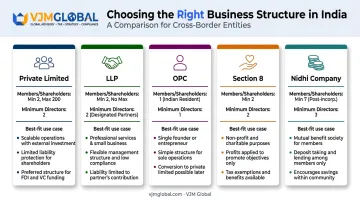
LLPs aren't registered through SPICe+ at all. They follow a separate incorporation route under the LLP Act, 2008. This structural difference matters if you're deciding between a Pvt Ltd and an LLP—it affects foreign investment eligibility, ongoing compliance, and how quickly you can bring in overseas capital. Our advisors at VJM Global regularly help foreign founders weigh this choice before filing.
The OPC route also has a hard limit: it permits only an Indian citizen, resident or otherwise, as the sole member. OCIs and foreign nationals without Indian citizenship can't use this structure, making Private Limited the more realistic path.
Cost, Timeline, and Post-Registration Compliance
Cost components typically include:
- MCA/government filing fees, which scale with authorized share capital
- Stamp duty on the MoA and AoA, charged per Uttar Pradesh's stamp schedule
- Professional or consultant fees for drafting, filing, and coordination
Exact government fee slabs change periodically, and MCA's own fee calculator labels its output as indicative rather than fixed. Check the current MCA fee schedule before budgeting — relying on last year's numbers can throw off your cost planning.
Timeline depends heavily on how clean your documentation is. Name rejections and incomplete filings, not RoC backlogs, are the most common causes of delay. Get your name choices and documents right the first time. You'll move through the process considerably faster than someone submitting three name applications in a row.
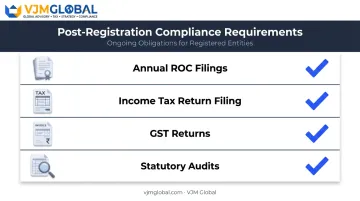
Post-registration compliance doesn't stop once the certificate arrives. Companies need to handle:
- Annual ROC filings (financial statements, annual returns)
- Income tax return filing
- GST returns, if registered
- Statutory audits, mandatory regardless of company size
For foreign-owned entities and NRI-promoted companies, there's an added layer: FEMA reporting, such as filing FC-GPR within 30 days of issuing shares to a person resident outside India, plus cross-border tax considerations.
VJM Global handles end-to-end company formation alongside ongoing accounting, tax, and compliance outsourcing for foreign investors and NRIs setting up in India. The goal is straightforward: your Agra-registered entity stays compliant while you focus on running the business, not chasing paperwork deadlines.
Frequently Asked Questions
How much does it cost to register a company in India?
Costs vary by entity type and authorized capital, generally covering MCA filing fees, state stamp duty, and professional charges. Check the current MCA fee schedule for precise, up-to-date figures before budgeting.
Where can I register my company in India?
Registration happens entirely online through the MCA portal using the SPICe+ form, regardless of which city you're in. The RoC with jurisdiction is determined by your registered office address.
Can an NRI or foreign national register a company in Agra?
Yes, subject to FEMA guidelines. Most structures also require at least one resident Indian director who stays in India for a minimum period each financial year, and professional advisory can help you navigate these FEMA and residency requirements correctly.
How long does it take to register a company in Agra?
Timelines depend heavily on document readiness and how quickly your proposed name gets approved. Incomplete paperwork or name rejections are the biggest causes of delay.
Is a physical office required for company registration in Agra?
No commercial office is mandatory. A registered address with valid proof—even a residential one—satisfies MCA requirements, provided you have proper utility bills and owner consent.
Which type of company is best for a small business in Agra?
A Private Limited Company suits businesses planning to raise funding or scale beyond a few founders. Solo founders or small partnerships often find OPC or LLP structures better suited to their lower compliance needs.