But first-time founders and overseas entrepreneurs often hit the same wall: confusion over which business structure to pick, what documents are needed, and how long the whole process actually takes.
This guide breaks down everything, structures, prerequisites, the step-by-step registration process, government fees, and what comes after incorporation, so you can plan your Ahmedabad setup with confidence.
Key Takeaways
- Gujarat generated ₹24.25 lakh crore in nominal GSDP for 2023-24, contributing 8.2% of India's total GDP
- Private Limited Companies are the top choice for foreign nationals, NRIs, and OCIs, offering limited liability and simpler FDI compliance
- Registration needs 2 directors, 2 shareholders, and one resident director present in India 182+ days yearly
- SPICe+ has replaced RUN for new company name reservations and filings
- Post-registration compliance, including ROC filings, audits, and GST, applies regardless of your company's turnover
Why Register a Company in Ahmedabad
Gujarat isn't just riding on reputation. The state was rated an "Achiever" in the government's LEADS 2024 logistics performance report, a category it has held onto since 2022, reflecting sustained strength in infrastructure and logistics efficiency.
The numbers back this up. Gujarat's nominal GSDP hit ₹24.26 lakh crore in 2023-24, growing 10.1% year-over-year, according to the Gujarat Finance Department's Socio-Economic Review 2024-25. That's 8.2% of India's entire GDP coming from one state, and Ahmedabad sits at the center of that growth story.
What makes Ahmedabad specifically attractive:
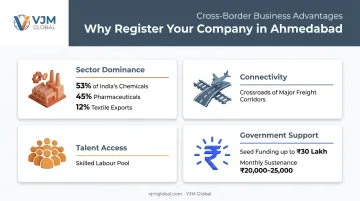
- Sector dominance: Gujarat produces 53% of India's chemicals, 45% of its pharmaceuticals, and accounts for 12% of textile exports
- Connectivity — Ahmedabad sits at the crossroads of major road, rail, and air freight corridors linking western India to global markets
- Talent access: a deep pool of skilled labour across textiles, IT, chemicals, and pharma manufacturing
- Government support: Startup Gujarat offers seed funding up to ₹30 lakh and monthly sustenance support of ₹20,000 (₹25,000 if there's a woman co-founder)
For NRIs, OCIs, and foreign investors, the appeal is straightforward. Operational costs run lower than in Mumbai or Bengaluru, while the industrial depth in manufacturing-heavy sectors remains genuine and hard to replicate elsewhere. Navigating the registration process still requires local expertise, particularly around FEMA compliance and entity structuring for foreign shareholders.
Choosing the Right Business Structure
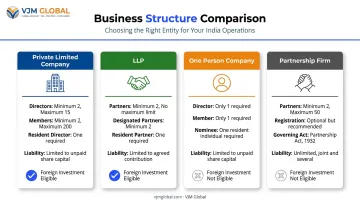
Picking the wrong entity type early on creates headaches later, especially around compliance and fundraising. Here's how the four common structures compare.
Common Structures for Ahmedabad Registration
| Structure | Best Suited For | Key Requirement |
|---|---|---|
| Private Limited Company | Startups, foreign subsidiaries, scalable businesses | 2 directors, 2 shareholders |
| LLP | Professional services, small partnerships | 2 designated partners, 1 resident |
| One Person Company (OPC) | Solo Indian entrepreneurs | 1 member (must be Indian citizen) |
| Partnership Firm | Small local businesses, NRI non-repatriation ventures | 2 partners, no MCA incorporation |
A few things worth flagging:
- OPCs are not open to every overseas founder. The sole member must be an Indian citizen — an eligible NRI can qualify, but OCIs and other foreign nationals cannot use this structure just because of their Indian heritage.
- Partnership firms sit outside MCA's jurisdiction entirely. They're registered with the state Registrar of Firms, not ROC Ahmedabad, and partners carry personal liability.
- LLP foreign investment isn't automatic in every sector. The automatic FDI route for LLPs only applies where 100% automatic-route investment is permitted with no performance conditions attached.
Given these restrictions, Private Limited Company ends up as the practical choice for most foreign nationals, NRIs, and OCIs. It offers the broadest scope for foreign equity, clean limited liability protection, and a well-defined path to raising capital later.
Your final decision still hinges on ownership plans, industry, and how much compliance your team can realistically handle. VJM Global's business setup advisors work through these specifics with foreign founders and NRIs before filing, matching entity choice to actual growth and investment plans rather than a generic default.
Prerequisites and Documents Required for Company Registration in Ahmedabad
Before you file anything, make sure you have the basics covered.
Minimum requirements for a Private Limited Company:
- 2 directors (at least one must be an Indian resident, meaning they stay in India for 182+ days during the financial year)
- 2 shareholders
- Authorized capital (commonly set at ₹1 lakh, though there's no strict statutory minimum since the 2015 amendment)
- A registered office address in Ahmedabad
Documents for Indian Nationals
- PAN card
- Aadhaar card
- Address proof (bank statement, utility bill)
- Passport-size photographs (self-attested, not older than 2 months)
Documents for Foreign Nationals, NRIs, and OCIs
This is where things get trickier, and where most delays happen.
- Notarized and apostilled passport copy
- Notarized address proof (from the home country)
- Recent photographs
Which authentication route applies depends on where the documents are signed. Under Rule 13 of the Companies (Incorporation) Rules, 2014, the requirements break down by country:
- Documents signed in a Hague Apostille Convention country (like the US) follow the apostille route
- Documents signed in a Commonwealth country (UK, Australia) may only need local notarization
- Documents from countries outside both categories need notarization plus consular authentication
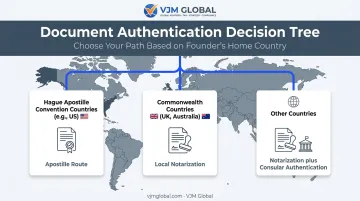
There's no single universal checklist here, since the requirement depends on the founder's home country. This is exactly the kind of detail that trips up first-time foreign applicants.
Registered Office Documentation
- Utility bill (electricity, water, or gas — recent)
- Rent agreement, if the office is leased
- No Objection Certificate (NOC) from the property owner
VJM Global's team regularly works remotely with foreign nationals, NRIs, and OCIs registering companies in Ahmedabad and across India, helping them get apostille-compliant documentation right the first time. Small mismatches, like an address spelled differently across two documents, are a leading cause of ROC resubmission notices. A professional review before filing catches these before they cost you weeks.
Step-by-Step Process to Register a Company in Ahmedabad
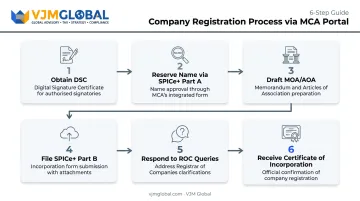
Once your documents are in order, incorporation follows a fixed sequence through the MCA portal.
Obtain Digital Signature Certificates (DSC) for all proposed directors and subscribers. Every signatory needs one, and skipping this step stalls the entire filing.
Reserve your company name using SPICe+ Part A. This has largely replaced the standalone RUN service for new incorporations. RUN is now used mainly when an existing company wants to change its name. You can propose up to two name choices.
Draft the Memorandum of Association (MOA) and Articles of Association (AOA), setting out your company's objectives and internal governance rules.
File SPICe+ Part B, along with linked forms including eMOA (INC-33), eAOA (INC-34), and AGILE-PRO-S. This single filing covers several registrations at once:
- Director Identification Number (DIN) for all directors
- PAN and TAN for the company
- GST registration through AGILE-PRO-S (optional at this stage)
- EPFO and ESIC registration, built into the process for new companies
Respond to ROC Ahmedabad queries, if any. The Registrar sometimes raises resubmission requests over document mismatches or clarification needs. This happens often enough that it's rarely a cause for concern.
Receive your Certificate of Incorporation (COI) with your Corporate Identification Number (CIN). From here, you can open a business bank account and start operations.
Important distinction: LLPs don't use SPICe+ at all. They go through FiLLiP (Form for Incorporation of LLP) instead, a separate filing track entirely.
For foreign entities unfamiliar with MCA procedures, this sequence involves considerable coordination between digital certification, statutory drafting, and government follow-up. Firms like VJM Global handle this end-to-end for international clients entering the Indian market, reducing the back-and-forth that often delays first-time filers.
Government Fees and Registration Timeline in Ahmedabad
Costs here break down into two separate buckets: ROC filing fees and state stamp duty.
1. MCA/ROC filing fees
These are slab-based, tied to your authorized capital. The current MCA framework offers a zero filing-fee concession for companies with authorized capital up to ₹15 lakh — though name reservation and stamp duty charges still apply separately. If you file SPICe+ Part A as a standalone name application, that costs ₹1,000.
2. Stamp duty
Beyond ROC fees, Gujarat separately charges stamp duty on your MOA and AOA, again based on authorized capital. Following the Gujarat Stamp (Amendment) Act, 2025, the maximum AOA duty cap rose from ₹5 lakh to ₹15 lakh. Because this depends on your specific capital structure, always check the live calculation on the MCA fee calculator portal at the time of filing rather than relying on a fixed quote.
Realistic timeline expectations:
- Name approval: typically a few working days, assuming no objections
- SPICe+ incorporation: several working days post document verification
- PAN and TAN: issued through the same integrated SPICe+ process, shortly after incorporation
There's no official published SLA for ROC Ahmedabad specifically, and timelines shift based on document readiness and whether the Registrar raises queries. Founders who submit clean, apostille-compliant documentation upfront typically shave several days off the process. VJM Global's business setup team handles this document preparation for foreign founders, reducing back-and-forth queries from the Registrar.
Post-Registration Compliance for Your Ahmedabad Company
Getting your Certificate of Incorporation is the beginning, not the finish line. Every registered company, regardless of size or turnover, carries ongoing obligations, and companies registered under the ROC Ahmedabad jurisdiction are no exception.
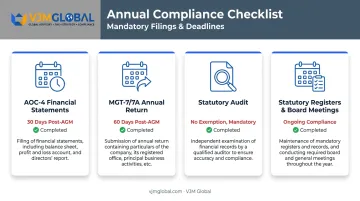
Mandatory annual compliances:
- AOC-4 (financial statements): filed within 30 days of your AGM; OPCs get 180 days from financial year-end
- MGT-7 / MGT-7A (annual return): filed within 60 days of the AGM; small companies and OPCs use the simplified MGT-7A
- Statutory audit: required for every company under Section 139, with no turnover exemption — a common misconception among new founders
- Maintenance of statutory registers and regular board meetings
Tax and GST obligations:
- GST registration becomes mandatory once turnover crosses ₹40 lakh for goods or ₹20 lakh for services, though certain transactions require registration below these thresholds
- Regular GST return filing once registered
- TDS deduction, deposit, and quarterly return filing wherever applicable
- Corporate income tax filing, separate from your ROC obligations
The statutory audit rule above has one exception. LLPs only need an audit once turnover exceeds ₹40 lakh or capital contribution exceeds ₹25 lakh — private companies registered in Ahmedabad don't get this exemption.
Keeping up with this calendar while running a business remotely as a foreign-owned entity is demanding, and missed deadlines carry real penalties.
VJM Global handles this for clients directly: bookkeeping, statutory filings, and CA-level oversight, drawing on 30+ years of experience with foreign businesses navigating Indian regulatory requirements. Founders get to focus on their business instead of tracking due dates.
Frequently Asked Questions
How to register a company in Ahmedabad?
Obtain Digital Signature Certificates, reserve your company name through SPICe+ Part A, file SPICe+ Part B with your MOA/AOA and AGILE-PRO-S, then receive your Certificate of Incorporation from ROC Ahmedabad.
What is the registration fee in Ahmedabad?
Fees include MCA filing charges (zero up to ₹15 lakh authorized capital, otherwise slab-based), Gujarat stamp duty on your MOA/AOA, and a ₹1,000 charge if filing SPICe+ Part A separately. Professional service fees vary by provider.
How long does it take to register a company in Ahmedabad?
Most incorporations complete within 10-15 working days with clean documentation, though delays in ROC queries or document readiness can push this to 30 days.
Can an NRI or foreign national register a company in Ahmedabad?
Yes. NRIs and foreign nationals can register a Private Limited Company or LLP, provided at least one director is an Indian resident and all foreign documents are notarized and apostilled per Rule 13. VJM Global regularly assists overseas founders through this documentation process.
What is the minimum capital required to register a company in Ahmedabad?
While ₹1 lakh authorized capital is commonly used, there's no statutory minimum since the 2015 amendment removed that requirement. Set capital based on what your initial operations actually need.
Is a physical office mandatory for company registration in Ahmedabad?
Yes, a registered office address with valid proof (rent agreement or ownership deed, plus owner NOC) is mandatory. A residential address is acceptable as long as proper documentation supports it.