Introduction
If you're running a business in Dubai, Abu Dhabi, or Sharjah and eyeing the Indian market, you've probably asked one question first: how many days will this actually take?
It's a fair question. India-UAE trade hit $100.05 billion in FY2024-25. Cumulative UAE investment into India has crossed $22.8 billion since 2000, according to the Consulate General of India in Dubai. The CEPA agreement, in force since May 2022, has accelerated this momentum.
More UAE entrepreneurs want in. Fewer understand what the registration clock actually looks like from their end. This article breaks the process into stages, compares your entity options, and flags exactly where UAE-based applicants tend to lose time (and how to avoid it).
Key Takeaways
- Foreign-owned Private Limited companies typically take 15–30 working days from DSC issuance to incorporation
- UAE document legalization is the single biggest variable that can stretch this timeline
- Branch, Liaison, and Project Offices need RBI approval under FEMA, often adding weeks or months
- A resident director requirement becomes a bottleneck if not arranged early
- An experienced firm like VJM Global can run documentation, director sourcing, and compliance in parallel
Step-by-Step Registration Process and Time Required at Each Stage
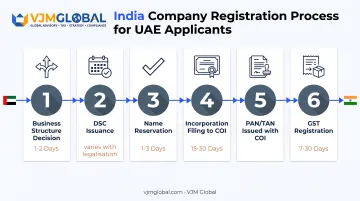
Typical stage timings for a UAE applicant look like this:
- Business structure decision: 1–2 days
- DSC (after document legalisation): often several extra days vs domestic issue in 1–2 days
- Name reservation (SPICe+/RUN): 1–3 working days
- DSC through Certificate of Incorporation: 15–30 working days total (7–14 for ROC on a clean file)
- PAN and TAN: issued with the Certificate of Incorporation
- GST (if required): 7 working days clean, or up to 30 days if verification is triggered
Choosing Your Business Structure
First, choose between a Private Limited subsidiary, an LLP, or a Branch/Liaison/Project Office. This decision usually takes 1-2 days, but it shapes everything downstream. A Pvt Ltd or LLP follows a purely ROC-driven path. A Branch or Liaison Office adds an entire RBI approval layer on top.
Digital Signatures and Director IDs
Every director needs a Digital Signature Certificate (DSC) to file electronically with the MCA. Domestically, Certifying Authorities often issue these within a day or two.
For UAE-based directors, identity and address proof for the DSC application usually need notarisation or consular authentication first. That step is where extra days creep in.
Director Identification Numbers (DINs) are now bundled into the SPICe+ filing itself, so they don't add a separate wait once your documents are ready.
Name Reservation to Certificate of Incorporation
Company name reservation through SPICe+/RUN typically clears in 1-3 working days, and an approved name stays valid for 20 days (extendable to 60 for a fee).
From there, drafting and filing SPICe+ Part B with the MoA and AoA takes the most preparation time. A 2026 professional benchmark from Global Law Experts puts the full window from DSC procurement to Certificate of Incorporation at 15 to 30 working days for a foreign-owned subsidiary, with 7-14 working days of that spent on ROC processing once a clean file is submitted.
Any query from the Registrar adds a 15-day resubmission window, so getting the paperwork right the first time matters more than it does for a domestic filing.
PAN, TAN and GST Registration
The MCA now issues PAN and TAN together with the Certificate of Incorporation, so there is no separate waiting period for these. GST registration, if required, runs on its own clock under CBIC Rule 9: 7 working days for a clean application, or up to 30 days if Aadhaar-based or physical verification is triggered.
For a UAE applicant, the end-to-end timeline runs longer than a domestic incorporation because everything upstream of the ROC filing—identity documents, board resolutions, and parent company papers—must clear a legalisation process that Indian residents do not face.
Timeline Comparison by Business Entity Type
The structure you pick has more influence on your timeline than almost any other decision. Here's how the main routes stack up.
| Structure | Approximate Timeline | Approving Authority |
|---|---|---|
| Private Limited Company | 15-30 working days (DSC to COI) | Registrar of Companies (MCA) |
| LLP | 15-30 working days (similar to Pvt Ltd) | Registrar of Companies (MCA) |
| Branch Office | Several weeks to a few months | RBI, via an Authorised Dealer bank |
| Liaison Office | Several weeks to a few months | RBI, via an Authorised Dealer bank |
| Project Office | Case-dependent (often weeks to months) | RBI |
Private Limited Company is the default choice for most UAE entrepreneurs setting up an Indian subsidiary. It allows full operational activity, limited liability, and a straightforward ROC-only approval path.
LLP follows a similar filing structure (FiLLiP instead of SPICe+) and is often assumed to be marginally faster because of fewer governance requirements. There's no verified data confirming this at scale. It's a reasonable option if you don't need equity fundraising flexibility.
Branch, Liaison, and Project Offices follow a different approval path. They require Reserve Bank of India approval under FEMA, processed through an Authorised Dealer bank. There's no published RBI turnaround time. Case-by-case processing plus AD-bank due diligence routinely pushes these into weeks-to-months territory, not days.
Choose based on what you need most:
- Speed to operate: Private Limited Company or LLP — typically the fastest ROC path
- Full commercial activity with limited liability: Private Limited Company
- Market testing or non-revenue liaison only: Liaison Office, if the longer RBI timeline is acceptable
- Contract-linked execution: Project Office, where general permission may apply
Factors From the UAE That Can Delay or Speed Up the Timeline
Document Legalisation Is the Real Wildcard
Here's something many UAE applicants don't realise: the UAE isn't a signatory to the Hague Apostille Convention, according to the HCCH's official status table. That means your passport copies, address proof, and parent company documents can't simply be apostilled. They need notarisation followed by consular authentication through the Indian Embassy or Consulate.
- UAE MoFA digital attestation can clear in as little as 2 hours
- Courier-based attestation typically takes 1-3 business days
- Indian mission legalization is often same-day, once the prior steps are done
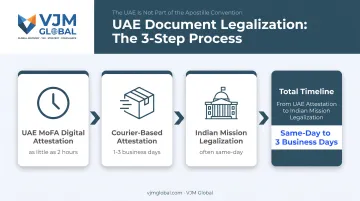
Starting this early, before you even begin the SPICe+ filing, is the single most effective way to avoid weeks of delay.
The Resident Director Requirement
Indian law requires at least one director who stays in India for at least 182 days during the financial year. If you don't already have someone who qualifies, sourcing a resident director is a separate workstream—start it before SPICe+ filing, not in week three.
Bank KYC Can Extend "Ready to Operate," Even After Incorporation
Getting your Certificate of Incorporation doesn't mean you're operational. Opening a corporate bank account in India still depends on checks that don't run on a fixed RBI timeline:
- Foreign shareholder KYC
- Beneficial ownership verification
- Document review by the bank
Treat account opening as its own phase after incorporation, not an afterthought.
Documents UAE Applicants Should Prepare in Advance to Avoid Delays
Prepare the documents below before you file. Incomplete or poorly legalized paperwork is what most often slows ROC review.
Identity and address proof:
- Notarized and apostilled/consularized passport copies for all directors and shareholders
- Emirates ID copies
- Recent address proof (utility bill, bank statement)
Registered office proof in India:
- Lease agreement or NOC from the property owner
- A recent utility bill for the registered address
A virtual office address can sidestep delays from securing and negotiating a physical lease before filing.
Parent company documents (if a UAE entity is incorporating an Indian subsidiary):
- Consularized certificate of incorporation of the UAE parent
- Memorandum and Articles of Association (MOA/AOA) of the parent entity
- Board resolution authorizing the Indian subsidiary and appointing signatories
Missing or improperly legalized versions of any of these most often stall filings at the ROC review stage.
How VJM Global Helps UAE Entrepreneurs Register Faster in India
Most delays in this process come from one thing: sequencing. Waiting for documents before starting director searches. Waiting for a director before finalising the registered office. Waiting for incorporation before starting bank account paperwork.
VJM Global runs these tasks in parallel instead of in a fixed queue:
- Manage ROC filings, FEMA compliance, and RBI coordination in-house so you are not ferrying updates between advisors
- Arrange a resident director and registered address while incorporation documents are still being prepared
- Complete PAN, TAN, GST, and FEMA reporting after incorporation so the entity can operate, not only exist on the register
With 30+ years in tax, audit, and advisory work and a 95% client retention rate, faster India company formation is built into how the engagement is scoped and staffed for UAE clients.

Frequently Asked Questions
How long does company registration take in India?
A standard Private Limited incorporation for a foreign-owned entity typically takes 15-30 working days from DSC issuance to Certificate of Incorporation. UAE applicants often take longer, toward the higher end due to document legalization requirements.
Can a UAE national register a company in India without visiting India physically?
Most of the process, including DSC application, SPICe+ filing, and ROC correspondence, can be completed remotely online. Travel is typically only needed for specific bank account formalities, if a bank requires it.
Does a UAE applicant need a resident director in India, and does this affect the timeline?
Yes, Indian company law requires at least one resident director on the board. Sourcing one in advance, rather than after filing begins, prevents this requirement from becoming a bottleneck.
Is company registration faster for a Private Limited Company or an LLP?
Both follow a similar ROC-driven filing structure and take similar timeframes. There's no verified data showing LLP registration is consistently faster at scale.
Does RBI or FEMA approval add time for Branch or Liaison Offices?
Yes. These structures require Reserve Bank of India approval under FEMA, processed through an Authorised Dealer bank. This typically extends timelines to weeks or months, compared to the more predictable Pvt Ltd/LLP route.
What UAE documents most commonly cause registration delays?
Incomplete or improperly authenticated passport copies and parent company documents are the most frequent culprits. Since the UAE isn't part of the Apostille Convention, these require notarization plus consular legalization, a step many applicants underestimate.