Introduction
Cross the Causeway on a business trip and you'll hear the same conversation in boardrooms across Johor Bahru and Kuala Lumpur: should we set up a Singapore entity? The pull is obvious. Singapore taxes corporate profits at a flat 17%, well below Malaysia's 24% headline rate, and the island's pro-business reputation keeps drawing regional headquarters.
But here's the pain point many Malaysian owners and CFOs run into: they assume Singapore's tax rules mirror Malaysia's. They don't.
Singapore runs a territorial tax system, uses different residency tests, and layers on exemption schemes that don't exist under Malaysian law. Get the details wrong, and a "tax-efficient" Singapore entity can turn into a compliance headache.
This guide breaks down the rate comparison, how chargeable income and residency actually work, and which exemptions apply to new companies. It also covers filing deadlines and what Malaysia-based directors and employees need to know about their own tax exposure.
Key Takeaways
- Singapore's flat 17% corporate tax rate is lower than Malaysia's headline rate
- Tax applies on a territorial, preceding-year basis, with dividends tax-free under Singapore's one-tier system
- SUTE and PTE exemption schemes can cut a new company's effective tax rate well below 17%
- The Malaysia-Singapore DTA blocks double taxation on profits, dividends, and employment income
- Every Singapore company must file ECI and Form C-S/C annually, even when making losses
Singapore vs Malaysia Corporate Tax Rate: A Side-by-Side Comparison
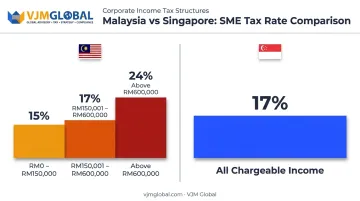
Singapore charges a flat 17% corporate income tax on chargeable income, and this applies equally to resident and non-resident companies. There's no tiered structure based on company size.
One feature that consistently surprises Malaysian business owners: Singapore's one-tier system. Once corporate tax has been paid, dividends distributed to shareholders are completely tax-exempt. No further tax at the shareholder level, no dividend imputation calculations.
Malaysia's structure works differently. The headline corporate tax rate is 24%, but qualifying Micro, Small and Medium Companies (MSMEs) get a preferential tiered rate on the first slice of income:
- 15% on the first RM150,000 of chargeable income
- 17% on the next RM150,001 to RM600,000
- 24% above RM600,000
To qualify, a company must meet three conditions:
- Be Malaysian-resident and incorporated locally
- Hold paid-up ordinary share capital of no more than RM2.5 million
- Generate gross business income under RM50 million
From YA 2024, this preferential rate disappears if more than 20% of the company is owned directly or indirectly by foreign companies or non-Malaysian citizens, according to LHDN's Public Ruling 8/2025.
Structural Differences Beyond the Headline Rate
Basis of taxation. Singapore taxes income accrued in or derived from Singapore, plus foreign income only when it's received or remitted there. Malaysia's regime is broader in how it captures income sourced both domestically and, in specified circumstances, from abroad. For a Malaysian group with regional revenue streams, this difference in scope matters more than the rate itself.
Capital gains. Singapore generally doesn't tax capital gains at all, though Section 10L (effective 1 January 2024) can capture foreign-asset disposal gains received in Singapore by MNE group entities lacking adequate economic substance.
Malaysia takes a different approach. It applies Real Property Gains Tax on property disposals, ranging from 30% within the first three years down to 10% from year six onward. A separate capital gains tax also applies to disposals of unlisted shares, typically at 10% of the gain.
| Factor | Singapore | Malaysia |
|---|---|---|
| Headline CIT rate | 17% flat | 24% (15–24% tiered for qualifying SMEs) |
| Basis of taxation | Territorial + remitted foreign income | Broader income capture |
| Capital gains | Largely untaxed (Section 10L exceptions) | RPGT on property; CGT on unlisted shares |
| Dividend tax | Tax-exempt (one-tier system) | Varies by structure |
| Startup incentives | SUTE + PTE | Tiered MSME rate |
The rate gap is a genuine reason Malaysian companies set up a Singapore holding or regional entity. Still, the headline number isn't the whole story. What matters more is the effective rate after exemptions, and that's where the next section becomes essential reading.
Understanding Singapore's Corporate Tax System
Here's a misconception that trips up almost every first-time foreign investor: chargeable income is not the same as revenue. It's profit after deducting allowable expenses, capital allowances, and approved donations. A company with SGD 2 million in revenue might have a chargeable income of a fraction of that once costs are stripped out.
Once you've pinned down chargeable income, timing matters just as much. Singapore assesses on a preceding-year basis: income earned during financial year 2024 gets assessed in Year of Assessment (YA) 2025. This is a different rhythm from Malaysia's assessment cycle, and it catches out owners who assume the two systems run in parallel.
Residency Depends on Control, Not Incorporation
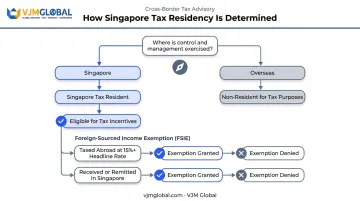
This is the most misunderstood rule in the entire system. Singapore determines tax residency by where control and management occur, meaning where the board actually makes strategic decisions, not where the company was incorporated.
A Malaysian-owned company incorporated in Singapore could still be classified as non-resident if the real decision-making happens from a Kuala Lumpur boardroom. That single fact changes several things:
- Eligibility for the Startup Tax Exemption scheme
- Access to Singapore's 90+ double tax agreements via a Certificate of Residence
- Withholding tax treatment on certain payments
Residency determines who Singapore taxes; the next question is what gets taxed. Taxable income covers trade profits, royalties, rental income, and investment income. Foreign-sourced income is taxable only when received or remitted in Singapore. This is subject to the Foreign-Sourced Income Exemption (FSIE) conditions, which require the income to have been taxed abroad at a headline rate of at least 15%.
One more wrinkle worth flagging: Section 10L, effective 1 January 2024, can tax foreign-sourced gains from asset disposals if the Singapore entity lacks adequate economic substance. This is squarely aimed at MNE groups using Singapore as a paper-thin holding layer, so Malaysian groups routing regional assets through a Singapore entity need genuine local substance, not just a registered address.
Tax Exemptions, Incentives and Rebates for New Companies
This is where the effective tax rate story gets interesting, and where the 17% headline number often becomes irrelevant for new entrants.
Startup Tax Exemption (SUTE)
New companies get a meaningful break for their first three Years of Assessment:
- 75% exemption on the first SGD 100,000 of chargeable income
- 50% exemption on the next SGD 100,000
To qualify, the company must meet three conditions:
- Be Singapore tax-resident
- Have no more than 20 shareholders, all individuals, or at least one individual holding 10% of ordinary shares
- Not be an investment-holding or property-development company
Partial Tax Exemption (PTE)
Companies that don't qualify for SUTE, or have moved past their first three years, still get:
- 75% exemption on the first SGD 10,000
- 50% exemption on the next SGD 190,000
Current CIT Rebate
IRAS also applies a CIT Rebate, currently set at 50% of tax payable for YA 2026, capped at SGD 40,000 (inclusive of a separate SGD 2,000 cash grant for companies with active local employment). This is calculated and applied automatically, according to IRAS's corporate tax rate and rebate schedule — no separate application needed.
Industry-Specific Incentives
Manufacturing, finance, and IP-heavy businesses may also qualify for the Pioneer Certificate or Development and Expansion Incentive. Administered by Singapore's Economic Development Board (EDB), these incentives offer tax exemption or concessionary rates of 5–10% on qualifying income for up to five years.
A Worked Example
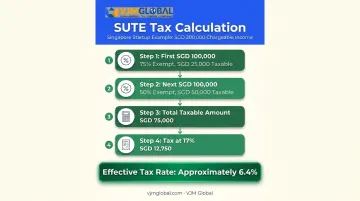
Take a Malaysian-owned Singapore startup with SGD 250,000 in headline profit, reduced to SGD 200,000 chargeable income after capital allowances. Applying SUTE:
- First SGD 100,000 → 75% exempt → SGD 25,000 taxable
- Next SGD 100,000 → 50% exempt → SGD 50,000 taxable
- Total taxable amount: SGD 75,000
- Tax at 17%: SGD 12,750
That's an effective rate of roughly 6.4% on the original SGD 200,000, far below the 17% headline figure.
One reassurance for smaller Malaysian businesses: the 15% global minimum tax under BEPS 2.0 only applies to multinational enterprise (MNE) groups with consolidated revenue above EUR 750 million. If your group falls under that threshold, the standard 17% rate with exemptions still applies to you.
Filing Obligations and Deadlines for Singapore Companies
Every Singapore-incorporated company faces two mandatory annual filings, regardless of profit or loss:
- Estimated Chargeable Income (ECI) — due within 3 months of financial year-end. Companies with revenue under SGD 5 million and nil ECI can skip this filing.
- Form C-S / C-S (Lite) / C: due by 30 November each year, with Form C-S available to companies with revenue up to SGD 5 million.
Record-keeping matters too: Companies must retain source documents for at least 5 years. Groups with gross revenue exceeding SGD 10 million face an additional requirement: transfer pricing documentation, directly relevant for Malaysian groups with related-party transactions flowing between entities.
Missing deadlines carries real consequences:
- IRAS can issue an estimated Notice of Assessment based on prior income
- Composition fines up to SGD 5,000 per offence
- Court summons for non-filing beyond 2 years, with directors facing fines up to SGD 10,000 or imprisonment
Managing these deadlines from across the border is exactly where things slip. A Kuala Lumpur-based finance team juggling Malaysian and Singaporean fiscal calendars often misses the 3-month ECI window simply because it doesn't align with local reporting cycles.
A cross-border advisory partner that tracks both compliance calendars, such as VJM Global, helps close that gap before deadlines slip.
Malaysia-Singapore Tax Treaty and Individual Tax for Malaysians Working in Singapore
Malaysian businesses and their employees are protected by a formal Double Taxation Agreement (DTA), effective since 2007 and updated through the 2021 Multilateral Instrument. Relief is claimed through a Certificate of Residence issued by the relevant tax authority.
The treaty covers:
- Business profits
- Dividends, with withholding capped at 5–10%
- Royalties, with withholding capped at 8%
- Employment income
Full details are set out in the IRAS-published Singapore-Malaysia DTA.
Do Malaysians Working in Singapore Pay Tax?
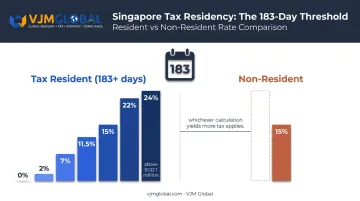
Yes, and the amount depends on Singapore's own residency rules, not Malaysian rules. Someone present or working in Singapore for at least 183 days in the preceding calendar year is treated as tax-resident and pays progressive rates from 0% up to 24% above SGD 1 million.
Non-residents face a different calculation: employment income is taxed at either a flat 15% or the resident progressive rates, whichever produces more tax. Singapore applies whichever calculation yields more tax rather than a simple flat rate, running the comparison at each assessment.
Corporate Tax Is Separate From Individual Tax
Here's a distinction that gets blurred often: a Malaysian director or employee's personal Singapore tax obligations are entirely separate from the company's corporate tax filings. And Malaysia's own domestic rules may still apply to income remitted back home. Both sides of the ledger need attention, not just one.
For Malaysian companies setting up a Singapore entity, this cross-border complexity is exactly where coordinated advisory pays off. VJM Global works across corporate tax structuring, individual tax exposure for seconded staff, and ongoing compliance, drawing on the firm's experience supporting business expansion into 100+ countries, Singapore included.
The firm's Singapore scope covers entity formation through ACRA, annual ECI and Form C-S filings with IRAS, and treaty-specific support. For Certificate of Residence applications and treaty benefit claims, VJM Global's DTAA advisory team can walk through what applies to your structure. The goal throughout: keeping Malaysian-owned Singapore entities compliant on both sides of the Causeway, without duplicated tax exposure.
Frequently Asked Questions
What is the Corporate Tax Rate in Singapore vs Malaysia?
Singapore charges a flat 17% on chargeable income. Malaysia's headline rate is 24%, though qualifying SMEs get a tiered rate starting at 15%. Exemption schemes can push Singapore's effective rate well below the headline 17%.
Do Malaysians working in Singapore pay taxes?
Yes. Tax depends on Singapore's 183-day residency test: residents are taxed progressively, non-residents at 15% or resident rates, whichever is higher. DTA relief prevents double taxation with Malaysia.
Can a Malaysian company register a business in Singapore?
Yes. Malaysian individuals and companies can incorporate a 100% foreign-owned Pte Ltd, subject to ACRA requirements like a local registered address and at least one Singapore-resident director.
Does Malaysia have a double taxation agreement with Singapore?
Yes, effective since 2007. It covers business profits, dividends, royalties, and employment income, with relief claimed via a Certificate of Residence.
What is the minimum effective corporate tax rate for a new Singapore startup?
Through the Startup Tax Exemption scheme, new companies can lower their effective rate on the first SGD 200,000 of chargeable income to roughly 6–8%. This applies for their first three Years of Assessment.
How is corporate tax residency determined for a Malaysian-owned Singapore company?
Residency depends on where the board makes strategic decisions, called control and management, not on where shareholders are based or where the company was incorporated.