This guide is built for real estate investors juggling several rental properties, e-commerce sellers running multiple brands, holding companies, serial entrepreneurs, and NRIs or OCIs managing ventures across the US and India. The structure you choose affects your liability exposure, your tax filings, and your ongoing compliance costs for years to come.
Series LLCs get pitched constantly as a cheaper alternative to forming separate entities. What rarely gets explained is the compliance reality underneath that pitch. Below, we'll cover what a Delaware Series LLC actually is, when it makes sense, the exact formation steps, and what it takes to keep the liability shield intact.
Key Takeaways
- A single Master LLC can spawn unlimited series, each shielded from the others' debts and lawsuits
- Delaware recognizes Protected Series (unfiled) and Registered Series (filed with the state)
- Formation requires a series-enabling Certificate of Formation and a detailed Operating Agreement
- Only about two dozen US states legally recognize series LLCs, limiting out-of-state reliability
- Each series needs separate books, EINs, and bank accounts to preserve its liability shield
What Is a Delaware Series LLC?
A Delaware Series LLC is a single legal entity, the Master LLC, that's authorized by its Certificate of Formation and Operating Agreement to create multiple internal divisions called "series." Each series can hold its own assets, have its own members and managers, and run its own line of business, all under one umbrella filing.
Delaware pioneered this structure back in 1996, well before most other states even considered the concept (Norton Rose Fulbright). The Master LLC itself typically holds nothing. It exists purely as the legal shell that houses the series beneath it.
Protected Series vs. Registered Series
Delaware offers two distinct types, governed by different sections of the Delaware LLC Act:
- Protected Series (Section 18-215): Formed entirely through the Operating Agreement, with no state filing, though the Certificate of Formation must note the liability limitation.
- Registered Series (Section 18-218): Filed as a Certificate of Registered Series with Delaware's Division of Corporations, creating a public record and UCC-recognized status that lenders rely on.
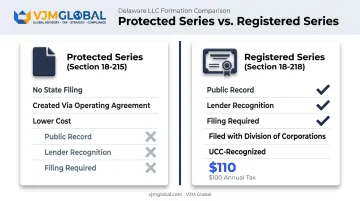
Delaware only began allowing registered series on August 1, 2019, so this is a relatively recent addition to an older law.
How This Differs From a Standard LLC
A traditional LLC exposes every asset it owns to any lawsuit filed against the business. If someone sues over one rental property, your other properties inside that same LLC are fair game too.
A Series LLC ring-fences liability at the individual series level. A lawsuit against Series A generally can't reach Series B's bank account, property, or contracts, provided the paperwork and recordkeeping actually support that separation.
Series don't work like a parent-subsidiary structure. They're more like siblings, sitting at the same level under the Master LLC with no hierarchy between them.
Why Choose a Delaware Series LLC? Benefits and Best Use Cases
The appeal comes down to three things: cost, liability separation, and simpler administration.
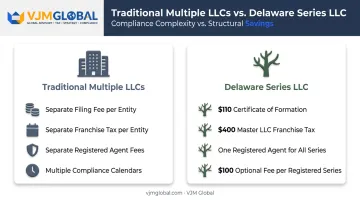
Cost efficiency. Instead of paying a separate filing fee and franchise tax for every LLC you form, you pay once for the Master LLC. Delaware's Certificate of Formation currently runs $110, and the Master LLC's annual franchise tax is $400, due June 1 each year under Section 18-1107 of the Delaware Code.
Registered series, if you use them, carry their own $100 annual tax each, still far less than standing up a brand-new LLC for every venture.
Liability segregation, in practice. Say you run two rental properties and an online retail brand under one Series LLC. A tenant lawsuit against Property A shouldn't be able to touch Property B or your retail inventory, as long as each series maintains separate records and bank accounts.
Common use cases include:
- Real estate investors holding multiple rental properties under one structure
- E-commerce sellers separating distinct product brands or storefronts
- Holding companies managing several passive investment vehicles
- Entrepreneurs, including NRIs and OCIs, running multiple low-risk ventures under shared ownership
Administrative simplicity. One registered agent covers the entire structure. You're not juggling renewal dates, agent fees, and separate compliance calendars for five or six different companies.
There's an important caveat, though. This structure works best for passive, asset-holding businesses. High-liability operating companies, such as a business with employees, physical customers, or heavy contractual risk, are poor candidates. Mixing a "hot" business with passive assets under the same Series LLC can undermine the very shield you're trying to build.
How to Form a Delaware Series LLC: Step-by-Step Guide
Forming a Series LLC follows the same basic path as a standard Delaware LLC, with two additions: series-enabling language in your Certificate of Formation and a more detailed Operating Agreement. Once your name and registered agent are locked in, the filing itself typically takes just a few business days.
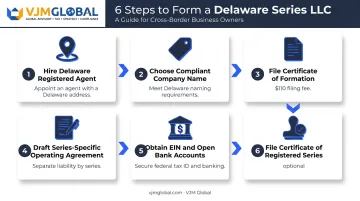
Step 1: Hire a Delaware Registered Agent
Delaware law requires every LLC to maintain a registered agent with a physical street address in the state. This agent receives legal notices and official state correspondence on your behalf, and you'll need this in place before you can file anything.
Step 2: Choose a Compliant Company Name
Your Master LLC name must include "LLC," "L.L.C.," or "Limited Liability Company" and be distinguishable from existing Delaware entities. Series names have their own rule: each one must begin with the Master LLC's full name, followed by a distinguishing identifier.
For example: "ABC Holdings, LLC – Series 1" or "ABC Holdings, LLC – Series Real Estate." This naming rule applies specifically to registered series under Delaware's statute.
Step 3: File the Certificate of Formation
This document must include a specific clause putting the public on notice that the LLC has the authority to create series with segregated liability. The current filing fee is $110. Skip this clause, and you may not get the liability protection you're counting on.
Step 4: Draft a Series-Specific Operating Agreement
This is the document that does the legal work. It establishes each series, defines how assets and liabilities are segregated between them, and sets out recordkeeping obligations. Courts will look closely at this agreement if a liability shield is ever challenged, so vague or boilerplate language is a real risk here.
Step 5: Obtain an EIN and Open Separate Bank Accounts
Each series generally needs its own federal EIN and its own dedicated bank account. IRS guidance on this remains a proposed regulation rather than a finalized universal rule. Even so, nearly every practitioner treats separate EINs and accounts as a baseline requirement for maintaining legal separation between series.
Step 6: File a Certificate of Registered Series (Optional)
If you want a series to have its own public record, useful for lenders or UCC financing, you'll file a separate Certificate of Registered Series for each one. The current fee is $110 per certificate, plus the $100 annual tax per registered series going forward.
Naming Rules, Registered Agent, and Ongoing Compliance
The naming convention isn't just bureaucratic. When a lender or title company searches Delaware's public records, a consistent naming pattern, like every series starting with "ABC Holdings, LLC," makes due diligence straightforward instead of a guessing game.
Annual compliance obligations include:
- Master LLC franchise tax of $400, due June 1
- Registered series annual tax of $100 each, same deadline
- Continuous maintenance of a Delaware registered agent
- Separate financial records for every series, whether protected or registered
That last point is where most Series LLCs run into trouble. Each series should ideally have its own EIN, its own bank account, and its own bookkeeping trail. Multiply that by five, six, or ten series, and the bookkeeping load grows fast.
This is where outsourced accounting support tends to pay for itself. Firms that specialize in multi-entity bookkeeping, like VJM Global, help business owners keep accurate, segregated records across each series while also managing cross-border tax compliance. That's especially relevant for entrepreneurs who are also expanding operations or personal holdings into India. There, DTAA and FEMA rules add another compliance layer on top of Delaware's requirements.
Common Mistakes, Misconceptions, and When a Series LLC May Not Be Right for You
Misconception #1: Every state recognizes Series LLCs. It doesn't. As of the Florida Bar Journal's most recent count, roughly 24 jurisdictions permit some form of series LLC, including Delaware, Texas, Illinois, Nevada, Montana, and Wyoming. If your series does business or holds property in a non-recognizing state, courts there may not honor the internal liability separation at all.
Misconception #2: Series work like a parent-subsidiary structure. They don't. Series sit side by side, horizontally, not stacked in a hierarchy. One series can't "own" another.
Practical challenge: banks and lenders often don't get it. Plenty of banks and accountants have never processed a Series LLC before. Opening a separate bank account or securing a distinct EIN for each series can take longer and require more explanation than it would for a standard LLC.
When to skip the Series LLC structure:
- You're running a single asset or single business line
- Your business is high-liability and operationally active (not passive)
- Your operations will mostly sit in states that don't recognize series LLCs
For these situations, a traditional LLC is often safer and considerably simpler to manage. A Series LLC rewards careful drafting, disciplined recordkeeping, and professional guidance. Used correctly, it's a genuinely useful tool, though it won't fit every business.
Frequently Asked Questions
How do I form a Series LLC in Delaware?
Appoint a Delaware registered agent, choose a compliant name, and file the Certificate of Formation with the required series clause. Then draft a detailed Operating Agreement and obtain EINs and bank accounts for each series.
Does Delaware recognize Series LLCs?
Yes. Delaware was the first state to legislate series LLCs, back in 1996, and it continues to recognize both protected and registered series under its LLC Act today.
What is the naming convention for a Delaware Series LLC?
Each series' name must begin with the Master LLC's full legal name, followed by a distinguishing identifier such as "Series 1" or a descriptive label, to stay compliant with Delaware's naming rules.
What's the difference between a protected series and a registered series?
A protected series is created solely through the Operating Agreement, with no state filing. A registered series is filed with the Delaware Secretary of State and appears on the public record.
Do I need a separate EIN and bank account for each series?
Most practitioners recommend it to preserve legal separation between series. The IRS has only issued proposed regulations on this point, with final guidance still outstanding.
How much does it cost to form and maintain a Delaware Series LLC?
The Certificate of Formation costs $110, the Master LLC's annual franchise tax is $400, and each registered series adds $110 to file plus $100 in annual tax.