
Introduction
UK businesses expanding into India face a challenge many overlook: whilst the India-UK DTAA governs tax on direct UK-India transactions, their Indian subsidiaries frequently transact with US-based vendors, investors, or parent-company affiliates. When that happens, the India-US DTAA suddenly applies, and without proper preparation, these businesses face unexpected TDS deductions at full domestic rates instead of lower treaty rates.
Consider a typical scenario: your UK parent company sets up an Indian subsidiary, which then licenses software from a US vendor or receives investment from a US-based fund. The moment those transactions occur, India-US DTAA provisions govern withholding tax rates and compliance — not the India-UK DTAA your finance team knows.
India maintains active tax treaties with over 95 countries. The India-US DTAA ranks among the most commercially significant, given the volume of cross-border trade between these economies and how often UK-structured businesses encounter US counterparts in their India operations.
This guide covers the key provisions of the India-US DTAA, when it becomes relevant for UK-structured businesses, how rates compare to the India-UK DTAA, and what compliance steps your finance team must follow to avoid costly TDS leakage.
TLDR: Key Takeaways for UK Businesses
- The India-US DTAA (signed 1989, effective December 1990) governs withholding tax on income flowing between India and the US
- UK businesses are affected when Indian subsidiaries exchange royalties, interest, dividends, or service fees with US entities
- Treaty rates differ from domestic TDS: dividends capped at 15–25%, interest at 10–15%, royalties at 15%
- Treaty benefits require a Tax Residency Certificate, Form 10F, and correct ITR schedules — without these, claims are rejected
- Full domestic TDS rates apply when documentation is missing, creating avoidable tax leakage
Why the India-US DTAA Matters for UK Businesses with India Operations
UK businesses typically operate under the India-UK DTAA for their own entity's India income. But their Indian subsidiaries frequently engage with US-based clients, vendors, investors, or affiliate entities, bringing the India-US DTAA into play unexpectedly.
Three common scenarios where UK companies encounter India-US DTAA:
- US holding structures — UK parent uses a US holding or intermediate entity that receives dividends or royalties from the India subsidiary
- US vendor payments — Indian subsidiary pays fees for technical services, software licensing, or consultancy to US-based vendors
- US investor distributions — US investors in the UK company's India operations receive interest or dividend distributions routed through India
](https://file-host.link/website/vjmglobal-l8s6go/assets/blog-images/f3fcc5d9-d49d-458f-92bf-f277e46d95c5/1778198538636565_390c3645556444cfa5e90a26af0a7303/360.webp)
The Triangular Structure Risk
When UK holding companies use US intermediaries or have US shareholders, finance teams often apply the wrong treaty to withholding tax calculations. Indian tax authorities scrutinise these structures closely. If your UK entity routes payments through a US intermediate purely to access favourable DTAA rates, the treaty benefit can be denied entirely.
CBDT Circular No. 789 (April 2000) established that a Tax Residency Certificate can serve as a basis for determining beneficial ownership. Indian authorities have since moved well beyond formal documentation — they now examine whether genuine economic substance supports the structure. That substance question is where triangular arrangements most often fail.
Beneficial Ownership Requirements
The India-US DTAA requires that the entity claiming treaty protection be the genuine beneficial owner of the income — not a conduit inserted to access lower withholding rates. For UK groups with multi-tier structures touching both US and Indian entities, this is the test most likely to trigger scrutiny.
Indian courts have clarified what "genuine" means in practice. In the Tiger Global case (January 2026), the Supreme Court ruled that treaty benefits can be denied where an intermediate entity lacks real commercial substance — regardless of its legal form. To satisfy beneficial ownership requirements, UK-structured arrangements must demonstrate:
- Actual decision-making authority held by the claiming entity
- Genuine business activity beyond holding shares or passing income
- Economic exposure to the income (real risk, not just legal title)
- Substance in the jurisdiction where treaty protection is claimed
What the India-US DTAA Covers: Key Provisions and Income Types
Tax Scope
The India-US DTAA applies to specific taxes in each country:
United States: Federal Income Tax under the Internal Revenue Code
India: Income tax including surcharge — excluding penalties, accumulated earnings tax, and wealth tax
Explicitly excluded from both sides:
- Social security taxes
- Personal holding company tax
- Estate and gift taxes
Defining Tax Residency
Article 4 of the treaty determines residence by domicile, place of incorporation, or place of management — not merely physical presence.
When an entity qualifies as resident in both countries, tie-breaker rules apply in this order:
- Permanent home location
- Centre of vital interests
- Nationality
- Mutual agreement between tax authorities
Main Income Categories Covered
| Income Type | Tax Treatment |
|---|---|
| Immovable property | Taxed in the country where the property is located |
| Dividends | Withholding rates vary by shareholding percentage (detailed below) |
| Interest income | Capped at treaty rates depending on payer type |
| Royalties and fees for included services | Both countries may tax; India's withholding is capped at treaty rates |
| Capital gains | Each country taxes under domestic law with limited treaty override; shipping and air transport exempt under Article 8 |
| Directors' fees | Taxable where the paying company is resident |
UK businesses with Indian subsidiaries paying royalties or dividends to US-connected entities should map each income stream against this table — the applicable rate determines your withholding obligation before any payment leaves India.
Relief from Double Taxation (Article 25)
The US allows a foreign tax credit for income tax paid in India. India allows a deduction for US tax paid, but that deduction cannot exceed the Indian tax rate applied to the foreign income.
Simplified example:
An Indian subsidiary pays ₹100,000 in royalties to a US parent. India withholds 15% (₹15,000) under DTAA rates.
The US parent reports the full ₹100,000 as income but claims a ₹15,000 foreign tax credit against its federal tax liability — eliminating double taxation on that income.
Article 25 covers most double-taxation scenarios — but one important carve-out affects any business with US-connected personnel.
The Saving Clause
The US retains the right to tax its citizens and residents as if the treaty did not exist. Exceptions apply only for:
- Government service income (Article 19)
- Students (Article 21)
- Professors (Article 22)
For UK businesses, this becomes relevant when US-citizen employees are based in India or when US-resident directors sit on the board of an Indian entity. The treaty may not shield that income from US taxation, even when it arises entirely in India.
India-US DTAA Tax Rates: What UK Businesses Should Know
| Income Type | DTAA Rate | Domestic TDS Rate (without DTAA) |
|---|---|---|
| Interest on bank loans | 10% | 20% |
| Other interest | 15% | 20% |
| Dividends (10%+ shareholding) | 15% | 20% |
| Dividends (other cases) | 25% | 20% |
| Royalties & technical services* | 15% | 10% |
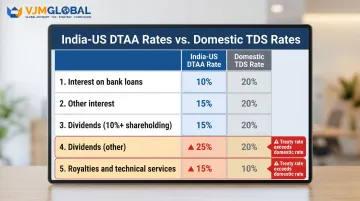
*For royalties and technical services, the DTAA rate (15%) exceeds the standard domestic rate (10%). Treaty protection still matters — see the Article 12 section below for why.
The 15% vs 25% Dividend Threshold
A US entity must hold at least 10% of the voting stock of the Indian company to qualify for the lower 15% withholding rate on dividends. UK businesses structuring US investment into Indian entities should structure shareholding to meet or exceed this 10% threshold.
Below 10% shareholding, India withholds 25% — significantly higher than the domestic rate, creating an unusual situation where treaty rates exceed standard TDS in certain scenarios.
Capital Gains Treatment
Unlike dividends and interest, capital gains are largely governed by domestic law in each country. The treaty provides limited protection — Article 8 carves out an exception only for income from operating ships and aircraft, which is unlikely to apply to most UK business structures.
When a US entity exits an Indian investment, Indian domestic capital gains rules apply — either Long-Term Capital Gains (LTCG) or Short-Term Capital Gains (STCG) depending on the holding period. UK businesses with US shareholders in their India operations should review exit structuring with an India tax adviser before any divestment is triggered.
Royalties and Fees for Technical Services (Article 12)
Both countries may tax these payments, but India's withholding is capped at 15% of the gross amount under the DTAA versus the standard domestic rate of 10%.
Whilst the domestic rate appears lower, treaty protection offers certainty and dispute relief. Without valid DTAA documentation, classification disputes over whether a payment is a "royalty" or a "fee for technical services" can trigger penalties and interest — pushing the effective rate well above 15%.
Documentation Requirements
DTAA rates apply only when the claimant submits proper documentation:
- Valid Tax Residency Certificate (TRC)
- Form 10F
- Self-declaration of beneficial ownership
Without these, the Indian payer must deduct TDS at the higher domestic rate or face penalties for under-withholding.
How the India-US DTAA Compares to the India-UK DTAA
India and the UK maintain their own DTAA, effective from 1993. UK businesses must understand both treaties because different income streams from their India operations fall under different treaties depending on the receiving entity's residency.
Key Rate Comparisons
| Income Type | India-US DTAA | India-UK DTAA |
|---|---|---|
| Dividends (10%+ holding) | 15% | 15% |
| Dividends (other) | 25% | 15% |
| Interest | 10–15% | 10–15% |
| Royalties | 15% | 10–15% |
| Technical service fees | 15% | 10–15% |
Structural Difference: Fees for Technical Services
The India-UK DTAA provides more favourable treatment for certain technical service fees, with rates ranging from 10–15% depending on service type. The India-US DTAA applies a flat 15% to most royalties and technical services.
If a UK entity and a US entity both provide similar services to your Indian subsidiary, routing the contract through the UK entity can reduce withholding tax by up to 5 percentage points — a meaningful difference at scale.
Which Treaty Applies When
The applicable treaty follows the residency of the beneficial owner receiving the payment:
- India-UK DTAA applies to payments from India to UK-resident beneficial owners
- India-US DTAA applies to payments from India to US-resident beneficial owners
UK businesses must ensure their Indian subsidiary applies the correct treaty to each counterpart. Classification errors create TDS (tax deducted at source) shortfalls, triggering:
- Interest charges on under-withheld amounts
- Potential penalties ranging from 100–300% of tax shortfall
- Compliance notices requiring detailed explanations
Claiming India-US DTAA Benefits: Steps for Your India Operations
UK businesses must have proper documentation in place before their Indian entity can apply India-US DTAA rates.
Required Documentation
1. Tax Residency Certificate (TRC)
- Issued by the US Internal Revenue Service
- Confirms the US entity is a US tax resident for the relevant financial year
- Must be valid for the specific period when payments are made
2. Form 10F
- Filed with Indian tax authorities
- Contains the US entity's TIN, registered address, and period of residency
- Required for each financial year in which treaty benefits are claimed
3. Self-declaration of beneficial ownership
- Confirms the US entity is the genuine beneficial owner
- Not a conduit or agent for another party
- Essential to avoid treaty-shopping allegations
ITR Reporting Requirements
Indian corporate subsidiaries must report foreign-linked income and tax relief in specific schedules:
- Schedule FSI — Reports income received from or paid to foreign entities
- Schedule TR — Auto-populated from FSI data; shows relief claimed under the DTAA
- Schedule FA — Required only if the Indian entity holds specified foreign assets
- Form 67 — Must be filed before the ITR deadline to claim foreign tax credits
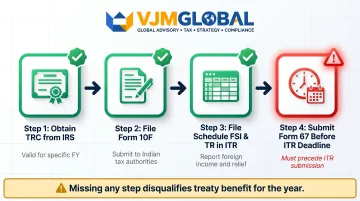
Critical timing: Form 67 must be submitted before filing the annual ITR. Missing this deadline disqualifies the entire foreign tax credit claim for that year, even if documentation was otherwise perfect.
Managing this documentation correctly across two jurisdictions is where most compliance gaps occur. VJM Global works with 250+ UK businesses on exactly this — handling TRC coordination, Form 10F filings, ITR schedule preparation, and Form 67 submissions ahead of deadlines. Missing any one of these steps can cause the entire treaty benefit to be disallowed for that year, resulting in avoidable withholding tax costs.
Common Pitfalls UK Businesses Face with India-US DTAA Compliance
1. Applying the Wrong Treaty
The most frequent mistake: using India-UK DTAA rates for payments to a US entity because the UK parent is involved, when the beneficial owner is actually US-resident.
Example scenario: UK parent company receives royalty income from its Indian subsidiary, but the intellectual property is actually owned by a US affiliate that licenses it to the UK entity. The beneficial owner is the US entity, so India-US DTAA rates apply, not India-UK rates.
2. Missing or Expired TRC
The TRC must be current and valid for the specific financial year — a TRC issued for FY 2023-24 does not cover payments made in FY 2024-25. Indian tax authorities reject outdated TRCs without exception.
When a TRC is missing or expired, the consequences are immediate:
- The payer must withhold tax at full domestic rates
- Recovery requires filing a refund claim with Indian tax authorities
- Refund processing typically takes 12-18 months
3. Not Filing Form 67 Before ITR Deadline
Form 67 must be filed before submitting the annual ITR to claim foreign tax credits. Missing this deadline disqualifies the claim entirely, even when all other documentation is in order. There is no late-filing provision.
4. Beneficial Ownership Trap in Multi-Tier Structures
Indian tax authorities scrutinise intermediary entities used in treaty shopping. If a UK parent routes income through a US holding company purely to access India-US DTAA rates without genuine US economic substance, the treaty benefit can be denied.
Under India's General Anti-Avoidance Rules (GAAR), effective from April 2017, arrangements lacking commercial substance or created primarily to obtain tax benefits face challenge. The tax department can:
- Disregard the arrangement
- Reallocate income to the genuine beneficial owner
- Apply domestic TDS rates retroactively, plus interest and penalties
Tiger Global ruling: India's Supreme Court held that treaty benefits could be denied where intermediate entities lacked genuine commercial substance — establishing that beneficial ownership requires actual economic activity in the treaty country, not just legal registration.
Frequently Asked Questions
How does DTAA work in India?
India allows relief from double taxation either by exempting foreign income or providing a credit for tax already paid abroad, based on the specific treaty between India and the other country. The taxpayer must submit proper documentation to claim treaty benefits.
What income is covered by DTAA?
DTAAs typically cover dividends, interest, royalties, fees for technical services, capital gains, income from immovable property, directors' fees, and employment income. Each treaty specifies different rates and conditions for these income types.
Is there a tax treaty between India and the USA?
Yes. The India-US DTAA was signed in 1989 and has been in force since December 1990, covering Federal Income Tax in the US and income tax including surcharge in India. UK businesses with US parent companies or American investors in their India operations need to understand this treaty's scope, as it directly affects how cross-border income is taxed.
How can I avoid double taxation between India and the US?
Obtain a Tax Residency Certificate from the relevant tax authority and submit Form 10F to the Indian payer. Also report foreign income and tax credits in the correct ITR schedules so the Indian entity deducts TDS at treaty rates rather than domestic rates.
How can a UK business claim DTAA benefits on Indian income?
The Indian entity or subsidiary must file Schedule FSI, Schedule TR, and Form 67 before the ITR deadline on the Indian income tax portal. These declare foreign income and establish the basis for claiming tax relief or credit under the DTAA.