Introduction
Singapore businesses expanding beyond Asia-Pacific often run into the same wall: their home base is excellent for regional operations, but serves Gulf, African, and European clients from the wrong side of the map. Dubai's free trade zones exist precisely to close that gap.
Dubai's free trade zones are special economic areas offering 100% foreign ownership, tax exemptions, and customs-free trade. They've become a practical expansion base for Singapore companies targeting the Middle East, Africa, and Europe. With bilateral merchandise trade between Singapore and the UAE reaching SGD 27.9 billion in 2025 (up 16% year-on-year), the momentum is clear.
More than 600 Singapore-based firms now operate in the UAE — and that number is rising.
What free zones offer that Singapore cannot is geographic reach. While Singapore dominates Asia-Pacific access, Dubai provides a separate legal base to serve the GCC, MENA, East Africa, and Eastern Europe — markets that are physically and commercially closer to Dubai. For trading firms, fintech companies, and logistics operators, the two jurisdictions work together rather than against each other.
Key Takeaways
- Dubai operates 20+ free zones (the UAE has 40+ total) where foreign businesses own 100% of their company with no local sponsor
- Key benefits: 0% corporate tax on qualifying income (Qualifying Free Zone Person status required under the UAE's 2023 corporate tax rules), zero customs duties, full profit repatriation
- Singapore businesses use Dubai as a western gateway to the GCC, Africa, and Eastern Europe, complementing existing Asia-Pacific operations
- Top zones for Singapore firms: DMCC (commodities/trading), DIFC (financial services), Dubai Internet City (tech), DAFZA (logistics)
- Setup takes 2–4 weeks: choose a free zone, pick an entity type (FZE or FZCO), obtain a license, and open a corporate bank account
What Are Dubai Free Trade Zones?
A Dubai free trade zone is a geographically designated economic area governed by its own regulatory authority, operating under rules distinct from UAE mainland law. Businesses inside these zones enjoy special tax, ownership, and customs treatment unavailable elsewhere in the country.
Dubai alone hosts more than 20 individual free zones. Across the UAE, 46 free zones operate across all seven emirates, including Abu Dhabi, Sharjah, and Ras Al Khaimah. The first and largest — Jebel Ali Free Zone (JAFZA), established in 1985 — started with just 19 companies.
Legal Entity Types
Two primary structures are available to foreign businesses:
- Free Zone Establishment (FZE): Single-shareholder entity—can be owned by one individual or one corporate entity
- Free Zone Company (FZCO): Requires at least two shareholders, up to 50 depending on the zone
Both enjoy identical free zone benefits. The distinction lies purely in ownership structure and governance requirements. Some free zones also offer a Free Zone Limited Liability Company (FZ-LLC) structure with specific shareholder provisions.
Why Singapore Businesses Are Choosing Dubai Free Zones
Geographic Complementarity
Singapore businesses already serve Asia-Pacific markets effectively. A Dubai free zone entity provides a separate legal base to serve the GCC, MENA, East Africa, and Eastern Europe—markets that are logistically and commercially closer to Dubai than to Singapore.
The goal is expanding operational reach into time zones, trade corridors, and regulatory environments where Dubai offers superior access—without displacing what Singapore already does well.
The Singapore-UAE Trade Relationship
The bilateral framework is strengthening:
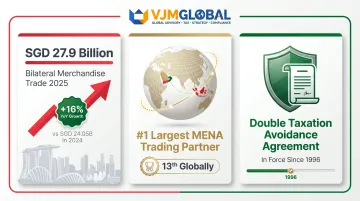
- Bilateral merchandise trade: SGD 27.9 billion in 2025, up from SGD 24.05 billion in 2024 (16% growth)
- The UAE is Singapore's largest trading partner in the MENA region and 13th largest globally
- Double Taxation Avoidance Agreement (DTAA): In force since 1996, covering business profits, dividends, interest, and royalties. Singapore-based shareholders receiving dividends or profits from a Dubai free zone company avoid double taxation under this agreement.
100% Foreign Ownership
Unlike UAE mainland companies—which in certain sectors still require an Emirati partner or local agent—free zone companies allow complete foreign ownership. A Singapore founder or company retains full control without sharing equity with a local partner.
This is critical for IP-sensitive businesses, proprietary trading strategies, or companies where ownership structure affects parent company compliance or financing arrangements.
Tax Efficiency for Singapore Business Owners
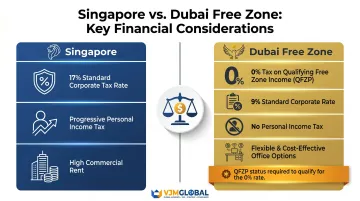
Dubai free zones offer 0% corporate tax on qualifying income, no withholding tax on dividends, and no capital gains tax—but the rules changed in June 2023.
UAE Corporate Tax (Effective June 2023):
- Standard rate: 9% on taxable income exceeding AED 375,000
- Qualifying Free Zone Person (QFZP) status allows companies to maintain 0% tax on qualifying income
- Non-qualifying income is taxed at 9%
QFZP Criteria (Summary):
- Maintain adequate substance in the UAE (physical presence, staff, assets)
- Derive qualifying income from qualifying activities
- Non-qualifying revenue must not exceed 5% of total revenue or AED 5 million (whichever is lower)
- Maintain audited financial statements and comply with transfer pricing rules
Singapore businesses should not assume automatic tax-free status—QFZP compliance requires careful planning.
Operational Cost Considerations
Singapore businesses should evaluate the full cost picture before committing:
- Free zone license and office costs vs. Singapore commercial rent
- Visa and employment costs
- Absence of personal income tax in the UAE (vs. Singapore's progressive tax)
- Corporate tax differential (Singapore's 17% standard rate vs. UAE's 0% QFZP or 9% standard)
- Regulatory compliance and professional service fees
For sectors like financial services, commodities trading, or tech, Dubai free zones may offer a lower cost base for regional expansion than expanding Singapore headcount.
Top Dubai Free Zones for Singapore Businesses
DMCC (Dubai Multi Commodities Centre)
Best for: Trading, commodities, supply chain, agri-business, fintech, e-commerce
DMCC surpassed 25,000 registered companies in 2024, growing at an 8% annual compound rate over five years. It won "Global Free Zone of the Year" from Financial Times fDi Intelligence for eight consecutive years through 2022.
Key features:
- Over 1,000 permitted business activities including gold, diamonds, energy, AI, sustainability, crypto
- 100% digital setup process—complete remotely from Singapore
- Approximately 10 working days for full license issuance
- Initial costs: AED 10,345 to AED 84,515 depending on license duration and office solution
DIFC (Dubai International Financial Centre)
Best for: Fintech companies, asset managers, financial services firms, fund managers
DIFC reached 8,844 active companies in 2025, recording 28% year-on-year growth in organically acquired firms.
Why Singapore financial firms choose DIFC:
- Operates under a common law framework (familiar to Singapore businesses)
- Independent judicial system via DIFC Courts
- Regulated by Dubai Financial Services Authority (DFSA)—recognized for rigorous standards
- Ideal for fund managers, fintechs, wealth advisors, and regulated financial activities
DAFZA (Dubai Airport Free Zone) and Dubai South
Best for: Logistics, aviation, e-commerce, time-sensitive goods
DAFZA: Adjacent to Dubai International Airport (DXB), the world's busiest international airport. Hosts 3,300+ registered businesses across 20+ sectors.
Dubai South: Surrounds Al Maktoum International Airport (DWC), spanning 145 square kilometers. Features EZDubai (the region's dedicated e-commerce zone) and a direct logistics corridor between Al Maktoum Airport and Jebel Ali Port, enabling sea-to-air goods movement without mainland transit.
Key advantages for Singapore businesses:
- Direct airside access cuts transit time for high-value or perishable shipments
- EZDubai provides dedicated e-commerce infrastructure including warehousing and last-mile logistics
- Jebel Ali Port corridor supports multimodal distribution across the Middle East and Africa
Dubai Internet City and Dubai Silicon Oasis
Best for: Tech startups, IT services, software development, innovation-driven businesses
Dubai Internet City (DIC): The region's leading technology and ICT hub, part of TECOM Group. Added AED 100 billion to Dubai's GDP over the past 15 years. Hosts global tech companies, startups via in5 Centres, and freelancers via GoFreelance packages.
Dubai Silicon Oasis (DSO): Dedicated economic zone for Knowledge and Innovation with 40,000+ registered company members. Features 11 industry clusters including AI & IoT, robotics, 3D printing, cybersecurity, and Web 3.0. Home to Dtec (Dubai Technology Entrepreneur Campus) and the MITDesignX Accelerator program.
Why tech-focused Singapore businesses choose these zones:
- Co-location with global tech firms (Microsoft, Oracle, Cisco at DIC) creates built-in networking opportunities
- DSO's 11 industry clusters provide specialized infrastructure for deep-tech and emerging technology companies
- Startup programs (in5, Dtec) offer mentorship, funding access, and reduced early-stage costs
IFZA (International Free Zone Authority)
Best for: Singapore SMEs and startups seeking cost-effective entry
IFZA positions itself as one of Dubai's more affordable free zone options, offering flexible office arrangements:
- Flexi Desk: Shared workstation with 10 hours of access per week, IFZA address, and meeting room time
- Flexi Desk+: Dedicated desk with unlimited access
Selection guidance: Choosing the right free zone depends on business activity, budget, and target market. A Singapore trading company cannot set up in a media-focused zone; each free zone licenses only specific activity categories.
How to Register a Company in a Dubai Free Zone
The end-to-end process typically takes 2–4 weeks for straightforward applications. Each free zone authority manages its own registration, meaning requirements and timelines vary. Singapore businesses should verify specific documentation requirements with their chosen free zone directly. The five steps below cover what to expect at each stage.
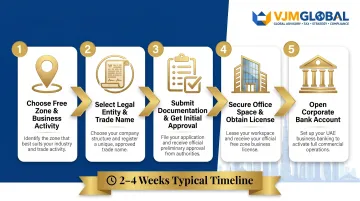
Step 1: Choose Your Free Zone and Business Activity
Each free zone licenses only specific activity categories — a Singapore trading company cannot automatically set up in a media-focused zone. Getting this choice right upfront avoids costly license amendments later.
Selection criteria:
- Permitted business activities for your industry
- Geographic location (airport, port, city center)
- Cost structure and office options
- Target customer base (free zone, UAE mainland, or international)
The Free Zones Gateway comparison tool is useful for comparing Dubai-specific zones.
Step 2: Select a Legal Entity and Trade Name
Entity choice:
- FZE (Free Zone Establishment): For single shareholder—typically used when a Singapore company is setting up a wholly-owned subsidiary
- FZCO (Free Zone Company): For multiple shareholders
Trade name rules:
- No previously registered names
- No references to religious or governmental bodies
- Must align with licensed business activity
Step 3: Submit Documentation and Obtain Initial Approval
Document requirements vary by free zone, but most authorities ask for the following as a baseline:
- Completed application form
- Passport copies of shareholders and directors
- Emirates ID (if already in the UAE)
- Business plan or financial statements (depending on free zone)
- Proof of residential address
- Company ownership/shareholding structure documents
- Ultimate Beneficial Owner (UBO) details (for individuals with 25%+ ownership)
Singapore advantage: Most major free zones allow remote/online registration. DMCC offers a 100% digital company setup process that can be completed entirely from Singapore, with documents submitted and signed electronically.
Step 4: Secure Office Space and Obtain Your License
Office space options:
- Physical offices: Full-time dedicated space
- Co-working/flexi-desks: Accepted in many free zones; cost-effective for lean operations
- Virtual office packages: Address and mail handling only
Visa allocation: The type of office space directly affects the number of employment visas available. Flexi-desk arrangements typically support 1-3 visas. Larger physical offices allow more visa allocations, making them the better fit for teams planning to hire locally.
Step 5: Open a Corporate Bank Account
Opening a UAE corporate bank account is often the most time-consuming part of the process for foreign businesses — plan for this step to extend your overall timeline by several weeks.
Expect the following from UAE banks:
- Detailed KYC/AML checks by UAE banks
- Documentation requirements for Singapore-incorporated parent companies
- Verification of business model, revenue sources, and beneficial ownership
- In-person meetings or video verification often required
Working with a business setup advisor who knows UAE bank requirements for Singapore-incorporated entities can significantly reduce back-and-forth. VJM Global's business setup and compliance professionals support Singapore businesses through both the banking process and the broader registration journey.
Free Zone vs. UAE Mainland: What Singapore Businesses Need to Know
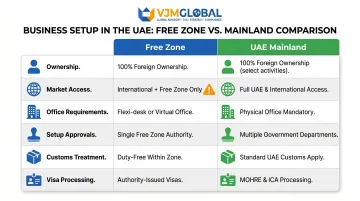
Choosing between a free zone and a UAE mainland entity is one of the most consequential decisions Singapore businesses face when entering the UAE market. The structures differ significantly in market access, costs, and operational flexibility.
The Core Operational Restriction
Free zone companies can only conduct business within the free zone or internationally—not directly with UAE mainland customers.
If a Singapore business wants to sell goods or services directly to UAE mainland customers, it needs:
- A mainland license, or
- A distribution agreement with a mainland company, or
- A separate mainland branch
Many Singapore businesses underestimate this restriction and run into compliance issues or miss market opportunities as a result.
Key Comparison Points
| Factor | Free Zone | UAE Mainland |
|---|---|---|
| Ownership | 100% foreign ownership | 100% foreign ownership (since 2021, except restricted sectors) |
| Market Access | International + free zone only | Full UAE mainland market access |
| Office Requirements | Flexi-desk options available | Minimum physical office (commonly ~200 sq ft) |
| Setup Approvals | Single free zone authority | Multiple government agencies |
| Customs Treatment | Customs-free for imports/exports; duty applies when moving goods to mainland | Standard UAE customs apply |
| Visa Processing | Handled by free zone authority | Requires coordination with immigration and labor departments |
Strategic Guidance for Singapore Businesses
Your structure should follow your revenue — assess your target customer base before committing:
- Primarily international or free zone revenue: A free zone entity is the most cost-efficient and straightforward option
- Primarily UAE mainland revenue: A mainland entity or dual structure (free zone + mainland branch) will likely be necessary, even with higher setup costs
- Mixed revenue streams: A dual structure or distribution agreement with a mainland partner offers the most flexibility
Common Misconceptions Singapore Businesses Have About Dubai Free Zones
"All Dubai Free Zone Companies Automatically Pay 0% Corporate Tax"
False. The UAE introduced a 9% corporate tax in June 2023 that applies to all businesses, including free zone entities. However, companies that meet "Qualifying Free Zone Person" (QFZP) criteria can still benefit from 0% tax on qualifying income.
Don't assume tax-free status without confirming QFZP eligibility first. Three requirements catch Singapore businesses off guard:
- Substance rules — your free zone entity must have genuine economic activity in the UAE
- Qualifying activities — only specific income types attract the 0% rate
- De minimis threshold — non-qualifying revenue must stay below 5% of total income
"A Dubai Free Zone Company Can Freely Sell to UAE Consumers"
Not quite. Free zone entities are restricted from direct mainland sales without additional approvals or a mainland entity.
The UAE government is explicit on this point: "While they can trade freely within the free zone and internationally, access to the UAE mainland market is regulated."
In practice, this means a free zone license alone won't cover UAE-wide operations. If your target customers are UAE-based consumers or businesses, plan for a mainland license or distribution arrangement from the start — not as an afterthought.
"Setup Is Entirely Self-Service and Simple"
Partially true. While some free zones offer online portals and streamlined processes, banking, visa processing, and regulatory compliance still require careful documentation — particularly for Singapore-based shareholders and parent companies.
Most Singapore businesses benefit from professional support in these areas:
- Corporate bank account opening (KYC/AML documentation for Singapore parent companies)
- Visa processing and Emirates ID applications
- Ongoing QFZP compliance and corporate tax filing
- Transfer pricing documentation for intercompany transactions
Frequently Asked Questions
What are the free trade zones in Dubai?
Dubai hosts 20+ free zones, each governed by its own authority and focused on specific industries. Key examples include DMCC (commodities and trade), DIFC (financial services), Jebel Ali Free Zone (logistics), Dubai Internet City (technology), IFZA (multi-activity SMEs), and Dubai South (aviation and e-commerce).
How many free trade zones are there in the UAE?
The UAE operates 46 free zones across all seven emirates, with Dubai hosting the largest concentration. The first was Jebel Ali Free Zone, established in 1985. The number continues to grow as the UAE expands its economic diversification strategy.
How does the Dubai free zone work?
A free zone is a designated economic area with its own regulatory authority, where businesses operate under special rules including 100% foreign ownership, tax exemptions on qualifying income (QFZP status required post-2023), and customs-free trade. The trade-off is that businesses must operate primarily within the zone or internationally, rather than selling directly to the UAE mainland.
Which Dubai free zone is best?
The right choice depends on your business activity, budget, and target market. For Singapore businesses: DMCC suits traders and commodities firms, DIFC suits financial services and fintech, Dubai Internet City and Silicon Oasis suit tech companies, and IFZA offers a cost-effective entry point for SMEs and startups.
Is Dubai a free trade zone?
No, Dubai is not itself a free trade zone—it is an emirate within the UAE that contains more than 20 individual free zones, each operating as a separate economic area with its own authority. The rest of Dubai operates under UAE mainland regulations with different ownership, tax, and operational rules.
Where are free zones in Dubai?
Dubai's free zones are spread across the emirate by industry focus. Notable locations include Jebel Ali Port (JAFZA, logistics), the financial district (DIFC), the airport corridor (DAFZA), Jumeirah Lake Towers (DMCC, commodities), and Dubai South near Al Maktoum International Airport (aviation and e-commerce).