That's not a technology problem. It's a planning, people, and process problem.
"Failure" rarely means a scrapped system. More often, it means a project that went over budget, missed its timeline, or delivered only a fraction of the promised efficiency gains. Any of those outcomes can be financially devastating — and operationally crippling.
This article breaks down the root causes, the hidden costs most businesses never anticipate, lessons from real-world disasters, and a practical prevention roadmap for US business leaders evaluating or already deep into an ERP project.
Key Takeaways
- ERP failures stem mostly from poor planning, weak change management, and bad data — not flawed software
- More than a quarter of ERP projects exceed their budget, per Panorama Consulting's 2024 research
- Rushed timelines are one of the strongest predictors of ERP implementation failure
- Successful implementations treat ERP as a business transformation — one that reshapes processes, people, and data across the organization
- US companies with cross-border operations must plan upfront for multi-currency accounting, multi-entity structures, and compliance across jurisdictions
The Scale of ERP Failure: What the Numbers Tell US Businesses
Most ERP projects don't fail at the technology layer. They fail because the business wasn't ready for the transformation the technology demands.
The numbers make the pattern clear:
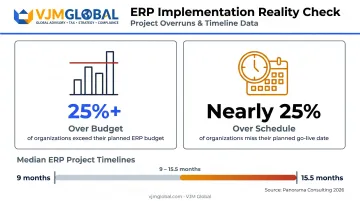
- More than a quarter of organizations exceeded their ERP project budget, according to Panorama Consulting's 2026 ERP Report. The most common reason: unexpected need for additional technology that wasn't scoped at the start.
- Almost a quarter reported going over schedule. The primary culprit wasn't software defects — it was organizational issues: governance gaps, resistance to change, and process redesign that took longer than planned.
- Median project timelines have ranged from 9 to 15.5 months across Panorama's recent annual surveys, depending on scope and methodology — yet many projects still launch with schedules compressed far below those benchmarks.
What "Failure" Actually Looks Like in Practice
For US businesses, the consequences of ERP failure extend well beyond the IT budget:
- Hershey's 1999 go-live left more than $100M in orders unprocessed during peak Halloween season — a textbook operational shutdown
- Distribution errors, delayed shipments, and empty shelves appear despite available inventory when order management modules misfire
- National Grid US absorbed $8M in unrecovered employee overpayments after a payroll module failure
- Late filings and incorrect tax treatment create audit risk, especially for US companies with multi-entity or cross-border operations
The financial hit compounds quickly — and it rarely stays contained to a single department. Understanding where these failures originate is the first step toward avoiding them.
The Top Reasons ERP Implementations Fail
Every failed ERP project has its own story. The underlying causes, though, are remarkably consistent across industries and company sizes.
Poor or Absent Pre-Implementation Planning
Many organizations begin ERP projects with goals like "improve efficiency" or "better reporting" — vague targets with no measurable success criteria. Without baseline metrics, mapped processes, and clear KPIs locked in before vendor selection, the project has no framework for making tradeoff decisions when complications arise.
If you never define what "working" looks like, you have no way to course-correct when it isn't.
Rushed or Unrealistic Timelines
Compressed schedules force teams to cut corners on testing, training, and change management. The Hershey's case is the classic example: the project was recommended as a 48-month effort and compressed to 30 months under Y2K deadline pressure. The final modules went live in July 1999, months behind even the accelerated schedule , directly into peak candy season. The result was more than $100M in unprocessed orders, a reported 19% quarterly profit drop, and a 12% annual sales decline.
Artificial deadlines don't compress the work — they just compress the time available to catch problems before they reach production.
Insufficient User Training and Change Management
ERP systems change the way employees work at every level. One-time training sessions before go-live are almost never sufficient. When users are uncomfortable with the new system, they revert to spreadsheets, paper logs, and shadow processes , slowing ROI even when the system itself functions correctly.
Panorama's 2026 report found that organizational change management focus increased from 38.4% to 46.8% year over year — a sign that the industry is learning this lesson. Even so, many organizations still treat change management as an afterthought, launching training programs only weeks before go-live rather than building adoption strategies from the start.
Poor Data Quality and Migration Planning
Migrating data from legacy systems is consistently underestimated in complexity. Dirty, incomplete, or inconsistently formatted data feeds directly into the new system's outputs , corrupting financial statements, inventory records, and customer invoices from day one.
Target Canada's SAP data was accurate only about 30% of the time at launch, compared to 98-99% accuracy in Target's US systems. The result was distribution centers flooded with overflow inventory while store shelves sat empty. Target Canada filed for creditor protection in January 2015, ultimately costing the parent approximately $7B.
Wrong Vendor or Implementation Partner Selection
Selecting an ERP vendor based on brand recognition or feature demos — rather than fit for your actual workflows — sets a project up to fail before kickoff. Choosing an implementation partner without verifying their industry depth and staffing capacity compounds the risk.
Two US cases illustrate the cost:
- MillerCoors filed a $100M suit against HCL Technologies alleging a flawed SAP implementation with missed deadlines, inadequate leadership, staffing issues, and thousands of defects
- National Grid US settled with Wipro for $75M after a botched SAP upgrade that left 15,000 supplier invoices unpaid
In both cases, partner vetting and contract structure were central to how the failure unfolded.
The Hidden Costs of ERP Failure US Businesses Often Overlook
The direct project cost is rarely the biggest number. Recovery, remediation, and operational disruption routinely dwarf the contracted implementation budget.
National Grid's total recovery cost reached approximately $585M — roughly 150% of the original implementation price — requiring two years of stabilization work and approximately 850 contractors. The pattern is consistent across documented ERP failures: recovery typically costs 150% to 200% of the initial implementation budget, according to ERP recovery specialists.
The Operational Disruption Cascade
When core systems fail, the damage compounds quickly:
- Employees spend hours recovering from errors instead of doing their jobs
- Customers face delays, leading to order cancellations and defections
- Leadership gets pulled into crisis management rather than growth
- Finance teams lose weeks to manual reconciliation
Mission Produce's November 2021 ERP conversion caused gross profit to fall from $22.7M to just $0.5M in a single quarter — a $22.2M decrease — driven by inventory management failures, fruit disposals, and sourcing disruptions. The company also reported $1.5M in noncapitalizable ERP implementation costs in that same quarter, including consulting fees.
A Dimension Specific to US Companies with Global Operations
US businesses operating across borders face an additional layer of risk that domestic implementations don't encounter: ERP misconfiguration for multi-entity or cross-border financial reporting.
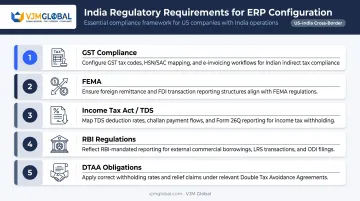
When ERP financial modules aren't correctly aligned with local regulatory requirements, the consequences include late filings, incorrect tax treatment, and heightened audit risk. For US companies expanding into India, the regulatory landscape covers:
When ERP financial modules aren't correctly aligned with local regulatory requirements, the consequences include late filings, incorrect tax treatment, and heightened audit risk. For US companies expanding into India, the regulatory landscape covers:
- GST compliance — multi-rate structures, input tax credit rules, and filing timelines
- FEMA — foreign capital flow restrictions and reporting obligations
- Income Tax Act — withholding tax configuration for cross-border payroll and payments
- RBI regulations — remittance limits and reporting requirements
- DTAA obligations — treaty-based tax treatment that affects how transactions are recorded
None of these are intuitive for a US-configured ERP. Firms like VJM Global, which specialize in cross-border accounting for US companies operating in India, help ensure ERP financial modules are correctly mapped to these requirements from the outset — before a misconfiguration becomes a regulatory exposure.
Lessons from Real-World ERP Disasters
Three Cases, Three Transferable Lessons
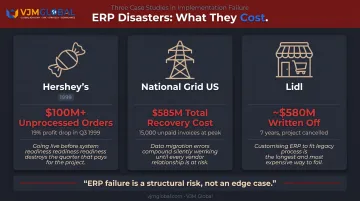
Hershey's (1999)
A 48-month project compressed to 30. Launched in peak candy season. Over $100M in orders sat unprocessed despite available inventory. Lesson: Artificial deadlines don't compress the work — they compress the safety margins.
National Grid US
Launched under deadline pressure with known deficiencies. The result: 15,000 unpaid supplier invoices, $8M in unrecovered payroll overpayments, a $75M settlement with Wipro, and a $585M total recovery bill. Lesson: An incomplete go-live costs far more than a delayed one.
Lidl
Lidl spent approximately $580M (roughly €500M) over seven years trying to force a SAP-based merchandise management system to replicate their existing retail processes exactly, rather than adapting workflows to align with the system. They eventually cancelled the project and reverted to their previous system. Lesson: Customizing an ERP to match broken legacy processes is one of the most expensive mistakes in technology.
Hershey's, National Grid, and Lidl are not edge cases — they are sophisticated enterprises with substantial IT budgets and experienced technology leadership. What these failures share isn't a shortage of talent. ERP failure is a structural risk, and that's exactly what makes systematic prevention strategies so valuable: they address the architecture of failure, not just the execution.
How to Avoid ERP Implementation Failures: A Step-by-Step Guide for US Businesses
Start with Business Process Mapping, Not Vendor Selection
Before approaching any ERP vendor, document and evaluate your current processes. Identify what works, what doesn't, and what must change. This prevents the expensive trap of over-customizing a new system to replicate broken legacy workflows — the same mistake that cost Lidl €500M.
A simple pre-selection checklist:
- Map every core business process end-to-end
- Identify pain points that the ERP must solve
- Document which processes can be standardized vs. which genuinely require customization
- Define what "improved" looks like, in measurable terms
Define Success Metrics Before You Sign Anything
Every ERP project should begin with documented KPIs tied to real business outcomes:
- Order fulfillment cycle time
- Financial close duration
- Inventory accuracy rate
- Invoice processing time
- System uptime and adoption rate by department
These metrics serve as the project's north star. They also provide objective criteria for evaluating vendor performance — and for knowing when the system is actually ready to go live.
Invest in Phased Implementation and Rigorous Testing
A phased rollout carries considerably lower risk than a Big Bang go-live. Not every situation allows for it, but where possible, rolling out by module, geography, or business unit reduces exposure significantly.
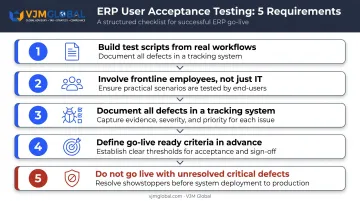
Equally critical: user acceptance testing (UAT) must involve actual end-users performing real business scenarios — not just IT staff confirming technical function.
Practical UAT requirements:
- Build test scripts based on real daily workflows
- Involve frontline employees, not just system administrators
- Document all defects formally in a tracking system
- Define "go-live ready" criteria in advance — and enforce them
- Do not go live with unresolved critical defects, regardless of timeline pressure
Treat Change Management as a Project Deliverable
Change management requires its own budget line, its own timeline, and a named owner. It is not a training event scheduled for the week before go-live.
Effective change management includes:
- Involving department leads in requirements-gathering from the start
- Appointing internal champions who understand both the technology and the organization's culture
- Providing role-based training that prepares users for real daily tasks, not just navigation
- Establishing a feedback loop post-go-live to catch adoption gaps early
For US companies expanding into India, this layer of change management extends into financial configuration. ERP modules must account for local regulatory requirements — GST, TDS, FEMA compliance, and dual reporting obligations — before go-live in that market.
This is where firms like VJM Global add direct value: their cross-border tax compliance, FEMA advisory, and management reporting services give ERP teams the regulatory grounding needed to configure Indian financial modules accurately from the start.
Vet Your Implementation Partner Like You Vet a Business Partner
The lawsuits from MillerCoors and National Grid both trace back to inadequate partner vetting and poorly written contracts. Before signing with any implementation partner, get specific answers to these questions:
- Do they have documented experience with companies of similar size and industry?
- Can they provide references from comparable implementations — not just logos?
- What is their staffing model, and how do they handle key personnel changes mid-project?
- What is their escalation process when deliverables slip?
- How do they handle scope changes contractually?
- What are the penalties and remedies for missed milestones?
A vendor's feature list is easy to evaluate. References, staffing continuity, and contract terms under pressure are harder to assess — and far more consequential when a project hits turbulence.
Frequently Asked Questions
What is the failure rate of ERP implementation?
Gartner predicts that by 2027, more than 70% of recently implemented ERP initiatives will fail to fully meet their original business goals — and up to 25% will fail catastrophically. "Failure" includes going over budget, missing timelines, and underdelivering on expected benefits, not just fully abandoned systems.
What are the most common reasons ERP implementations fail?
The leading causes are poor pre-implementation planning, rushed timelines, inadequate user training, weak change management, bad data migration, and wrong vendor or partner selection. Technology itself is rarely the primary cause — organizational and process failures drive the majority of troubled implementations.
How much does a failed ERP implementation typically cost?
Total losses — including operational disruption and remediation — can be staggering. National Grid's recovery cost reached approximately $585M; Lidl wrote off roughly €500M in Europe. Recovery typically runs 150% to 200% of the original implementation budget.
How long does ERP implementation take for a US business?
Timeline depends on company size, complexity, and deployment model. Panorama Consulting's data shows median timelines ranging from 9 to 15.5 months across recent years. Compressed timelines that fall significantly below vendor recommendations are strongly correlated with implementation failure.
Can a failing ERP implementation be recovered?
Recovery is possible but expensive. It requires specialized consultants, an ERP audit, and addressing root causes — usually data quality or change management failures — before resuming the rollout. Early intervention significantly reduces total recovery cost.
What should US companies look for when selecting an ERP vendor?
Prioritize industry-specific experience, methodology, and post-go-live support — not just feature lists or brand recognition. The implementation partner matters as much as the software, and contracts should clearly define deliverables, milestones, and remedies.