The right ERP implementation consultant changes that outcome. They bridge the gap between what ERP software can do and what your business actually needs, steering the project from initial scoping through post-launch optimization.
This article covers what ERP implementation consultants do, the specific responsibilities they own across each project phase, the skills to look for, and how to hire the right one.
Key Takeaways
- ERP implementation consultants manage the full project lifecycle—strategy, configuration, training, and ongoing support
- Functional consultants align business processes; technical consultants handle coding, integrations, and customization
- Core responsibilities cover needs analysis, vendor selection, data migration, user training, and post-go-live support
- India-entry projects require GST, TDS, and FEMA compliance built into ERP financial module configuration
- Red flags include vague scoping, unrealistic timelines, and weak post-implementation commitments
What Is an ERP Implementation Consultant?
An ERP implementation consultant is a specialist who guides organizations through every phase of deploying an ERP system—from initial needs analysis and software selection through configuration, data migration, training, and post-launch support.
Unlike general IT consultants, they combine deep expertise in specific ERP platforms with a practical understanding of how business processes should map to system functionality.
Functional vs. Technical Consultants
Most projects require both types:
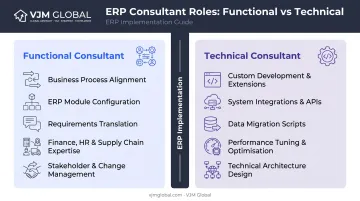
- Functional consultants focus on aligning ERP modules with business processes—finance, HR, procurement, supply chain. They translate operational requirements into system configuration decisions.
- Technical consultants handle the engineering layer—custom development, system integrations, APIs, data migration scripts, and performance tuning.
For straightforward implementations, a strong functional consultant may suffice. Complex, multi-system environments almost always need dedicated technical expertise alongside functional consultants.
Why Experienced Guidance Matters
Panorama's analysis of 30+ ERP lawsuits found that change management issues contributed to project failure in every single case. This pattern holds because projects derail when the human, organizational, and process dimensions aren't managed alongside the technical work. An experienced consultant owns all of those dimensions, not just the software setup.
Key Roles and Responsibilities of an ERP Implementation Consultant
An ERP consultant's responsibilities span the full project lifecycle. They function simultaneously as strategist, project manager, trainer, and ongoing advisor. Here's what that looks like in practice.
Business Needs Analysis and Requirements Gathering
Before any software decision is made, the consultant conducts a thorough assessment of the organization's current state:
- Stakeholder interviews across departments
- Current-state process mapping and documentation
- Gap analysis between existing capabilities and business goals
- Definition of what the ERP must accomplish—functionally and technically
This phase determines the entire project scope. Shortcuts here create problems that compound through every subsequent phase.
System Selection and Vendor Evaluation
Consultants help businesses evaluate ERP platforms—SAP, Oracle, Microsoft Dynamics, NetSuite, and others—against their specific needs. The evaluation covers:
- Industry-specific functional fit
- Total cost of ownership (licensing, implementation, ongoing support)
- Scalability as the business grows
- Integration complexity with existing systems
- Vendor support quality and implementation methodology
A good consultant produces a recommendation grounded in your business requirements, not vendor relationships or commission arrangements.
Implementation Planning and Project Management
Once a platform is selected, the consultant builds the implementation roadmap:
- Defining project phases and milestones
- Setting realistic timelines with built-in contingency
- Allocating internal and external resources
- Identifying and documenting risks with mitigation strategies
- Establishing success metrics before the project begins
In many engagements, the consultant also serves as the de facto project manager—coordinating between internal teams, the ERP vendor, and any third-party integration partners.
System Configuration, Customization, and Integration
ERP configuration is where the system takes shape. Consultants align modules with the organization's processes, develop custom workflows where standard functionality falls short, and build integrations with adjacent systems—CRM, payroll, accounting software, e-commerce platforms.
For companies operating across multiple jurisdictions, this phase has an added layer of complexity. Businesses entering the Indian market, for instance, must configure their ERP financial modules to meet local statutory requirements: GST workflows (including e-invoicing for applicable turnover thresholds), TDS processing, FEMA-compliant foreign currency tracking, and intercompany transfer pricing rules.
This is where firms like VJM Global add direct value alongside ERP consultants. Covering GST registration and audit, FEMA advisory, Companies Act financial reporting, and international taxation, VJM Global helps ensure that a foreign company's compliance obligations are accurately reflected in how the ERP's financial modules are configured.
Entity registration, GST and PAN/TAN setup, EPF/ESI registrations, and ongoing statutory accounting all feed directly into what the ERP must process and report.
Data Migration and Quality Assurance
Moving data from legacy systems into a new ERP is one of the highest-risk activities in the entire project. The consultant oversees:
- Data cleansing and deduplication
- Field mapping from source to destination systems
- Validation rules to catch errors before migration
- Test migration runs with reconciliation checks
- Final cutover planning with rollback procedures
Poor data quality entering a new ERP is nearly impossible to fix after go-live without significant disruption.
User Training and Change Management
The best-configured ERP fails if people don't use it correctly. Consultants design and deliver:
- Role-specific training programs for each department
- User documentation and quick-reference guides
- Change management plans that address resistance proactively
- Super-user programs to build internal capability post-launch
User adoption is where many implementations break down — the system works, but people revert to familiar habits and the investment goes unrealized.
The ERP Implementation Lifecycle: Phase-by-Phase Responsibilities
Knowing exactly what your consultant should deliver at each stage makes it easier to set expectations — and spot gaps before they become problems.
| Phase | Consultant Responsibilities |
|---|---|
| Discovery & Planning | Stakeholder workshops, current-state documentation, scope definition, project charter |
| Design & Configuration | Translating requirements into system design, configuring modules, documenting customizations |
| Testing | Unit testing, integration testing, UAT oversight, issue tracking and resolution |
| Go-Live & Cutover | Managing go-live transition, executing data cutover, hypercare support in first days |
| Post-Implementation | System monitoring, user issue resolution, configuration fine-tuning, upgrade advisory |
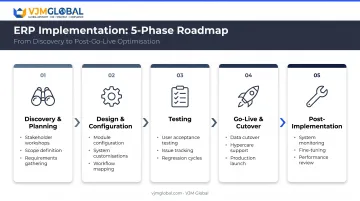
The post-implementation phase is frequently underestimated. Real-world usage surfaces gaps that testing never exposed, and a consultant who disappears after go-live leaves the business to resolve those issues without support.
Essential Skills and Qualifications to Look For
Technical Skills
- Platform certifications: SAP Certified Implementation Consultant (S/4HANA Cloud), Oracle Fusion Cloud Financials Implementation Professional, Microsoft Dynamics 365 Functional Consultant Associate (Finance, Supply Chain, or Business Central), NetSuite ERP Consultant Professional
- Data migration tools: Experience with extraction, transformation, and load (ETL) toolsets
- Integration methods: Working knowledge of APIs, middleware platforms, and point-to-point integrations
Business and Functional Skills
- Deep knowledge of at least one industry vertical—manufacturing, financial services, retail, professional services
- Business process analysis and documentation capabilities
- Familiarity with the regulatory environment relevant to the client's operations
Soft Skills That Determine Outcomes
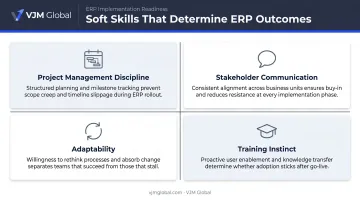
Soft skills are where ERP projects are won or lost—technical competence gets the system live, but these qualities determine whether it actually gets adopted:
- Project management discipline: PMP or equivalent credentials indicate someone who tracks dependencies, manages timelines proactively, and escalates risks before they become crises
- Stakeholder communication: Can explain the same configuration decision in two completely different ways—one for the CFO, one for the warehouse team
- Adaptability: Requirements change mid-project. Consultants who handle scope shifts gracefully are far more valuable than those who treat every change request as a crisis
- Training instinct: Patient, clear, and effective at coaching non-technical users under pressure
When and How to Hire the Right ERP Implementation Consultant
Signals That You Need One
- Your team lacks hands-on ERP implementation experience
- Your business processes are complex, multi-entity, or span multiple jurisdictions
- You're working against a tight go-live deadline
- A previous ERP attempt failed or stalled and needs rescuing
What to Evaluate When Selecting
- Industry-specific experience: Ask for case studies and references from companies in your sector, not just your industry category
- Platform specialization: A consultant certified in SAP S/4HANA and an Oracle specialist are not interchangeable—match credentials to your chosen platform
- Clear methodology: They should be able to articulate their implementation approach, phase structure, and how they handle scope changes
- Pricing transparency: Understand whether you're looking at fixed-fee, time-and-materials, or a hybrid model. Panorama Consulting's cost benchmarks put average ERP implementation costs at $450,000—make sure pricing discussions account for your full scope
Red Flags to Watch For
- Vague project scoping with no documented requirements process
- Overpromising on timelines without explaining the methodology behind them
- No clear answer on change management approach
- Weak or ambiguous post-implementation support commitments
For companies expanding into international markets, particularly India, ERP consultant selection should go hand in hand with engaging local compliance advisors. The ERP system needs to be configured for how the business actually operates legally in that market.
VJM Global's India entry services cover the full compliance foundation that an ERP must reflect:
- Entity registration and GST setup
- PAN/TAN, EPF/ESI registrations
- Statutory accounting and payroll compliance
- FEMA advisory
Getting that infrastructure in place and aligned with ERP configuration decisions from the start avoids expensive rework later.
Before committing to any consultant, request a preliminary consultation. A qualified consultant will spend meaningful time understanding your business before proposing anything. Those who pitch solutions before asking questions are a warning sign.
Frequently Asked Questions
What is an ERP implementation consultant?
An ERP implementation consultant is a specialist who helps businesses select, configure, deploy, and optimize ERP systems. They serve as the strategic and technical guide throughout the entire implementation, ensuring the system aligns with business goals, regulatory requirements, and operational workflows.
How much does an ERP implementation consultant cost?
Project costs vary widely based on complexity, company size, and platform. Panorama Consulting benchmarks average ERP implementation costs at $450,000, with larger enterprise projects running significantly higher. Fees are typically structured as fixed-fee, time-and-materials, or milestone-based, so clarify the model before signing.
Which ERP system is most used in the US?
Statista identifies SAP, Oracle, Microsoft, Infor, and Sage as the dominant players in the US ERP market. The right choice depends on your industry, company size, and functional requirements rather than market share alone.
What qualifications should an ERP implementation consultant have?
Look for platform-specific certifications (SAP, Oracle, Microsoft Dynamics, or NetSuite), demonstrated industry experience in your sector, project management credentials (PMP or equivalent), and a track record of completed implementations in comparable business environments.
How long does an ERP implementation typically take?
The median project timeline across 170 organizations in Panorama's 2026 report was 9 months. Smaller SMB implementations can move faster; large enterprise rollouts with heavy customization often run 18 months to three years. Scope of customization and data complexity are the primary variables.
What is the difference between an ERP consultant and an ERP vendor?
The vendor builds and sells the software. The implementation consultant—independent or a certified partner—configures, deploys, and optimizes that software for your specific business. Consultants typically bring greater flexibility and industry-specific expertise than a vendor's own implementation team, and they aren't bound by a single platform's interests.