Registering a company here follows a set process, but your results won't be identical to the next applicant's. Tax eligibility, approval speed, and even ownership structure depend on your industry classification, your zone choice, and how prepared your paperwork is before you file.
This guide covers the exact registration steps, the documents authorities expect, the tax and zone factors shaping your outcome, and the mistakes that stall otherwise well-funded applications.
Key Takeaways
- Registering a WFOE-style entity in Hainan typically takes 6-8 weeks, from name approval to a working bank account, though delays are possible.
- Encouraged industries qualify for a 15% corporate income tax rate versus the 25% national standard, plus an IIT cap for qualifying talent.
- Business scope must fall inside Hainan's Encouraged Industries Catalogue or outside the applicable Negative List.
- Zone choice — Yangpu, Haikou Jiangdong, Sanya, or Boao — determines which incentives and sector-specific support you can actually access.
- Real staff, a genuine office, and on-island management are mandatory; authorities check for substantive operations.
Step-by-Step Guide to Register a Company in Hainan Free Trade Port
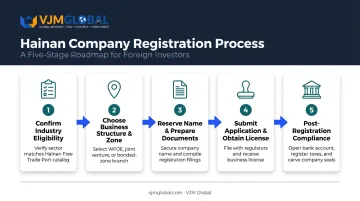
Step 1: Confirm Industry Eligibility and Business Scope
Start by checking your activity against the Catalogue of Encouraged Industries in the Hainan Free Trade Port (2024 Edition), effective March 1, 2024, which replaced the 2020 version. This catalogue combines national encouraged-industry lists with Hainan-specific additions.
Then cross-check the negative lists: the National Negative List (2024 Edition), with 29 restrictive measures effective November 1, 2024, and the Hainan FTP Negative List (2020 Edition), with 27 measures effective February 1, 2021 that remain notably more liberal than the national version in areas like locally provided data-processing telecommunications.
Sectors such as cross-border e-commerce or medical tourism often require additional permits beyond standard registration, so confirm licensing needs before filing.
Step 2: Choose the Business Structure and Zone
"WFOE" and "joint venture" describe ownership, not separate legal forms. Both structures typically register as a limited liability company under Chinese law. Representative offices are limited to non-profit liaison activities, and branch offices aren't independent legal persons, which affects their tax treatment.
Match your zone to your sector:
| Zone | Best Suited For |
|---|---|
| Yangpu | Port logistics, petrochemicals, advanced manufacturing |
| Haikou Jiangdong | Headquarters economy, finance, offshore trade |
| Sanya (CBD / Yazhou Bay) | Tourism, cruise/yacht commerce, seed and deep-sea technology |
| Boao Lecheng | Medical tourism, licensed medicines and devices |
Step 3: Reserve the Company Name and Prepare Core Documents
Submit your proposed name through Hainan's One-Stop Service using the Enterprise Name Self-Declaration function, which checks for duplication before you proceed with foreign-investment registration. Names generally follow the sequence: administrative division, trade name, industry descriptor, organizational form.
Core documents typically include:
- Articles of Association
- Investor qualification and identity evidence
- Appointment and ID documents for the legal representative and finance manager
One important shift: since November 7, 2023, public documents from Hague Apostille Convention countries generally need only an apostille, not full Chinese consular legalization. Documents from non-Convention countries still follow the older notarization route.
Step 4: Submit the Application and Obtain the Business License
File through Hainan's One-Stop Service under Enterprise Registration > Foreign Investment. If your business scope touches a negative-list activity, you'll need sector approval before registration can move forward.
On domicile: Hainan's 2025 rules use a standard-address self-declaration and commitment system rather than a blanket physical inspection requirement. You remain responsible for the truth and legality of the address you declare, and false information can trigger penalties even after your license is issued.
A lease agreement is one common way to support this declaration, but treat it as evidence, not a rigid checklist item.
Step 5: Complete Post-Registration Compliance
Once your license is issued, three things happen roughly in parallel:
- Bank account opening - You'll need your business license, foreign-investment registration details, and identity/authorization materials. Legal representative attendance depends on the bank; some, including ICBC Hainan and Sanya CBD's platform, now offer video-based verification instead of requiring a physical visit.
- Tax registration - Register with the local tax bureau through Hainan's electronic tax system promptly after licensing, confirming your accounting method and bank details to secure eligibility for preferential rates.
- Company seals - Official chops are issued as part of the same one-stop workflow and are required before you can sign contracts or issue invoices.
Documents and Requirements Needed Before You Register
Thorough preparation directly affects both approval speed and your eligibility for preferential tax treatment. Missing or poorly prepared documents are the single biggest cause of delay.
- Investor documentation: Legalized or apostilled certificate of incorporation, shareholder ID or passport copies, and a bank reference letter for the parent company.
- Local personnel appointments: Valid appointment letters for the legal representative and finance manager. Small LLCs with unanimous shareholder consent can skip the supervisor role (Article 83).
- Capital commitment: China's 2024 Company Law revision requires shareholders to pay in full subscribed capital within five years of formation, with no Hainan-specific exception.
- Physical address proof: A genuine, verifiable lease or address declaration for your chosen zone. Authorities can still investigate authenticity after registration.
- UBO disclosure readiness: Since November 1, 2024, new companies must file beneficial-owner information under PBOC/SAMR rules (ownership above 25%, voting control, or actual control). The small-entity exemption rarely applies once a corporate shareholder is involved, covering most WFOEs.
Tax Incentives, Zones, and Key Factors That Affect Registration Outcomes
Your final tax benefits and approval outcome hinge on three things: industry classification, zone choice, and proof of real, substantive operations.
Corporate Income Tax Incentives
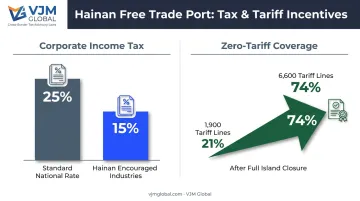
Enterprises in encouraged industries with genuine operations in Hainan qualify for a 15% CIT rate, well below the 25% national standard.
To qualify, revenue from encouraged activities must exceed 60% of total revenue, and the company's actual management must sit in Hainan with real control over operations, personnel, accounts, and assets. This preference, under Cai Shui (2020) No. 31, runs through December 31, 2027.
There's a separate, often confused incentive: Hainan tourism, modern-service, and high-tech enterprises can also receive CIT exemption on profits from new overseas investments (outbound branches or holdings of at least 20%, in jurisdictions with a statutory CIT rate of 5% or higher). This is not a break on inbound foreign investment into Hainan itself.
Individual Income Tax Caps
High-end and urgently needed talent working in Hainan don't pay a flat 15%. Instead, the portion of their actual IIT burden exceeding 15% is exempted, a policy also extended through December 31, 2027.
Zero-Tariff and Customs Benefits
Under the "first-line open, second-line control" model, goods move freely between Hainan and the rest of the world, while a second customs line manages goods flowing into mainland China.
Since the full closure, duty-free coverage expanded from roughly 1,900 tariff lines (21%) to about 6,600 lines, covering 74% of goods. Encouraged-industry products processed in Hainan with at least 30% value added can also enter the mainland free of import duty.
Choosing the Right Zone
Zone selection isn't cosmetic: each of Hainan's four zones caters to different industries and incentive structures.
- Yangpu: Leans toward manufacturing and trade financing
- Haikou Jiangdong: Favors financial services and headquarters functions
- Sanya: Blends tourism commerce with tech-sector support
- Boao Lecheng: Built around medical licensing exceptions unavailable elsewhere on the island
Registering in the wrong zone won't disqualify you outright, but it can mean missing the support programs your sector was counting on.
Is Hainan FTP Right for You? Best Fit and Common Mistakes to Avoid
Who Hainan FTP Suits Best
Hainan works best for businesses in encouraged sectors, meaning trade, tourism, high-tech, and modern services, that plan genuine, long-term on-island operations. It's a weaker fit for companies wanting quick market testing without a physical presence, or for businesses in restricted sectors better served by a joint venture structure elsewhere in China.
Getting the fit right is only half the battle; avoiding registration missteps matters just as much.
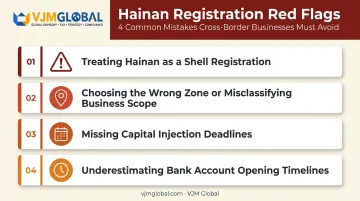
Common Mistakes When Registering
- Treating Hainan as a shell registration. Without real staff and office presence, you lose the 15% CIT rate and risk penalties.
- Choosing the wrong zone or misclassifying business scope. This leads to missed incentives or scope restrictions you didn't anticipate.
- Missing capital injection deadlines. The five-year capital injection rule and delayed tax registration both invite compliance scrutiny from the AMR.
- Underestimating bank account timelines. Strict UBO clearing requirements can delay your operational launch by weeks.
Conclusion
Hainan FTP rewards businesses that align with encouraged industries, pick the right zone, and maintain real, substantive operations on the island. Most delays trace back to incomplete documentation, address verification gaps, or a misunderstanding of capital and UBO compliance rules, not bad luck.
For investors evaluating multiple international markets alongside China, firms like VJM Global offer complementary cross-border business setup and compliance advisory. This includes entity structuring, FEMA advisory, and DTAA-based tax planning for parallel market entry into India.
Frequently Asked Questions
How do I check if a company is registered in Hainan Free Trade Port or elsewhere in China?
You can verify registration status through China's National Enterprise Credit Information Publicity System, which covers Hainan-registered entities alongside those registered nationally. It shows licence status, registered capital, and business scope.
Is Hainan Free Trade Port a tax haven?
No. Hainan offers preferential rates like the 15% CIT, but only to companies proving substantial economic activity, real staff, and genuine management on the island. Shell registrations don't qualify.
Is Hainan Free Trade Port a free trade zone?
Not quite the same thing. A free trade port operates island-wide under a special customs regime with first-line and second-line controls. A free trade zone, by contrast, is typically a smaller, localized area within standard customs jurisdiction.
How long does it take to register a company in Hainan FTP?
Most applicants plan for 6-8 weeks from name approval to a functioning bank account, though document legalization and bank UBO clearing can extend the timeline in either direction.
Can foreigners own 100% of a company in Hainan FTP?
Yes, for any sector not listed on Hainan's Negative List, which is shorter and more open than the national negative list. Sector-specific licenses may still apply on top of general registration.
What is the corporate tax rate in Hainan FTP?
Qualifying encouraged-industry enterprises with substantive operations pay a 15% CIT rate, compared to the standard 25% rate applied elsewhere in mainland China.