Introduction
India's digital economy is no longer a speculative opportunity—it's a proven growth frontier. The country's e-commerce market is projected to reach $300–350 billion by 2030, fuelled by 1.02 billion internet users and 750 million smartphones. For Singapore entrepreneurs, this represents one of the most accessible high-growth markets in Asia, strengthened by deep bilateral trade ties: Singapore has been India's largest FDI source for three consecutive years, with US$14.94 billion in inflows in FY2024-25 alone.
Yet starting an online business in India as a foreign national is fundamentally different from operating as a domestic entrepreneur. FDI rules, permitted business models, entity structures, and compliance obligations each follow their own track for foreign entrants. Getting these right from day one is what keeps a business compliant and scalable — getting them wrong is expensive to fix.
This guide provides a practical framework built specifically for Singapore entrepreneurs who want to enter India's online market legally and with a clear path to profitability.
TL;DR
- India's e-commerce market will exceed $300 billion by 2030, ranking among the highest-growth digital markets globally
- 100% FDI under automatic route is permitted in marketplace e-commerce and B2B models—Singapore investors can fully own an Indian entity without government approval
- A Private Limited Company is the most practical structure for foreign-owned online businesses
- Key compliance obligations include FEMA reporting, GST registration (required regardless of turnover), and using the Singapore-India DTAA to reduce tax exposure
- Working with an India-based advisory partner reduces setup time from 8+ weeks to as few as 4–6 weeks
Why Singapore Entrepreneurs Are Targeting India's Online Market
India's digital infrastructure has reached critical mass. By 2025, the country had 270 million online shoppers, projected to grow significantly through 2030. UPI (Unified Payments Interface) alone processed 24,162 crore transactions in FY2024-25. That volume—worth approximately US$3.65 trillion— represents 49% of global real-time payment volume, making India the world's largest real-time payments market.
Several structural factors make Singapore a natural launchpad for India market entry:
- Established trade corridors: Singapore was India's largest FDI source in FY2024-25 (US$14.94 billion), with cumulative FDI of US$174.88 billion since 2000
- CECA framework: The Comprehensive Economic Cooperation Agreement (2005) reduces trade and investment barriers, offers protection for intellectual property, and streamlines movement of professionals between the two countries
- UPI-PayNow linkage: Singapore is the first country with P2P payment interoperability with India, reducing cross-border transaction friction
- Language and legal system alignment: English is a shared business language; both legal systems share Commonwealth roots
India's FDI policy for e-commerce is liberal by global standards. 100% FDI is permitted under the automatic route in marketplace model e-commerce and B2B e-commerce—meaning Singapore entrepreneurs can fully own an Indian entity without government approval. In practice, this means a Singapore founder can incorporate an Indian Private Limited company, retain full ownership, and begin operations without seeking prior FIPB or RBI approval—a significant structural advantage over most other Asian markets.
What Singapore Entrepreneurs Need to Know Before Starting
Three factors shape every Singapore entrepreneur's India entry: your compliance obligations as a foreign investor, how long the setup process realistically takes, and which business model you're actually building.
Compliance Obligations for Foreign Investors
As a foreign investor, you face requirements that domestic Indian entrepreneurs do not—FEMA (Foreign Exchange Management Act) reporting, RBI documentation of foreign equity inflows, and specific conditions on how the business operates based on its model. With structured planning, each obligation is manageable.
Timeline and FEMA Penalties
Entity incorporation, tax registrations, and business banking collectively take 4–8 weeks when managed correctly. VJM Global's end-to-end incorporation service typically completes the full process within 13 working days for document-ready clients.
Attempting to operate informally before completing these steps creates FEMA exposure. Penalties under Section 13 of FEMA 1999 can reach three times the amount involved, plus ₹5,000 per day for continuing violations.
Why Business Model Classification Comes First
The type of online business you choose — inventory-based retail, marketplace platform, digital services, or SaaS — directly determines your FDI route, entity structure, and ongoing compliance obligations. These decisions must be made sequentially, not in parallel:
| Business Model | FDI Route | Key Restrictions |
|---|---|---|
| Marketplace E-commerce | 100% automatic | Cannot hold inventory; cannot influence pricing |
| Inventory-Based E-commerce | Not permitted | FDI prohibited in B2C inventory models |
| B2B E-commerce | 100% automatic | No restrictions |
| Digital Services / SaaS | 100% automatic (sector-dependent) | Check sector-specific FDI caps |
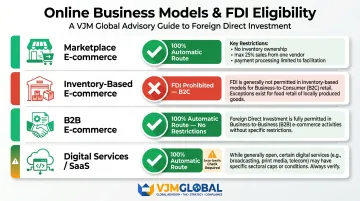
Misclassifying your model (for example, operating as a marketplace but holding inventory) triggers FEMA violations that compound over time.
Choosing the Right Business Structure as a Foreign Investor in India
Entity Options
Singapore entrepreneurs entering India's online market have three primary entity structures. The Private Limited Company (Pvt Ltd) is the recommended structure in nearly all cases:
Why Private Limited Company is the default choice:
- 100% foreign ownership permitted under automatic route for most e-commerce models
- Limited liability protection for shareholders
- Straightforward path to GST registration, business bank account opening, and payment gateway integration
- Most scalable structure for raising investment, hiring employees, and eventual exit
- Recognized and trusted by Indian banks, payment processors, and logistics partners
The other two structures have narrow applications. An LLP only accepts foreign investment where 100% FDI is allowed under the automatic route with no FDI-linked performance conditions — making it unsuitable for most online businesses unless the model is strictly professional advisory or consulting. Liaison and Branch Offices are representative structures only; they cannot generate revenue in India and have no place in an online business setup.
Private Limited Company Requirements
To incorporate a Pvt Ltd with foreign shareholders, you must satisfy these conditions:
- Minimum 2 directors (at least one must be an Indian resident—someone who resided in India for 182+ days in the preceding calendar year)
- Registered office address in India
- Memorandum and Articles of Association (MoA and AoA)
- Initial equity infusion from foreign investors routed through FEMA-compliant banking channels (AD Category I bank)
- Company name approval via the MCA (Ministry of Corporate Affairs) portal using the SPICe+ form
These requirements are manageable with the right advisory support in place before you begin filing.
VJM Global handles the full incorporation process for Singapore-based investors: DSC (Digital Signature Certificate), DIN (Director Identification Number), MCA name approval, SPICe+ filing, and initial FEMA compliance. Most incorporations complete within 13 working days.
If you don't yet have an Indian resident director, VJM Global can connect you with qualified resident director service providers or ensure the directorship meets statutory requirements.
How to Start Your Online Business in India – Step by Step
The following roadmap assumes you are entering as a foreign investor. For Singapore entrepreneurs, the first two steps—model validation and entity incorporation—are foundational. Errors at this stage compound into compliance problems later.
Step 1 – Validate Your Business Model and FDI Eligibility
Define your intended online business model precisely before incorporating:
- Marketplace (connecting buyers and sellers without holding inventory)
- Direct-to-consumer product sales (inventory-based; not permitted for FDI)
- B2B e-commerce (selling to registered businesses)
- Digital services or SaaS (platform subscription, software licensing, online consulting)
Research whether your chosen model qualifies under the FDI automatic route or requires government approval. For example, operating a marketplace requires strict compliance with conditions: you cannot hold inventory, influence pricing, or have more than 25% of platform sales come from a single vendor.
Conduct market research on Indian consumer demand, competitor pricing, and platform dynamics for your niche. Validate whether demand exists at a price point that supports your cost structure.
Indian consumers prioritise value and trust signals differently than Singaporean buyers. Local customer support, GST-compliant invoicing, transparent return policies, and payment options like UPI and Cash on Delivery (COD) directly influence conversion rates.
Step 2 – Incorporate Your Company and File Initial FDI Documentation
Complete the Pvt Ltd company incorporation process:
- Apply for DIN (Director Identification Number) and DSC (Digital Signature Certificate) for all directors
- Reserve company name via MCA portal (must comply with Companies Act naming rules)
- File SPICe+ form for company registration with RoC (Registrar of Companies)
- File FC-GPR (Foreign Currency – Gross Provisional Return) with RBI within 30 days of share allotment to report the foreign equity investment
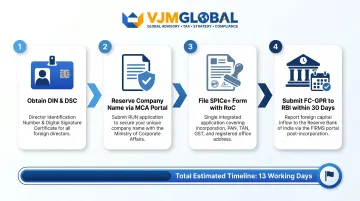
Open a business bank account with an AD Category I bank (a commercial bank authorised by RBI to conduct foreign exchange transactions). This account is required both for receiving the initial foreign investment and for sending profits back to Singapore later.
VJM Global manages the full incorporation cycle, including document preparation, MCA filings, and FC-GPR submission, ensuring FEMA compliance from day one.
Step 3 – Obtain Tax IDs, Key Licences, and Set Up Payments
Mandatory registrations:
- GST registration: Mandatory for all e-commerce businesses in India, regardless of turnover (Section 24(x) of the CGST Act). E-commerce operators must also collect TCS (Tax Collected at Source) at 1% of net taxable supplies
- PAN (Permanent Account Number): Required for all companies
- IEC (Import Export Code): Required if your business involves importing or exporting physical goods across India's borders
- FSSAI licence: Required if your business involves selling food products online
Once registrations are in place, payment infrastructure is the next operational layer to configure. Integrate a domestic payment gateway such as Razorpay or PayU that supports:
- UPI (Unified Payments Interface) (baseline expectation for Indian consumers)
- Net banking
- Credit/debit cards
- Cash on Delivery (COD)
Approximately 75% of e-commerce volume in India comes from mobile purchases. A UPI-enabled, mobile-optimised checkout is essential — skipping it costs conversions directly.
Step 4 – Build Your Online Presence and Go-to-Market Strategy
Choose your primary sales channel:
- List on established marketplaces (Amazon India, Flipkart, Meesho) for lower initial customer acquisition cost and instant access to logistics infrastructure
- Build a direct-to-consumer website (Shopify, WooCommerce) for long-term brand control and margin protection
| Marketplace | Market Share | Commission Model | Best For |
|---|---|---|---|
| Flipkart | ~48% | Per-sale commission (5–30% depending on category) | Electronics, fashion, broad consumer base |
| Amazon India | ~30–35% | Referral fee + closing fee + weight handling | Premium customers, established brands |
| Meesho | ~8% | 0% commission (no platform fees) | Tier 2/3 towns, value-conscious buyers |
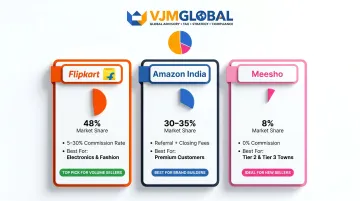
Most Singapore entrepreneurs entering India start by listing on Meesho and Amazon/Flipkart simultaneously to test demand at different price points and geographies, then build their own D2C channel once product-market fit is confirmed.
Whichever channel you choose, trust-building signals carry more weight in India than most Singapore entrepreneurs expect. Prioritise:
- Local phone support during Indian business hours
- GST-invoiced purchases
- Transparent return and refund policies
- Customer reviews in local languages (Hindi, Tamil, Telugu, etc.)
- Delivery timeline expectations set conservatively (3–7 days, not 24–48 hours)
Step 5 – Monitor Performance, Ensure Compliance, and Scale Responsibly
Track core operational metrics alongside compliance deadlines:
Operational metrics:
- Monthly revenue and gross margin
- Customer acquisition cost (CAC)
- Order return rate
- Repeat purchase rate
Compliance deadlines:
- Monthly or quarterly GST returns
- Quarterly TDS (Tax Deducted at Source) filings
- Annual income tax returns
- Periodic FEMA filings (FC-GPR, annual return on foreign liabilities and assets)
Confirm that your supply chain, logistics partners, customer support, and pricing are consistent and sustainable at current volumes before expanding your product range or entering new Indian geographies. According to the Startup Genome Report, 74% of high-growth internet startups fail due to premature scaling. Operational stability, not growth speed, is what determines whether the expansion holds.
VJM Global provides ongoing accounting, GST compliance, FEMA advisory, and tax filing support for foreign-owned businesses in India, allowing Singapore entrepreneurs to stay fully compliant without needing to be physically present day-to-day.
Compliance, Tax, and Cross-Border Financial Considerations
FEMA Obligations
All equity investment from Singapore into an Indian entity must flow through authorised banking channels (AD Category I banks). Every round of foreign investment must be reported to the RBI via FC-GPR within 30 days of share allotment.
Repatriation of profits or dividends to Singapore must follow RBI procedures, including appropriate withholding tax deductions. Under Section 13 of FEMA 1999, penalties for non-compliance can reach three times the amount involved in the contravention, plus ₹5,000 per day for continuing violations.
GST and E-Commerce-Specific Tax Obligations
GST registration is mandatory for all e-commerce sellers and operators in India, regardless of turnover. The threshold exemptions (₹20 lakh or ₹40 lakh) that apply to regular businesses do not apply to e-commerce operators or sellers on platforms.
Beyond registration, e-commerce sellers face additional obligations:
- Marketplace platforms deduct TCS (Tax Collected at Source) at 1% of net taxable supplies before disbursing payments
- Non-compliant GST status triggers payment blocks — platforms will freeze disbursements until filings are current
- GST returns must be filed regularly to maintain active seller status across all major Indian marketplaces
Singapore-India DTAA (Double Taxation Avoidance Agreement)
The Singapore-India DTAA reduces the risk of double taxation on income earned in India by a Singapore-based parent company or investor.
Key treaty rates:
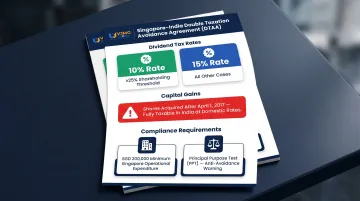
| Income Type | Treaty Rate | Conditions |
|---|---|---|
| Dividends | 10% | Beneficial owner holds ≥25% share capital |
| Dividends | 15% | All other cases |
| Capital gains (shares acquired after April 1, 2017) | Full domestic rate | No exemption; taxable in India |
Important considerations:
- Capital gains on shares acquired after April 1, 2017 are fully taxable in India at domestic rates—the historical exemption no longer applies to new investments
- To avoid classification as a shell/conduit company and denial of treaty benefits, the Singapore entity must maintain minimum annual operational expenditure of SGD 200,000 in Singapore (Limitation of Benefits clause)
- The treaty includes a Principal Purpose Test (PPT): benefits can be denied if obtaining the benefit was "one of the principal purposes" of an arrangement
Structuring the holding arrangement correctly — to maximise treaty benefits while maintaining substantive Singapore operations — requires specialist input. VJM Global's international taxation team advises Singapore-based investors on exactly this kind of cross-border structuring.
Conclusion
India's online market represents a substantive, long-term opportunity for Singapore entrepreneurs—not a speculative one. The difference between a business that grows cleanly and one that encounters regulatory friction almost always comes down to how well the setup phase was handled: the right entity structure, the right FDI compliance, and the right tax planning from day one.
That 60-day foundation matters more than most entrepreneurs expect. Before moving quickly, get these right:
- Validate your business model against India's FDI and e-commerce regulations
- Choose the right entity structure (Private Limited vs. LLP) for your ownership goals
- Register for GST and open a business bank account before transacting
- Engage a qualified India advisory partner to manage ongoing compliance
The groundwork laid in those first weeks determines how freely your business can operate for the years that follow.
VJM Global has helped 500+ American, 250+ UK, and 250+ Australian businesses establish and operate in India over 30+ years—and brings that same cross-border expertise to Singapore entrepreneurs entering the Indian market. The firm covers the full setup journey: company incorporation, FEMA compliance, GST registration, ongoing accounting, and international tax advisory. One team handles what would otherwise require coordinating multiple local specialists.
To discuss your India entry, contact VJM Global at [email protected].
Frequently Asked Questions
How much does it cost to start an online business in India?
For Singapore entrepreneurs, expect ₹15,000–25,000 in government fees (company incorporation, GST registration), plus professional advisory fees if engaging a firm like VJM Global. Initial website or marketplace setup costs vary by business model; budget ₹50,000–2,00,000 for basic digital infrastructure and first-quarter marketing spend.
Which is the best online business to start in India?
For Singapore entrepreneurs, digital services, B2B e-commerce, online consulting, and branded D2C products are the most FDI-friendly and scalable starting points. The right model depends on your expertise, capital, and timeline: marketplace models offer faster go-to-market at lower margins, while D2C requires higher upfront investment but builds stronger long-term brand value.
What is the 20 lakh grant for startups in India?
This refers to seed funding available under the Startup India Seed Fund Scheme, offering grants of up to ₹20 lakh for proof of concept and investments of up to ₹50 lakh for commercialisation. However, the scheme generally requires 51% Indian promoter shareholding—most fully foreign-owned subsidiaries will not qualify.
Can I sell online for free?
While platforms like Meesho, Amazon, and Flipkart allow free seller registration, all marketplaces charge per-sale commissions (0–30% depending on category). Running a proprietary website adds hosting, payment gateway, and logistics costs—making a zero-cost setup realistic only for digital services or content businesses in the very early stage.
What is the 80 20 rule in ecommerce?
The 80/20 rule in e-commerce means that roughly 80% of revenue typically comes from 20% of products or customers. For Singapore entrepreneurs entering India, this means focusing on the highest-demand product categories and highest-value customer segments first, rather than trying to cover the entire market.
Can a Singapore entrepreneur register a company in India without being physically present there?
Yes, company incorporation in India can be completed remotely through authorised representatives or professional advisory firms. The key requirement is that at least one director must be an Indian resident. VJM Global manages the full incorporation and compliance process on behalf of Singapore entrepreneurs, including document preparation, MCA filings, and ongoing compliance—eliminating the need for physical presence during setup.