Introduction
India's ecommerce market reached US $125 billion in 2024 and is projected to exceed US $345 billion by 2030, growing at approximately 15% annually. This explosive growth has made India one of the most attractive opportunities for foreign entrepreneurs, with Singapore-based founders increasingly looking to tap into India's expanding digital consumer base of nearly 300 million online shoppers.
Starting an ecommerce business in India from Singapore is not a simple cross-border extension. Foreign ownership norms, mandatory entity requirements, and India-specific ecommerce regulations require full legal setup before you can operate. Skipping that structure exposes founders to FEMA violations and tax penalties.
This guide walks Singapore-based entrepreneurs through every critical step: understanding the legal landscape, choosing the right entity structure, completing mandatory registrations, and launching operations that scale sustainably.
Key Takeaways
- India's ecommerce market is projected to exceed $200B by 2026 — one of the largest growth windows available to Singapore-based entrepreneurs
- Foreign nationals cannot directly own inventory-based ecommerce businesses—marketplace models only
- You must register an Indian entity (Wholly Owned Subsidiary or LLP) before operating on any platform
- GST, Import Export Code, and RBI compliance are mandatory for cross-border operators
- Getting the legal structure right from day one avoids expensive restructuring down the line
What to Know Before You Start an Ecommerce Business in India from Singapore
India has specific Foreign Direct Investment (FDI) regulations that directly affect how Singapore residents can structure and operate ecommerce businesses. This isn't the same as running a Singapore business and casually selling to Indian customers—attempting informal operations without proper registration exposes you to FEMA violations and significant tax penalties.
FDI is not permitted in inventory-based ecommerce models where foreign companies directly hold and sell stock. Foreign-owned entities may only operate under the marketplace model, connecting buyers and sellers without the platform stocking inventory directly. This restriction, established under Press Note No. 2 (2018), shapes everything from business planning to profitability forecasting.
Operating through the right Indian entity is non-negotiable. Even if you have products, a website, and willing customers, you cannot legally transact without a registered entity.
Plan for a realistic setup timeline before committing to any go-live dates. Done in sequence, the core steps typically take 6-12 weeks minimum:
- Register your Indian company (Private Limited or LLP)
- Obtain GST registration
- Secure an Import Export Code (IEC) if moving goods across borders
- Open a business bank account and complete KYC requirements
Why India's Ecommerce Market Makes Sense for Singapore Businesses
India's e-retail market hit USD 65-66 billion in GMV in 2025 and is projected to exceed USD 170-180 billion by 2030, growing at over 20% annually. E-retail accounts for just 1.6% of India's GDP today — compared to 13-14% in China — suggesting the market is still in early stages with room to run.
Singapore is strategically advantageous as a base for India market entry:
- Singapore-India CECA (Comprehensive Economic Cooperation Agreement) offers tax treaty benefits and investment protection provisions
- Singapore has been India's largest source of FDI for seven consecutive years, accounting for 19% of India's total FDI inflows in FY 2024-25
- Singapore entities carry strong credibility with Indian banks and regulators
- Cumulative FDI from Singapore to India stands at USD 186.82 billion (April 2000 – September 2025)
Demand drivers favour Singapore-based sellers across several categories:
- Premium consumer goods and specialty foods
- Fashion and lifestyle D2C brands
- Electronics accessories and tech products
- Cross-border B2B supply categories
For operators entering these categories, ONDC (Open Network for Digital Commerce) now provides a low-cost distribution channel worth knowing about. Unlike marketplace models that charge percentage commissions, ONDC offers open-network access with only a nominal ₹1.5 fee per transaction for orders above ₹250.
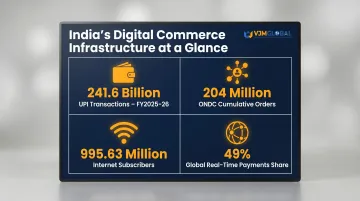
The scale is already significant: ONDC processed over 16 million orders in March 2025, with cumulative transactions exceeding 204 million.
The payment and connectivity infrastructure also works in your favour. UPI processed over 241.6 billion transactions in FY 2025-26 — with 63% of those being Person-to-Merchant — and India now accounts for nearly 49% of global real-time payments by volume. With broadband subscribers at 995.63 million as of September 2025, the consumer base is both digitally connected and accustomed to transacting online.
Early Decisions That Matter When Starting an Ecommerce Business in India from Singapore
Most early-stage mistakes don't stem from poor product choices—they come from underestimating the structural complexity of cross-border ecommerce. Business model selection, entity type, and FDI compliance must be resolved before any platform or marketing decisions.
Business Model Decision: Marketplace vs. Inventory-Based
Under current FDI rules, a foreign-owned Indian entity operating ecommerce must follow the marketplace model. This means:
- The entity earns through commissions, logistics fees, or value-added services
- The entity cannot buy and sell stock directly
- The platform cannot exercise ownership or control over inventory
- No more than 25% of platform sales can come from any single vendor
This model restriction fundamentally affects unit economics. Marketplace operators face platform commission costs (15–30%), but inventory-based models—while offering higher margins—remain legally closed to foreign-owned entities.
Entity Type Decision
Wholly Owned Subsidiary (Private Limited Company) is the most common and operationally flexible choice for Singapore residents:
- 100% FDI permitted under automatic route for marketplace ecommerce
- Straightforward profit repatriation through dividends
- Easier access to funding and partnerships
- Higher compliance burden (annual audits, detailed filings)
- Requires minimum two directors (at least one India-resident)
Limited Liability Partnership (LLP) is an alternative but carries FDI restrictions:
- FDI permitted only in sectors where 100% FDI is allowed under automatic route
- Lower compliance requirements than a private limited company
- Profit repatriation involves additional FEMA scrutiny
- Limited flexibility for downstream investments
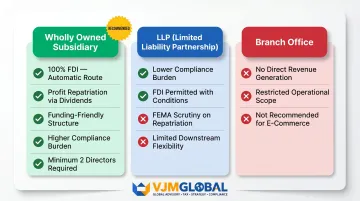
Branch Office is generally not recommended for ecommerce. It cannot generate direct revenue in India, faces restrictions on operational scope, and adds regulatory complexity without the structural benefits of a subsidiary.
Capital and Cost Realism
Budget for these real cost components:
- Company incorporation fees (registrar filings, stamp duty, professional charges)
- Registered office rental and maintenance in India
- Monthly or quarterly compliance and accounting retainers
- GST registration and recurring filing costs
- Platform onboarding fees for Amazon, Flipkart, or ONDC
- Logistics partnerships and third-party fulfillment setup
- Payment gateway integration and per-transaction fees
Ongoing compliance costs are routinely underestimated — most founders budget for setup but not for what follows. Quarterly GST filings, annual returns, FEMA reporting, and transfer pricing documentation create recurring obligations that add up quickly.
Repatriation and Banking Considerations
Profits earned by the Indian entity can be repatriated to Singapore as dividends after applicable taxes. Setting up an Indian business bank account authorized for foreign remittances is essential — understanding transfer pricing rules early prevents cash flow complications later.
Key FEMA reporting obligations to track from day one:
- FC-GPR filing: Report incoming funds from Singapore to RBI within 30 days of share allotment
- FLA return: File Foreign Liabilities and Assets return annually by July 15
- Bank account: Ensure the Indian account is authorized for inward and outward foreign remittances
How to Start an Ecommerce Business in India from Singapore – Step by Step
This section walks through the process in execution order. Each step depends on the one before it—skipping or rushing any stage creates downstream legal or operational problems.
Step 1 – Choose Your Ecommerce Model and Product Category
Decide whether to operate a marketplace-model platform, dropshipping-based store, or D2C brand model. Confirm the chosen model complies with India's FDI norms for foreign-owned entities.
Product category affects licensing requirements:
- Food products require FSSAI registration
- Electronics may need BIS (Bureau of Indian Standards) compliance
- Premium consumer goods, fashion, and lifestyle products typically face fewer regulatory barriers
Validate demand for your category using:
- Google Trends India
- Amazon India bestsellers
- Meesho trending categories
- ONDC category growth data
Prioritize categories where your Singapore-side sourcing or expertise gives a genuine competitive edge. Indian consumers show strong demand for premium D2C products, specialty foods, and differentiated lifestyle brands — categories where foreign entrants can command margin premiums.
Step 2 – Set Up Your Indian Legal Entity
Register a Private Limited Company (Wholly Owned Subsidiary) in India under the Companies Act, 2013. This requires:
- Minimum two directors (at least one must be India-resident)
- Minimum two shareholders (can be the same individuals as directors)
- Registered office address in India
- Memorandum and Articles of Association clearly stating ecommerce as business object
Documents the Singapore resident needs to provide:
- Passport copies and proof of residence
- Digital Signature Certificate (DSC) for all directors
- Director Identification Number (DIN) for all directors
- Proposed company name (two options recommended)
The India-resident director requirement is where many Singapore founders stumble. Section 149(3) of the Companies Act mandates at least one director who has stayed in India for 182 days during the financial year. This director carries legal responsibility. Choose carefully, and avoid nominee services that don't clarify compliance obligations.
Common mistakes at this stage include incomplete address proofs for the registered office, improper DSC documentation, and misunderstanding resident director obligations. Any of these errors can delay GST registration or banking setup downstream.
Engaging a firm experienced in cross-border entity setup — such as VJM Global, which has supported foreign companies across 15+ industries including fintech and ed-tech — reduces these risks. They handle name reservation, MoA/AoA preparation, RoC filing, and Certificate of Incorporation in a single engagement.
Step 3 – Complete Mandatory Registrations and Compliance Setup
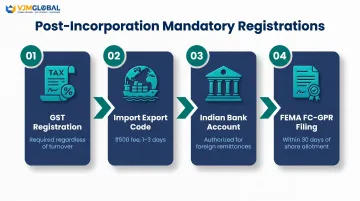
After company registration, complete these mandatory steps:
GST Registration: Mandatory for any ecommerce operator in India regardless of turnover threshold. Section 24 of the CGST Act requires both ecommerce platforms and sellers listing on platforms to register for GST. Apply through the GST portal with company PAN, Certificate of Incorporation, registered office proof, and director identification.
Import Export Code (IEC): Required if cross-border goods movement is involved. Issued by DGFT (Directorate General of Foreign Trade) with lifetime validity. Government fee: ₹500. Typically issued in 1-3 days.
Indian Bank Account: Open a current account with an Indian bank authorized for foreign-remittance transactions. This account is needed for GST registration, payment gateway approvals, and operational transactions. Common banks for foreign-owned entities include ICICI, HDFC, Axis, and Yes Bank.
FEMA Compliance: File Form FC-GPR within 30 days from the date of share allotment via RBI's FIRMS portal. The Indian company must receive investment funds within 60 days from share issuance date, or the allotment becomes void. File Annual Return on Foreign Liabilities and Assets (FLA) by July 15 every year.
Do not issue shares below Fair Market Value. A SEBI-registered merchant banker or practicing CA must certify valuation using the DCF method.
Annual compliance is where most cross-border businesses fall short. Missing quarterly GST deadlines or FEMA reporting triggers penalties that can freeze operations. VJM Global's compliance team handles ongoing filings — GST returns, ROC filings, transfer pricing documentation, and RBI reporting — so Singapore founders aren't navigating Indian regulatory cycles without local expertise.
Step 4 – Build Your Ecommerce Store and Operations Stack
Choose your platform approach:
For marketplace operators: List on Amazon India, Flipkart, or ONDC. This is the fastest path to buyers and provides built-in trust signals. Amazon India and Flipkart together dominate India's ecommerce GMV, with Flipkart alone hitting roughly USD 29 billion in FY2023.
For D2C brands: Use Shopify India or WooCommerce with an Indian payment gateway (Razorpay or Cashfree). Payment gateway approval requires your Indian entity's:
- PAN card
- GST registration certificate
- Certificate of Incorporation
- Bank account in company name
- Functional website with mandatory pages: About Us, Contact Us, Privacy Policy, Terms & Conditions, Refund/Cancellation Policy
Both Razorpay and Cashfree follow strict RBI and KYC/KYB guidelines. Onboarding typically takes 3-7 days once documents are submitted.
Set up Indian logistics: Integrate a logistics aggregator (Shiprocket, Delhivery, or Pickrr) that covers pin codes relevant to your target customer base. Confirm return and reverse logistics processes, as these directly affect unit economics in India's COD-heavy market.
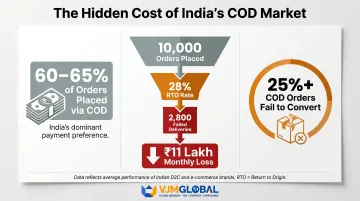
Logistics deserve more attention here than most founders expect. Approximately 60-65% of ecommerce orders are placed through COD (Cash on Delivery), especially in Tier 2 and Tier 3 cities. Over 25% of COD orders fail to convert to successful sales. These Return to Origin (RTO) shipments create costs without revenue. A D2C brand shipping 10,000 orders monthly at 28% RTO loses roughly ₹11 lakh per month on orders that generate zero revenue.
Step 5 – Define Your Go-to-Market Approach for India
With your operations stack in place, the next question is customer acquisition. For Singapore-based D2C brands entering India, credibility signals matter more than ad spend alone:
- Local language support (Hindi and regional languages)
- INR pricing displayed clearly
- Indian customer reviews and testimonials
- Visible return policies and customer service contact
Prioritize the right initial channels:
- Instagram and YouTube have the highest ecommerce influence in India for most consumer categories
- ONDC provides an emerging low-cost channel with minimal platform fees
- Amazon India's sponsored ads give immediate visibility but require margin planning (platform commissions run 15-25%)
Avoid spreading across all channels before proving conversion on one. Start with a single platform, validate unit economics, then expand.
Quick commerce (Blinkit, Zepto, Swiggy Instamart) has reached USD 10-11 billion in GMV in 2025 and shows 8x higher conversion rates than traditional e-retail — but requires localized inventory and fulfillment infrastructure better suited for later-stage expansion.
Step 6 – Monitor, Comply, and Scale Systematically
Track the metrics that matter for India:
- Conversion rate by platform
- Return-to-Origin (RTO) percentage
- Customer acquisition cost (CAC) by channel
- GST filing compliance dates (quarterly deadlines are strict)
Missing quarterly GST filings triggers penalties and can freeze your entity's GSTIN, halting all legal sales.
Stabilize operations and unit economics before scaling. The most common failure mode for Singapore founders entering India is scaling ad spend before logistics reliability and return rates are under control. Fix the fulfillment and compliance foundation first.
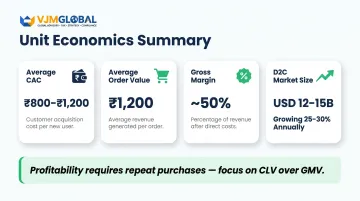
Average CAC for D2C brands in India runs ₹800-₹1,200 per customer. With average order values around ₹1,200 and approximately 50% gross margins, unit-level profitability requires repeat purchases. India's D2C market (estimated at USD 12-15 billion in 2025, growing 25-30% annually) has shifted from breakneck GMV growth to disciplined profitability. Focus on contribution margin and customer lifetime value, not just top-line GMV.
Conclusion
Starting an ecommerce business in India from Singapore is genuinely achievable—but the cross-border legal and compliance layer means the basics must be set up correctly before the business side can gain traction. Entity structure and registration have to come before product and marketing. That sequencing matters more than most founders expect.
India's ecommerce market is on a sustained growth curve, and Singapore entrepreneurs are well-positioned to enter it. The structural advantages are concrete: established FDI pathways, CECA treaty benefits, strong credibility with Indian institutions, and a shared time zone that makes operational coordination easier than it is for US or European counterparts.
The key is working with advisors who understand both the Indian regulatory environment and the specific requirements of foreign-owned entities. Firms like VJM Global—with experience serving 500+ American, 250+ UK, and 250+ Australian businesses, including Singapore-based clients—ensure that early decisions support long-term growth rather than create compliance friction down the line.
When entity setup, FEMA compliance, GST registration, and ongoing accounting are handled correctly from day one, you can direct your energy toward the variables that actually move the business: finding product-market fit in India's competitive ecommerce landscape and building the customer acquisition engine to support it.
Frequently Asked Questions
Can a Singapore-based foreigner own an ecommerce business in India?
Yes, a Singapore resident can own an ecommerce business in India by setting up a Wholly Owned Subsidiary (Private Limited Company). FDI is permitted under the marketplace model but not the inventory-based model, making entity and model selection critical.
How much does it cost to start an ecommerce business in India?
Core costs cover company incorporation (₹15,000–₹25,000), GST registration, platform or website setup, and initial marketing budget. Foreign-owned entities add FEMA compliance and mandatory CA/CS support, bringing typical first-year setup and compliance costs to ₹50,000–₹1,50,000.
Is ecommerce profitable in India?
India's ecommerce sector can be profitable but is margin-sensitive. Unit economics depend heavily on logistics costs, RTO rates (20-30% for COD-heavy businesses), and platform fees (15-30%). D2C brands with strong differentiation and controlled CAC tend to reach profitability faster than marketplace-dependent models.
What are the 4 types of ecommerce?
The four types are B2B (business-to-business), B2C (business-to-consumer), C2C (consumer-to-consumer), and C2B (consumer-to-business). For Singapore founders entering India, B2C and B2B are most relevant — B2C dominates across both marketplace and D2C models.
Which is the best online business to start in India?
High-demand, high-margin categories for foreign-owned ecommerce operators include premium D2C consumer goods, specialty lifestyle products, and niche B2B supply categories. Singapore founders often have a natural edge in Southeast Asian sourcing networks and premium brand positioning — both strong starting points for entering India's mid-to-premium consumer segments.
What is the 80/20 rule in ecommerce?
In ecommerce, 80% of revenue typically comes from 20% of products or customers. Focus early-stage effort on identifying and doubling down on top-performing SKUs and customer segments rather than expanding breadth prematurely. For India-entry operations with limited runway, applying this rule early prevents capital from being spread thin across categories that won't generate returns quickly.