Here's the direct answer: the UK equivalent of an LLC is a Private Limited Company (Ltd), registered under the Companies Act 2006 through Companies House. It offers the same limited liability protection founders want from an LLC, just wrapped in a different legal framework.
This guide covers the legal basis for that equivalence, how a Ltd differs from a US LLC in tax and structure, what it actually costs to set one up, and a couple of alternative UK structures worth knowing before you file.
Key Takeaways
- The UK has no LLC; the closest equivalent is a Private Limited Company (Ltd)
- A UK Ltd pays Corporation Tax at 19%-25% before any dividend tax, unlike an LLC's pass-through model
- Online registration with Companies House costs £100 and typically completes within 24 hours
- Non-UK residents can fully own and direct a UK Ltd with no residency requirement (UK registered office still required)
What Is the UK Equivalent of an LLC?
GOV.UK's own list of business structures covers sole trader, limited company, business partnership, social enterprise, overseas company, and unincorporated association. "LLC" does not appear anywhere on it—the term has no meaning in UK company law.
The structure that does the same job is the Private Limited Company, defined under the Companies Act 2006. Section 3 of the Act limits a shareholder's liability to whatever amount remains unpaid on their shares, meaning personal assets stay protected if the business runs into debt. That's the exact protection most people are searching for when they type "UK LLC" into Google.
A Ltd stands as its own legal entity. It can:
- Own property and assets in its own name
- Sign contracts independently of its owners
- Sue and be sued separately from its directors or shareholders
- Continue existing even if ownership changes hands
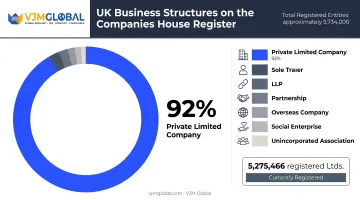
Private limited companies dominate the UK business landscape. According to Companies House's latest register activity statistics, they account for 5,275,466 of all corporate bodies on the register, roughly 92% of the total. If you're forming a company in the UK, this is almost certainly what you'll end up with.
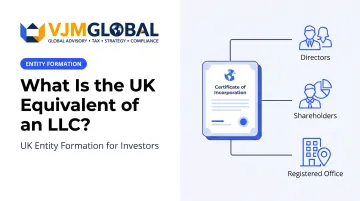
A single person can hold both the sole shareholder and sole director roles in a Ltd, much like a single-member LLC in the US. You don't need a co-founder or a board to get started.
LLC vs. UK Private Limited Company: Key Differences
The liability protection might feel similar, but the day-to-day mechanics of running a Ltd differ from an LLC in ways that catch founders off guard.
Ownership, Management, and Terminology
An LLC has "members" who hold membership interests. An operating agreement governs the entity, and members can shape it almost however they like.
A Ltd has "shareholders" who hold shares. It must appoint at least one director, keep statutory registers, and follow governance rules set out in the Companies Act rather than a private agreement alone.
Tax Treatment
This is where the two structures diverge most.
- US LLC: Defaults to pass-through taxation. Profits hit the owner's personal return once, unless you elect corporate treatment with the IRS.
- UK Ltd: Pays Corporation Tax at entity level first—19% on profits under £50,000 and 25% above £250,000, with marginal relief in between. Dividends then face a second layer of tax.
That's effectively two tax events for a Ltd versus one for a typical LLC, which matters a lot for cash flow planning.
Compliance Burden
LLCs in the US often face fairly light ongoing paperwork, depending on the state. A UK Ltd carries more fixed obligations:
- Confirmation Statement: filed at least once every 12 months
- Annual Accounts: filed with Companies House
- Corporation Tax Return (CT600): filed with HMRC
Quick Comparison
| Factor | US LLC | UK Ltd |
|---|---|---|
| Owners called | Members | Shareholders |
| Governance | Operating agreement | Directors + statutory registers |
| Tax | Pass-through (default) | Corporation Tax + dividend tax |
| Filings | Varies by state | Confirmation Statement, Accounts, CT600 |
| Liability | Limited to investment | Limited to unpaid share value |
Those filing and tax differences are only part of the picture. A Ltd also carries recognition across the UK and much of the Commonwealth, which matters if customers or partners sit in Australia, India, or Singapore rather than purely the US.
How Much Does It Cost to Set Up the UK Equivalent of an LLC?
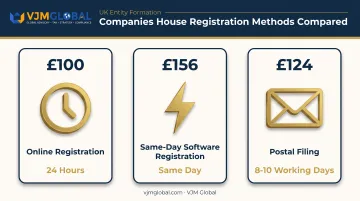
Registration itself is inexpensive. Companies House offers three tiers. Per the Companies House fees schedule:
- £100 for standard online registration, processed within 24 hours
- £156 for same-day software registration
- £124 for postal filing, taking 8-10 working days
That's the government fee. It's rarely the full picture for a non-resident founder.
What Else to Budget For
- Registered office address — Companies House requires a physical UK address, not a PO Box. Address services often start around £39 plus VAT per year if you have no UK base.
- Formation agent or advisory support — Useful when handling the Memorandum and Articles, HMRC registration, and UTR setup remotely without a UK team.
- Ongoing accounting fees — Confirmation Statements, Annual Accounts, and Corporation Tax returns recur each year and usually need a qualified accountant.
VJM Global helps international founders with UK company formation and the recurring compliance that follows, so setup costs and ongoing filings stay coordinated from day one.
For US-Based Comparison
If you're weighing this against a domestic LLC, state formation fees are in a similar range, plus registered agent fees most states require:
- Delaware: around $110
- Wyoming: around $100
- California: around $70
Filing-stage costs are broadly comparable. The real gap shows up later in tax treatment and compliance, so check with a formation or tax advisor before assuming one route is cheaper long-term.
Other UK Business Structures Similar to an LLC
A Ltd isn't the only option if you want liability protection without full corporate tax treatment.
Limited Liability Partnership (LLP)
An LLP taxes each member individually on their share of profits, similar to how a US LLC defaults to pass-through taxation. It still offers liability protection through separate legal personality.
UK rules require an LLP to have at least two designated members, and members are generally not personally liable to third parties for the partnership's debts.
LLPs tend to suit:
- Professional service firms (law, accountancy, consultancy) where partners want pass-through taxation
- Businesses with multiple active partners who all want a say in management
- Founders who want to avoid the extra tax layer on Ltd dividends
Sole Trader and Traditional Partnership
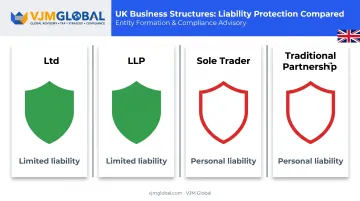
Neither structure offers the liability protection most LLC-seekers want:
- A sole trader is personally liable for all business debts
- A traditional partnership spreads that same personal liability across partners
If protecting personal assets is the goal, both fall short of what a Ltd or LLP provides.
Why International Founders Choose a UK Private Limited Company
There's no residency requirement for directors or shareholders of a UK Ltd. Founders based in India, the US, Australia, or anywhere else can own 100% of the company and run it entirely remotely.
The one non-negotiable requirement is a physical, deliverable UK registered office address. It has to be a real location where someone can receive post, not a PO Box. Formation agents and registered address services solve this cleanly for founders without a UK office of their own.
That accessibility is a big reason international founders pick a UK Ltd. Where things tend to go wrong isn't the registration itself—it's what comes after:
- Missing the Confirmation Statement deadline because the 12-month cycle isn't familiar
- Misjudging when VAT registration kicks in
- Underestimating PAYE obligations once staff get hired
- Assuming annual accounts work the same way they do back home
None of these are complicated once you know the rules, but they trip up founders who assume UK compliance mirrors their home country's system.
VJM Global has supported 250+ UK businesses through formation and ongoing compliance. Much of that work is with founders setting up remotely from outside the UK—exactly where these preventable misses show up.
Frequently Asked Questions
How much does it cost to start the UK equivalent of a US LLC?
Standard Companies House registration costs £100 online, with same-day and postal options at £156 and £124. Non-residents should also budget for a registered address service and accountant support for ongoing filings.
What is the difference between an LLC and an LLP in the UK?
The UK has no LLC. An LLP is a limited liability partnership whose members are taxed on their share of profits; a Ltd (the usual LLC equivalent) is owned by shareholders and pays Corporation Tax at entity level. Both offer limited liability.
Can a non-UK resident set up a UK private limited company?
Yes. There's no residency requirement for directors or shareholders, provided the company maintains a valid UK registered office address for official correspondence.
Is an LLC the same as a Ltd?
No. Both protect personal assets from business debts, but they operate under entirely different legal systems, tax treatments, and governance requirements. They're functional equivalents, not identical structures.
Can I convert my US LLC into a UK Ltd?
Not directly. The two entities exist under separate national legal systems, so there's no automatic conversion process. Founders typically form a new UK Ltd and transfer assets or operations across.
Which structure is better for a business serving both US and UK/European clients?
It depends on where most customers and revenue are based. Many growing founders eventually run an LLC and a Ltd side by side rather than picking just one, once operations genuinely span both markets.