This guide covers every major tax a UK private limited company faces: Corporation Tax, VAT, Employer NICs, and the personal taxes directors and shareholders pay on salaries and dividends. You'll also find current rates, critical filing deadlines, and practical strategies to minimise your overall tax burden legally.
The UK limited company structure offers genuine tax advantages over sole trading—but only when you understand how the system works. Whether you've just incorporated or you're reviewing your position after years in business, this guide provides the clarity you need.
Key Takeaways
- Corporation Tax applies at 19% on profits up to £50,000 and 25% on profits above £250,000, with Marginal Relief for profits in between
- Private limited companies handle VAT (if turnover exceeds £90,000), Employer NICs on staff wages at 15%, and PAYE on director salaries
- Directors and shareholders face personal taxes separately: income tax and NICs on salaries, plus dividend tax at 8.75%, 33.75%, or 39.35% depending on income tax band on distributions
- Pay Corporation Tax 9 months and 1 day after the accounting period ends, file CT600 within 12 months, and file accounts with Companies House within 9 months
- The main tax-saving strategies: low salary plus dividends, employer pension contributions, and claiming all allowable expenses
Corporation Tax: Rates, Thresholds, and Marginal Relief
Corporation Tax is charged on a company's taxable profits—not total turnover. All UK-resident private limited companies are liable, regardless of size or sector.
Rates and Thresholds
The two-tier rate structure took effect from April 2023, replacing the previous flat 19% rate. Here's how it currently works:
- Small profits rate: 19% applies when annual profits are £50,000 or below
- Main rate: 25% applies when profits exceed £250,000
- Marginal Relief: Companies with profits between £50,000 and £250,000 don't jump straight to 25%. Instead, a sliding scale using a fraction of 3/200 gradually increases the effective rate. HMRC's Marginal Relief calculator can compute your exact liability.
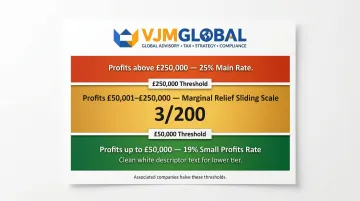
One rule catches many directors off guard: HMRC divides both thresholds by the total number of associated companies. If you run two active limited companies, both thresholds are halved to £25,000 and £125,000 respectively. Shorter accounting periods also trigger proportionate reductions.
Taxable Profits and Allowable Deductions
Taxable profit is calculated by starting with total revenue, then deducting allowable business expenses:
- Staff salaries (including director salary)
- Office costs, professional fees, travel
- Equipment purchased via capital allowances
- Pension contributions made by the company
- R&D tax credits for qualifying innovative work
Beyond these standard deductions, three reliefs are routinely underused—and each can meaningfully reduce your bill:
- Employer pension contributions are fully deductible and carry no employer NIC liability, making them one of the most efficient ways to extract value from a company
- Annual Investment Allowance (AIA) is permanently set at £1,000,000 per 12-month period, allowing a full first-year deduction for qualifying capital expenditure
- R&D Expenditure Credit replaced the previous SME and RDEC schemes from 1 April 2024, offering a single 20% credit on qualifying costs. Loss-making R&D-intensive SMEs may also qualify for the 14.5% payable credit under Enhanced R&D Intensive Support (ERIS), provided R&D spending represents at least 30% of total expenditure
Other Business-Level Taxes: VAT and Employer NICs
VAT
Registration threshold: Once a company's taxable turnover crosses £90,000 in a rolling 12-month period, VAT registration becomes compulsory. Voluntary registration below the threshold can be beneficial if you have significant input VAT to reclaim.
Flat Rate VAT Scheme: Simplifies accounting for smaller businesses by charging a fixed percentage of gross turnover rather than calculating input and output VAT separately.
- Available to businesses with VAT taxable turnover of £150,000 or less expected in the next 12 months
- You pay a fixed, sector-specific rate to HMRC — input VAT on most purchases cannot be reclaimed
- A 1% discount applies to your flat rate during the first year of VAT registration
- You must leave the scheme once turnover exceeds £230,000 (including VAT)
Employer National Insurance Contributions
VAT is just one piece of the employer tax picture. Your company also pays Employer NICs on wages you pay to any employee — including yourself as director — above the Secondary Threshold.
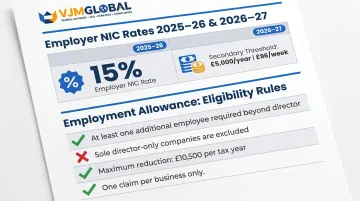
For tax years 2025-26 and 2026-27, the Employer NIC rate is 15%, applied to wages above the Secondary Threshold of £5,000/year (£96/week).
Employer NICs are a deductible expense for Corporation Tax purposes, which reduces the net cost.
Employment Allowance: Eligible businesses can reduce their annual Employer NIC bill by up to £10,500. Key rules:
- At least one employee must be on the payroll in addition to the sole director
- Companies where the sole director is the only employee are not eligible
- No upper liability cap applies to eligibility
- Only one claim per business — connected employers cannot each claim separately
Personal Taxes for Directors and Shareholders
Corporation Tax is just the first layer. Once profits sit inside the company, extracting them personally triggers a second round of tax — and the method of extraction determines how much you pay.
Income Tax and PAYE on Director Salary
A director's salary is processed through PAYE just like any other employee's pay:
Tax year 2026-27 rates:
- Personal Allowance: Up to £12,570 (0%)
- Basic rate: £12,571 to £50,270 (20%)
- Higher rate: £50,271 to £125,140 (40%)
- Additional rate: Over £125,140 (45%)
The Personal Allowance reduces by £1 for every £2 of adjusted net income (total income minus reliefs such as pension contributions) above £100,000, reaching zero at £125,140.
Employee NIC thresholds:
- Lower Earnings Limit (LEL): £125/week (£6,500/year)
- Primary Threshold (PT): £242/week (£12,570/year)
- Employee NIC rate: 8% on earnings between PT and £50,270; 2% above that
Many director-shareholders set their salary at or just above the Lower Earnings Limit (£6,500/year). This preserves State Pension entitlement — earnings at or above the LEL count as a qualifying year — while keeping both income tax and NIC exposure at zero.
Dividend Tax
Dividends are distributions of after-Corporation-Tax profits paid to shareholders. They are taxed at lower rates than salary:
Tax year 2026-27 rates (effective from 6 April 2026):
- Dividend allowance: £500 tax-free
- Basic rate: 10.75%
- Higher rate: 35.75%
- Additional rate: 39.35%
Dividends attract no NICs — not employee NIC, not employer NIC — which is what makes the salary-plus-dividend combination so tax-efficient for director-shareholders. That said, dividends can only be paid from genuine distributable profits. They cannot substitute for salary to sidestep payroll obligations.
Self-Assessment
Both extraction strategies carry a reporting obligation. Directors who receive dividends, earn above £100,000, or have other untaxed income must register for and file a Self-Assessment tax return by 31 January each year. Missing the deadline triggers automatic penalties — so registering early is worth the effort.
Key Tax Filing Deadlines and Compliance Requirements
Every private limited company must track four critical deadlines:
| Obligation | Deadline | Notes |
|---|---|---|
| First accounts to Companies House | 21 months after incorporation | Applies only to newly incorporated companies |
| Annual accounts to Companies House | 9 months after financial year end | Shorter than CT600 deadline—often missed |
| Corporation Tax payment to HMRC | 9 months and 1 day after accounting period end | Interest charged at 7.75% per annum for late payment |
| Company Tax Return (CT600) to HMRC | 12 months after accounting period end | Penalties start at £200 for 1 day late |
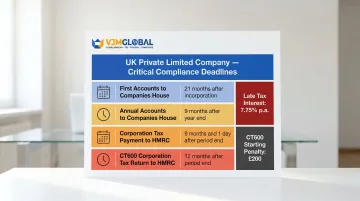
The accounting period for Corporation Tax is normally the same 12-month period as the company's financial year. Exceptions occur if the incorporation date and financial year-end don't align.
Missing any of these dates triggers automatic penalties — and the costs escalate faster than most directors expect.
Penalty Structures
CT600 late filing penalties (HMRC):
- 1 day late: £200
- 3 months late: Another £200
- 6 months late: 10% of unpaid tax (HMRC estimates the bill)
- 12 months late: Another 10% of unpaid tax
- Late 3 times in a row: £200 penalties increase to £1,000 each
Companies House late filing penalties (annual accounts):
- Up to 1 month: £150
- 1 to 3 months: £375
- 3 to 6 months: £750
- More than 6 months: £1,500
Penalties are automatically doubled if accounts are late in two successive financial years. Companies House penalties can reach £3,000 for a company filing late two years running across both sets of accounts.
On top of filing penalties, HMRC charges late payment interest at 7.75% per annum (effective from 9 January 2026) — calculated as the Bank of England base rate plus 2.5 percentage points. On £50,000 of unpaid Corporation Tax, that's nearly £3,900 in interest charges over a year.
Tax-Efficient Strategies to Minimise Your Private Limited Company Tax Bill
Optimal Salary-Dividend Split
Taking a low director salary (typically just above the NIC Lower Earnings Limit) keeps PAYE and NIC costs minimal. Extract remaining profit as dividends, taxed at the lower dividend rates, to maximise take-home pay.
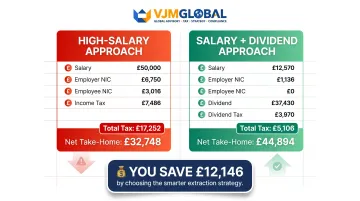
Worked example (2026-27):
High-salary approach:
- Salary: £50,000
- Employer NIC (15% on £45,000 above £5,000 threshold): £6,750
- Employee NIC (8% on £37,700 between £12,570 and £50,270): £3,016
- Income Tax (20% on £37,430): £7,486
- Total tax/NIC: £17,252
- Net take-home: £32,748
Salary-plus-dividend approach:
- Salary: £12,570 (at Personal Allowance)
- Employer NIC (15% on £7,570 above £5,000): £1,136
- Employee NIC: £0 (salary at Primary Threshold)
- Dividend: £37,430
- Dividend tax (10.75% on £36,930 after £500 allowance): £3,970
- Income Tax on salary: £0
- Total tax/NIC: £5,106
- Net take-home: £44,894
The salary-dividend strategy delivers £12,146 more in take-home pay on the same £50,000 extraction.
Company Pension Contributions
Contributions made directly by the company are a deductible business expense (reducing Corporation Tax) and are not subject to NICs. Employer pension contributions are one of the most tax-efficient ways to extract value.
Annual allowance: £60,000 for 2025-26 and 2026-27. Tax relief is available on contributions up to the higher of 100% of UK taxable earnings or £3,600.
Claiming All Allowable Business Expenses
Before calculating taxable profit, claim every legitimate business expense. The "wholly and exclusively" rule requires that expenditure must be incurred wholly and exclusively for business purposes.
Commonly missed deductions:
- Home office costs: £6/week (£312/year) flat-rate deduction without detailed records, or claim a proportion of actual household costs (heating, lighting, broadband) based on reasonable apportionment
- Professional subscriptions: Membership fees for industry bodies
- Training costs: Courses and qualifications relevant to the business
- Use of company vehicle: Mileage or actual running costs
R&D Tax Relief
Businesses investing in qualifying R&D activities may be eligible for R&D tax relief, which can significantly reduce Corporation Tax liability or generate a payable credit.
Merged scheme (from 1 April 2024):
- RDEC rate: 20% (a taxable credit)
- ERIS: Loss-making R&D-intensive SMEs can claim 14.5% payable credit if R&D spending is at least 30% of total expenditure
Eligibility criteria and claim processes are detailed in HMRC's merged scheme guidance.
When to Seek Specialist Tax Advice
These strategies are straightforward in principle, but the interactions between them — salary levels, pension contributions, R&D claims, and dividend timing — become harder to optimise as a company grows or its structure becomes more complex.
For companies with cross-border operations, particularly those with activity in India or other international markets, the planning layer deepens further. VJM Global, with 30+ years of experience serving 250+ UK businesses, advises on international tax structuring and compliance for UK companies operating across borders. For purely domestic UK tax matters, a qualified UK-based tax adviser or accountant is the appropriate starting point.
Frequently Asked Questions
What is the current Corporation Tax rate for private limited companies in the UK?
The rate is 19% for profits up to £50,000 (small profits rate) and 25% for profits above £250,000 (main rate). Marginal Relief applies on profits between the two thresholds. Check HMRC's Corporation Tax rates page for the latest figures.
What taxes does a private limited company pay in the UK?
Company-level taxes include Corporation Tax on profits, VAT if turnover exceeds £90,000, and Employer NICs at 15% on staff wages. Directors and shareholders separately pay personal taxes: income tax, dividend tax, and employee NICs on what they extract from the company.
Is it worth setting up a private limited company in the UK?
A private limited company offers lower tax rates on profits than sole trader income tax, limited personal liability, and flexibility to extract profits via the salary-dividend strategy. The trade-off is greater administrative and filing obligations. For most directors earning above £30,000–£40,000 in profits, the tax savings outweigh the added complexity.
When does a private limited company need to register for VAT?
Registration becomes compulsory once taxable turnover exceeds £90,000 in a rolling 12-month period. Voluntary registration is possible below the threshold, which can benefit businesses with significant input VAT to reclaim.
What is the deadline for filing a Company Tax Return with HMRC?
The Company Tax Return (CT600) must be filed with HMRC within 12 months of the end of the accounting period. The Corporation Tax payment itself is due earlier—9 months and 1 day after the accounting period ends.
Can a director reduce their personal tax bill by taking dividends instead of a salary?
Yes. Dividends attract lower tax rates than salary and carry no NICs, making a combined low-salary and dividend strategy popular among director-shareholders. However, dividends can only be paid from distributable profits — they cannot simply replace a market-rate salary to sidestep tax.