
Introduction
India's digital economy is expanding at double the rate of its broader economy — 1.02 billion internet users, a digital GDP contribution of 13% today, and a projected 20% by 2030. For Singapore entrepreneurs, few markets offer this combination of scale and accessibility. Geographic proximity, the India-Singapore Comprehensive Economic Cooperation Agreement (CECA), and a diaspora of 650,000 overseas Indians give Singapore-based founders structural advantages that most foreign investors simply don't have.
The bilateral opportunity runs both ways:
- Singapore's edge: Access to global capital, cross-border operating experience, and institutional credibility with Indian regulators
- India's pull: Developer salaries 3–5x lower than Singapore, a billion-plus consumer base, and a tax treaty (DTAA) that reduces cross-border friction
- Proven track record: Singapore ranked as India's top FDI source in FY2024-25, with $14.94 billion in equity inflow
That investment momentum points to something real. This guide covers the top online business ideas best suited for Singapore entrepreneurs entering India — what makes each viable, and what to get right before launch, from FDI compliance to tax structuring under the India-Singapore DTAA.
Key Takeaways
- India's 1 billion+ internet users and $250 billion e-commerce market (projected by 2030) create high-growth conditions for digital businesses
- Top opportunities: cross-border e-commerce, IT outsourcing, digital marketing agencies, EdTech platforms, SaaS products
- 100% FDI permitted under automatic route for most digital sectors — no government pre-approval needed
- India-Singapore DTAA reduces withholding tax to 10% on royalties and technical services versus 20% domestic rate
- Entity structure, tax planning, and compliance setup from day one prevent costly penalties later
Why India Is a Smart Bet for Singapore Entrepreneurs
India's internet user base reached 1.02 billion by September 2025, representing 70% penetration. Rural areas now account for over half of active users, growing at twice the urban rate. This digital expansion is reshaping e-commerce: India's e-retail market hit $65-66 billion in 2025 and is projected to reach $170-180 billion by 2030 — growing at 20%+ annually.
The digital economy contributes approximately 13% of India's GDP currently and is projected to reach 20% by 2030 — double the broader economy's growth rate. Software services exports alone exceed $250 billion annually, underscoring India's global digital competitiveness.
The India-Singapore Corridor Advantage
Singapore holds a unique position in India's investment landscape. Cumulatively, Singapore has invested $171.92 billion in India since 2000, representing 23.87% of total FDI equity inflow and ranking #2 among all source countries. In FY2024-25 alone, Singapore led all nations with $14.94 billion in FDI.
CECA provides structural advantages unavailable to most foreign investors:
- Zero customs duties on electronic transmissions — removes a key cost barrier for digital service delivery
- Service sector access across 120+ sub-sectors, including IT, telecommunications, and professional services
- Professional mobility across 127 occupational categories, with permitted stays of 1-2 years
- Investment protections: national treatment, safeguards against expropriation, and free transfer of funds
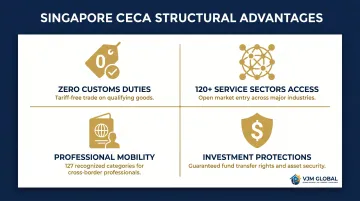
This framework, combined with cultural familiarity via India's 650,000-strong diaspora in Singapore, cuts the market-entry barriers that slow down most foreign investors.
The market conditions are favorable. What determines success from here is choosing the right business model — which is exactly what the following section covers.
Best Online Business Ideas in India for Singapore Entrepreneurs
Each idea below is chosen for low capital requirements, strong scalability, and clear FDI compliance — practical for Singapore entrepreneurs running remote or hybrid operations.
Cross-Border E-Commerce (Indian Products to Global Markets)
Singapore entrepreneurs can establish India-based e-commerce export businesses, sourcing from India's large artisan, textile, and manufacturing base and selling internationally. India's textiles and apparel exports reached $37.8 billion in FY2024-25, with MSMEs contributing 48.55% of merchandise exports. Production costs remain low while export incentive schemes like RoDTEP (Remission of Duties and Taxes on Exported Products) enhance margin potential.
Singapore's logistics infrastructure, global trade relationships, and payment platforms (PayNow, Stripe) create real operational advantages. Singapore handles order flows and international payments; India manages production and fulfillment. The cost difference between both markets typically translates to 40–50% margins.
Startup & Revenue Model
| Requirement | Details |
|---|---|
| Startup Requirements | India company registration, supplier partnerships, IEC (Import Export Code), e-commerce storefront |
| Revenue Model | Product markup on exports, marketplace fees (Amazon Global, Etsy) |
| Singapore-India Edge | Singapore's trade network + India's low manufacturing cost = 40-50% margin potential |
IT Services and Tech Outsourcing Hub
India's tech talent pool is hard to match: 5.8 million developers (second-largest globally), 1.5 million engineering graduates annually, and an AI talent base of 600,000–650,000 professionals. Singapore entrepreneurs can build India-based IT services companies offering software development, QA, cloud services, or AI/ML solutions to global clients.
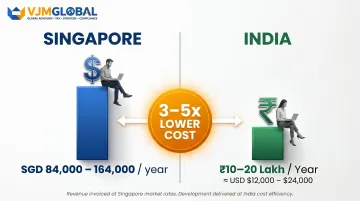
The cost advantage is significant. Mid-level developer salaries in India range ₹10–20 lakh/year ($12,000–$24,000), compared to SGD 84,000–164,000 ($63,000–$123,000) in Singapore — a 3–5x differential. Revenue gets invoiced at Singapore or global rates; delivery runs from India at a fraction of the cost.
India's tech industry revenue is projected at $315 billion in FY26, with IT services accounting for approximately $149 billion. Many Singapore tech firms already use this model through Indian subsidiaries.
Startup & Revenue Model
| Requirement | Details |
|---|---|
| Startup Requirements | India Private Limited Company, registered office, tech team hiring, client contracts |
| Revenue Model | Project-based or retainer billing to global clients; offshore delivery from India |
| Singapore-India Edge | Singapore entity invoices at premium rates; India entity delivers at 3-5x lower cost |
Digital Marketing Agency for Indian SMBs
India registered over 78.3 million enterprises on the Udyam platform as of February 2026. Only 43% have achieved basic digital maturity, meaning approximately 44+ million businesses lack websites, social media presence, or digital payment integration. This gap creates sustained demand for SEO, social media, content marketing, and paid advertising services.
Singapore entrepreneurs can build remote-first agencies serving Indian SMBs with minimal capital. The business scales via Indian freelancers managed remotely, keeping overhead low. The Singapore connection adds credibility and international positioning that justifies premium pricing.
India's digital advertising market reached ₹71,621 crore (~$8.5 billion) in 2025, commanding 59% of total ad spend — Indian businesses are investing in digital marketing at scale, and that spending is still accelerating.
Startup & Revenue Model
| Requirement | Details |
|---|---|
| Startup Requirements | India LLP or Private Limited Company, SEO/analytics tools, initial client acquisition |
| Revenue Model | Monthly retainers (₹25,000–₹1,00,000/month), project-based campaign fees |
| Singapore-India Edge | International credibility adds premium positioning; remote delivery keeps costs lean |
EdTech and Online Coaching Platform
India's EdTech market was valued at $7.5 billion in 2025 and is projected to reach $29–33 billion by 2030–34, growing at 27.94% CAGR. Demand spans K-12 learning (43% market share), test preparation for exams like JEE/NEET/UPSC (25% share), and professional upskilling (20% share).
Only 0.6% of India's 1.5 million schools are digitally served — the institutional gap is substantial. Singapore entrepreneurs with specialized expertise can build subscription or cohort-based learning platforms targeting students and working professionals alike.
The content-first approach works well here. Create course IP in Singapore, partner with Indian educators for localized delivery, and monetize through platforms like Teachable, Graphy, or a custom LMS — no physical infrastructure required.
Startup & Revenue Model
| Requirement | Details |
|---|---|
| Startup Requirements | LMS platform or app, content creation, India-compliant payment gateway (Razorpay, Instamojo) |
| Revenue Model | Course subscriptions (₹999–₹9,999/month), one-time purchases, live cohort fees, B2B licensing |
| Singapore-India Edge | Singapore-origin brand commands premium pricing for professional upskilling courses |
SaaS or Software Product Business Targeting India
India's SaaS market reached $50 billion+ in ARR in 2025, with projections of $50–70 billion in revenue by 2030, capturing 4–6% of the global SaaS market. SMB adoption is accelerating, driven by demand for affordable CRM, invoicing, HR, and logistics tools that comply with Indian regulations (GST, EPFO, etc.).
Singapore entrepreneurs can build India-focused SaaS products by hiring development teams in India at 3–5x lower cost than Singapore, while maintaining strategic control and global market access from Singapore. Products can be priced in INR or USD and marketed globally from day one.
FDI into software product companies is 100% permitted under the automatic route — one of the cleanest regulatory pathways available to foreign entrepreneurs entering India.
Startup & Revenue Model
| Requirement | Details |
|---|---|
| Startup Requirements | India Private Limited Company, product development team, AWS/Google Cloud infrastructure, GTM strategy |
| Revenue Model | Monthly/annual SaaS subscriptions (₹499–₹4,999/user/month); freemium to paid conversion |
| Singapore-India Edge | Singapore HQ supports global VC fundraising; India entity keeps R&D costs lean |
Key Factors Singapore Entrepreneurs Must Evaluate Before Starting
Entity Structure Decision
Singapore nationals have three primary options when establishing an online business in India:
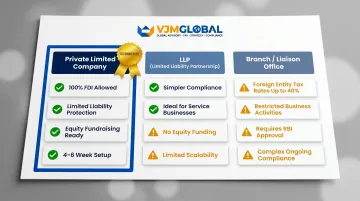
Private Limited Company (Most Recommended)
- 100% FDI permitted under automatic route for most digital sectors
- Limited liability protection separates personal and business assets
- Enables equity fundraising and institutional investment
- Professional credibility with Indian clients, vendors, and banks
- Typical timeline: 4-6 weeks for foreign nationals via digital incorporation (SPICe+)
Limited Liability Partnership (LLP)
- Simpler compliance requirements than Private Limited
- Good for service businesses (consulting, agencies)
- Cannot raise equity funding — limits scalability
- Less recognized by institutional investors
Branch/Liaison Office
- Treated as foreign entity with higher income tax rates (up to 40%)
- Restricted activities — cannot engage in manufacturing or certain commercial operations
- Requires RBI approval — lengthier setup process
If you plan to scale or raise capital, the Private Limited Company structure is the practical starting point — it keeps the most options open.
FDI and Sector Eligibility
Most digital business categories qualify for 100% FDI under the automatic route — meaning no prior government approval is required. Covered sectors include:
- IT services and software products
- B2B e-commerce and marketplace platforms
- EdTech and online education services
- SaaS and cloud software
- Digital marketing and advertising services
Critical Restrictions:
- Inventory-based B2C e-commerce: FDI NOT permitted — foreign-owned entities cannot hold and sell inventory directly to Indian consumers. Marketplace models (connecting buyers and sellers) are allowed.
- Digital news media: 26% FDI cap under government approval route
- No single vendor may account for more than 25% of sales on a marketplace platform
Sector rules shift — verify your specific category before filing incorporation documents, as a structural mismatch at the outset creates costly corrections later.
Tax Planning and the India-Singapore DTAA
The India-Singapore Double Taxation Avoidance Agreement (DTAA) provides significant tax benefits for Singapore residents operating businesses in India. Proper structuring from the outset minimizes withholding tax and avoids double taxation.
DTAA Withholding Tax Rates
| Income Type | DTAA Rate | Domestic Rate | Benefit |
|---|---|---|---|
| Dividends | 10% (25%+ shareholding) or 15% | 20% | 25-50% tax reduction |
| Royalties | 10% | 20% | 50% tax reduction |
| Fees for Technical Services | 10% | 20% | 50% tax reduction |
| Interest | 10% (banks) or 15% | 20% | 25-50% tax reduction |
Limitation of Benefits (LOB) Clause: To claim DTAA benefits, Singapore entities must demonstrate commercial substance — annual operating expenditure in Singapore of at least S$200,000 in the 24 months preceding the claim. Shell companies fail this test and are denied treaty benefits.
Required Documentation:
- Tax Residency Certificate (TRC) from Singapore tax authorities
- Form 10F filed with Indian tax authorities
- No Permanent Establishment declaration
Correctly structured, the DTAA reduces effective tax rates by 25-50% on cross-border income flows. VJM Global's DTAA advisory services help Singapore entrepreneurs claim those benefits correctly and stay compliant throughout.
Compliance Obligations
India-registered companies — regardless of ownership origin — carry the same ongoing compliance obligations as domestic entities:
GST Registration
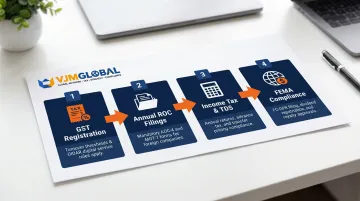
- Mandatory if turnover exceeds ₹40 lakh (₹20 lakh in special category states)
- OIDAR services (Online Information Database Access or Retrieval) have NO threshold — foreign providers must register from the first transaction with Indian consumers
- GST rate: 18% IGST on most digital services
Annual ROC Filings
- Annual returns (Form AOC-4, Form MGT-7)
- Financial statements and director disclosures
- Statutory register updates
Income Tax Returns and TDS
- Annual corporate income tax return filing
- TDS deduction on payments to Indian residents (professional fees, rent, etc.)
- Transfer pricing documentation for intra-group transactions
FEMA Compliance
- Form FC-GPR filing within 30 days of issuing shares to foreign investors
- Dividend remittance documentation
- Royalty and technical service payment approvals
Engaging a local compliance partner early prevents penalties and operational disruption. VJM Global brings 30+ years of India-specific advisory experience and provides end-to-end support — from entity formation through ongoing tax, accounting, and regulatory compliance — so Singapore entrepreneurs can focus on growth while staying fully compliant.
Conclusion
India's digital economy offers Singapore entrepreneurs a compelling combination of scale (1 billion+ internet users), cost advantage (3-5x lower talent costs), and regulatory openness (100% FDI under the automatic route for most sectors).
The five business models covered here — cross-border e-commerce, IT outsourcing, digital marketing agencies, EdTech platforms, and SaaS products — are practical, FDI-compliant entry points with strong revenue potential across India's fastest-growing digital segments.
The real risk is underestimating India's compliance complexity. Entering without the right legal and operational foundation creates costly liabilities, delays timelines, and exposes businesses to penalties. These four areas must be addressed before you incorporate:
- Entity structure — choosing between a subsidiary, LLP, or branch office
- FDI eligibility — confirming your sector and ownership structure qualify
- Tax planning — using the India-Singapore DTAA to avoid double taxation
- Ongoing compliance — GST registration, annual filings, and FEMA reporting
Ready to launch an India-based online business? Consult with specialists before incorporating. VJM Global helps Singapore entrepreneurs navigate India's company registration, tax, and compliance requirements — with dedicated support designed specifically for international business owners entering the Indian market. Contact VJM Global at [email protected] or call +91-9213397070 to get your India market entry structured correctly from day one.
Frequently Asked Questions
What business can I start with $5,000 in India?
With approximately S$5,000 (roughly ₹3–3.5 lakh), Singapore entrepreneurs can realistically start a digital marketing agency, freelance IT services firm, or online coaching platform in India. These models require minimal infrastructure — a registered entity, basic tools, and initial marketing spend to acquire clients.
What are the 7 types of e-commerce?
The seven models are B2C, B2B, C2C, C2B, B2G, G2B, and D2C (direct-to-consumer). For Singapore entrepreneurs entering India, B2B, marketplace B2C, and D2C export models are the most relevant — and the most straightforwardly FDI-compliant.
Can a Singapore entrepreneur own 100% of an online business in India?
Yes, 100% FDI is permitted in most digital and technology business categories under the automatic route — no prior government approval needed. This includes IT services, software products, B2B e-commerce, marketplace platforms, EdTech, and SaaS. However, inventory-based B2C e-commerce and certain sectors like news media or fintech may have restrictions that should be verified before incorporation.
What business structure is best for a Singapore entrepreneur starting an online business in India?
A Private Limited Company is generally the preferred structure for foreign entrepreneurs due to FDI compliance, limited liability protection, ability to raise equity funding, and credibility with Indian clients and vendors. LLPs are suitable for service businesses but cannot raise equity, while Branch Offices face higher tax rates and activity restrictions.
Does the India-Singapore tax treaty benefit entrepreneurs operating businesses in both countries?
Yes, the India-Singapore DTAA reduces withholding tax on royalties, technical service fees, and certain dividends from 20% to 10%. To claim treaty benefits, you'll need a Tax Residency Certificate (TRC), Form 10F, and proof of commercial substance — including S$200,000+ in annual Singapore expenditure. A cross-border tax advisor can help structure income flows to make full use of these rates.
How long does it take to register a company in India as a foreign national?
Company incorporation in India for foreign nationals typically takes 4-6 weeks via the fully digital SPICe+ process. The timeline depends on document readiness (passport, address proof, apostille), name approval, and appointing a resident Indian director. Working with a local firm like VJM Global helps avoid common delays and ensures FEMA/FDI compliance from day one.