Introduction
India represents one of Asia's fastest-growing markets, and Singapore entrepreneurs are increasingly looking to establish a business presence there. Singapore has been India's largest source of foreign direct investment for seven consecutive years, contributing $14.94 billion in FY2024-25 alone and accounting for 23.87% of cumulative FDI. However, the licensing process is often misunderstood or underestimated by foreign entrepreneurs.
A "business license" in India is not a single document — it's a layered set of registrations and permits. Singapore entrepreneurs also face compliance requirements that domestic applicants don't encounter, including:
- FDI regulations and FEMA (Foreign Exchange Management Act) approvals managed through the RBI
- Central government registrations such as company incorporation and tax identifiers
- State-level and municipal licenses that vary by location and industry, each with distinct timelines and fees
Unlike Singapore's streamlined ACRA/UEN system, India operates across three parallel compliance tracks that must be addressed in sequence.
Key Takeaways
- There is no single "business license" — you need entity registration, tax IDs, and sector permits
- Check FDI eligibility under Automatic Route vs Government Approval before filing anything
- Wholly Owned Subsidiary (Private Limited) is the most recommended structure for Singapore founders
- Mandatory registrations include MCA incorporation, GST, PAN/TAN, Trade License, and FC-GPR filing with RBI
- Hire an India-based compliance specialist — apostille of Singapore documents, RBI deadlines, and state-level permits all have local nuances
What Is a "Business License" in India?
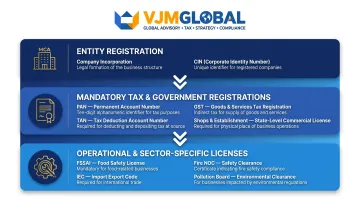
Unlike Singapore's unified business registration system, India does not issue a single business license. Operating legally requires a combination of registrations across three tiers:
Entity Registration — Company incorporation through the Ministry of Corporate Affairs (MCA), which establishes your legal entity and issues your Corporate Identity Number (CIN).
Mandatory Tax and Government Registrations, including:
- PAN (Permanent Account Number) and TAN (Tax Deduction Account Number)
- GST registration (if turnover exceeds ₹20 lakh for services or ₹40 lakh for goods)
- State-level Shops & Establishment registration
Operational and Sector-Specific Licenses, depending on your business activity:
- FSSAI for food businesses
- IEC (Import Export Code) for trading
- Fire NOC for commercial premises
- State Pollution Control Board consent for manufacturing
For Singapore entrepreneurs, this three-tier structure is only part of the picture. Because you're bringing in foreign capital, your licensing process is also governed by FEMA and RBI circulars — not just the Companies Act and state laws. That translates to additional filings: the FC-GPR (Foreign Currency-Gross Provisional Return) within 30 days of share allotment, and annual FLA (Foreign Liabilities and Assets) returns. Most domestic setup guides skip these entirely.
Choosing the Right Business Structure as a Singapore Entrepreneur
Before applying for any license, you must choose a legally permissible entity structure. This decision determines your FDI route, allowed activities, tax treatment, and compliance obligations.
Wholly Owned Subsidiary (Private Limited Company)
The most common choice for Singapore entrepreneurs. A Wholly Owned Subsidiary allows 100% foreign ownership in most sectors — you can enter contracts, open bank accounts, hire locally, and retain profits in India.
Key requirements:
- Minimum two shareholders and two directors
- At least one director must be ordinarily resident in India (182+ days in prior calendar year)
- Incorporated under the Companies Act 2013; typical setup timeline is 4–6 weeks
Best for: Entrepreneurs seeking full control, scalability, and eventual access to Indian funding or venture capital.
Branch Office
Extension of your Singapore parent company that can conduct commercial operations, but restricted to specific activities like trading, IT services, or manufacturing.
Key requirements:
- Parent company must have net worth of at least USD 100,000
- Requires RBI approval
- Cannot conduct retail trading
Tax implication: Branch Office profits are taxed at 40% (higher than the 22% domestic corporate rate).
Liaison Office
Purely representational — cannot generate revenue or conduct commercial activities. Limited to market research, promoting the parent company, and facilitating business.
Key restrictions:
- Requires RBI approval with maximum validity period
- Prohibited from earning income in India
- Parent company must have minimum net worth of USD 50,000
Best for: Market reconnaissance only — not suitable if you intend to generate India-based revenue.
Limited Liability Partnership (LLP)
Permitted for foreign investment only in sectors with 100% FDI under the Automatic Route.
Key requirements:
- At least one designated partner must be resident Indian
- Suitable for professional service firms
- Limited capital repatriation options
Best for: Professional services firms with a long-term India partner in place.
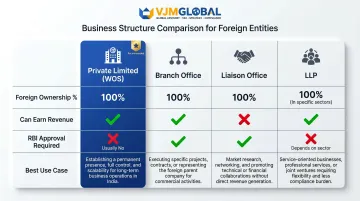
Quick Comparison: Which Structure Fits Your Goals?
| Structure | Foreign Ownership | Can Earn Revenue? | RBI Approval Needed? | Best For |
|---|---|---|---|---|
| Private Limited (WOS) | 100% (most sectors) | Yes | No (Automatic Route) | Full control, scaling, VC access |
| Branch Office | 100% | Yes (limited activities) | Yes | Established parent companies |
| Liaison Office | 100% | No | Yes | Market testing without revenue |
| LLP | 100% (Automatic Route sectors) | Yes | No | Professional service partnerships |
Step-by-Step: How to Get a Business License in India
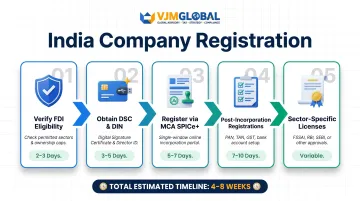
Standard incorporation (Private Limited Company) takes approximately 4–8 weeks, with sector-specific licenses adding further time depending on your industry and state.
Step 1: Verify FDI Eligibility and Entry Route
Singapore entrepreneurs must confirm whether their sector permits 100% FDI under the Automatic Route (no prior government approval needed) or requires Government Approval.
Sectors with restrictions include:
- Defence (up to 74% under automatic, beyond requires approval)
- Telecom (100% with conditions)
- Insurance (100% automatic route — recently liberalised)
Critical: Singapore is NOT affected by Press Note 3 (2020), which requires government approval for investments from land-bordering countries. Singapore investors benefit from the standard FDI framework.
Verify your sector eligibility using the current DPIIT FDI policy before proceeding.
Step 2: Obtain Digital Signature Certificate (DSC) and Director Identification Number (DIN)
All proposed directors must obtain:
- DSC (Class 3): Required for filing e-forms on the MCA portal
- DIN: Unique identifier for directors, valid for lifetime
For Singapore nationals:
- Apostilled identity documents (passport) and address proof required
- Singapore acceded to the Hague Apostille Convention in January 2021
- DSC and DIN applications can be processed simultaneously
Timeline: 2-3 business days
Step 3: Register the Company via MCA SPICe+ Form
The SPICe+ (Simplified Proforma for Incorporating Company Electronically Plus) process includes:
- Reserve company name via RUN (Reserve Unique Name) service
- File SPICe+ form with Memorandum of Association (MOA) and Articles of Association (AOA)
- Receive Certificate of Incorporation with CIN, PAN, and TAN issued simultaneously
Director residency requirement: At least one director must be ordinarily resident in India. Singapore entrepreneurs typically address this by appointing a trusted local nominee director — but governance controls must stay firmly in place.
Timeline: 5-7 business days after name approval
Step 4: Complete Post-Incorporation Registrations
Once your Certificate of Incorporation arrives, several registrations must be completed before you can receive FDI or begin operations. These are time-sensitive — some carry 30-day deadlines with FEMA penalties for non-compliance.
Open an Indian current account
- Required to receive FDI and commence operations
- Some banks require foreign directors to be physically present for KYC
File FC-GPR with RBI
- Must be completed within 30 days of share allotment
- Non-compliance incurs compoundable penalties under FEMA
- Filed through RBI's FIRMS portal
GST registration
- Mandatory if turnover exceeds ₹20 lakh (services) or ₹40 lakh (goods)
- Also mandatory for interstate supply or e-commerce sales
- Recommended from day one for foreign-owned entities
Shops & Establishment registration
- Required within 30 days of commencing operations
- Rules and fees vary by state (e.g., Maharashtra has Gumasta licence)
Step 5: Apply for Sector-Specific Licenses
Once basic registrations are complete, apply for industry-specific licenses:
- FSSAI for food businesses
- IEC for import/export
- Drug License for pharmaceuticals
- NBFC registration for financial services (minimum Net Owned Funds: ₹10 crore)
These applications run parallel to or immediately after incorporation. Plan in advance to avoid operational delays.
Key Licenses and Registrations Every Singapore Business Needs
Not every license applies to every business. The combination depends on industry, physical presence, turnover, and workforce size.
GST Registration
Mandatory if:
- Annual turnover exceeds ₹20 lakh (services) or ₹40 lakh (goods)
- Business makes interstate supply
- Sells through e-commerce platforms
For foreign-owned entities: GST registration is recommended from day one as it enables invoicing, claiming input tax credits, and complying with TDS obligations.
Trade License and Shops & Establishment Registration
Any business operating from physical premises (office, warehouse, retail) needs:
- Trade License from local Municipal Corporation
- Shops & Establishments registration under state act within 30 days
State-specific examples:
- Maharashtra: Gumasta licence
- Delhi, Karnataka, Tamil Nadu: Own respective acts
Required even for home offices if employees are present.
Import Export Code (IEC)
Any business importing goods or raw materials — or exporting from India — requires an IEC. It's a one-time registration with DGFT (no renewal), mandatory for customs clearance and foreign payments. Fee: ₹500. Processing time: 10–15 days.
MSME/Udyam Registration
Registration is voluntary, but foreign-owned entities that qualify often benefit directly. It unlocks:
- Government subsidies
- Priority lending
- Lower GST compliance burdens
- Protection against delayed payments
Updated thresholds (effective April 2025):
- Micro: Investment up to ₹2.5 Cr, turnover up to ₹10 Cr
- Small: Investment up to ₹25 Cr, turnover up to ₹100 Cr
- Medium: Investment up to ₹125 Cr, turnover up to ₹500 Cr
Sector-Specific Licenses
Beyond the standard registrations above, certain industries carry their own mandatory licensing layer:
| License | Who Needs It | Key Detail |
|---|---|---|
| FSSAI | Food-related businesses | Three tiers by turnover: Basic (up to ₹1.5 Cr), State (₹1.5–50 Cr), Central (above ₹50 Cr). Thresholds effective 1 April 2026. |
| Fire NOC | Hotels, warehouses, hospitals, large commercial spaces | Issued by local fire department |
| Pollution Consent | Manufacturing and industrial units | Consent to Establish + Consent to Operate from State Pollution Control Board |
| NBFC / SEBI Registration | Financial services businesses | RBI license (NBFC) or SEBI registration depending on activity |
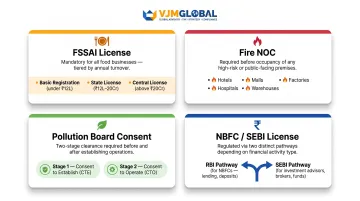
Singapore entrepreneurs entering sectors like food, manufacturing, or financial services should confirm which of these apply before incorporating — some require approvals before operations begin.
Common Challenges Singapore Entrepreneurs Face
Director Residency Requirement
At least one director must be ordinarily resident in India (present for 182+ days in the prior calendar year). Singapore nationals typically resolve this by appointing a trusted local nominee director.
Critical: Ensure proper governance controls are in place. Non-compliance with Section 149(3) can result in penalties of ₹50,000 to ₹5,00,000.
Document Apostille
Identity and address proofs from Singapore must be apostilled under the Hague Convention before submission to MCA and banks. Singapore acceded to the Apostille Convention in January 2021, simplifying this process.
VJM Global has supported foreign companies through this process for over 30 years — coordinating apostille requirements and simplifying document submission to reduce delays.
RBI/FEMA Reporting Deadlines
FC-GPR filing: Must be completed within 30 days of share allotment. Missing this deadline incurs compoundable penalties under FEMA — an obligation many first-time foreign investors overlook.
FLA return: Due annually by July 15 through the FLAIR portal.
Ongoing Compliance Obligations
Company incorporation does not complete the compliance picture. You must also:
- File annual returns with MCA (MGT-7, AOC-4)
- File income tax returns
- Comply with Transfer Pricing rules if transacting with Singapore parent (Sections 92-92F, Form 3CEB)
- Submit FLA returns annually with RBI
An India-based compliance partner handles these obligations proactively, so penalties don't catch you off guard after incorporation.
Choosing the Wrong Business Structure
Structure errors are among the most costly to undo. A common one: setting up a Liaison Office when you intend to generate revenue, or choosing a Branch Office when a Wholly Owned Subsidiary (WOS) would offer better tax efficiency and scalability.
Tax comparison:
- Private Limited Company: 22% corporate tax
- Branch Office: 40% tax on profits
Make the structure decision before any filing begins — preferably with a qualified India market entry advisor.
Frequently Asked Questions
What is a business license in India?
"Business license" in India refers collectively to a set of registrations and permits covering entity incorporation, tax registrations (GST, PAN, TAN), and sector-specific licenses, rather than a single document. The exact combination depends on your business type, location, and industry.
How to obtain a business license in India?
Determine FDI eligibility and entry route, register your company via MCA's SPICe+ form, complete post-incorporation registrations (GST, bank account, RBI filings), and apply for sector-specific licenses relevant to your business activity.
How much does a business license cost in India?
Total costs go beyond MCA government fees (a few thousand rupees) and typically include DSC (₹1,000-₹2,000), professional fees (₹15,000-₹50,000), state license fees, and GST registration. For foreign entrepreneurs, a realistic all-in range for Private Limited Company setup is ₹50,000-₹1,00,000.
Which industries require a business license in India?
All industries require foundational entity registration and tax IDs. Sector-specific licenses apply to regulated industries: food and beverages (FSSAI), import/export (IEC), manufacturing (Factory License, Pollution Consent), financial services (RBI/SEBI registration), healthcare (drug license), and hospitality (FSSAI, Fire NOC).
Why is a business license important in India?
Operating without required licenses exposes businesses to penalties, forced closure, and reputational damage. For Singapore entrepreneurs specifically, non-compliance with FEMA or RBI filing requirements can result in personal liability for directors and compoundable penalties on foreign investment amounts.
Can a Singapore entrepreneur register a business in India without visiting India?
Yes, incorporation can be completed remotely using apostilled documents and Digital Signature Certificates, though some banks require in-person KYC for account opening. You must also appoint a local resident director. VJM Global handles the full remote setup process, with a typical timeline of 13-15 business days from initial engagement to Certificate of Incorporation.