Introduction
Expanding into Dubai doesn't have to mean starting from scratch. A branch office lets Singapore companies extend their existing legal identity directly into one of the world's most accessible markets for foreign-owned businesses — no new entity required, and no loss of direct operational control.
This guide is written for Singapore-registered businesses — private limited companies, LLPs, and sole proprietors under ACRA — evaluating Dubai as their next expansion market.
The timing is notable. UAE FDI inflows reached USD 45.6 billion in 2024, a 48.7% increase over 2023. Combined with the Singapore-UAE Double Tax Agreement, full foreign ownership rights, and Dubai's role as a gateway to the Middle East, Africa, and South Asia, the branch office route offers a structurally sound entry point — before the market gets more crowded.
Key Takeaways
- A Dubai branch office extends your Singapore parent company's legal identity, keeping full ownership and operational control with the parent entity.
- Choose between mainland (regulated by DET) or free zone branches: each structure carries distinct market access rules and restrictions.
- Key documents include ACRA Business Profile, Certificate of Incorporation, M&A, and board resolution — all requiring apostille
- Setup typically takes 4–8 weeks from document submission to licence approval
- Ongoing obligations include trade licence renewal, corporate tax registration (9% above AED 375,000), and VAT compliance
- Work with experienced cross-border advisors to reduce document errors and approval delays
Why Singapore Businesses Are Expanding to Dubai
Singapore and Dubai share a strategic fit: both are neutral, business-friendly financial hubs with strong legal frameworks. Dubai gives Singapore businesses a physical foothold to serve the MENA, South Asian, and African markets that are harder to reach from Singapore alone.
The numbers validate this opportunity. Dubai attracted 1,117 greenfield FDI projects worth over AED 52 billion in 2024, a 33% increase from 2023. Bilateral merchandise trade between Singapore and the UAE reached S$24 billion in 2024. Singapore investments into the UAE also grew 13% year-on-year to S$4.9 billion in 2023, with approximately 200 Singapore firms now operating across the UAE.
That commercial momentum is backed by a tax structure that makes the move financially practical.
Singapore-UAE Double Tax Agreement (DTAA)
The Singapore-UAE DTAA — signed 1 December 1995, in force 30 August 1996 — provides financial efficiency for branch structures through three key provisions:
- Article 5(2)(b) classifies a branch as a permanent establishment
- Article 7 limits taxation to profits attributable to the branch
- Article 23 provides Singapore tax credits for UAE taxes paid
Together, these provisions eliminate or significantly reduce double taxation on profits a Singapore parent earns through its Dubai branch — an advantage that uncoordinated tax regimes simply cannot match.
Beyond the tax structure, three business drivers consistently push Singapore companies toward Dubai:
- Trade companies seeking Gulf procurement contracts — Dubai's port and logistics infrastructure supports distribution across MENA and South Asia
- Professional service firms (legal, tech, consulting) serving regional clients who value on-ground presence
- Manufacturers wanting distribution hubs — Dubai International Airport and Jebel Ali Port provide unmatched regional connectivity
Branch Office vs. Subsidiary: What Singapore Companies Need to Know
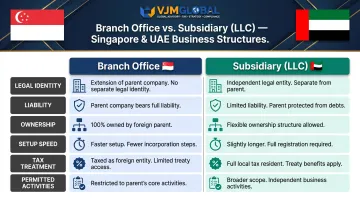
A branch office is not a separate legal entity. It operates under the Singapore parent company's name, is subject to the same business activities as the parent, and the parent bears full liability for the branch's obligations.
A subsidiary is a new UAE-incorporated company owned by the parent. It carries independent legal identity and limited liability.
| Attribute | Branch Office | Subsidiary (LLC) |
|---|---|---|
| Legal identity | Extension of parent | Separate legal entity |
| Liability | Parent bears full liability | Subsidiary shields parent |
| Ownership | 100% parent-controlled | Requires own share capital |
| Setup speed | Faster (4–8 weeks) | Slower (6–12 weeks) |
| Tax treatment | PE under DTAA; 9% UAE CT | Independent UAE tax resident |
| Permitted activities | Must mirror parent exactly | Can pursue any licensed activity |
When a Branch Is the Right Choice
A branch office suits Singapore businesses seeking:
- Faster market entry without incorporation delays
- Brand continuity using the parent company's trade name
- No minimum share capital requirement
- No need for new corporate governance structures
When a Subsidiary Is Preferable
Choose a subsidiary if the Singapore company wants to:
- Pursue activities beyond the parent's licensed scope
- Bring in UAE-based partners or investors
- Create liability separation for high-risk operations
Critical Constraint for Branch Offices
Under UAE Commercial Companies Law, a branch office's permitted activities must mirror those of the Singapore parent company exactly. If your parent company is licensed for IT consulting, the branch cannot engage in trading or manufacturing without first updating the Singapore licence. Submitting a branch application with mismatched activities will result in rejection — and resolving it requires amending the Singapore licence before reapplying.
Step-by-Step: How to Register a Dubai Branch Office from Singapore
Registration has two parallel tracks: mainland (regulated by the Department of Economic Development, DED) or free zone (regulated by the relevant free zone authority). Each has distinct authorities, document flows, and timelines.
Step 1: Choose Your Jurisdiction — Mainland or Free Zone
| Factor | Mainland Branch | Free Zone Branch |
|---|---|---|
| Market access | Trade freely with UAE local companies and government | Restricted to free zone or international; cannot trade mainland directly |
| Corporate tax | 9% above AED 375,000 | 9% above AED 375,000 (some zones offer qualifying income benefits) |
| Office space | Physical office required; Ejari registration | Virtual offices may be permitted (varies by zone) |
| National Service Agent | Not required (abolished 2024) | Not applicable |
Key Operational Difference
A mainland branch can trade directly with local UAE companies and government entities. A free zone branch is restricted to activities within its registered free zone or internationally — not directly in the UAE mainland without a distributor.
Step 2: Prepare and Authenticate Your Singapore Company Documents
Singapore companies must gather foundational incorporation documents and have them authenticated for UAE submission.
Authentication Process
Since Singapore is a signatory to the Hague Apostille Convention (effective 16 September 2021), Singapore documents require apostille certification rather than embassy legalisation. The Singapore Academy of Law (SAL) is Singapore's designated Competent Authority.
Apostille fees: S$10.70 per document for legalisation; S$87.20 for authentication of notarised private documents.
Arabic Translation Requirement
For mainland registrations, all documents must be translated into Arabic by a certified legal translator. Free zones (including DMCC and DIFC) generally accept English-language documents, though specific zones may vary.
Step 3: Appoint a Local Service Agent (No Longer Required)
Previously, mainland branch registration required a UAE National Service Agent (NSA). This requirement was abolished by Ministerial Resolution No. 138 of 2024. Singapore companies can now register mainland branches with full operational independence.
Step 4: Obtain Initial Approvals and Submit Application
Mainland Branch Approval Sequence:
- Initial approval from the Ministry of Economy and Tourism (MoET)
- Submission to Dubai Department of Economy and Tourism (DET)
- Approval from UAE Federal Foreign Companies Committee
- Ministerial licence issuance
Free Zone Process:
The free zone authority (e.g., DMCC, DIFC, JAFZA) handles the entire process. Steps typically include:
- Submit application and documents to the relevant free zone authority
- Receive initial approval and name reservation
- Execute branch registration agreement
- Collect trade licence from the free zone
Most free zones offer online application portals, making this track faster than the mainland route.
Sector-Specific Approvals
Finance, healthcare, education, and media sectors require additional approvals from regulators like the Central Bank UAE, Department of Health, or Knowledge and Human Development Authority.
Step 5: Receive Trade Licence and Complete Commercial Registration
Once approvals are secured, the branch office trade licence is issued under the parent Singapore company's name. The branch must then register with the Chamber of Commerce and Industry and, for mainland branches, the Ministry of Economy's Companies Register.
Critical Timeline Rule: Complete MoET registration within one month of receiving the local licence. Missing this deadline triggers a penalty of AED 100,000 — one of the most common compliance missteps for new branches.
Step 6: Open a Corporate Bank Account and Process Employee Visas
Corporate Bank Account
Required documents include:
- Trade licence
- MoET approval
- Parent company documents
- Passport copies of directors and signatories
UAE banks apply strict AML checks. The process takes 2–6 weeks.
Employee Visas
Residency visas for staff are tied to office size (approximately one visa per 80–100 sq ft). Work permits must go through the Ministry of Human Resources and Emiratisation (MOHRE), including medical testing, Emirates ID, and visa stamping.
Residency visas for staff are tied to office size (approximately one visa per 80–100 sq ft). Work permits process through the Ministry of Human Resources and Emiratisation (MOHRE) and cover medical testing, Emirates ID, and visa stamping.
End-to-end, most Singapore companies complete the full registration process — from document authentication to first visa issuance — within 6–12 weeks, depending on jurisdiction and sector approvals required.
Documents Singapore Companies Need for Dubai Branch Registration
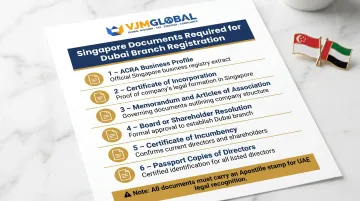
Core Documents from Singapore Parent Company
- ACRA Business Profile / BizFile+ extract — serves as Singapore's Certificate of Incumbency
- Certificate of Incorporation issued by ACRA
- Memorandum & Articles of Association
- Board Resolution or Shareholder Resolution authorising the branch establishment
- Certificate of Incumbency or equivalent confirming current directors and shareholders
- Passport copies of all directors and authorised signatories
Singapore-Specific Authentication
Singapore is a party to the Hague Apostille Convention. Singapore-issued public documents can be apostilled through SAL rather than requiring full embassy legalisation — typically faster and cheaper. The e-Apostille system for ACRA-issued documents was announced in September 2024, further streamlining the process.
Arabic Translation Requirement
All documents submitted to Dubai mainland authorities must be translated into Arabic by a UAE-certified legal translator. This requirement applies without exception. Free zone authorities may accept English originals with Arabic translations depending on the specific free zone.
Corporate Ownership Structure
If the Singapore parent company has corporate shareholders (i.e., is owned by another company rather than individuals), Dubai authorities typically require additional corporate structure documents tracing ownership up the chain. This is a frequently overlooked requirement that can stall applications.
Best Practice: Map your full corporate ownership structure before starting the process.
When to Engage a Cross-Border Specialist
Businesses with complex Singapore ownership structures or those in regulated industries benefit from engaging a cross-border specialist early — before document preparation begins — to pre-audit the document trail and avoid costly re-submissions.
VJM Global brings 30+ years of cross-border business setup and compliance experience, helping companies identify documentation gaps before they become submission delays.
Costs, Timeline, and Ongoing Compliance Obligations
Cost Framework
Mainland Branch (MoET Fees):
| Fee Component | Amount (AED) | SGD Equivalent* |
|---|---|---|
| MoET initial approval | 3,500 | ~1,225 |
| MoET registration | 7,500 | ~2,625 |
| Late registration penalty | 100,000 | ~35,000 |
| Total (on time) | 11,000 | ~3,850 |
*Based on 1 AED = 0.35 SGD
Free Zone Branch (DMCC Example):
| Fee Component | Amount (AED) | SGD Equivalent* |
|---|---|---|
| Application fee | 1,035 | ~360 |
| Registration fee | 9,020 | ~3,157 |
| Annual licence fee | 10,000–50,000 | ~3,500–17,500 |
| First-year estimate | 20,000–60,000 | ~7,000–21,000 |
Note: These are government fees only. Total first-year costs include office lease, visa fees, PRO services, and professional advisory fees.
No Minimum Share Capital
There is no minimum share capital requirement for a foreign branch office in Dubai. The previously required AED 50,000 bank guarantee was abolished by Ministerial Resolution No. 138 of 2024.
Timeline
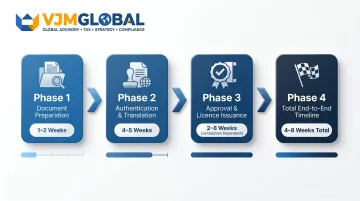
| Phase | Duration | Notes |
|---|---|---|
| Document preparation | 1–2 weeks | Gather ACRA documents, board resolutions |
| Authentication and translation | 4–5 weeks | Apostille + Arabic translation |
| Approval and licence issuance | 2–4 weeks (free zones); 4–8 weeks (mainland) | Varies by sector and completeness |
| Total end-to-end | 4–8 weeks | Assuming pre-prepared documents |
Once your branch is operational, the regulatory clock starts immediately. Here are the ongoing obligations to plan for from Day 1.
Ongoing Compliance Obligations
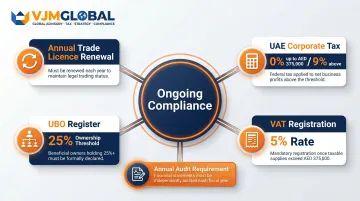
Annual Trade Licence Renewal
Must be renewed through DET or free zone authority annually.
UAE Corporate Tax
Under Federal Decree-Law No. 47 of 2022:
- 0% on taxable income up to AED 375,000
- 9% on taxable income above AED 375,000
- Effective for financial years starting on or after 1 June 2023
- Branch offices are taxable as permanent establishments
VAT Registration
- Rate: 5%
- Mandatory registration threshold: AED 375,000 annual taxable turnover
- Foreign businesses must register regardless of threshold if making taxable supplies in the UAE
Annual Audit Requirements
- Branch offices must file audited branch financial statements with MoET annually (for MoET purposes, regardless of revenue)
- Ministerial Decision No. 84 of 2025 requires audited financials for taxable persons with revenue exceeding AED 50 million
Beneficial Ownership (UBO) Register
Under Cabinet Decision No. 58 of 2020:
- Any natural person owning or controlling ≥25% must be disclosed
- Changes must be updated within 15 days
- Registers must be maintained for five years following de-registration
Planning Note: Annual recurring costs — licence renewal, audit, visa renewals, and tax filings — can match or exceed your initial setup spend by Year 2. Singapore businesses that plan only for setup typically face cash flow surprises once operations begin. Build recurring compliance costs into your annual UAE budget from the outset.
Frequently Asked Questions
How to start a Branch office in Dubai?
Starting a Dubai branch office requires choosing between a mainland or free zone jurisdiction, preparing and apostilling Singapore incorporation documents, and obtaining trade licence approval from the relevant Dubai authority. The process typically takes 4–8 weeks end-to-end.
How much does it cost to set up an office in Dubai?
Costs vary by jurisdiction. Mainland branch setup costs approximately AED 11,000 (SGD 3,850) in government fees alone. Free zone setup ranges from AED 20,000–60,000 (SGD 7,000–21,000) for the first year, excluding office lease and visa fees. There is no minimum share capital requirement.
Do Singapore companies need to apostille their documents for Dubai branch registration?
Yes. Singapore documents require apostille certification under the Hague Convention (Singapore is a signatory), followed by Arabic translation by a UAE-certified legal translator. Both steps must be completed before submitting documents to Dubai authorities.
What is the difference between a Dubai mainland branch and a free zone branch for Singapore companies?
A mainland branch allows direct trading with UAE local companies and government clients. A free zone branch is restricted to the free zone or international trade and cannot trade directly in the mainland market. Free zones are generally faster to set up but limit local market access.
How long does it take to set up a Dubai branch office from Singapore?
The full process — from document preparation through trade licence issuance — typically takes 4–8 weeks for mainland branches and 3–5 weeks for free zone branches. The longest delays occur during document authentication and translation.
Does the Singapore-UAE Double Tax Agreement benefit Singapore companies with a Dubai branch?
Yes. The Singapore-UAE DTAA reduces or eliminates double taxation on branch income — Article 7 limits UAE tax to profits attributable to the branch, while Article 23 allows Singapore tax credits for UAE taxes paid. Application varies by business structure and income type, so qualified tax advice is recommended.