But getting there isn't just about picking a name and filing paperwork. Many international founders struggle with unfamiliar entity types, registered agent requirements, EIN applications from overseas, and Oregon's layered tax system, which includes the Corporate Activity Tax alongside standard income tax.
This guide walks through every step, from naming your business to staying compliant year after year.
Key Takeaways
- Oregon has no state sales tax, but the Corporate Activity Tax (CAT) and income tax up to 9.9% still apply
- LLCs and corporations file Articles with the Secretary of State for $100 and must appoint a registered agent
- Secure an EIN, business bank account, and payroll setup before you hire your first employee
- Founders without a US presence need a registered agent plus help with entity formation and tax registration—support VJM Global provides for cross-border setups
Step 1: Choose Your Business Idea and Structure
Before filing anything, validate your idea. Oregon's Small Business Development Center (SBDC) network offers free market research assistance and advice if you're unfamiliar with local demand or competition.
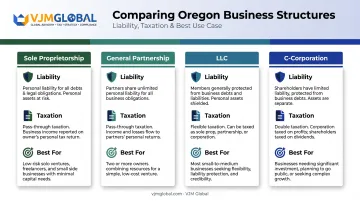
Once you've settled on an idea, pick a structure:
| Structure | Liability | Taxation | Best for |
|---|---|---|---|
| Sole proprietorship | Owner personally liable | Reported on Schedule C | Solo, low-risk ventures |
| General partnership | Partners personally liable | Pass-through (Form 1065) | Two or more owners, informal setups |
| LLC | Limited liability | Pass-through by default | Most small businesses, foreign founders |
| C-Corporation | Limited liability | Separate entity (Form 1120) | Raising capital, issuing shares |
Foreign entrepreneurs typically choose an LLC or C-Corp. Both offer liability protection and make it far easier to open a US bank account or attract investors. Sole proprietorships and general partnerships don't require Secretary of State registration unless you're using an assumed name, but they leave you personally exposed.
Think ahead: if you plan to raise venture capital or hire across multiple countries, a C-Corp structure often works better long-term than an LLC.
Step 2: Name and Register Your Oregon Business
Checking Name Availability
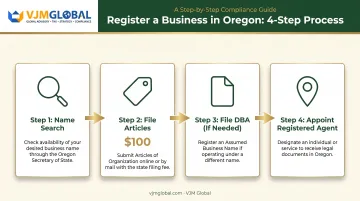
Search the Oregon Secretary of State's business registry to confirm your name isn't already taken. Check federal trademark records separately to avoid branding conflicts later.
Naming rules are straightforward:
- LLCs must include "Limited Liability Company," "L.L.C.," or "LLC"
- Corporations typically include a designator such as "Corporation," "Incorporated," or an abbreviation
- Your name must be distinguishable from other active names on the registry
Filing Your Formation Documents
File Articles of Organization (LLC) or Articles of Incorporation (Corporation) online or by mail. The fee is $100 either way.
If you plan to operate under a different name than your legal entity name, file an Assumed Business Name (DBA) for $50, renewable every two years.
Appointing a Registered Agent
Every LLC and corporation needs a registered agent with a physical Oregon street address — no PO boxes. You can serve as your own agent if you have an Oregon address, but most foreign founders use a third-party service.
Pricing varies widely, from $99 to nearly $600 per year, averaging around $200 annually according to Forbes Advisor.
Step 3: Handle Federal and State Tax Registrations
Getting Your EIN
You'll need a federal Employer Identification Number (EIN) from the IRS before opening a bank account, hiring staff, or filing taxes. Applying is free.
Here's the catch for international founders: the IRS's online EIN application requires a US-based responsible party with an SSN or ITIN.
If you don't have a US legal residence or principal place of business, apply via Form SS-4 by phone, fax, or mail instead. International applicants can call 267-941-1099; mailed applications take roughly four weeks.
Understanding Oregon's Tax Structure
Oregon skips sales tax, but doesn't skip everything else:
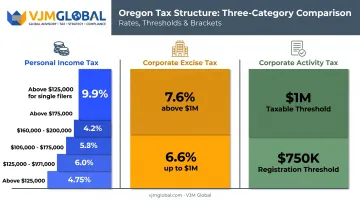
- Personal income tax: rates of 4.75%, 6.75%, 8.75%, and 9.9%, with the top bracket starting above $125,000 (single) or $250,000 (joint filers)
- Corporate excise tax: 6.6% on income up to $1 million, then $66,000 plus 7.6% on anything above that
- Corporate Activity Tax (CAT): register within 30 days of hitting $750,000 in Oregon commercial activity; tax applies above $1 million at $250 plus 0.57% of the excess
Registering for Payroll Taxes
If you're hiring, register with the Oregon Department of Revenue and obtain a Business Identification Number (BIN) through Revenue Online before your first paycheck. You'll also withhold the Statewide Transit Tax (0.1% of wages) and pay the Workers' Benefit Fund assessment (1.8 cents per hour worked in 2026).
Navigating IRS rules and Oregon's Department of Revenue remotely is one of the biggest friction points for foreign-owned entities.
Firms that combine Oregon tax know-how with cross-border setup experience, such as VJM Global, can handle EIN applications, state tax registrations, and the filings that follow.
Step 4: Set Up Business Banking, Insurance, and Payroll
Business Banking
A separate business bank account isn't always legally required, but it's critical anyway. It protects your liability shield and makes tax season far less painful when your business and personal finances aren't tangled together.
Insurance Requirements
- Workers' compensation: mandatory for most employers with even one employee
- Unemployment insurance: register through Revenue Online or the Combined Employer's Registration form
- General liability: not mandatory, but a smart safeguard for most businesses
Oregon's Regional Minimum Wage System
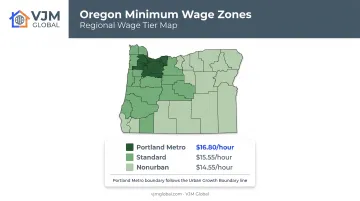
Oregon splits minimum wage into three tiers, effective July 2026 through June 2027:
- Portland Metro: $16.80/hour
- Standard: $15.55/hour
- Nonurban: $14.55/hour
Employers must track where employees actually work, not just where the company is registered. Portland Metro's boundary follows the urban growth boundary rather than city lines.
Payroll Basics
Before running payroll, you'll need your EIN, a BIN, and completed W-4 and I-9 forms for each employee. From there, most businesses use a payroll provider for ongoing withholding and filings. VJM Global handles payroll compliance across multiple US states if you want that work off your plate.
Step 5: Stay Compliant with Ongoing Filings
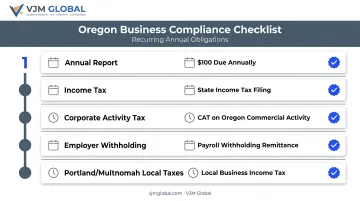
Oregon requires an Annual Report ($100 for LLCs and corporations) due on your formation anniversary. The Secretary of State typically sends a reminder about 45 days before the due date. Miss it, and you risk administrative dissolution.
Recurring obligations don't stop there:
- Income tax — corporate excise or personal income tax, depending on structure
- Corporate Activity Tax (CAT) — required if commercial activity exceeds $1 million
- Employer withholding — transit tax, unemployment insurance, Workers' Benefit Fund
- Portland Business License Tax — 2.6% of net income ($75,000 exemption threshold)
- Multnomah County Business Income Tax — 2% of net income ($100,000 exemption threshold)
Tracking state, city, and county filings at once is hard to do from overseas. VJM Global handles entity formation with ongoing accounting, payroll, and tax compliance across 100+ countries, so internationally based owners can stay in good standing without a physical presence in Oregon.
Business Licenses and Permits You May Need
Oregon has no general statewide business license. Most commercial activities still need industry-specific permits, which you can search in the Business Xpress License Directory.
Common requirements include:
- Food establishment licenses for restaurants, cafes, and similar venues
- Professional licenses for cosmetology, contracting, and healthcare
- City and county permits that vary by location
Running a home-based food business? Oregon's cottage food law lets you sell non-perishable items such as baked goods and confectionery up to $52,700 annually (as of 2026). Key rules:
- Complete food-handler training
- No formal state registration required
- No sales to restaurants, schools, or hospitals
Frequently Asked Questions
How much does it cost to start a business in Oregon?
Filing Articles of Organization or Incorporation costs $100. A DBA filing adds $50. Add-ons like registered agent services (roughly $100-$200/year) and the $100 annual report bring your first-year total closer to $250-$400.
How do I register my business with the State of Oregon?
File Articles of Organization (LLC) or Articles of Incorporation (Corporation) through the Oregon Business Registry's online portal. Most online filings process within 1-3 business days.
What is required to start an LLC in Oregon?
You need a unique, distinguishable business name, a registered agent with a physical Oregon address, completed Articles of Organization, and the $100 filing fee.
How long does it take to get my LLC approved in Oregon?
Online filings typically process in 1-3 business days. Mail filings take longer — add 7-10 days for delivery on top of processing time.
How can I check if a business name is available in Oregon?
Use the Oregon Secretary of State's business name search tool on the Business Registry website. It checks your proposed name against all active entities in the state.
Can I sell food from my home in Oregon?
Yes, under Oregon's cottage food law, provided you sell qualifying non-perishable items and stay under the $52,700 annual sales cap. Some sales venues require county health department awareness, so check local rules before you start.