Why the UK specifically? It's a large English-speaking market where a limited company still carries real weight with customers and marketplaces. Many US founders exploring this path aren't full-time entrepreneurs — they're side-hustlers, designers with a UK following, or established US sellers testing international waters.
This guide walks through the practical steps: validating a UK niche, choosing a business structure, handling tax and banking as a non-resident, and setting up a store that actually works for British buyers.
Key Takeaways
- Print-on-demand requires no inventory — a supplier handles printing, packing, and shipping per order
- US residents can own 100% of a UK limited company and act as director without relocating
- Non-resident business banking is the most common bottleneck; EMI/fintech accounts often fill the gap
- Company registration, UK tax setup, and store launch can realistically happen within a few weeks
- Full compliance stability (banking, tax filings, VAT tracking) usually takes a few months to settle
What Is a Print-on-Demand Business?
Print-on-demand (POD) is a model where nothing gets manufactured until a customer actually orders it. A third-party supplier prints, packages, and ships the item — a mug, a hoodie, a canvas print — directly to the buyer. There's no warehouse, no upfront stock, and no leftover inventory sitting unsold.
The founder's job isn't production. It's:
- Designing the products that go on the storefront
- Running the store (listings, pricing, descriptions)
- Marketing to the right audience
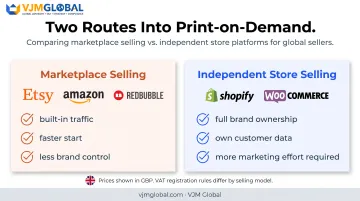
There are two common routes into this model:
- Marketplace selling: Upload designs to Etsy, Amazon, or Redbubble and lean on existing buyer traffic.
- Independent store selling: Build on Shopify or WooCommerce so you own the brand and the customer relationship.
Each route carries different implications once you sell into the UK. Three areas matter more than most beginners expect:
- GBP pricing on storefronts and checkouts
- VAT visibility on invoices and product pages
- Order routing to UK versus US fulfillment centers
Why US Entrepreneurs Are Starting Print-on-Demand Businesses in the UK
A UK-facing POD business makes sense under the right conditions. It's not an automatic win just because the market is large. Timing and execution matter as much as opportunity.
Market signals support the case. The UK personalized-gifts market alone is projected to grow by USD 1.13 billion between 2024 and 2028, at a compound annual growth rate near 11%. That's a market forecast, not a guarantee of individual seller profit, but it points to sustained appetite for custom goods.
Social commerce is adding fuel. TikTok reported that UK TikTok Shop shoppers grew 131% year-over-year as of March 2025, with UK sellers up 180% over the same period. Etsy's UK marketplace, meanwhile, hosts over 800,000 active sellers, evidence of a mature independent-seller ecosystem, though not evidence that UK niches face less competition than US ones.
A few reasons founders still find the UK worth the extra setup work:
- UK buyers show real demand for niche, independent brands rather than mass-market goods
- A UK limited company adds credibility with local customers, marketplaces, and potential wholesale partners
- Registering in the UK creates a foothold for expanding into wider EU markets later, without re-incorporating
- Remote operation stays workable with cloud tools, POD suppliers, and UK compliance support—no relocation required
What to Know Before You Start: Key US-to-UK Considerations
Before you launch, get clear on the legal, tax, and banking mechanics of running a UK company from the US. Realistic expectations here save time and cost later.
Ownership and Company Basics
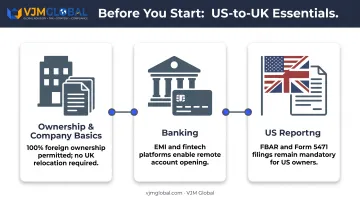
US citizens and residents can own 100% of a UK limited company and serve as director without a UK visa or relocation. Forming the company doesn't automatically make you UK tax resident, but the company itself still owes UK Corporation Tax on its profits, separate from your personal US tax situation.
Every UK company also needs a registered office address inside the UK, even if the director never sets foot there. As of November 2025, Companies House now requires identity verification for all directors, including overseas founders, either through GOV.UK One Login or an authorized service provider.
Banking Is the Real Bottleneck
Opening a UK business bank account remotely tends to be the biggest practical snag. Many high-street banks still expect an in-person branch visit, which rules them out for most US founders. The common workaround:
- Apply for a UK-regulated EMI or fintech business account instead
- Expect eligibility checks and processing that can run several weeks
- Confirm the provider's regulatory status before relying on it for GBP payouts
Don't Forget the US Side
Owning a UK company can trigger US reporting on top of UK filings:
- FBAR: required if foreign account balances you control exceed $10,000 at any point in the year
- Form 5471: applies once US ownership reaches 10% or more of the company
Engaging a cross-border advisor early avoids the far more expensive fix of untangling missed filings after the fact.
How to Start a Print-on-Demand Business in the UK from the USA – Step by Step
Starting a UK print-on-demand business from the US means pairing normal POD setup with UK company, tax, and compliance work. Two mistakes show up constantly: assuming US best-sellers will translate directly to UK buyers, and putting off company or tax registration until after the store is already live.
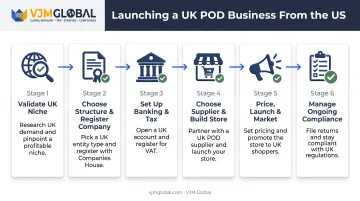
Step 1: Validate Your Niche for UK Buyers
Skip the temptation to copy your US catalogue wholesale. UK buyers respond to different themes, sizing conventions, and price points.
- Research UK-specific trends through Etsy UK listings, Google Trends UK, and UK-focused social communities
- Test a handful of designs with GBP pricing before building out a full product range
- Watch for sizing differences (UK apparel sizing isn't identical to US) and seasonal references (Bonfire Night sells; the Fourth of July doesn't)
Step 2: Choose Your UK Business Structure and Register Your Company
Most US founders weigh two options: a UK limited company or registering as an overseas sole trader with HMRC. A limited company offers stronger liability protection and generally reads as more credible to UK customers and marketplaces.
Whichever route you pick, you'll need:
- A UK registered office or service address
- Completed identity verification with Companies House as an overseas director
This is where a formation specialist earns its keep. A cross-border firm such as VJM Global handles UK company registration, registered office setup, and statutory filings end-to-end, so the entity is structured correctly from day one rather than patched up later.
Step 3: Set Up UK Banking, Tax Registrations, and Cross-Border Compliance
Once the company exists, register for Corporation Tax with HMRC shortly after trading starts.
Also track the VAT registration threshold of £90,000 in taxable turnover. Non-established taxable persons can face registration obligations regardless of turnover, so this needs case-specific review.
On banking, most non-resident founders end up with a UK-regulated EMI account rather than a traditional bank, because the account-opening process is faster and doesn't require a branch visit.
Firms that combine entity formation, tax registration, and payroll support (including VJM Global) help close the gap between US and UK filing obligations before it becomes a compliance problem as the business scales.
Step 4: Choose Your POD Supplier and Build Your Online Store
Supplier location changes everything about delivery speed and cost. Favour partners with UK or EU production:
- Printful: UK fulfilment from Wolverhampton, plus facilities in Riga and Barcelona
- Gelato: 17 UK production hubs
- Printify: Eligible listings that can fulfil locally in the UK and EU
US-only fulfilment adds shipping delays and customs friction on every UK order.
When setting up the storefront itself:
- Price listings in GBP, not USD
- Write a UK-compliant returns policy
- Handle customer data in line with UK GDPR requirements
Choosing a supplier with only US-based fulfilment is the single most common misstep here. It turns a two-day UK delivery into a two-week one.
Step 5: Price, Launch, and Market to UK Customers
Build pricing around UK-facing margins: platform fees, currency conversion, shipping, and inclusive pricing norms. UK shoppers expect the price they see at checkout to stay close to what they actually pay.
For marketing, prioritize UK-relevant channels:
- TikTok UK and Instagram, ideally with UK-based micro-influencers
- Localised spelling (colour, not color) and UK sizing references
- Seasonal moments that actually matter in the UK calendar
Track conversion by channel and product line, then reinvest in whatever's actually working with UK audiences rather than assuming US-tested tactics will repeat.
Step 6: Manage Ongoing Cross-Border Compliance as You Scale
Once sales pick up, the paperwork doesn't stop. Annual obligations include:
- A confirmation statement filed with Companies House every 12 months
- Annual accounts, generally due nine months after your financial year ends
- Corporation Tax returns filed on form CT600
As UK sales grow, reassess your VAT position and any payroll needs. Keep US and UK filing deadlines coordinated. The US-UK tax treaty offers relief to avoid double taxation on the same profits, but only if filings are aligned in the first place.
Common Mistakes US Founders Make When Launching in the UK
Three mistakes show up repeatedly when US founders set up in the UK:
- Treating company ownership as personal tax residence. HMRC's Statutory Residence Test assesses you separately from the company. Owning or directing a UK Ltd from abroad is not a residence trigger on its own.
- Underestimating remote bank account timelines. Non-resident applications often take longer than expected, and many traditional banks still require an in-person visit.
- Letting US and UK deadlines drift apart. Miss a Companies House or HMRC filing while also falling behind on FBAR or Form 5471, and you can face penalties on both sides of the Atlantic.
Frequently Asked Questions
How much money do I need to start a print-on-demand business?
Many US founders launch a UK POD setup for roughly £500–£2,000. That typically covers Companies House formation, a registered office address, sample orders, and basic store tools—with no inventory bought upfront.
Is print-on-demand still profitable in 2026?
Yes, it remains a viable low-overhead model. Profitability depends more on niche selection and marketing consistency than the model itself, especially once you factor in supplier, platform, and currency conversion costs.
What are the most profitable print-on-demand sites?
Etsy, Shopify, and Amazon are the usual strong performers for reaching UK buyers. Niche fit, pricing, and consistent marketing matter more than which of these platforms you pick.
Can a US citizen fully own and run a UK limited company remotely?
Yes. A US resident can own 100% of a UK Ltd and act as its sole director without relocating, provided the registered office and director identity verification requirements are met.
Do I need to pay UK tax if I live in the US but sell through a UK company?
The UK company pays Corporation Tax on its profits regardless of where the founder lives. Your personal US tax position is assessed separately, often with treaty relief available to prevent double taxation.
Do I need a UK business bank account to sell to UK customers?
It isn't strictly mandatory, but most founders open a UK-regulated account—often through an Electronic Money Institution (EMI) or fintech—to simplify GBP payments, VAT handling, and supplier payouts.