A non-resident founder running a US LLC from London still needs a visa to ever set foot in the business they own. A green card holder has full legal parity with a US citizen for work purposes, and full US tax residency to go with it.
That second half of the trade-off gets skipped in most guides. UK outward investment into the US hit $742.7 billion by the end of 2024, up $52.9 billion during the year, according to the US Bureau of Economic Analysis. More UK entrepreneurs are choosing to build and run US businesses on-site rather than rely on nonimmigrant visas that need renewing indefinitely.
This guide covers what a green card actually changes for business ownership, the realistic pathways to get one, and the tax obligations that follow.
Key Takeaways
- Green card holders can own, operate, and work in a US business with no visa restrictions
- EB-5, EB-1A, and EB-2 NIW can lead directly to permanent residency via business or investment
- Worldwide income becomes taxable once you hold the card, not just US-source earnings
- S-Corporation ownership becomes available, unlike for nonresident alien founders
- Continuous US residence intent must be preserved and may clash with UK-based operations
What Does Holding a Green Card Actually Change for Starting a US Business?
A green card removes the work-authorization barrier entirely. There's no sponsoring employer to satisfy, no investment-maintenance clause tied to your immigration status, no clock ticking on a visa category. You found the company, manage it, and draw income from it exactly as a citizen would.
That's a sharp contrast to nonimmigrant routes like the E-2. An E-2 visa holder must keep maintaining investment thresholds, ownership percentages, and "non-marginal enterprise" status just to stay in valid status. A green card carries no equivalent business-performance condition.
Green card holders can also:
- Be an employee of their own company and draw a W-2 salary
- Qualify for the same Social Security and benefits treatment as citizens
- Hold any legal job, with rare exceptions for security-sensitive federal roles
Rights and Responsibilities That Come With Permanent Residency
That freedom comes with obligations non-residents don't carry. USCIS lists filing income tax returns and reporting all income among a permanent resident's core responsibilities. Reporting covers worldwide income, not US-only.
Other requirements matter for founders who travel:
- Eligible males aged 18–25 must register for Selective Service (registration only, not enlistment)
- An absence of six months to a year creates a rebuttable presumption that continuous residence was broken
- An absence of a year or more generally breaks continuous residence automatically
For a founder splitting time between a UK office and a US operation, that residence clock matters as much as any tax deadline.
How UK Entrepreneurs Can Actually Obtain a Green Card to Start a Business
There's no dedicated "startup green card." UK entrepreneurs reach permanent residency through a handful of employment or investment-based categories, each with different capital, skill, or timeline demands.
EB-5 Immigrant Investor Program
This is the most direct buy-your-way-in route, and it's the one clear exception to the "no ongoing performance condition" rule.
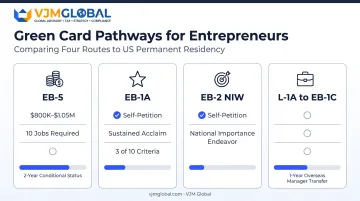
- Standard investment: $1,050,000, or $800,000 in a Targeted Employment Area (rural or high-unemployment region) or infrastructure project, per USCIS
- Requires creating at least 10 full-time US jobs
- Residency starts conditional for two years, with the I-829 filing to remove conditions
It's capital-intensive but procedurally predictable. The main risks are capital exposure and a multi-year timeline before conditions lift.
EB-1A and EB-2 NIW for Entrepreneurs of Exceptional Ability
Founders with a strong track record, meaning media coverage, awards, or measurable business impact, may qualify without an employer sponsor or a large investment.
- EB-1A requires sustained national or international acclaim, evidenced by one major achievement or at least 3 of 10 listed criteria
- EB-2 NIW requires the endeavor to have substantial merit and national importance, with the applicant well-positioned to advance it
- Both allow self-petitioning — no employer or labor certification needed
The evidentiary bar is demanding. This route rewards founders who already have a documented public track record, not early-stage entrepreneurs with an idea and a pitch deck.
Other Routes Worth Knowing
UK founders already running a UK company have an additional stepping stone:
- L-1A to EB-1C: Managers or executives with one year at a qualifying overseas parent, branch, or affiliate can transfer, then pursue EB-1C after the US entity has operated for a year
- Family and marriage-based green cards: A common non-business path; company formation usually follows residency rather than driving the petition
How Hard Is It for a UK Citizen to Get a US Green Card?
Difficulty depends entirely on the category chosen, not on nationality. UK applicants currently have a favourable position on paper. EB-1, EB-2, and every EB-5 line were listed as current for the UK in the August 2026 Visa Bulletin, meaning no backlog wait for chargeability purposes.
Processing time is a separate question from backlog status:
| Petition Type | Median Processing Time (USCIS FY2026) |
|---|---|
| I-140 (EB-1A/EB-2 NIW), premium | 1.1 months |
| I-140, standard | 3.7 months |
| I-526 standalone (EB-5) | 25.0 months |
| I-526E, regional center (EB-5) | 10.5 months |
| I-829 (EB-5 condition removal) | 10.6 months |
Investment routes take longer at the petition stage but move through a known process. Merit-based categories process faster once filed, but getting a strong enough petition together in the first place is the real bottleneck.
Choosing the Right Business Structure as a Green Card Holder
Once the immigration side is settled, structure choice opens up. IRC Section 1361(b)(1)(C) requires S-Corporation shareholders to be US citizens or resident aliens. A green card holder meets the IRS's green card test for resident-alien status.
Nonresident founders are legally barred from this election; you're not. That gives you three real options:
- LLC — simplest to run, flexible pass-through taxation, fewer formalities
- Delaware C-Corporation — preferred by outside investors and venture funds, subject to corporate-level tax
- S-Corporation election — pass-through taxation, with possible self-employment tax savings on distributions above a reasonable salary
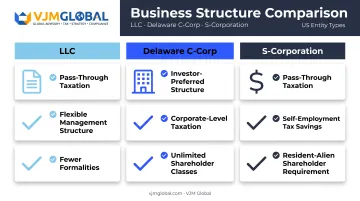
When does S-Corp make sense? Usually when you're the sole or primary owner drawing income directly from the business, and payroll tax efficiency matters more than raising outside capital. If you're planning a funding round, a Delaware C-Corp remains the more familiar structure for investors, regardless of your immigration status.
State registration mechanics don't change based on who owns the company. Whether you incorporate in Delaware, Wyoming, or the state where you physically operate is a business decision, not an immigration one. Filing requirements apply the same way to citizens, resident aliens, and non-residents alike.
Step-by-Step: Registering Your US Business as a Green Card Holder
The mechanical process is identical no matter your immigration status:
- Choose a state of formation: Delaware, Wyoming, or the state where you'll physically operate are the usual candidates
- File Articles of Organization or Incorporation with the relevant Secretary of State
- Appoint a registered agent in that state
- Draft an Operating Agreement or corporate bylaws
- Apply for an EIN with the IRS
- Register for beneficial-ownership reporting with FinCEN
Where a green card helps is in the practical logistics:
- An SSN simplifies EIN applications and bank account opening versus the ITIN-and-fax process non-resident founders often face
- You can open a business account in person at most mainstream US banks with US residency proof and an SSN
- Non-residents are often limited to fintech providers, since traditional banks want an in-person visit and an SSN they don't have
Multi-state compliance, registered-agent choice, and entity setup while you're still partly based in the UK are where this gets harder in practice. Firms like VJM Global handle that work regularly: entity formation, registered agent appointment, EIN registration, and ongoing annual and beneficial-ownership filings for clients forming US companies from abroad.
Tax and Compliance Obligations for Green Card Holder Entrepreneurs
Here's the core shift: once you hold the card, you're a US tax resident, taxed on worldwide income. That includes UK-sourced income, rental property back home, and dividends, not just what your US business earns.
Several reporting obligations follow that non-resident founders simply don't face:
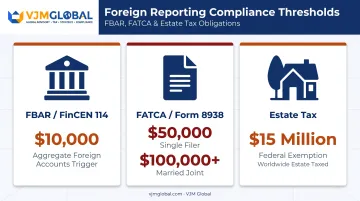
- FBAR (FinCEN 114) — required when aggregate foreign financial accounts exceed $10,000 at any point in the year
- FATCA (Form 8938) — thresholds start at $50,000 year-end for a US resident filing single, rising to $100,000+ for married joint filers
- Estate tax exposure — green card holders face tax on their worldwide estate (same federal exemption as citizens; currently $15 million per IRS 2026 draft instructions), not the $60,000 nonresident threshold on US-situs assets only
UK–US treaty relief and dual residency
The UK-US tax treaty still matters here. Article 24 generally provides a US credit for UK tax paid and vice versa, and Article 4's tie-breaker rules (permanent home, then center of vital interests, then habitual abode) resolve disputes over which country you're primarily resident in.
Treaty tie-breakers do not erase dual filing. UK residency can still apply at 183 days, or via the UK-home or sufficient-ties tests. A green card holder splitting time between countries can end up filing in both jurisdictions in the same year.
Missed information returns turn into penalties quickly, so this is not a DIY area once HMRC and IRS obligations run at the same time.
VJM Global's cross-border teams handle foreign tax credit claims, treaty positioning, and FATCA/FBAR disclosures in dual-country situations, along with the US entity's corporate filings (Forms 1120, 1120-S, or 1065 depending on structure).
Frequently Asked Questions
Can a green card holder start a business in the USA?
Yes, without restriction. A green card holder can form, own, and operate any US business structure and work on-site exactly as a citizen would, with no separate work visa required.
How hard is it for a UK citizen to get a US green card?
It varies sharply by pathway. EB-5 is capital-intensive but procedurally predictable; EB-1A and NIW are merit-based, selective, and require strong documented evidence. Processing times differ by category too.
Can a green card holder own an S-Corporation?
Yes. Green card holders qualify as resident aliens under IRC Section 1361, which excludes nonresident aliens but not lawful permanent residents.
Do green card holders pay US tax on worldwide income?
Yes. Once you hold a green card, you're taxed as a US resident on all worldwide income, and you must file FBAR and FATCA disclosures for foreign accounts above the relevant thresholds.
Can I lose my green card if I spend too much time running my business from the UK?
Potentially. Extended absences without a re-entry permit can be treated as abandonment of permanent residence, so plan trips and paperwork carefully if you're splitting operations across both countries.
What's the difference between an E-2 visa and a green card for starting a US business?
An E-2 requires maintaining investment and ownership thresholds indefinitely with no path to permanent residency. A green card is permanent status with no ongoing business-performance conditions attached.