.jpg)
Planning to expand your U.S. business into India? You are in good company. India is attracting global investors, and U.S. firms are playing a significant role. According to a recent report by McKinsey & Company, more than 900 international firms entered the Indian market between 2021 and 2023, a substantial rise from previous years. This surge reflects growing global confidence in India’s business potential and its evolving investment climate.
For U.S. businesses, India offers a combination of scale, skilled talent, and competitive operational costs that is hard to ignore. The country’s expanding consumer base and digital-first environment make it a natural extension for American startups and enterprises seeking long-term growth.
Among the different business structures available, registering a Private Limited Company remains the preferred route for most foreign investors. It strikes a balance between control and compliance, providing the credibility necessary to operate seamlessly across borders.
This guide will help you understand what a Private Limited Company is, why it is suitable for U.S. businesses entering India, and how to register one with clarity and confidence.
Expanding into India can feel unfamiliar, especially when the local business terms sound different from what U.S. founders are used to. One of the first questions most investors ask is simple: “What kind of company should we register?”
In India, the Private Limited Company is the most common structure that foreign businesses choose. It offers the legal protection of a corporation while maintaining flexible ownership. Before you begin the registration process, it’s essential to understand how this structure works, the types that exist, and the requirements applicable to foreign shareholders.
The sections below guide you through these essentials step by step, enabling you to make informed decisions with confidence.
Also Read: Documents Needed for Private Limited Company Registration
A Private Limited Company (Pvt Ltd) is one of the most widely used business structures in India. It is a separate legal entity, meaning the company is distinct from its owners and directors. This separation protects personal assets while allowing full operational control.
For U.S. founders, a Pvt Ltd is comparable to an LLC or a C-Corporation. It combines liability protection with structured governance, which helps build credibility among Indian clients, banks, and investors. Unlike a partnership or sole proprietorship, ownership can be distributed through shares, making it easier to raise funds or bring in local partners.
Foreign investors prefer this model because:
In short, registering a Private Limited Company provides U.S. businesses with a legally recognized and growth-ready foundation for operating in India.
Read: Understanding Limited Liability Partnership (LLP): A Comprehensive Guide for Businesses
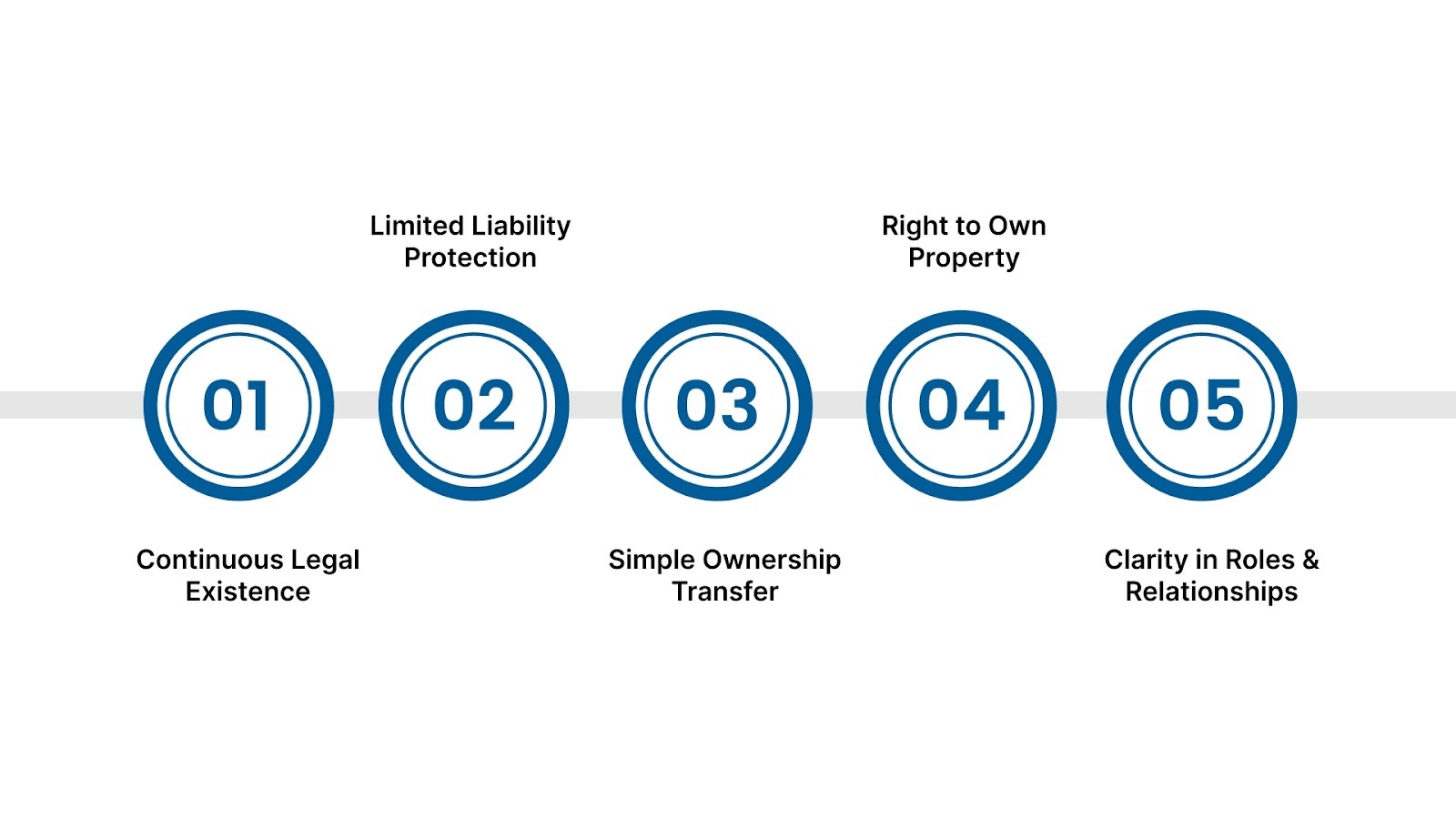
Registering as a Private Limited Company offers tangible advantages for international businesses entering India. It helps maintain control, protects personal assets, and builds immediate trust with regulators, banks, and local partners. Below are five key benefits that make this structure ideal for global expansion.
A Private Limited Company enjoys what Indian law refers to as perpetual succession. The company continues to exist even if one or more directors leave or pass away. This stability is crucial for overseas investors who want their operations in India to remain unaffected by changes in ownership.
Shareholders are only liable for the amount they invest in the company. Their personal wealth remains secure even if the business incurs losses or faces legal claims. This protection gives investors and corporate owners confidence while entering a new market.
Ownership can be transferred by selling or assigning shares to another person or entity. The process is recorded through a share transfer form and company filings. For foreign subsidiaries or joint ventures, this flexibility makes restructuring or bringing in new investors much easier.
The company can own property in its own name, whether it is land, equipment, or intellectual assets. The property remains under company ownership, independent of individual shareholders or directors. This legal separation simplifies asset management and long-term planning.
A company can legally enter into contracts with its own members. One person can hold the positions of director, shareholder, and employee simultaneously. This helps founders maintain both ownership and an active operational role without legal conflict.
For international founders and investors, these advantages create a secure, credible, and flexible way to operate in India. The Private Limited structure offers the balance of protection and freedom that global businesses value when establishing a long-term presence.
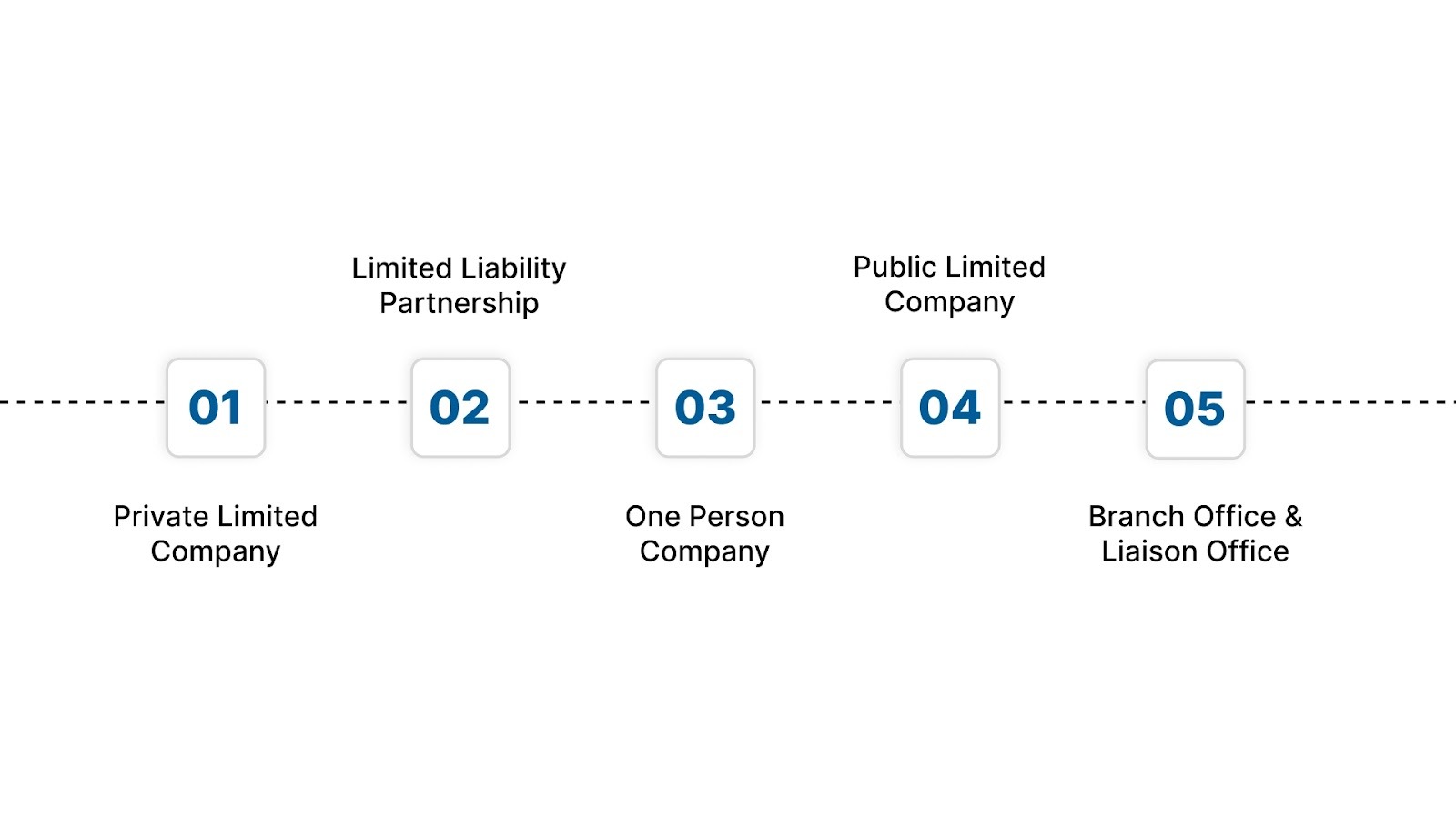
Selecting the proper legal structure is a key strategic step when entering India. It determines how you operate, how profits are taxed, and how much control you retain over your business. For global founders and investors, understanding the main business types helps align your setup with long-term goals.
Here’s a clear overview of the primary options available to international companies entering India.
A Private Limited Company is the most popular structure for international firms building a long-term base in India. It is a distinct legal entity that allows foreign or Indian shareholders to own shares and participate in management. It offers limited liability, credibility with banks and clients, and flexibility to raise capital. For investors, it functions similarly to a closely held corporation in the United States. This setup is ideal for companies planning to sell products, hire employees, or operate full-time within India.
Best suited for: Product or service-based companies, technology firms, and subsidiaries of established global brands.
An LLP combines the simplicity of a partnership with the protection of limited liability. Partners are only responsible for the capital they invest, and the entity is legally separate from its members. However, foreign investment is allowed only in sectors that permit 100% FDI under the automatic route. An LLP involves lighter compliance, but does not allow for share issuance, which limits its fundraising potential.
Best suited for: Consulting practices, design agencies, and small professional firms seeking operational flexibility with minimal administrative work.
An OPC allows a single founder to incorporate a business while enjoying limited liability. It was introduced under the Companies Act, 2013, to provide solo entrepreneurs with a formal business identity without the need for partners. This structure is ideal for early-stage founders exploring India before committing to larger-scale operations.
Best suited for: Individual entrepreneurs or digital founders testing market potential with controlled investment.
A Public Limited Company can issue shares to the public and is typically listed on a recognized stock exchange. It requires greater financial disclosure and compliance oversight under India’s Securities and Exchange Board (SEBI). This structure is suitable for large corporations seeking to raise capital from public investors or undertake large-scale projects.
Best suited for: Established global enterprises and Indian subsidiaries planning to go public in the future.
Foreign companies can also open a Branch Office or Liaison Office to operate in India without full incorporation. A Branch Office can conduct activities such as consulting, R&D, or technical support, but it cannot manufacture locally. A Liaison Office serves purely as a communication and coordination hub and cannot earn revenue in India.
Best suited for: Global firms testing the market, coordinating with Indian partners, or maintaining a non-commercial presence.
Choosing the proper structure depends on the scale of your investment, your need for control, and how quickly you plan to expand. For most international investors, the Private Limited Company remains the preferred choice. It offers the right mix of control, credibility, and compliance for sustainable growth in India.
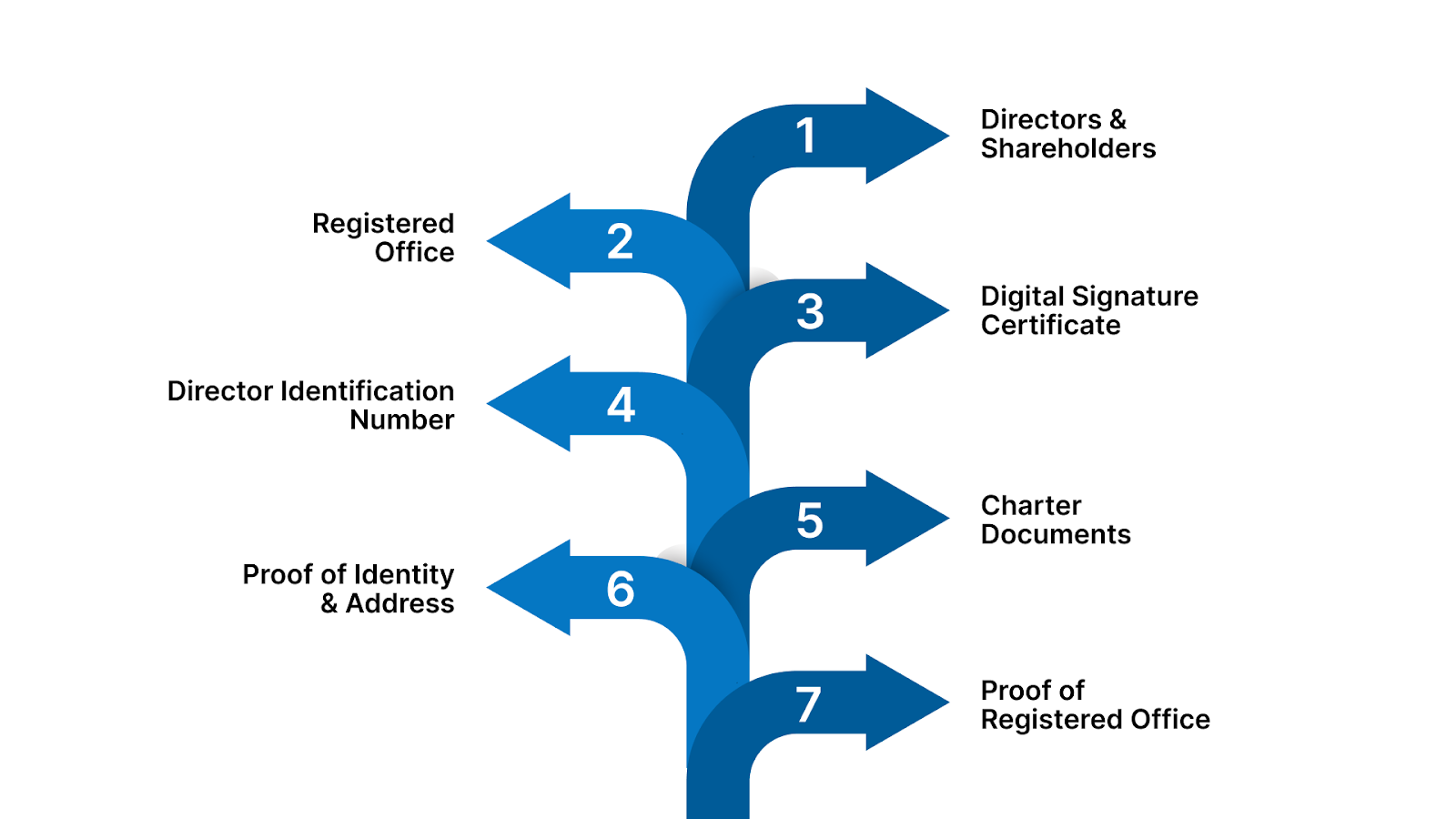
Alt text: Requirements for Starting a Private Limited Company in India
Registering a Private Limited Company in India is a structured process that suits global founders seeking stability and compliance from the outset. Whether you represent a growing SaaS firm, an investment-backed startup, or a mid-sized enterprise expanding operations, these are the basic conditions to prepare for.
For global businesses, these requirements establish a transparent framework that fosters legal clarity and facilitates smooth coordination with Indian authorities. Preparing them early shortens approval timelines and helps you start operations without unnecessary delays.
Setting up a Private Limited Company in India is a structured process managed by the Ministry of Corporate Affairs (MCA). For U.S. founders, it is similar to registering a C-Corporation or LLC, but it involves digital verification and a few additional compliance steps.
Below is the complete 14-step process, written in clear and practical terms.
Select a name that reflects your brand and is not already taken or trademarked in India. You can check availability on the MCA portal. It works much like reserving your company name through the Secretary of State’s website before filing incorporation papers.
Every director and shareholder must have a Digital Signature Certificate to sign documents electronically. It functions like a secure DocuSign certificate but is issued by licensed authorities in India. The DSC verifies identity for all online filings.
Each proposed director must apply for a Director Identification Number through the MCA portal. It is similar to a government-issued identification number for company directors. In the U.S., it can be thought of as an equivalent to an Employer Identification Number (EIN), but assigned to individuals rather than companies.
These two documents define what your company does and how it operates. The MOA outlines your business objectives, and the AOA sets the internal rules of management. You can prepare and file them digitally using the SPICe+ form on the MCA portal. They are similar to corporate charters and bylaws in the U.S.
Each director must file Form DIR-2 to confirm consent to act as a director. Shareholders must complete Form INC-9 to declare compliance with the Companies Act, 2013. Both forms must be digitally signed using the DSC.
Submit your chosen name through the MCA portal using the SPICe+ form. Once the Registrar of Companies (RoC) approves it, the name is reserved for your business. The process is similar to name approval through the U.S. Patent and Trademark Office, but India’s corporate regulator handles it.
Upload all required incorporation forms, including MOA, AOA, AGILE-PRO, INC-14, and INC-15, through the MCA portal. This step is your official application for company formation. It is comparable to filing Articles of Incorporation in the U.S., except that everything happens online.
The registration fee depends on your company’s authorized share capital and its registered location. Payments are made online through the MCA payment gateway. It is similar to paying your state filing fees, although the cost is based on share capital rather than a flat rate.
The RoC reviews your documents and verifies that all requirements are met. If approved, they issue a Certificate of Incorporation. This certificate confirms the legal existence of your company. It is similar to the Certificate of Formation issued by U.S. state authorities.
The RoC reviews your documents and verifies that all requirements are met. If approved, they issue a Certificate of Incorporation. This certificate confirms the legal existence of your company. It is similar to the Certificate of Formation issued by U.S. state authorities.
After incorporation, apply for a Permanent Account Number (PAN) and Tax Deduction and Collection Account Number (TAN) through the MCA portal.
Once incorporated, open a corporate bank account using your Certificate of Incorporation, PAN, and company documents. Indian banks may require proof of a registered office and information about authorized signatories.
Licensing needs vary depending on your business activity. Examples include:
This is similar to state or federal permits that U.S. businesses need for regulated industries.
If your annual revenue exceeds ₹42 lakh (approximately USD 48,000; 1 USD = ₹ 87), register for GST. GST works similarly to sales tax registration in the U.S. and is mandatory for interstate or e-commerce operations.
After completing all filings, tax registrations, and banking formalities, your company can begin operations in India. This marks the official start of your business, now recognized as a legally established entity with full commercial rights.
For international founders, the process may appear detailed at first. With expert support, most registrations are completed within 10 to 15 working days. A professional advisory team, such as VJM Global, can guide you through documentation, filings, and compliance, allowing you to focus on building your business in India.
Before registration begins, every director and shareholder must submit valid proof of identity and address. The documents differ slightly for foreign and Indian nationals, particularly when notarization or an apostille is required.
The total cost of registering a Private Limited Company depends on government fees, professional charges, and optional services. Understanding these expenses helps founders plan their entry and avoid hidden costs during the setup process.
*USD conversion is based on an exchange rate of ₹83 = USD 1.
Note: Costs vary by state, share capital, and service provider. Additional expenses may apply for high-value capital structures or extra compliance requirements for foreign shareholders.
The timeline for registering a Private Limited Company in India typically ranges from 10 to 18 working days. The exact duration depends on factors such as name approval, document accuracy, and the speed at which digital signatures and director IDs are issued.
For foreign founders, document authentication through apostille or notarization in the United States typically adds a few extra days before filing can begin. Once all papers are ready, the Ministry of Corporate Affairs (MCA) generally processes approvals within one to two weeks.
Typical sequence and time frame:
In total, most companies complete incorporation within two to three weeks, assuming all documents are accurate and the MCA portal is functioning smoothly. Working with an experienced Indian advisory partner helps maintain this timeline and avoid delays due to resubmission.
Expanding into India offers remarkable potential for growth, scale, and long-term profitability. Registering a Private Limited Company gives your business the credibility, protection, and structure needed to operate smoothly in this fast-growing market. With the proper preparation, compliance, and local guidance, the process can be transparent and time-bound.
At VJM Global, our experts simplify every step of company registration for foreign founders. We assist with document preparation, name approval, tax registration, and post-incorporation compliance. Our goal is to make your setup fully compliant with Indian law while maintaining global operational standards.
Ready to start your business in India? Connect with VJM Global today and begin your registration with confidence. Get in touch with us!
Private companies often enjoy several advantages compared to public companies. They have greater freedom in making long-term business decisions, unaffected by market fluctuations or shareholder expectations. Their financial information and share values remain confidential, enabling greater flexibility and privacy in their operations. This independence makes them better suited for long-term strategic growth.
A private limited company must have a minimum of two members and two directors. All members of the company have limited liability. The Companies Act now allows a maximum of 200 members in a private company, an increase from the earlier limit of 50 members.
The cost of registering a private limited company in India usually ranges from INR 6,000 to INR 30,000. The total cost depends on several factors, including the number of directors, the number of members, the authorized share capital, and the professional service fees involved in the incorporation process.
As per Section 134 of the Companies Act, 2013, every private limited company must hold an Annual General Meeting (AGM) within six months after the end of its financial year. Additionally, the company must comply with statutory requirements such as filing annual returns, maintaining books of accounts, and adhering to audit regulations.
An LLP (Limited Liability Partnership) is a form of business where each partner’s liability is limited, and partners are not responsible for the actions of other partners. A Private Limited Company, on the other hand, has shareholders with limited liability who can transfer their shares. LLPs generally face fewer compliance requirements and lower taxation compared to private limited companies, although private limited companies have better opportunities to raise external funding.
There is no mandatory minimum turnover requirement for a private limited company in India. However, once a company reaches specific financial thresholds based on its paid-up capital, turnover, profit, or net worth, certain compliance obligations such as CSR contributions, internal audits, and auditor appointments become applicable.
To incorporate a private limited company, the following conditions must be fulfilled:
Yes, the Ministry of Corporate Affairs (MCA) allows a company to use a residential address as its registered office. The company must provide valid address proof at the time of incorporation. Therefore, a residential address can be legally used for the purpose of company registration.
SPICe INC-32 was the earlier e-form used for company incorporation. SPICe+ INC-32, however, is an upgraded integrated web form that combines ten different services from various government departments, including the Ministry of Corporate Affairs, Ministry of Labour, the Department of Revenue, and one State Government (Maharashtra). This new system streamlines and accelerates the incorporation process by reducing steps, saving time, and lowering costs. Since 15th February 2020, all new companies must use the SPICe+ form for incorporation.
Yes, at the time of company incorporation, a maximum of three directors can apply for a Director Identification Number (DIN) using the SPICe+ INC-32 form.
No, PAN and Aadhaar are not mandatory for subscribers who already hold a valid DIN. According to the Companies (Incorporation) Third Amendment Rules, 2016, individuals possessing a valid DIN are exempt from attaching identity and residence proof during incorporation.
Yes, it is compulsory to file electronic versions of the MOA (eMOA) and AOA (eAOA) under the following circumstances:
Once the SPICe+ INC-32 form is approved, the Certificate of Incorporation (COI) is issued along with valid PAN and TAN details assigned by the Income Tax Department. These details are sent to the registered email address of the applicant, along with the COI attachment. A physical PAN card is no longer necessary, as the electronic version serves as official proof.