Introduction
Most finance leaders discover how complex Singapore amalgamations really are only after execution — when a misapplied accounting method or a missed tax election triggers liabilities that could have been avoided. Under the Companies Act (Cap. 50), amalgamation transfers all property, rights, liabilities, and obligations of the merging entities to a single surviving company. The accounting and tax consequences of that transfer are where the real decisions lie.
This guide is written for CFOs, tax managers, and finance directors at Singapore-incorporated companies — and for multinational groups restructuring regional entities. The legal procedure is well-documented; what rarely gets explained together is the SFRS(I) 3 accounting treatment, the irrevocable Section 34C tax election, and the strategic trade-offs between them.
The IRAS guidance confirms that 90-day election deadlines are frequently missed, permanently costing companies deferred tax benefits and loss carryforwards. This guide covers both choices — and what's at stake with each.
Key Takeaways
- Amalgamation is governed by Sections 215A–215K of the Companies Act 1967 (procedure) and Section 34C of the Income Tax Act 1947 (tax treatment)
- Two accounting methods apply: purchase method under SFRS(I) 3 for business combinations, and merger accounting for common control transactions
- The Section 34C election must be filed within 90 days of amalgamation and is irrevocable — late or missed filings cannot be corrected after the fact
- Unabsorbed losses and capital allowances transfer only if the amalgamated company continues the same trade or business
- GST and stamp duty relief require separate proactive applications to IRAS and IRAS/SLA respectively, each with their own filing deadlines
What Is Amalgamation in Singapore and Why Do Accounting and Tax Rules Matter?
Amalgamation under Sections 215A–215K of the Companies Act 1967 is the process whereby two or more Singapore-incorporated companies combine into one entity, with all assets, liabilities, and obligations transferring automatically to the surviving (amalgamated) company by operation of law. Unlike a standard merger via asset or share transfer, amalgamation creates statutory vesting — property rights transfer without separate legal transfers for each asset.
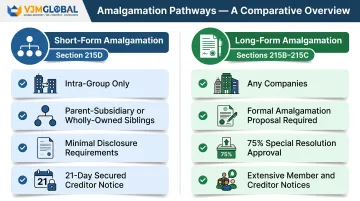
Two Forms of Amalgamation
Short-form amalgamation (Section 215D) is available for intra-group companies:
- Parent-subsidiary combinations (vertical)
- Wholly owned subsidiaries of the same parent (horizontal)
- Bypasses extensive disclosure requirements
- Directors must notify secured creditors 21 days in advance
Long-form amalgamation (Sections 215B–215C) applies to any companies:
- Requires formal amalgamation proposal
- Special resolution (75% majority) approval
- Extensive notice to members and creditors
- More rigorous documentation
Why Accounting and Tax Rules Deserve Dedicated Attention
Unlike straightforward business transfers, amalgamation triggers specific questions that determine financial outcomes:
Accounting questions:
- How are assets valued on consolidation — historical book value or fair value?
- Which financial reporting standard governs the transaction?
- Should newly identified intangible assets be recognized?
Tax questions:
- Determine whether a Section 34C election is required to prevent adverse tax consequences
- Confirm whether unabsorbed losses and capital allowances can transfer to the amalgamated company
- Clarify treatment of interest deductions on borrowings used to acquire cancelled shares
The intersection of SFRS requirements and Income Tax Act provisions creates layers of complexity that go well beyond the legal mechanics of amalgamation. Getting the accounting treatment and tax elections right from the outset avoids costly corrections after the amalgamated company is already operational.
Accounting Standards and Methods for Amalgamation in Singapore
The applicable accounting standard depends on the economic substance of the amalgamation, not just its legal form.
SFRS(I) 3: Business Combinations (Purchase Method)
When it applies: Long-form amalgamations between unrelated parties that meet the definition of a "business combination."
SFRS(I) 3, the Singapore equivalent of IFRS 3, requires the purchase (acquisition) method:
Key requirements:
- Identify the acquirer
- Determine fair value of identifiable assets and liabilities
- Recognize goodwill (or gain on bargain purchase)
- Separately recognize intangible assets not previously on the amalgamating company's balance sheet
Critical accounting entries:
- Cancellation of shares — eliminate share capital of amalgamating company
- Recognition of net assets — record at fair value as of amalgamation date
- Goodwill calculation — excess of consideration over net identifiable assets
- Elimination of intercompany balances — remove intra-group receivables/payables
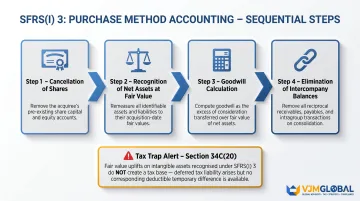
Tax trap under Section 34C(20): No writing-down allowance (WDA) is granted for intellectual property rights recognized solely due to SFRS(I) 3 purchase accounting that did not exist as assets pre-amalgamation. Fair value uplifts that create new intangible assets generate no corresponding tax benefit.
Merger Accounting (Pooling of Interests)
When it applies: Short-form intra-group amalgamations where combining entities are under common control.
SFRS(I) 3 explicitly excludes common control combinations from its scope. Entities must develop accounting policies under SFRS(I) 1-8; ISCA RAP 12 recommends merger/pooling accounting as the preferred approach.
Key features:
- Assets and liabilities combined at existing book values
- No goodwill recognized
- Comparative figures restated as if companies had always been combined
- No fair value adjustments
Impact on Tax Calculations
The choice of accounting method directly shapes your post-amalgamation tax compliance workload. Purchase method creates the more complex outcome:
- Tax base and accounting base of assets diverge
- Creates deferred tax differences under SFRS(I) 1-12
- Property transferred at fair value for accounting but at historical cost for tax creates timing differences
- Requires ongoing deferred tax schedule maintenance
Merger accounting keeps the tax picture much cleaner:
- Book values align with tax values
- No new deferred tax differences created
- Simpler ongoing compliance
- No Section 34C(20) intangible disallowance risk
The accounting method must be determined before amalgamation execution — not retrospectively. Getting this wrong means correcting misstated goodwill, unwinding non-deductible intangibles, and rebuilding deferred tax schedules from scratch.
Tax Treatment of Amalgamation Under Section 34C of the Income Tax Act
Qualifying Amalgamation Definition
Section 34C applies only to amalgamations where ACRA issues a Notice of Amalgamation under Section 215F on or after 22 January 2009, or where the Minister approves the amalgamation.
Critical requirement: The amalgamated company must make a formal, irrevocable election within 90 days of the amalgamation date.
Without this election:
- Normal tax rules on cessation of business apply
- Disposal of assets may trigger balancing charges
- Transfer of trading stock taxed at market value
- Unabsorbed losses permanently lost
Tax Continuity Principle
When the Section 34C election is made, the amalgamation is treated as a seamless continuation of business — not a cessation and restart. Three key continuity rules flow from this:
- Business operations: The amalgamated company is treated as having carried on all amalgamating companies' trades from the amalgamation date — no cessation, no new commencement
- Revenue account property: Treated as always held by the amalgamated company, acquired at the original cost incurred by the amalgamating company, preventing recognition of disposal gains or losses
- Capital account property: Fixed assets transfer at historical tax values with no balancing charges triggered
Trading Stock Treatment
| Treatment | Default (NBV) | Elective (Fair Value) |
|---|---|---|
| Transfer value | Net book value as reflected in amalgamating company's books | Fair value as reflected in financial accounts |
| Tax consequence | No profit/loss recognized in amalgamating company | Gain (FV minus NBV) taxed in amalgamating company in year of assessment covering amalgamation date |
| Strategic use | Standard treatment | Can be used where amalgamating company has losses to absorb the gain |
| Election | Automatic | Irrevocable, must cover all stocks from that amalgamating company |
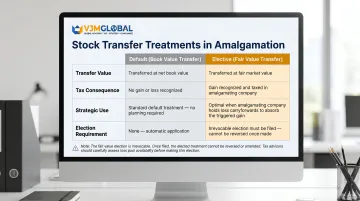
The table above assumes trading stock remains on the revenue account after transfer. Where an asset switches accounts entirely — from revenue to capital or vice versa — different rules apply.
Assets Changing Character on Transfer
Section 34C(14): Revenue to capital
Where property moves from revenue account in the amalgamating company to capital account in the amalgamated company:
- Transfer valued at open market value
- Resulting gain taxed on amalgamating company
Example: Amalgamating Company A holds inventory (revenue account) valued at $500,000 (NBV). Amalgamated Company B intends to hold these items as fixed assets, so transfer occurs at open market value of $600,000 — the $100,000 gain is taxable in Company A's hands.
Section 34C(16): Capital to revenue
Where property moves from capital account to revenue account, the treatment differs: consideration is the lower of open market value or actual payment, deductible as an expense in the amalgamated company when the stock is eventually sold.
Example: Amalgamating Company C holds equipment (capital account) with a TWDV of $200,000 and OMV of $250,000. Amalgamated Company D will hold it as trading stock — transfer consideration is set at $250,000, which Company D deducts upon eventual sale.
Cancellation of Shares Provision
Section 34C(7) addresses a frequently overlooked trap:
When an amalgamating company holds shares in another amalgamating company and those shares are cancelled:
- Holding company treated as having disposed of shares at cost (no gain/loss recognized)
- If borrowings were taken to acquire those cancelled shares, no interest deduction on those borrowings is available to the amalgamated company post-amalgamation
This directly affects leveraged intra-group restructurings where acquisition debt remains outstanding after amalgamation — a planning point that is often missed until the deduction is denied.
Transfer of Tax Attributes, Stamp Duty, and GST Considerations
Unabsorbed Losses, Capital Allowances, and Donations
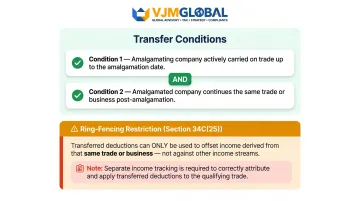
Under Sections 34C(23) and (24), unabsorbed capital allowances, trade losses, and donations of an amalgamating company can transfer to the amalgamated company, but only if two conditions are met:
Condition 1: Business continuity (amalgamating company)
- Amalgamating company was actively carrying on a trade or business up to the date of amalgamation
Condition 2: Business continuity (amalgamated company)
- Amalgamated company continues to carry on the same trade or business from the date of amalgamation
Ring-fencing restriction (Section 34C(25)):
Transferred deductions may only be set off against income from that same trade or business, not against other income streams of the amalgamated company.
Transferred losses cannot shelter unrelated income — which makes the choice of amalgamated entity strategically important. The amalgamated company must maintain separate income tracking to stay compliant with ring-fencing requirements.
Capital Allowance Transfer
These ring-fencing rules connect directly to how capital allowances are handled. Under Section 34C(8), the amalgamation preserves continuity for plant, machinery, and industrial buildings.
Section 34C(8) treatment:
For plant, machinery, and industrial buildings on which allowances were previously granted:
- The transfer is treated as if both companies elected for "book value" transfer under Section 24(3) ITA
- The amalgamated company steps into the shoes of the amalgamating company
- Continues claiming allowances at same rate and on same residual value
- No balancing charge triggered
Section 34C(8A) provides additional continuity for Section 18C building allowances.
Stamp Duty Relief
Instruments relating to asset transfers during a qualifying amalgamation may qualify for ad valorem stamp duty relief under Section 15 of the Stamp Duties Act, provided:
Conditions:
- No significant change in ultimate ownership of businesses being combined
- Companies must be wholly connected (directly or indirectly)
- Transfer consideration at market value for non-wholly associated entities
- At least 90% consideration settled by voting shares
Submission deadlines:
- Singapore-executed instruments: 14 days from execution
- Overseas-executed instruments: 30 days from execution
Retention period: 2-year asset/share retention period applies, with clawback provisions including 6% annual interest if breached.
GST Treatment
Where an amalgamation constitutes a Transfer of a Business as a Going Concern (TOGC) under Regulation 10 of the GST (General) Regulations, the transfer may be treated as neither a supply of goods nor services and thus outside the scope of GST.\
Five conditions must be satisfied:
- Supply of assets made in connection with transfer of a business (not mere asset transfer)
- Transferred assets used to carry on same kind of business as transferor
- Part transferred must be capable of operating independently (if partial transfer)
- Continuity of business after transfer
- Transferee must be GST-registered or become registered immediately as result of transfer
Important limitations:
- TOGC treatment is not automatic — specific conditions must be satisfied
- Isolated asset transfers not part of a going concern are subject to standard GST output tax
- GST registration is non-transferable — amalgamated company must apply separately
- Consult IRAS before the transaction to confirm TOGC treatment applies
Common Mistakes and Misconceptions in Amalgamation Accounting and Tax
Misconception: No Tax Consequences Without Third-Party Sale
Many companies assume that because amalgamation is a legal unification — not a third-party sale — there are no immediate tax consequences. Without the Section 34C election, that assumption is costly:
- Transfers of trading stock taxed at market value
- Disposal of capital assets may trigger balancing charges
- Unabsorbed losses permanently lost
- Tax cessation rules apply to amalgamating companies
Missing the 90-day irrevocable election window makes these tax consequences permanent — there is no mechanism to reverse them.
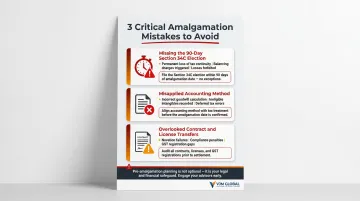
Accounting Error: Misapplied Accounting Method
Applying purchase method accounting (fair value) to a common control amalgamation — or merger accounting where it doesn't belong — creates a cascade of downstream errors:
- Incorrect goodwill recognition
- Overstated intangibles (some ineligible for deduction under Section 34C(20))
- Deferred tax calculation errors
- Ongoing compliance burden from divergent tax and accounting bases
The accounting method must be determined before the amalgamation is executed, not retrospectively. The choice depends on the relationship between companies (common control vs. business combination) and determines both accounting presentation and tax consequences.
This accounting misstep often compounds the tax errors above — making the method decision one of the earliest and most consequential choices in the process.
Overlooked Obligations: Contract and License Transfers
Statutory vesting does not automatically carry over every business relationship. Companies frequently overlook the need to actively transfer employment contracts, licenses, and third-party agreements — with real compliance consequences:
- Certain contractual rights require explicit novation
- Contractual anti-assignment clauses may be triggered by the statutory "transfer"
- Government licenses may require re-application or notification
- GST registration must be applied for separately
When these transfers are missed, income may continue to be reported under a company that no longer legally exists — triggering compliance failures and potential penalties.
Best practice: Seek counterparty consent for material contracts prior to amalgamation, particularly those governed by foreign law where Singapore statutory vesting may not be recognized.
Frequently Asked Questions
What is the process of amalgamation in Singapore?
Amalgamation follows either the short form (Section 215D, for wholly-owned intra-group companies) or long form (Sections 215B–215C, for any companies) procedure. Both require director solvency statements, shareholder resolutions, and lodgement with ACRA, culminating in a Notice of Amalgamation that triggers automatic vesting of assets and liabilities.
Which accounting standard is applicable for amalgamation?
SFRS(I) 3 (Business Combinations) applies to amalgamations between unrelated parties and requires the purchase method. Common control amalgamations may instead use merger (pooling of interests) accounting, which is a permitted policy choice under SFRS(I) 1-8.
What are the two main methods of accounting for amalgamation?
The purchase method records net assets at fair value and may recognize goodwill. Merger accounting (pooling of interests) combines assets and liabilities at historical book values with no goodwill recognized.
What happens to unabsorbed losses and capital allowances after amalgamation?
Under Section 34C(23), unabsorbed losses and capital allowances transfer to the amalgamated company if business continuity conditions are met. The amalgamated company must continue the same trade or business, and transferred deductions can only be applied against income from that specific trade.
What is the Section 34C election and how does a company make it?
The Section 34C election is a written, irrevocable notice submitted to IRAS within 90 days of the amalgamation date. It must cover all amalgamating companies and, once made, activates tax continuity provisions that prevent adverse tax consequences on asset and trading stock transfers.
Is GST applicable during the amalgamation of companies in Singapore?
If the amalgamation qualifies as a transfer of a going concern (TOGC) under Regulation 10 of the GST (General) Regulations, the transfer falls outside the scope of GST. Key conditions include both parties being GST-registered and the transferee using the assets for taxable supplies — consult IRAS before proceeding.